


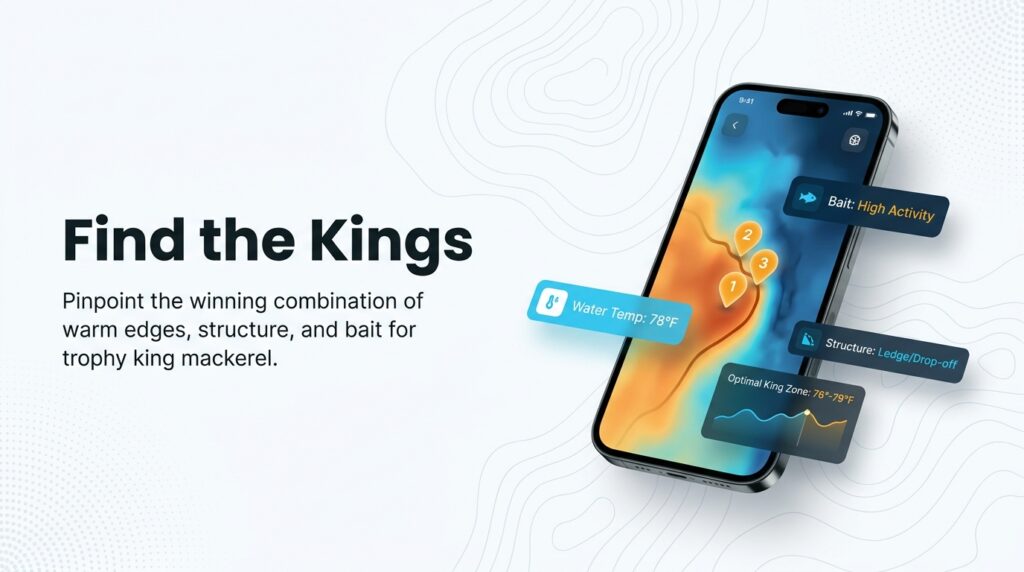
King mackerel are fast, toothy, migratory gamefish caught from North Carolina to Texas. A king hits hard, strips line off the reel, and rarely leaves you a quiet moment.
This guide draws on NOAA Fisheries, the regional councils and state agencies, and it flags places where the science and the dock disagree. Two separately managed populations exist, one in the Gulf of America (Gulf of Mexico) and one in the Atlantic. The NOAA Fisheries king mackerel profile covers the basics.
By the end you will know how to:
- Identify a king correctly.
- Know when and where the fish show up.
- Rig a simple live-bait setup.
- Know which rules apply and where to verify them.
Size and bag limits differ by stock, by season and between federal and state waters. This guide names the agencies and leaves the current numbers to them, so check the date on whatever you read.
King mackerel quick facts
| Field | Content |
|---|---|
| Scientific name | Scomberomorus cavalla |
| Common names | king mackerel, kingfish, king |
| Range | Gulf and U.S. Atlantic coast, from North Carolina to Texas as a popular gamefish range. Confirm exact range wording with NOAA Fisheries. |
| Preferred water temperature | About 68 to 73°F, per Coastal Angler Magazine. A guide, not a guarantee. |
| Primary method | Slow trolling live bait on a wire stinger rig |
| Regulations | Managed under the Coastal Migratory Pelagics plan. See Regulations below, and verify before you fish. |
Overview
King mackerel are fast, toothy, migratory members of the mackerel family. They usually hold in schools near structure and bait, and most are caught by trolling. The biology here relies on NOAA Fisheries.
How to identify a king mackerel
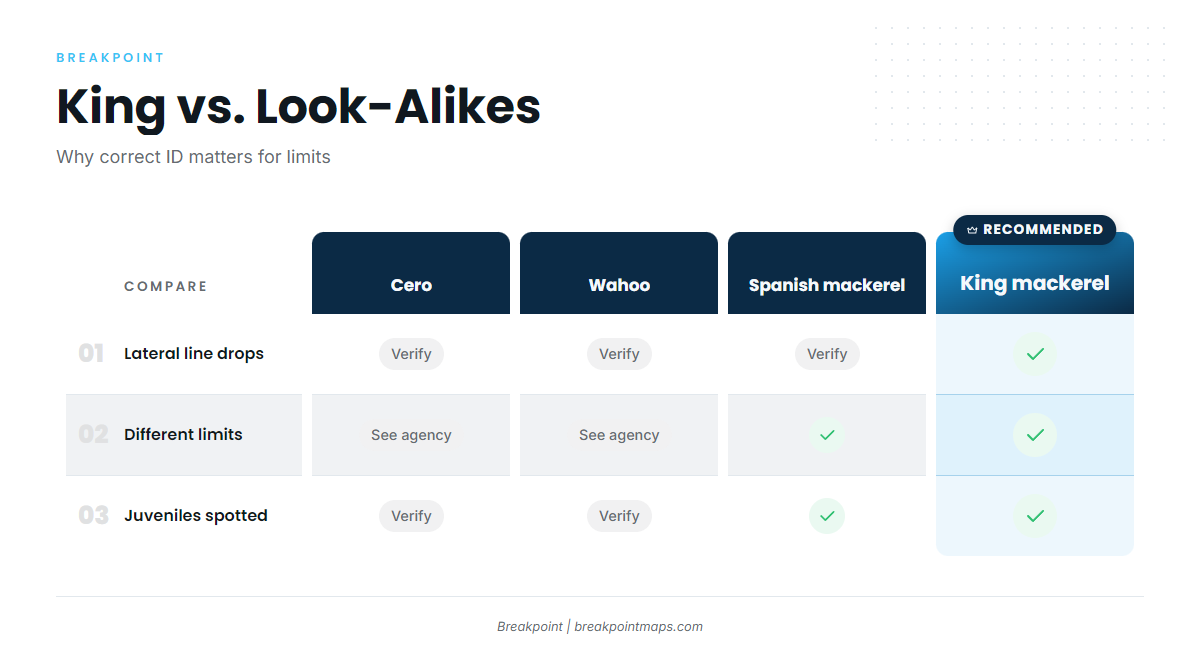
Look at the lateral line first. On a king it drops sharply past the second dorsal fin, and on a Spanish mackerel it does not. Juvenile kings can carry small yellowish spots, which is where much of the confusion with Spanish mackerel starts.
The table below lists the features to check. Only the entries that could be verified are filled in, so confirm the rest against NOAA Fisheries or a state agency identification guide.
| Feature | King mackerel | Spanish mackerel | Cero | Wahoo |
|---|---|---|---|---|
| Lateral line | Drops sharply below the second dorsal fin | Verify with agency guide | Verify with agency guide | Verify with agency guide |
| Juvenile markings | Can show small yellowish spots | Spotted | Verify with agency guide | Verify with agency guide |
Swipe the table sideways to see every column.
Identification matters legally. Kings and Spanish mackerel carry different limits, so a misidentified fish can become a violation. When in doubt, check the fish against an agency guide before it goes in the box.
Behavior and the smoker king
Kings school and follow bait and water temperature. Strikes come fast and hard, and kings often hit the back half of a bait. That tail-biting habit is why anglers add a stinger, a second hook placed near the tail. The rig is covered under Tactics.
Anglers call the biggest fish "smokers," after the run they make. Sources disagree on what weight qualifies, so no hard number is given here. For a typical fish, Wikipedia describes king mackerel as medium-sized, usually 11 to 30 lb, with some exceeding that. Treat that as a range, not a rule.
For anglers who already fish kings: big fish near bait pods seem to behave differently, sometimes holding under or beside the school and picking off stragglers. That is observation, not established fact.
Eating quality and mercury
The flesh is firm and oily, and kings are popular smoked, with smoked fish dip the classic preparation.
Mercury is the main concern. FDA and EPA fish consumption advice lists king mackerel among the fish to avoid, particularly for sensitive groups. Check the current FDA and EPA advice before you eat one, since the wording gets updated. State health advisories may also apply where you fish.
Is it worth running out for kings in a 20 to 26 ft boat?
It can be. Kings often hold on nearshore structure, piers and bait near the beach at times, so a long offshore run isn’t always necessary. Whether a trip makes sense depends on sea state, range, fuel and your experience.
Check the marine forecast, file a float plan, and turn around early. Nothing in this guide is navigation guidance. For many anglers, kings add a fast pelagic target without demanding the longest run of the season.
Habitat & Range
Kings follow warm water and bait, moving north in spring and south in fall along both coasts. The two stocks mix off South Florida in winter. Within suitable water, kings hold on reefs, wrecks, rigs, piers, bait pods and color changes. Temperature comes first, then migration and stocks, then structure.
Water temperature
According to Coastal Angler Magazine, kings prefer a range of about 68 to 73°F, which the magazine describes as specific enough to keep them moving. More on kingfish migration and temperature is available there.
Some captains report a shift. A Charlotte Sun captain said the run used to key to 65 to 72°F, and that "now it seems anywhere from 70 to 75 degrees is when they are better." Other captains report warmer preferred water in recent years.
The reason for the difference is uncertain. Regions and seasons differ, a surface reading is not always where fish actually sit, and the water itself may be changing. Treat every range as a guide.
For anglers who already fish kings: a temperature break is a sharp change in water temperature across a short distance, and the edge often matters more than the absolute number.
Spring and fall migration
The general pattern holds on both coasts, with fish moving north in spring and south in fall on a schedule tied to water temperature. There are no month-by-region tables here, because timing can’t be sourced to an agency.
On the Atlantic side, the page on king mackerel fishing in the Atlantic Southeast covers the run from Florida to Hatteras. For a concrete Carolina fall example, see fishing kings off Morehead City.
On the Gulf side, see king mackerel fishing in the Gulf.
Two stocks and the mixing zone
Management follows biology, and the order below is the one that matters in practice:
- Two migratory groups. NOAA Fisheries describes one population in the Gulf and one in the Atlantic.
- A winter mixing zone. Atlantic and Gulf fish intermingle off South Florida in winter, around the Florida Keys.
- A boundary that moves. The line between the groups shifts by season. The exact definition comes from the Gulf Council and the South Atlantic Fishery Management Council (SAFMC), so read it from them.
| Gulf migratory group | Atlantic migratory group | |
|---|---|---|
| Managing council | Gulf Council | SAFMC |
| General seasonal pattern | North in spring, south in fall | North in spring, south in fall |
| Mixing zone | South Florida in winter. Boundary per the councils’ definition. | Same |
| Go deeper | Gulf-specific seasons and spots | Atlantic Southeast page |
Structure: where kings hold
Structure concentrates bait, and bait concentrates kings. The usual holding spots:
- Nearshore reefs, wrecks and ledges.
- Oil and gas platforms in the Gulf.
- Live bottom off the Atlantic coast.
- Piers and inlets.
- Bait pods. Schools of baitfish balled up near the surface or along structure.
- Color changes. A visible edge between water masses, such as green water meeting blue.
For anglers who already fish kings: Gulf rigs are commonly fished by trolling up, then drifting or anchoring with live bait. Atlantic live bottom and wrecks lean toward trolling over the structure. Both are common practice, not rules.
What the data can’t tell you
Migration timing shifts from year to year, temperature ranges are guides, and a satellite SST pass can be blocked by cloud. Nobody fully knows why fish stack on one ledge and not the next one over. Data narrows the search but doesn’t finish it.
Go deeper by region: Atlantic Southeast, Morehead City, Gulf.
Tactics
Most kings are caught by slow trolling live bait on a light wire stinger rig over structure or bait. A slow troll means moving just fast enough to keep baits swimming naturally. Spoons, plugs and dead bait fill in when live bait is scarce.
Slow trolling live bait
Common live baits by region include menhaden, blue runners, threadfin herring, ribbonfish and cigar minnows. Silvery baits are widely preferred to dead bait.
Sources disagree on speed. Live-bait guidance ranges from a dead idle to about 2 to 3 knots. The 4 to 7 knot figures you will see apply to spoons and plugs, not live bait. The practical test is that the bait should swim upright and not spin.
In the Carolinas, live baits are fished off piers and over nearshore structure alike. The Morehead City page goes further on that fishery.
Stinger rigs and wire leaders
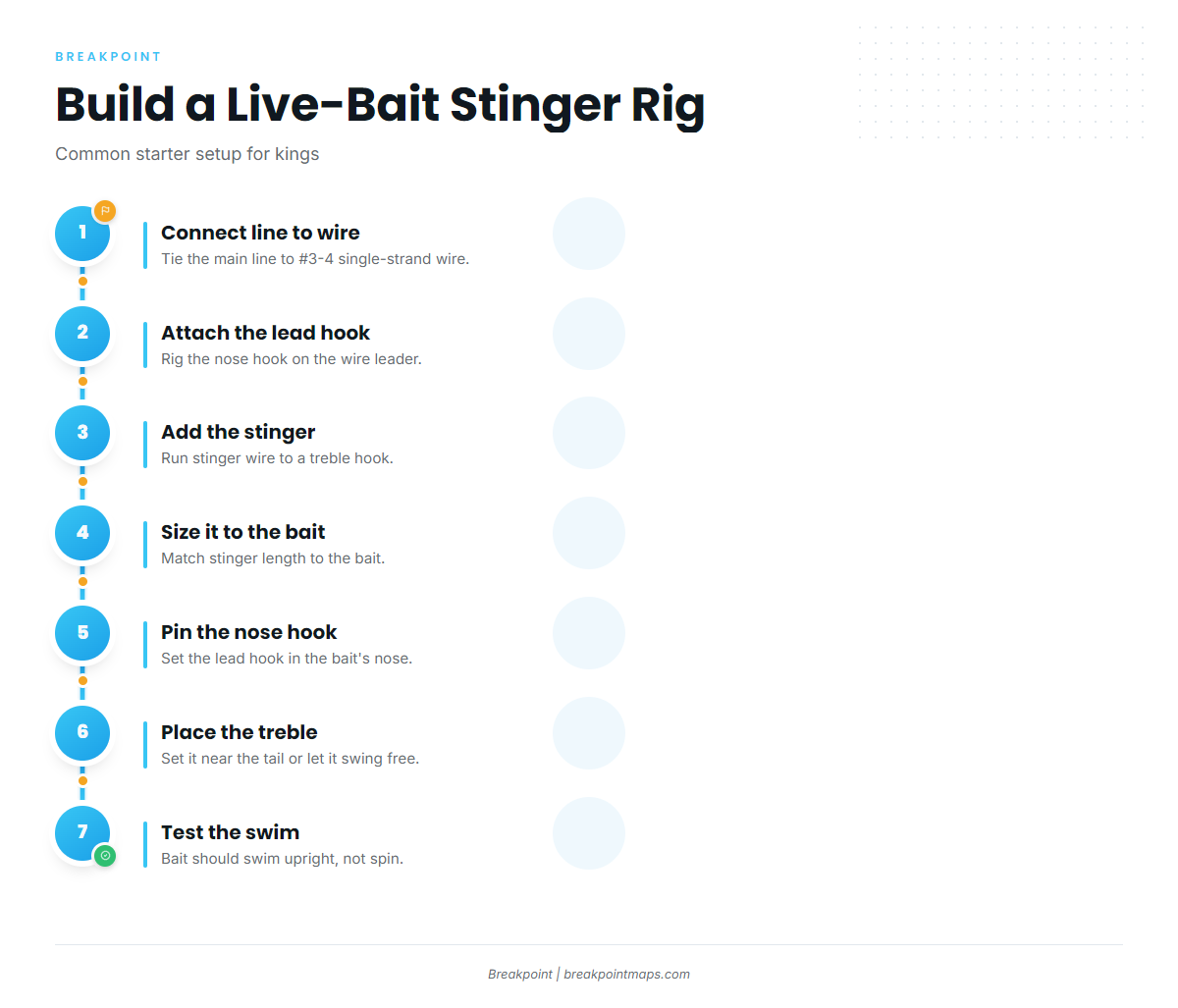
A stinger is a trailing hook rigged behind the lead hook to catch short strikes. It works because kings commonly bite the tail section of a bait. With live bait, the standard two-hook live bait rig puts one hook in the nose or mouth and a treble either through the back or left to swing free.
A common starter setup, described as common practice:
- A light-tip conventional or spinning outfit in the roughly 20 to 30 lb class.
- Monofilament main line.
- #3 to #4 single-strand wire.
- A nose hook plus a treble stinger.
To build it:
- Connect the main line to the wire leader.
- Attach the lead hook.
- Add the stinger wire to a treble hook, sizing its length to the bait.
- Pin the lead hook in the nose.
- Set the treble near the tail or let it swing free.
- Check that the bait swims naturally.
For anglers who already fish kings: some run fluorocarbon when fish refuse wire-rigged baits, accepting more cut-offs in exchange for more strikes. A limber tip and light drag forgive the head shakes of a lightly hooked fish. Stinger placement is worth adjusting to match bait size.
Dead bait, spoons and plugs
When live bait is scarce, other options work, all as common practice:
- Fresh-dead bait. Menhaden, cigar minnows or strip baits on a king rig.
- Spoons and diving plugs. Trolled faster along color changes.
Chumming
Chum draws kings up and holds them near the boat, sometimes close enough to take an artificial lure. It is common practice, but check chumming restrictions with your state agency before you try it.
Landing and handling
Kings have razor teeth, so keep hands away from the mouth and use pliers or dehookers. A clean gaff shot behind the head is common practice for a keeper.
For fish under the size limit, minimize handling and release them quickly, in the water when possible. Big kings are often weighed at Southern Kingfish Association (SKA) tournaments, which shows how much of the fishery centers on size.
Frequently Asked Questions
What is the best bait for king mackerel?
Live menhaden, blue runners or threadfin herring on a stinger rig is common practice. Availability varies by region and season, so ask at a local bait shop. Silvery live baits are widely preferred over dead bait.
How do you tell a king from a Spanish mackerel?
Check the lateral line, which on a king drops sharply below the second dorsal fin. Juvenile kings can show small yellowish spots, which is where the confusion starts. Use the ID table above and confirm against an agency guide.
What water temperature do kings like?
Coastal Angler Magazine puts it at about 68 to 73°F. A Charlotte Sun captain reports 70 to 75°F working better lately. Treat both as a guide, not a guarantee, because region, season and depth all shift the answer.
What is the king mackerel size limit?
Size is measured by fork length, and it varies by stock and jurisdiction. No current figure has been confirmed here, so use the regulations table above and check the agency page on the day you fish.
Is king mackerel safe to eat?
FDA and EPA fish consumption advice lists king mackerel among the fish to avoid, especially for sensitive groups. Check the current wording, and check for state advisories where you fish.
When is king mackerel season?
Kings are present in parts of the range year-round. Runs follow spring and fall water temperature, and timing varies by year. For regional detail, see the Atlantic Southeast and Gulf pages.
Can you catch kings from a pier?
Yes. Pier fishing with live bait is common in the Carolinas and parts of the Gulf. See fishing kings off Morehead City for a Carolina example, and check pier and state rules first.
Finding kings
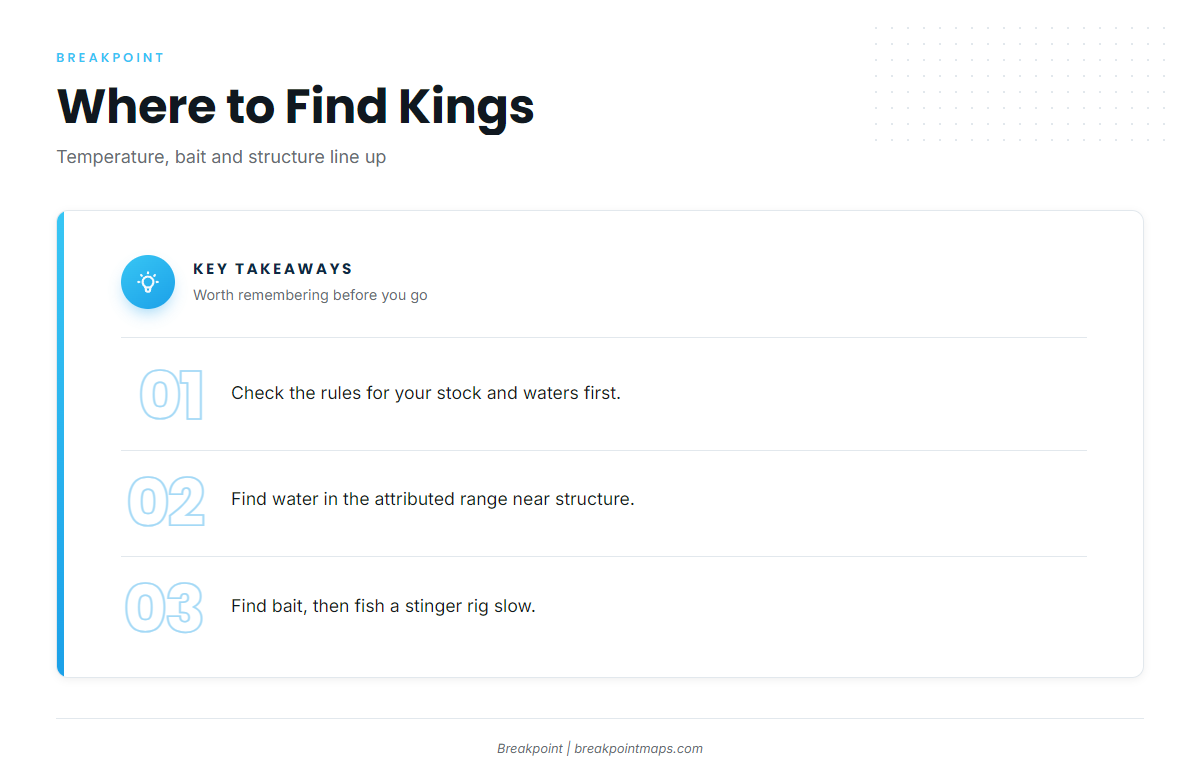
Kings show up where temperature, bait and structure line up. This King Mackerel Fishing Guide comes down to three steps:
- Check the rules. Confirm size, bag and season with your state agency and the regional council.
- Find the water. Look for water near the attributed temperature range, close to structure.
- Find bait, then fish slow. Locate bait pods, then work a stinger rig at a pace that keeps the bait swimming.
For current rules, go back to NOAA Fisheries and your state agency.
Breakpoint’s hotspots and Fish Intel, alongside layers like OBS SST and Chlorophyll, help show where temperature, bait and structure line up so you know where to look first. Chart layers are not for navigation.