


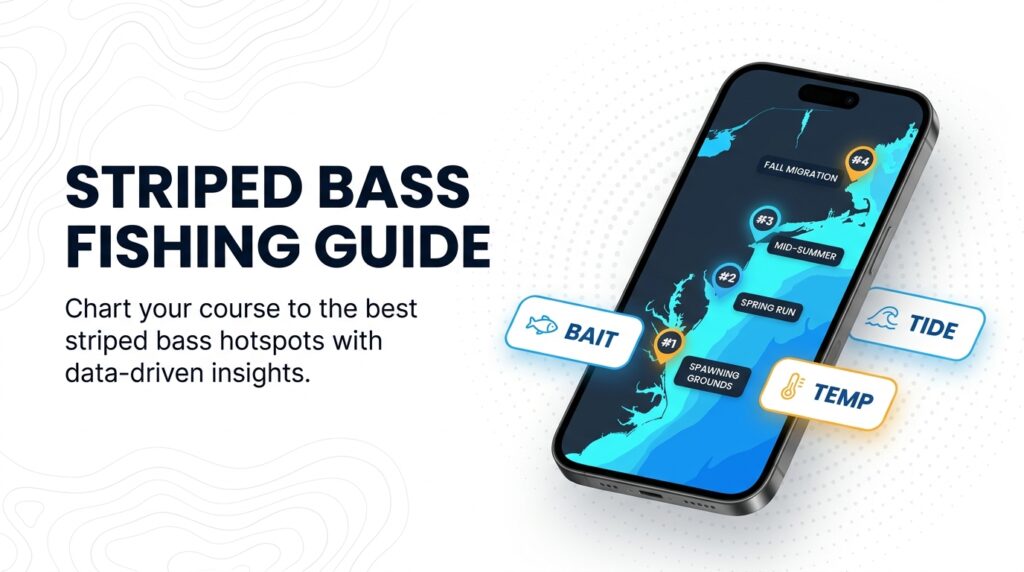
Meta description: Our striped bass fishing guide covers how to identify the fish, where it lives from New England to the Southeast, baseline tactics, and the rules that govern the catch.
Striped bass are the signature inshore gamefish of the Atlantic coast. Most of the stock migrates between spawning rivers in the Mid-Atlantic and summer water in New England. The stock is overfished and under a rebuilding plan, and that shapes how you can fish for it.
This guide is Breakpoint’s reference for the species. It covers what the fish is, where it lives, how people catch it, and who sets the rules.
Depending on where you start:
- New to the fish: how to tell a striper from its look-alikes and what you can legally keep.
- Already fishing them: how the management layers fit together, from the coastwide framework to your state’s bays and rivers.
- Fishing offshore in the Southeast: whether this fish is within reach.
Overview
The striped bass (Morone saxatilis) is a silvery fish with dark, unbroken horizontal stripes along its sides. It schools, follows bait, and feeds hardest in low light. It lives in both salt and fresh water, so you find it in the surf, in tidal rivers, and in some inland reservoirs. Anglers also call it "striper" or "linesider."
The ocean fishery thins out south of North Carolina. If you fish in the Southeast, our guide to striped bass fishing in the Atlantic Southeast covers what is available near you.
Identification
Check these features when a fish comes over the rail:
- Stripes: several dark horizontal stripes running unbroken along the silver sides.
- Body shape: a long, fairly shallow body rather than a deep, slab-sided one.
- Fins: two separate dorsal fins.
- Mouth: a large mouth on a broad-tailed fish.
Stripers look like freshwater bass but are not related to them. If you are unsure between two fish, start with the table below.
Look-alikes
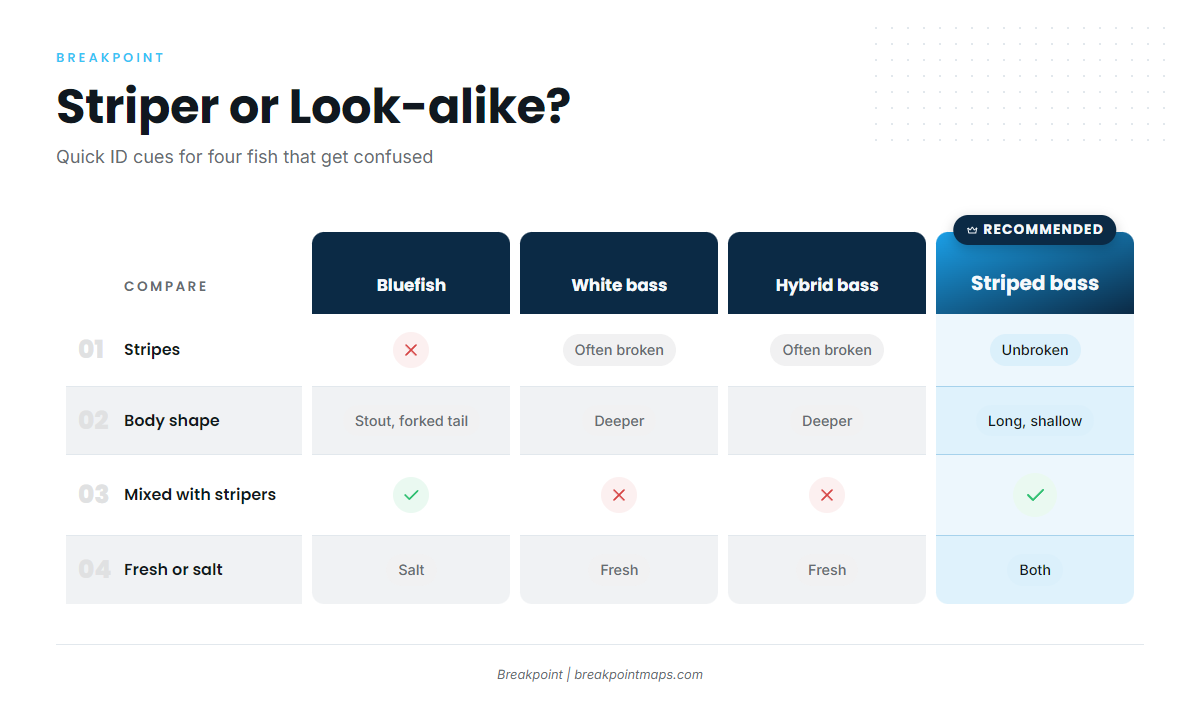
Hybrids and white bass cause most of the confusion, especially for anglers who already fish freshwater in the Southeast. The hybrid is a cross of striped bass and white bass. Its accepted names are palmetto bass and sunshine bass, and it was first produced in South Carolina in the mid-1960s, according to the SRAC hybrid striped bass fact sheet.
| Fish | Stripe pattern | Body shape | Typical habitat |
|---|---|---|---|
| Striped bass | Unbroken stripes | Longer, shallower | Coastal ocean, estuaries, rivers, some reservoirs |
| Hybrid (palmetto or sunshine bass) | Often broken stripes | Often deeper | Stocked reservoirs and rivers |
| White bass | Often faint or broken stripes | Deeper, more compact | Freshwater lakes and rivers |
| Bluefish | No stripes | Streamlined, forked tail | Coastal ocean, often mixed into blitzes |
Bluefish are in the table because beginners often mistake them in mixed blitzes, where both species feed on the same bait.
The stripe and body-shape cues give a first read, not a guarantee. If a fish matters for a legal decision, check the tooth-patch and fin details against your state agency’s ID guide.
Size and lifespan
Striped bass range from small school fish to very large, older females. What matters for fishing is that large females contribute the most to spawning, which is why slot limits protect them.
Behavior
Stripers school, move with bait, and feed hardest at dawn, dusk and night. They are opportunistic, and menhaden (bunker), herring, eels, crabs and worms are all common forage.
That suggests one organizing idea for the rest of this page: follow the bait, then the tide, then the temperature. If you already work weedlines for mahi, reading bait and birds for stripers will feel familiar.
Habitat & Range
Striped bass range from the St. Lawrence River in Canada to the St. John River in northern Florida and the northern Gulf of America, according to the USFWS striped bass species profile. The Chesapeake Bay, Hudson River and Delaware River are the main spawning systems. Adults run north along the coast in spring and return south in fall.
| Attribute | Summary |
|---|---|
| Range | St. Lawrence River to northern Florida and the northern Gulf of America |
| Main spawning systems | Chesapeake Bay, Hudson River, Delaware River |
| Coastal movement | North in spring, south in fall |
| Water types | Salt, brackish and fresh |
Spawning rivers
Spawning happens in spring in tidal rivers. Running water keeps the eggs moving until they hatch, per USFWS. The Chesapeake Bay, Hudson River and Delaware River produce most coastal fish.
Because of this, Chesapeake young-fish counts drive assessments of stock health and the rule changes that follow. Poor spawning years show up in the fishery later.
The migration
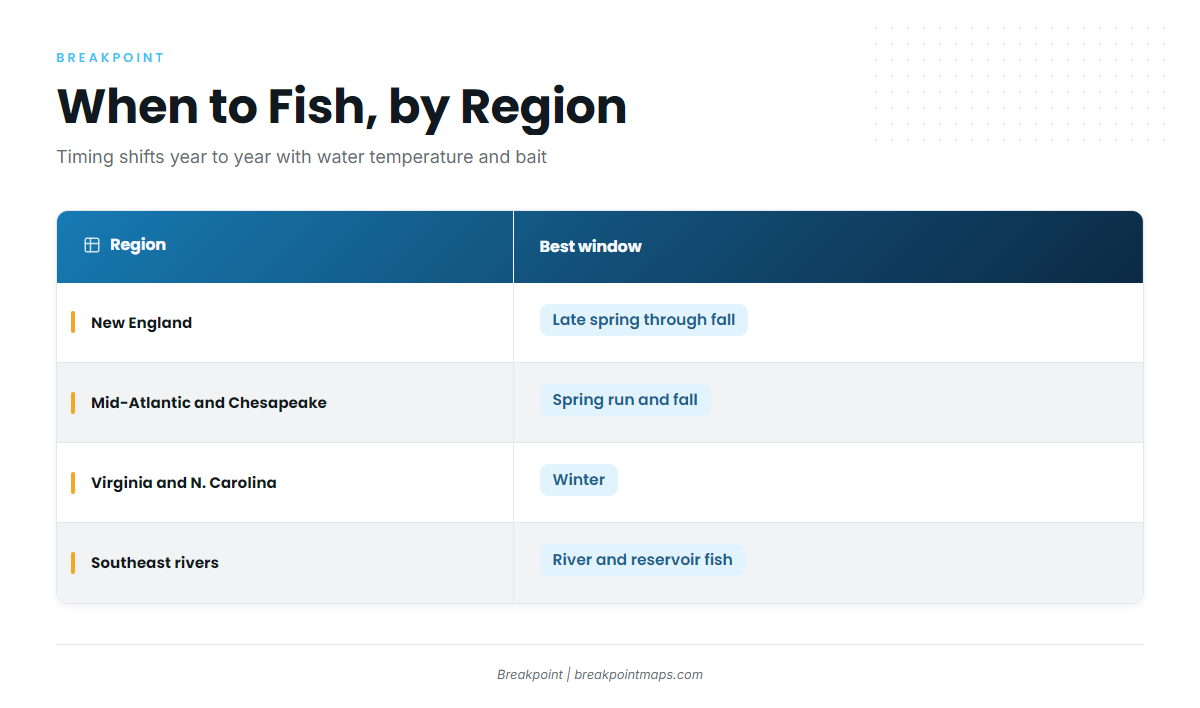
Adults leave the spawning rivers and move north through the Mid-Atlantic into New England for summer. They return south in fall, and many winter off Virginia and North Carolina. Fish move as the water cools or warms, following bait along the way.
| Region | General season | Note |
|---|---|---|
| New England | Late spring through fall | Summer and fall are the core months |
| Mid-Atlantic and Chesapeake | Spring run and fall run | Fish pass through in both directions |
| Virginia and North Carolina | Winter | Wintering fish off the coast |
| Southeast rivers and reservoirs | Varies by system | Mostly river and reservoir fish |
Timing shifts from year to year with water temperature and bait.
Structure
Stripers hold where current pushes bait past something they can ambush from. Look for:
- rips and current seams;
- rocky shorelines;
- inlets and river mouths;
- estuaries and bays;
- surf troughs;
- channel edges.
Current delivers the bait, so fish can feed with little effort. The same edge logic underlies everything we map: fish concentrate where conditions change.
Northeast
New England holds the summer and fall fishery. The Hudson and Delaware rivers have spring fisheries, and the Mid-Atlantic sees the run pass through in both directions. For regional detail, see our guide to striped bass fishing in the Atlantic Northeast.
Southeast
The ocean fishery thins out south of North Carolina, so the coastal fish you are most likely to reach is the winter bite off Virginia and North Carolina.
Most Southeast stripers are river or reservoir fish. Santee Cooper in South Carolina and the Roanoke River hold them. In Florida, stripers are found mainly in the Apalachicola and St. Johns rivers, according to FWC’s striped bass river fisheries page. Many reservoir populations are maintained by stocking.
For what is available near you, read striped bass fishing in the Atlantic Southeast.
What we don’t know
Some of this fish still resists explanation. Scientists and captains can’t fully say why Chesapeake spawning success swings from year to year. Migration routes appear to shift, and fish leave spots that held them the year before. We treat these as open questions.
Tactics
Follow the bait, then the tide, then the temperature. Stripers concentrate where current pushes bait past structure or along a temperature edge. Once you know where to look, choose among live bait, trolling, or casting to breaking fish.
We leave numbers out of this section. Trolling speeds, depths and temperature ranges vary by region and by day. Match your presentation to where the bait marks on your sounder.
Finding fish
Work through the cues in this order:
- Bait: look for bunker schools on the surface and marks on the sounder.
- Birds: diving terns and gulls often sit over feeding fish.
- Tide and current: moving water is the priority. Slack tide is usually slower, so fish the rips and inlet edges during the flow.
- Temperature: look for edges where water of different temperatures meets.
Low-light windows and a moving tide combine well, and dawn, dusk and night on a moving tide are the classic setups.
Bait fishing
If you are new, start with a simple rig:
- Fishfinder or sliding-sinker rig so the fish can take the bait without feeling weight.
- Leader between the swivel and the hook.
- Inline (non-offset) circle hook sized to the bait.
Let the fish load the rod. Do not set the hook hard, because a circle hook does the work when the line comes tight.
For live bunker, snag bait from a school, then live-line it back into or below the school. Chunking and chumming with bunker also work, and the circle hook rules apply. Other common baits include herring, eels, clams and worms, depending on region.
If you already run live-bait spinning or conventional gear for kings or cobia, most of it carries over.
Trolling
Common boat setups include:
- Umbrella rigs and tandem rigs: common in the Chesapeake and Mid-Atlantic.
- Tube-and-worm: used in New England rips and bays.
- Bunker spoons: pulled for large fish near bunker schools.
Set your depth to where the bait marks on the sounder. Offshore trolling gear and wire or lead-core setups carry over from other fisheries.
Casting to breaking fish
When fish are busting bait on the surface, cast:
- topwater plugs, such as pencil poppers;
- soft plastics;
- bucktails;
- metal jigs.
Match lure size to the bait in the water. A back-bay flat may hold tiny crabs or small baitfish, while the oceanfront may hold full-size menhaden or mackerel. Approach from upwind or up-current and avoid running through the school.
Night and eels
Live eels are a classic bait for big fish after dark, drifted along rocks and rips. Eels are slippery, so put a swivel in the rig to limit tangles.
Keep white light off the water and use a red light instead. Night navigation carries its own risks, so run slowly and know your water.
Surf notes
The same logic carries from boat to beach: moving tide, low light, and plug choices matched to the bait. Boat anglers who understand tide and structure already have most of what they need for the surf.
Release
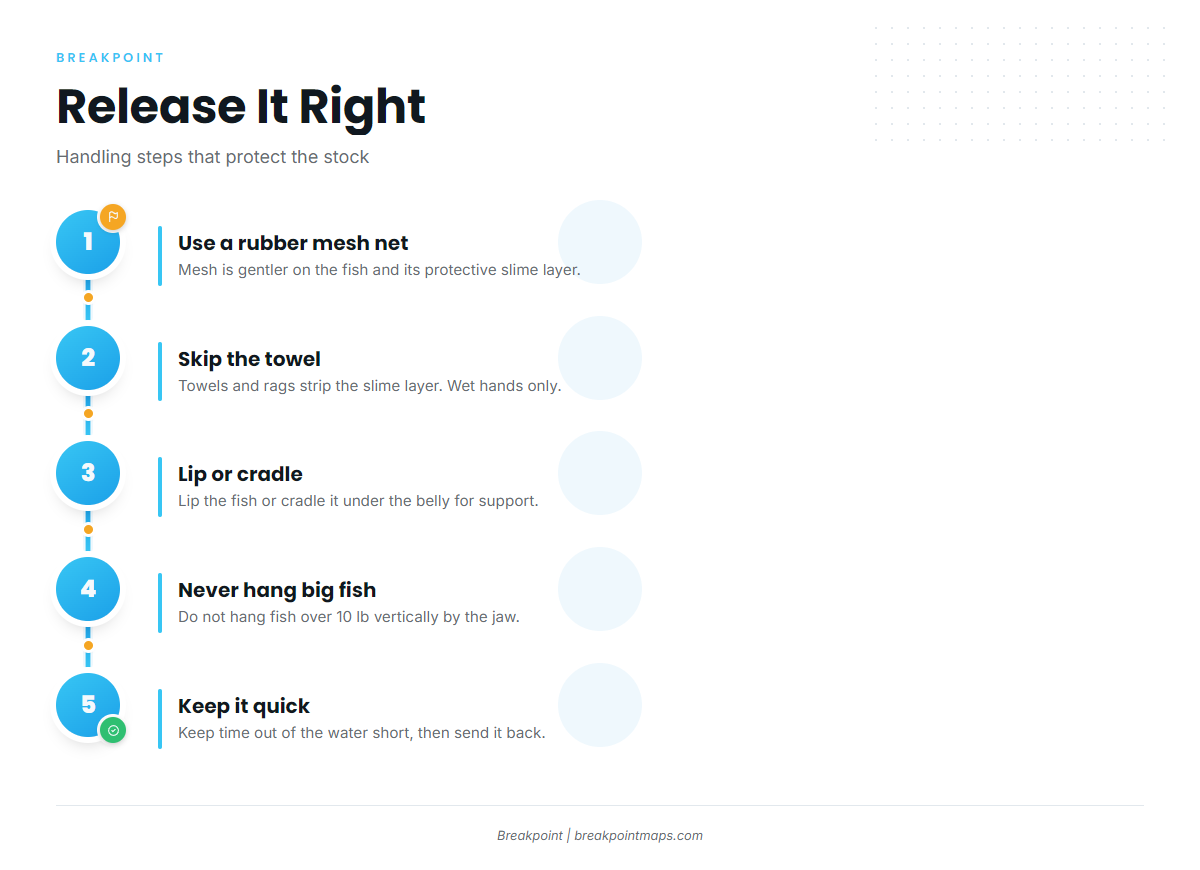
Stripers are a shared resource under a rebuilding plan, and how you release a fish matters. These practices come from Maryland DNR handling guidance:
- Never use a towel or rag. It strips the slime layer and scales.
- Lip the fish or cradle it under the belly.
- Do not hang fish over 10 pounds vertically by the jaw. It can damage the jaw and internal organs.
- Scoop fish with a rubber mesh net, which protects the slime layer.
- Keep time out of the water short.
Careful release is how anglers contribute to rebuilding the stock.
Stripers are widely eaten, so check your state’s consumption advisories. If you don’t have a boat, a charter is an option.
Frequently Asked Questions
What is the striped bass slot limit?
The ocean limit is 1 fish at 28 to 31 inches total length under ASMFC’s coastwide framework. Bays and rivers can differ by state. Verify current numbers with your state agency before you fish.
Can you keep striped bass in federal waters?
No. Possession and harvest are prohibited in federal waters, from 3 to 200 miles offshore, according to NOAA Fisheries. State waters follow state rules within the ASMFC framework.
Are there striped bass in Florida?
Yes, mostly in rivers. FWC lists the Apalachicola and St. Johns rivers as the main fisheries. USFWS places the southern end of the species’ range near the St. John River in northern Florida.
How do you tell a striped bass from a hybrid?
Stripers have unbroken stripes and a longer, shallower body. Hybrids often show broken stripes and a deeper body. Hybrids are palmetto or sunshine bass, a striped bass and white bass cross, per SRAC.
What is the best bait for striped bass?
Menhaden (bunker) is the most widely used bait, followed by eels and herring, depending on region. Clams and worms also work. Fish natural bait on an inline circle hook.
When is striped bass season?
It depends on region and state rules. The spring run moves through the Mid-Atlantic, summer and fall are the core months in New England, and winter fish sit off Virginia and North Carolina. Check your state agency for open seasons.
Closing
Follow the bait, then the tide, then the temperature, and verify the rules before you go.
Breakpoint’s hotspots and Fish Intel layer OBS SST, Chlorophyll and Chart Contours so you can narrow where to start looking for striped bass. The layers won’t find fish for you, but they can help you decide where to spend the tide.
Chart layers are not for navigation.