


A sailfish is an Atlantic billfish identified by its tall dorsal fin, which runs most of the length of its back. It is a realistic target off Southeast Florida in winter, and along the Gulf Stream and in the Gulf of Mexico in warmer months. A light live-bait or trolling setup with circle hooks is enough to start. A federal HMS Angling Permit is required to fish for it from a recreational vessel in federal waters.
This guide covers the fish, the water it uses, a starting setup and the rules. Sailfish come closer to shore than marlin, they fight on light tackle, and they are released rather than kept, which makes them a practical first billfish for a boat owner who already fishes offshore.
No one can promise where they’ll be on a given day. We’ll show what the water tells you, and where the science runs out.
You’ll learn how to:
- Identify a sailfish and separate it from white marlin.
- Find sailfish water in 3 regions.
- Rig a starting setup.
- Stay legal, with official sources to check.
If you already fish billfish, skip to the regional comparison table under Habitat & Range and the "If you’ve fished Pacific sails" note under Overview.
Overview: What a Sailfish Is and How It Behaves
Sailfish belong to the billfish family, Istiophoridae, alongside marlin and spearfish. The Florida Museum sailfish profile is a good reference for the species. Most references call the fish Istiophorus platypterus, and Atlantic fish are sometimes listed as I. albicans.
Identification
The dorsal fin is the giveaway. Look for these features:
- Dorsal fin. It runs nearly the full length of the back and often stands taller than the body is deep.
- Bill. Long and round, like other billfish.
- Color. A gray to dark blue back, with silvery sides that shimmer in blues and purples.
- Markings. Rows of small blue spots forming vertical bars along the sides, and dark spots on the fin.
In the water, the fin and bill often cut the surface behind a trolled bait. You may see a raised sail before you see anything else.
Sailfish vs. White Marlin, Spearfish and Small Blue Marlin
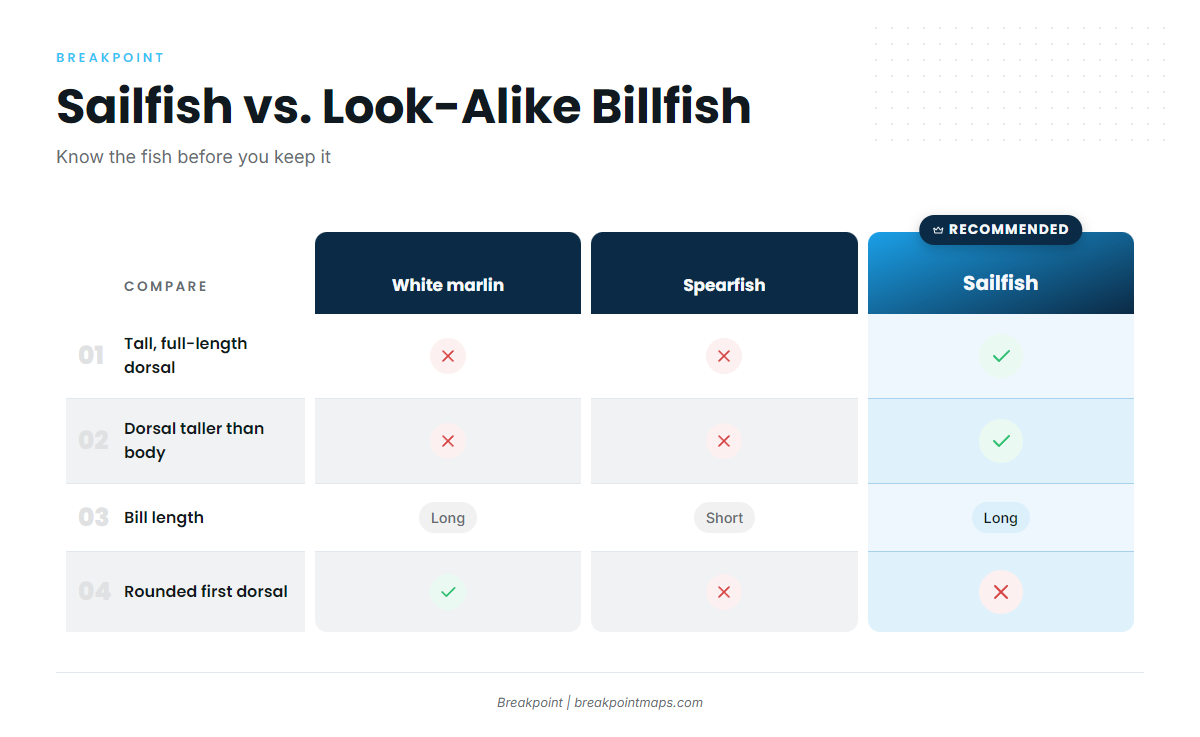
The fin is the fastest way to tell them apart. Check the table, then confirm against the official species pages from NOAA Fisheries or the Florida Museum before you rely on any single feature.
| Species | Dorsal fin | Bill | Body |
|---|---|---|---|
| Sailfish | Runs most of the back, often taller than body depth | Long, round | Slender, dark blue back, spotted bars on sides |
| White marlin | Shorter than body depth, rounded front lobe | Long, round | Deeper body, silvery sides |
| Longbill or roundscale spearfish | Lower fin profile | Shorter bill | Slim, more compact look |
| Small blue marlin | Fin lower than sailfish, pointed front lobe | Long, stout | Heavier body |
Identification is a legal issue. Sailfish and white marlin fall under different federal size rules, and keeping a misidentified fish is a violation. When in doubt, release the fish without taking it out of the water.
Behavior and Feeding
Sailfish raise their sails to herd baitfish into tight balls, then pick the bait off. An excited or feeding fish can flash bright color, which anglers call "lighting up." Feeding happens near the surface, often in groups working the same bait ball.
You may read that sailfish reach 68 mph. The measurements behind that number don’t hold up, so we leave it out.
Taxonomy is also unsettled. Many references treat sailfish as one worldwide species. Some still list the Atlantic fish separately, and the Saltwater Sportsman species overview notes that no differences have been found in their DNA. We treat it as an open question.
If you’ve fished Pacific sails. According to that same overview, Atlantic sailfish are smaller and harder to spot when they first come up behind the boat. They tend to be more cautious, and they make up their minds about a bait faster, which leaves less time to tease a fish close to the transom. Be ready to present the bait sooner than you would on a Pacific fish.
Habitat & Range
Sailfish live in warm water, and where they show up depends on where that water meets something else. Three terms come up repeatedly.
What Sailfish Water Looks Like
- Current edge. The line where fast, warm current meets slower shelf water.
- Temperature break. A sharp change in sea surface temperature over a short distance.
- Color change. Where clean blue water meets greener, bait-rich water.
Each of these concentrates food. Current and temperature boundaries collect plankton, small baitfish gather there, and predators work the edge. A weedline or rip on the surface is often the visible sign of a boundary you can’t see below.
Sailfish are a warm-water fish, typically found in subtropical to tropical surface water. Reefs and steep drop-offs matter too, because they push edges and bait close to shore.
Atlantic Southeast
The Gulf Stream runs close to the Southeast Florida coast, which is why the fishery works there. The winter peak comes as cold fronts push bait and fish south. Stuart is known as the "Sailfish Capital of the World."
Methods differ by port. Boats out of Stuart and Fort Pierce commonly troll dredges and dead bait, while boats farther south kite live bait. For local seasons and spots, see sailfish fishing in the Atlantic Southeast.
Gulf of Mexico
The Loop Current enters the Gulf through the Yucatán Channel and sheds warm eddies. Sailfish and bait follow the edges of those eddies and the color changes along them. Summer is the typical pattern. We’re keeping this qualitative on purpose. For regional detail, see sailfish fishing in the Gulf of Mexico.
Atlantic Northeast
The Northeast is the edge of the range. Sailfish show up in summer, when warm Gulf Stream water or warm-core eddies push toward the shelf. Because that warm water comes and goes, the fishery here is less predictable than in the Southeast. For more, see sailfish off the Atlantic Northeast.
Regional Comparison
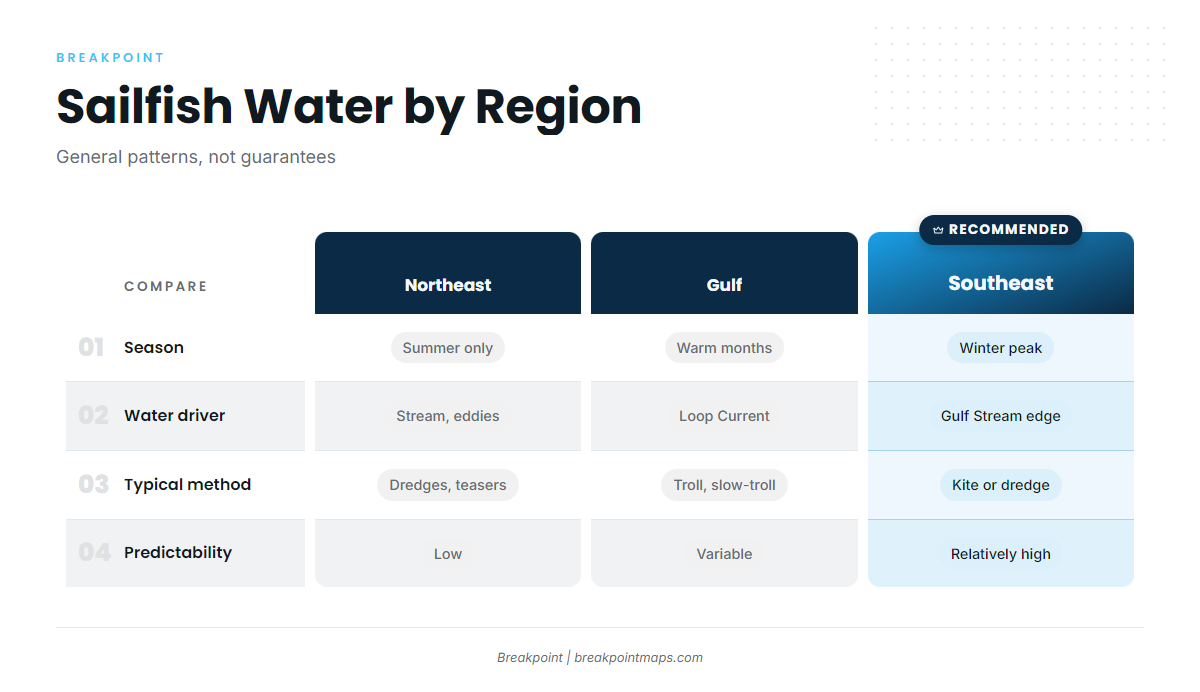
The table below summarizes the three regions. These are general patterns, not guarantees.
| Southeast | Gulf | Northeast | |
|---|---|---|---|
| Season | Winter peak | Warm months | Summer only |
| Water driver | Gulf Stream edge | Loop Current and eddies | Gulf Stream intrusions and eddies |
| Typical method | Kite or dredge troll | Troll or slow-troll | Troll with dredges and teasers |
| Predictability | Relatively high | Variable | Low |
What We Don’t Know
Migration timing and routes are only partly mapped, and Atlantic spawning grounds and timing are not fully described. Nobody has a complete explanation for why fish stack up in one season and vanish the next. Tagging programs add data over time, but they haven’t closed these gaps, and we would rather say so than guess.
Regional pages: Southeast, Gulf, Northeast.
Tactics
Start simple: find an edge, present a natural bait on a circle hook, and let the fish eat. The sections below build from a basic kit to the methods each region favors.
Minimum Setup to Start
Here is a workable starting kit. These are common practice, not fixed specs:
- 20 to 30 lb class conventional or spinning outfit with a smooth drag.
- Fluorocarbon leader.
- Non-offset circle hooks.
- Live-bait well.
- Dehooking tool and release gloves.
- HMS Angling Permit aboard.
You don’t need a kite to start. Slow-trolling live bait works.
Live Bait
The common choices are goggle-eyes, pilchards, threadfin herring and blue runners. Ballyhoo are often rigged dead for trolling. FishTrack notes that South Florida crews typically drift live goggle-eyes and threadfin herring from kites. What you use will depend on what’s available near your port.
Kite Fishing
A kite holds a live bait splashing on the surface with no leader showing. When a fish strikes, the release clip pops and you’re connected. Most boats fish three baits on each kite and run at least two baits off flat lines, according to FishTrack’s Florida sailfish tactics.
Kites need wind, so this is mainly a Southeast method. See how the Southeast kite fishery works in detail.
Slow-Trolling Live Bait
Slow-trolling means bumping the engine along an edge or color change with live baits out. It is the simplest starting method, and it needs neither a kite nor much wind.
Trolling With Dredges and Teasers
Dredges and teasers imitate a school of bait and raise fish. Boats out of Stuart and Fort Pierce commonly pull dredges and dead bait. Once a fish is up, pull the teaser away and pitch a natural bait, a bait-and-switch approach that Saltwater Sportsman describes as popular in Central and South America.
This is the realistic approach for sailfish in the Northeast, where kites are uncommon.
The Drop-Back and Circle-Hook Technique
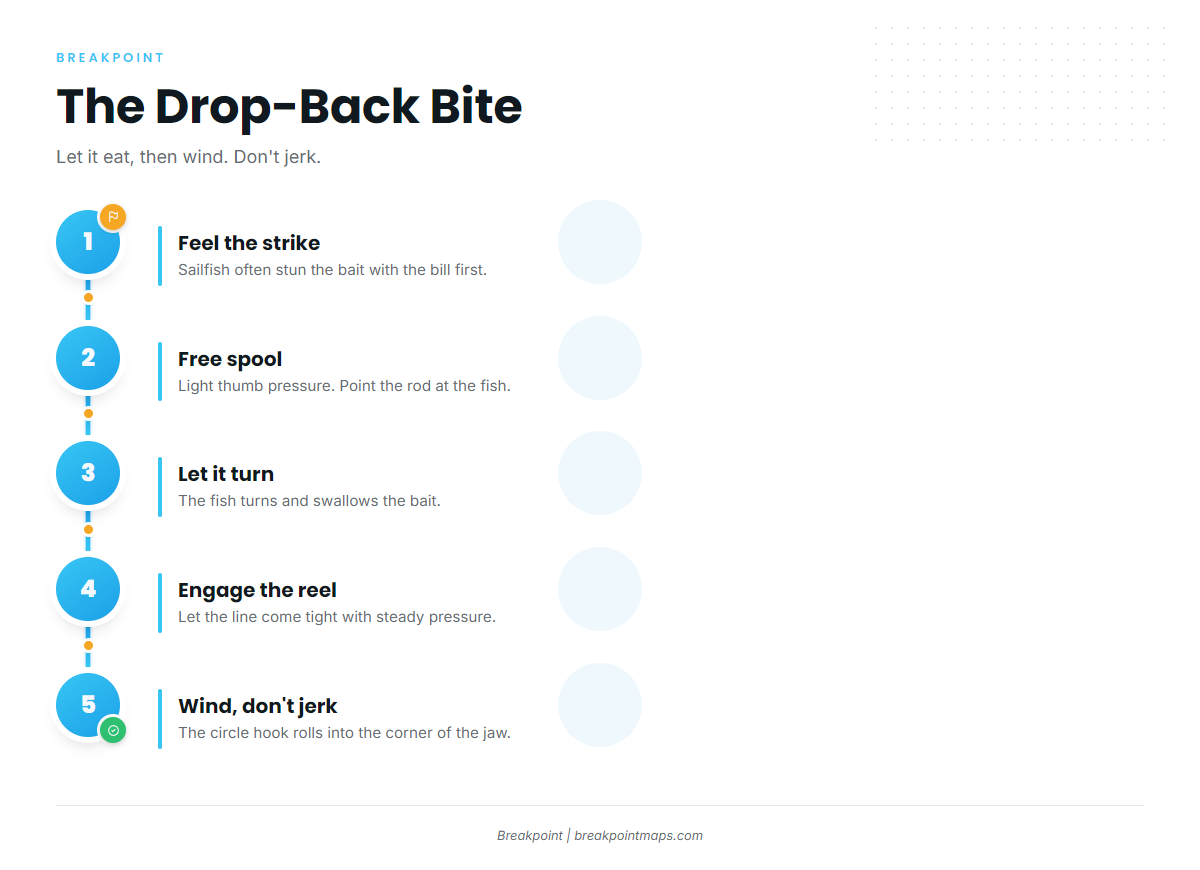
A sailfish often stuns or grabs the bait with its bill, then turns and swallows it. Tension at that moment pulls the bait away. So:
- Point the rod at the fish.
- Put the reel in free spool with light thumb pressure.
- Let the fish turn and eat.
- Engage the reel and let the line come tight with steady pressure. Wind; don’t jerk.
The circle hook does the work. It rolls into the corner of the jaw as the line tightens, whereas a hard hookset pulls it free or into the throat.
The Fight on Light Tackle
Expect jumps and runs. Use a moderate drag and keep the fight short so the fish is released with energy left.
Releasing a Sailfish
Follow these steps:
- Keep the fish in the water. This is required in federal waters (see Regulations).
- Wear gloves and control the fish by the bill carefully.
- Remove the hook with a dehooker, or cut the leader close to the hook.
- Revive it by holding it upright while the boat idles slowly forward so water flows over the gills.
- Release it when it kicks and its color returns.
- Take any photo boatside, with the fish in the water.
For agency guidance, see the FWC billfish page cited under Regulations.
Sailfish Fishing Guide FAQ
Do you need a permit to fish for sailfish?
Yes, in federal waters. A Federal HMS Angling Permit is required to fish for Atlantic HMS, including billfish, from a recreational vessel. FWC states this requirement. Confirm the details with NOAA Fisheries Atlantic HMS before you go.
What is the minimum size to keep a sailfish?
The minimum is 63 inches lower jaw fork length (LJFL), measured from the tip of the lower jaw to the fork of the tail. Verify the current figure with NOAA HMS and your state agency before you fish.
Can you eat sailfish?
It is legal if the fish meets the legal size and you hold the right permit. Still, most anglers release sailfish. The meat is generally regarded as poor eating, and an in-water release keeps a fish alive to be caught again.
When is sailfish season in Florida?
Winter is the peak off Southeast Florida, as cold fronts push fish and bait south. Fish can be around at other times too. For local timing, see our Southeast regional page.
How do you tell a sailfish from a white marlin?
Look at the dorsal fin. A sailfish’s fin runs most of the back and is often taller than the body is deep. A white marlin’s fin is shorter. The difference matters legally, because the two species have different federal rules.
Can you take a sailfish out of the water for a photo?
Not if you plan to release it. Under 50 CFR 635.21(a)(2), a released billfish can’t be removed from the water in federal waters. Florida applies the same rule in state waters if you hold an HMS permit. Take the photo boatside.
What is the best bait for sailfish?
Live goggle-eyes, pilchards, threadfin herring and blue runners are common choices, and ballyhoo work well rigged dead for trolling. The best bait usually depends on what’s available near your port.
Closing
Find the edge, rig circle hooks, let the fish eat, keep it in the water and carry the permit. That covers most of what separates a good day from a bad one with sailfish.
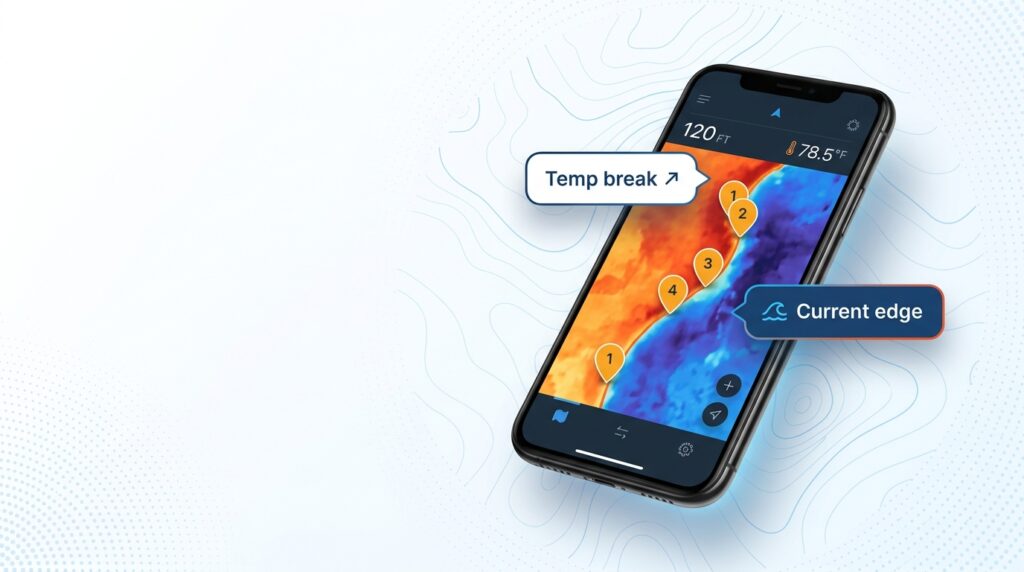
Pick the regional page that matches your water, then verify the rules with the agencies named above before you go. Breakpoint’s hotspots and Fish Intel put temperature breaks, color changes and current edges side by side, so you can compare them before you run. That helps you decide where to look but doesn’t promise fish. Cloud cover can block a satellite pass, and a forecast is still a forecast.