


Pacific bluefin (Thunnus orientalis) migrate across the Pacific and reach our coast from western Pacific spawning grounds. Southern California and Baja have a regular fishery. Oregon and Washington see occasional fish, mostly caught incidentally. Bluefin are hard to catch because they hunt by sight, spook easily and shy from heavy line. This guide covers how to identify the fish, where they live, how to approach them and what the rules are.
Regional pages carry the local detail. This one gives the general picture. According to NOAA’s pacific bluefin species page, the fish are present year-round, but most are caught between May and October. Newcomers will find an answer on whether the fish is worth targeting. Experienced anglers can skim the tables.
Overview: Identification and Behavior
Pacific bluefin are large, fast predators. The ISS Foundation describes them as having the largest range of all tunas, spread across the North Pacific from East Asia to the North American West Coast. The fish that reach our coast crossed from western Pacific spawning grounds.
Behavior comes before tactics. Every method later in this guide follows from three facts: bluefin hunt by sight, they spook easily, and they feed in distinct modes.
How to Identify Pacific Bluefin
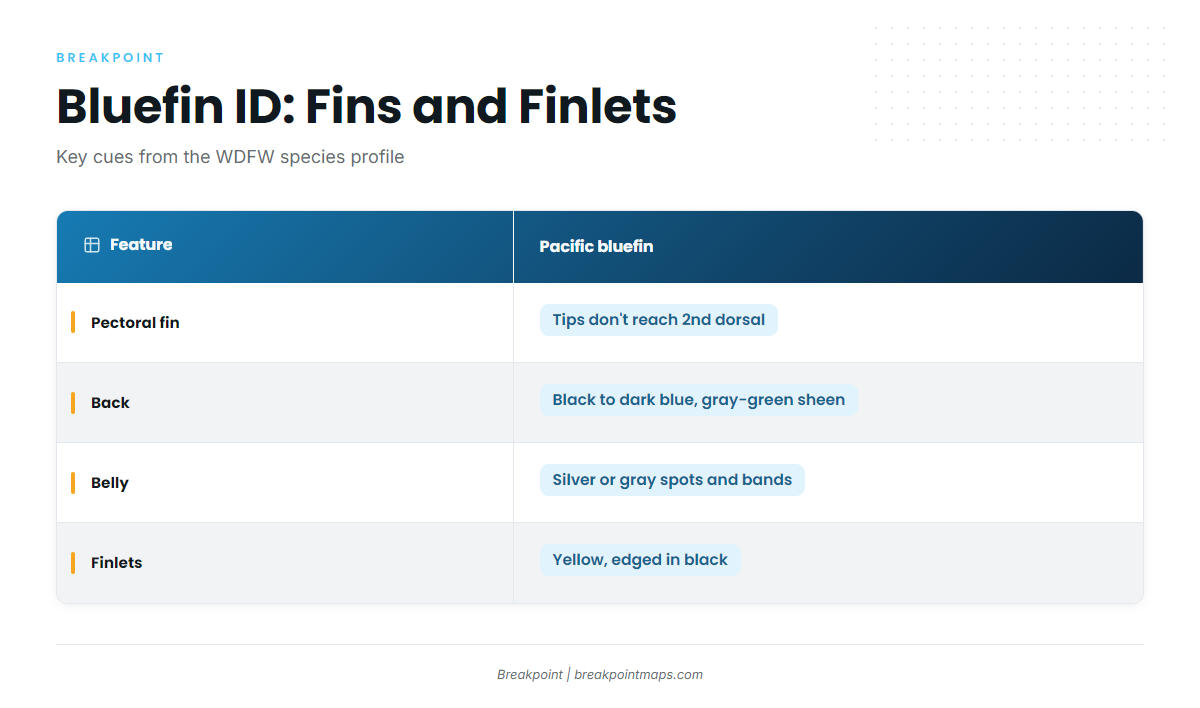
The most reliable cue comes from Washington Department of Fish and Wildlife (WDFW). According to Washington’s bluefin species profile, the tips of the pectoral fins do not reach the front of the second dorsal fin.
WDFW also lists these traits:
- Back: black or dark blue with a grayish-green iridescence.
- Belly: silver or gray spots or bands.
- Finlets: yellow, edged in black, running from the second dorsal fin to the tail.
The table separates bluefin from the tunas most often mixed with them.
| Species | Pectoral fin length | Finlets | Body and color cues |
|---|---|---|---|
| Pacific bluefin | Tips do not reach the front of the second dorsal fin | Yellow, edged in black | Dark blue-black back with grayish-green iridescence. Silver or gray spots or bands on the belly |
| Yellowfin | Do not extend past second dorsal fin | See ODFW tuna ID key | Second dorsal and anal fins elongate in adults |
| Albacore | Extend past second dorsal fin | See ODFW tuna ID key | Pectoral fins dark in color |
| Bigeye | Do not extend past second dorsal fin | See ODFW tuna ID key | Second dorsal and anal fins not elongate |
Northwest anglers usually ask whether the long-finned fish in the box is an albacore. Short pectorals point to bluefin. If you fish out of Oregon or Washington, our guide to bluefin in the Pacific Northwest covers what to expect on albacore grounds.
Size, Diet and Migration
NOAA lists sardines, anchovies, saury, herring, pompanos, mackerel, hake and other tunas in the bluefin diet, along with occasional red crabs and krill.
They are generally smaller than Atlantic bluefin. The ISS Foundation gives a common size range of 80 to 200 cm, or roughly 31 to 79 inches. Fish also sort into size-matched schools, sometimes mixed with other tuna and mackerel species.
The fish on our coast made a long trip from western Pacific spawning grounds in the East China Sea and the Sea of Japan to waters off Baja California and the U.S. West Coast. NOAA researchers found no evidence of spawning in the southern California Current.
How Bluefin Behave: Sight, Spook and Feeding Modes
AFTCO reports that bluefin hunt by sight and are boat-shy. Most of the tactics below follow from that.
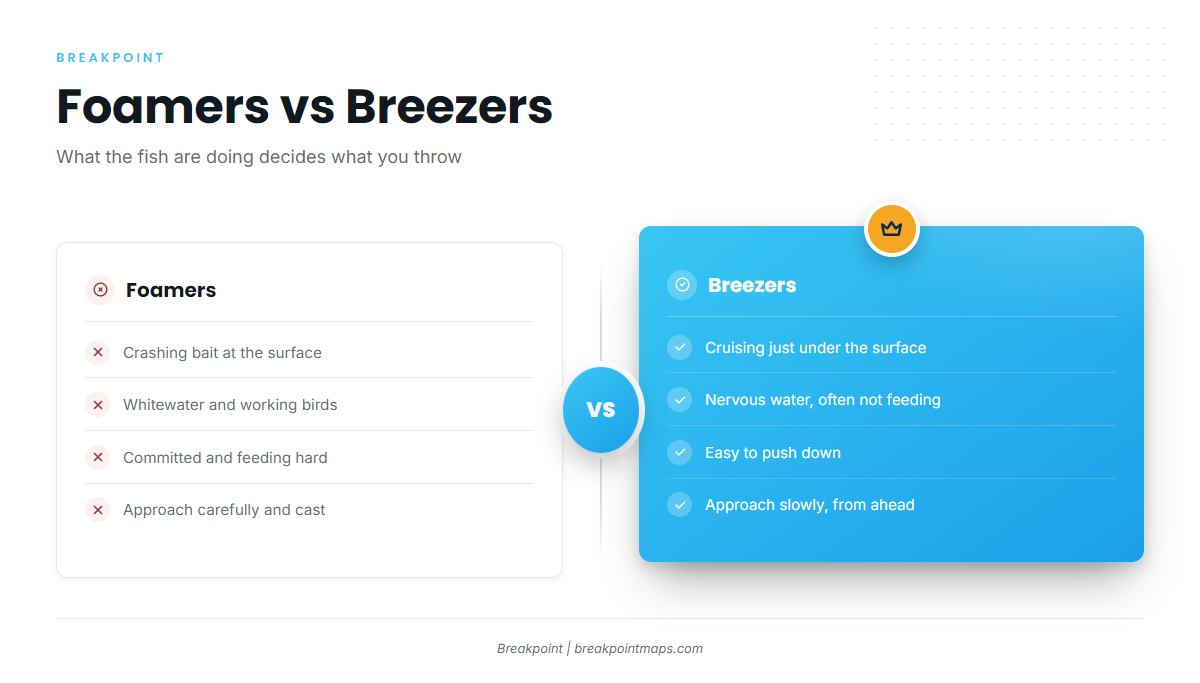
They feed in two surface modes you’ll learn to read:
- Foamers: fish crashing bait at the surface, with whitewater and birds.
- Breezers: schools cruising just under the surface, showing as nervous water. They often aren’t committed to feeding and are easy to push down.
What the fish are doing decides what you throw. Why a school eats one day and ignores everything the next isn’t fully explained. We know what helps, but not the reason.
If You’ve Fished Atlantic Bluefin
- Size: Pacific fish run smaller on average, and schools sort by size (ISS Foundation).
- Bait culture: West Coast bluefin fishing leans on live sardine and mackerel from bait receivers, plus jigs and surface lures. Chunking is not the regional default.
- Mexican waters: many trips cross the border, so a separate license applies. See Regulations.
- Management: the fishery runs through IATTC and WCPFC internationally and the PFMC Highly Migratory Species FMP federally, with state bag limits. It does not use the Atlantic permit-category system.
Habitat & Range
Temperature, structure and timing decide where bluefin sit. The far north is the exception.
Water Temperature, Color and Breaks
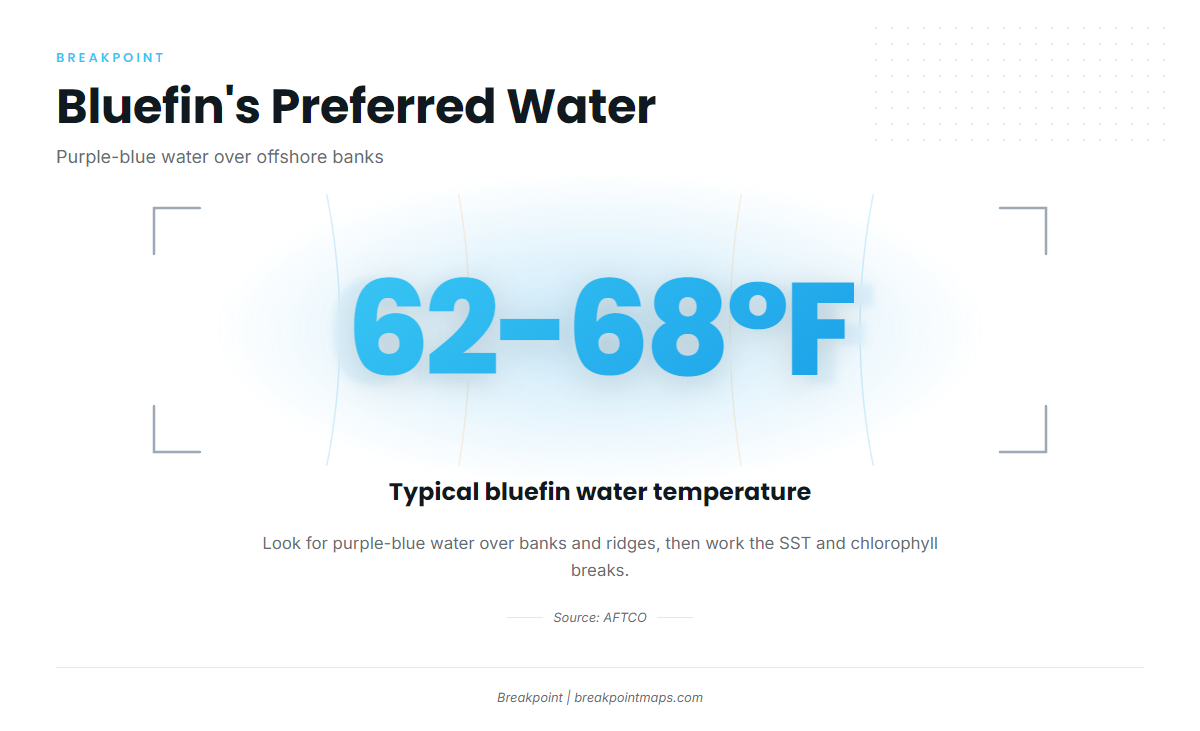
AFTCO reports bluefin are usually found over offshore banks and ridges in purple-blue 62 to 68-degree water. Look for cool, clean water with bait and current edges.
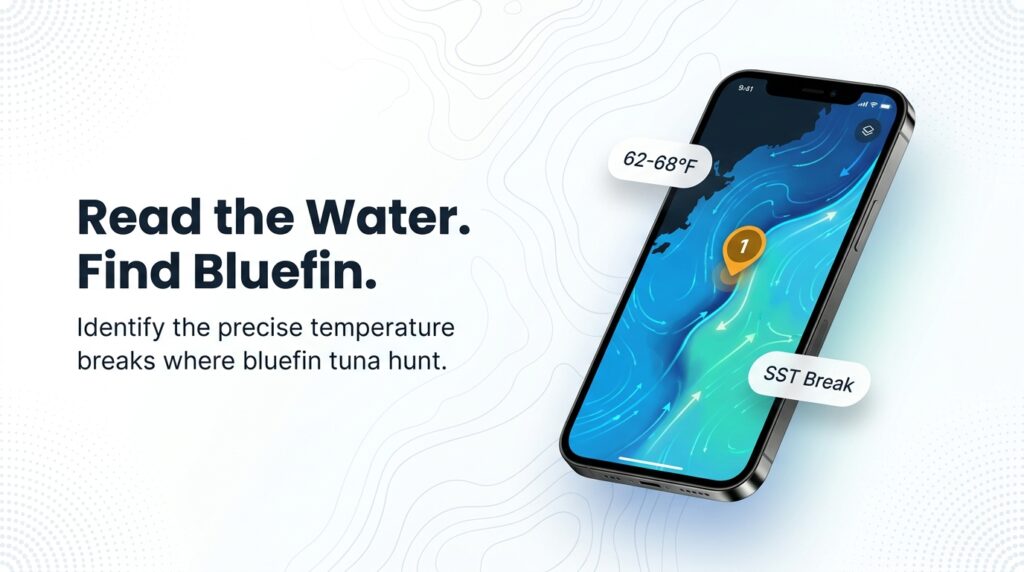
Saltwater Sportsman notes that bluefin hunt along sea-surface temperature (SST) and chlorophyll breaks for anchovies, squid and other forage. A break concentrates bait, and bait holds fish. SST and chlorophyll maps help you find those edges before you leave the dock.
Maps have limits. Cloud can block a satellite pass, and a map shows the surface, not what sits 200 feet down.
Banks, Ridges and Structure
Saltwater Sportsman names several spots where bluefin gather:
- Tanner Bank
- Cortes Bank
- The 43-fathom spot southeast of San Clemente Island
- Desperation Reef, south of the lower end of San Clemente Island
Bluefin Season in Southern California
NOAA puts the peak catch at May to October. AFTCO notes that in recent years schools have shown up in late spring and stayed as late as December. Arrival and departure shift year to year, so don’t plan a season around last year’s dates.
| Source | Timing |
|---|---|
| NOAA Fisheries | Present year-round, most caught May to October |
| AFTCO | Late spring through December in recent years |
Southern California and Baja
This is the core fishery, and many trips run into Mexican waters. Local detail, including banks and current patterns, is on our page for Pacific bluefin tuna fishing in the Pacific Southwest.
The Northern Range: Oregon and Washington
Bluefin in Oregon and Washington are rare and mostly incidental, usually met by albacore anglers. Don’t plan a trip around them.
WDFW says the Pacific Northwest has likely always sat at the northern edge of the range. Bluefin bones have turned up at Native American archaeological sites on the Washington and British Columbia coast. In July 2023, an adult estimated at more than 200 lbs washed up recently dead on Orcas Island. Our guide to bluefin in the Pacific Northwest covers the north in more detail.
What We Don’t Know
- Northwest frequency. How often bluefin reach the Northwest is poorly documented.
- Depth. Depth behavior varies, and published depth figures conflict.
- Timing. Arrival timing shifts year to year.
Go deeper by region: Pacific Southwest | Pacific Northwest
Tactics for Pacific Bluefin Tuna Fishing
AFTCO lists the main methods: trolling, kite fishing, casting to feeding fish, vertical jigging, sinker rigs and fly lining. The right choice depends on the fish’s behavior, your boat and your ability, so match the method to what the fish are doing.
Finding Fish: Breaks, Bait and Meter Marks
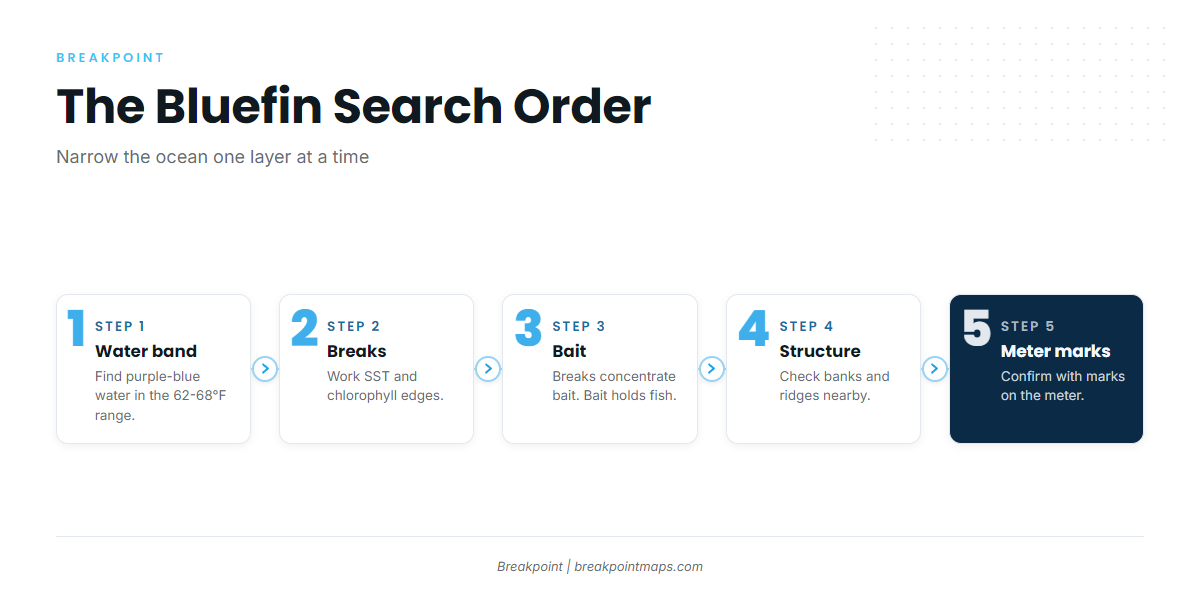
Work the search in order:
- Find the right water band.
- Find the breaks inside it.
- Find the bait.
- Check structure.
- Look for marks on the meter.
The Approach: Upwind, Upswell, Quiet
Get upwind and upswell of the school and let the fish come to the bait. Don’t run over the school.
AFTCO describes turning off all sonar, both down-looking and side-scan, over boat-shy fish. Then position the boat ahead of the direction the fish were working.
Foamers and breezers need different handling:
- Foamers: approach carefully, then make your cast.
- Breezers: approach slowly and from ahead, since they push down easily.
Match the Method to the Fish
| Fish behavior | Method | When it works | Key gear note |
|---|---|---|---|
| Foamers | Poppers, stickbaits, surface iron | Fish committed at the surface | Heavy spinning gear, long casts. Land the lure ahead of the fish |
| Foamers, boat-shy | Kite or helium balloon bait | Keeping line and boat out of the fish’s sight | Kites need wind. Balloons cover calm days |
| Breezers or finicky surface fish | Flylined sardine or mackerel | Fish refusing lures | Fluorocarbon leader. See the trade-off below |
| Meter marks, night fish | Flat-fall and knife jigs | Night and deep marks | Drop to the marks |
| Searching | Trolling | Covering water to find fish | Use it to locate fish, then switch methods |
Kites place bait with no visible line and at distance from the boat. They only work in wind, so plan a backup. Flylining live mackerel for bluefin is a proven answer when fish refuse lures.
Saltwater Sportsman reports night jigging can be the most effective method. Flat-fall jigs are dropped to intercept fish, with jigs stopping around 200 feet.
Regional tactics and current patterns are on our Pacific Southwest page.
The Leader Trade-Off
Lighter fluorocarbon gets more bites but also causes more break-offs. Pick your leader for the fish and the conditions that day, and accept the cost.
Tackle Classes
| Class | Role | Sourced spec |
|---|---|---|
| Light | Flylined bait for finicky fish | Varies with conditions. |
| Medium or surface | Casting to surface fish | Short, stout rod of 6’6" to 8′, rated 40 to 80 lb, slower medium taper |
| Heavy | Big fish, kite and balloon work | 130 lb braid with a 300 lb leader |
These figures come from Saltwater Sportsman’s California bluefin setup. Big fish are often fought from a stand-up harness.
Fighting and Landing
- Clear the other lines when a fish is hooked.
- Use the boat to keep the fish from taking a lot of line.
- Use steady pumps rather than a tug-of-war.
- Have a gaffing plan before the bite, especially with a small crew.
Bleeding and Handling
Bleed the fish promptly and chill it fast in an iced slurry. Some anglers use ikejime. NOAA describes the flesh as having the firmness and appearance of beef steaks, which is worth protecting.
Frequently Asked Questions
How do you tell bluefin from yellowfin or albacore?
Look at the pectoral fin first. On a bluefin, the tips do not reach the front of the second dorsal fin, and the finlets are yellow edged in black (WDFW). Albacore pectoral fins extend past the second dorsal fin (ODFW).
When is bluefin season in Southern California?
NOAA says most are caught May to October. AFTCO reports that in recent years fish have arrived in late spring and stayed into December. Timing shifts year to year, so treat any calendar as a guide.
Are there bluefin in Oregon and Washington?
Yes, but they are rare and mostly incidental. WDFW cites bluefin bones at archaeological sites and a July 2023 Orcas Island adult over 200 lbs. Sightings are sporadic, so don’t plan a trip around them.
What water temperature do bluefin like?
AFTCO reports bluefin over offshore banks and ridges in purple-blue water of 62 to 68°F. Saltwater Sportsman adds that SST and chlorophyll breaks concentrate the bait bluefin hunt. Check both when you plan a run.
Do I need a Mexican license?
Yes, fishing in Mexican waters requires a license through CONAPESCA. Rules on who needs one and how to get it can change. Verify current requirements with CONAPESCA before you cross the line.
Why are bluefin line-shy?
They hunt by sight and are boat-shy (AFTCO). Anglers answer with fluorocarbon leader, kites and a quiet approach, at the cost of more break-offs. Why they eat or refuse on any given day isn’t well understood.
Where to Look First
Find the water band and the breaks, then the bait. Read what the fish are doing and match the method to it. That is the baseline this guide is meant to give you.
Breakpoint’s hotspots and Fish Intel feature puts OBS SST and Chlorophyll layers side by side, so you can see the breaks and bait edges where bluefin hunt. It doesn’t promise fish, but it helps you decide where to look first.
Chart layers are not for navigation.