The wahoo (Acanthocybium solandri) is a fast, toothy member of the mackerel and tuna family that hunts warm offshore current edges and structure. Anglers chase it for its reel-screaming runs and its excellent table fare. It is the only species in its genus. This guide covers how to identify one, where to look, how to rig, and whose rules apply.
No guide can promise a bite, but this one should help you decide whether the run is worth the fuel. If regulations are your first question, jump to regulations.
Quick Facts
| Fact | Detail |
|---|---|
| Scientific name | Acanthocybium solandri, the only species in its genus |
| Family | Scombridae (mackerels and tunas) |
| Typical size | Commonly 20–50 lb; verify against the NOAA Fisheries species page |
| All-tackle record | 184 lb, per Sport Fishing magazine (confirm with the IGFA before quoting) |
| Speed | Most often cited around 48 mph. Higher figures circulate but are probably optimistic |
| Preferred water | Most productive reports cluster in the low-to-high 70s °F. Sources disagree |
| Key structure | Ledges, drop-offs, humps, seamounts, deepwater platforms, current edges |
| Signature technique | High-speed trolling on wire leaders |
Overview: Identification and Behavior
A wahoo is long, blue-backed and barred, with a beak-like snout and a mouth full of sharp, serrated teeth built to shear prey. If you’ve caught kings, the first thing to learn is how to tell the two apart.
Its speed is real. Saltwater Sportsman’s wahoo guide puts the most widely cited figure at 48 mph and notes that 60 mph shows up in some searches but is probably optimistic. We use 48.
Identification matters for more than bragging rights. Wahoo and king mackerel fall under different management and different limits, so misreading one as the other can put you over a bag limit.
Wahoo vs. King Mackerel
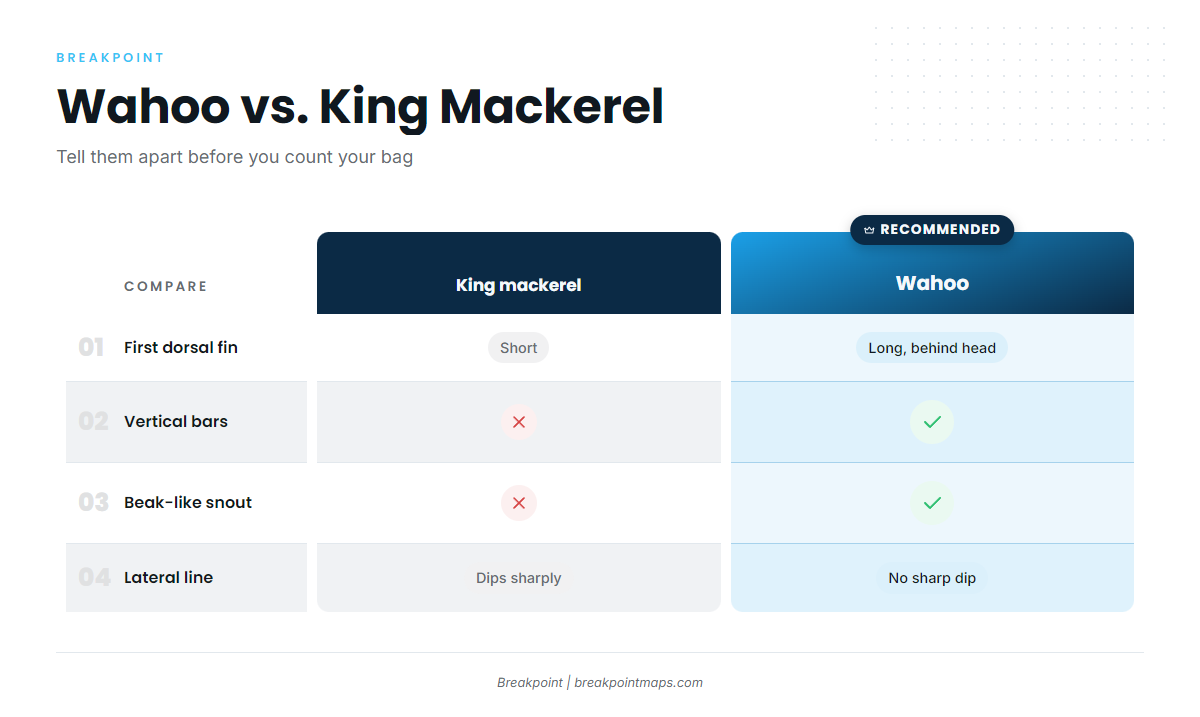
Check these features before you decide what is in the cooler. Verify each against your state agency’s identification guide, starting with the FWC wahoo page linked in the Regulations section.
| Feature | Wahoo | King mackerel |
|---|---|---|
| First dorsal fin | Long, starting just behind the head | Short |
| Body markings | Vertical bars | No bars on adults |
| Snout | Long and beak-like | Shorter, less pronounced |
| Lateral line | Runs fairly straight | Dips sharply below the second dorsal |
| Teeth | Sharp, serrated, closely set | Sharp, but the fish is less elongated overall |
How Wahoo Behave
Wahoo travel, and a spot that produced one day can be empty the next. As Coastal Angler’s wahoo tips puts it, indicators of their presence are much more useful than a report from a few days ago. Bait, temperature and current tell you more than last week’s dock talk.
- They roam. A good spot can go quiet without warning, and a quiet one can light up.
- They show up uninvited. Anglers running for tuna, mahi and marlin often pick up a wahoo along the way.
- They hit hard. A strike is fast and long, and line leaves the reel in a hurry.
Habitat & Range: Where to Find Wahoo
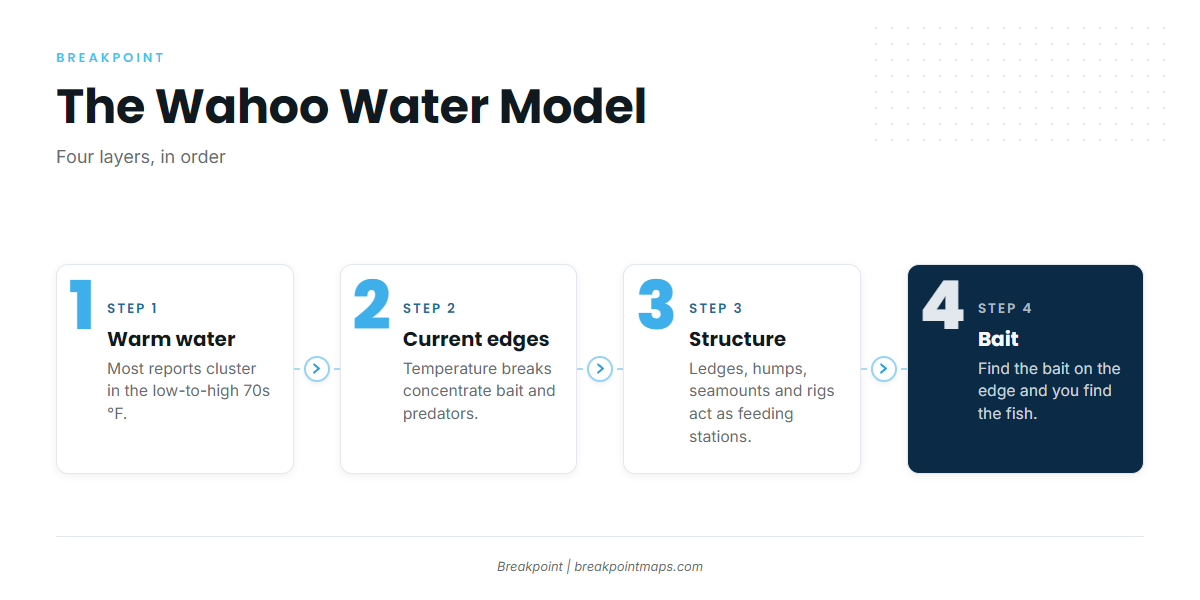
Look for warm, moving water near structure with bait on it. Everything else is detail.
Water Temperature and Current Edges
Most productive reports cluster in the low-to-high 70s °F. Published ranges disagree, from the mid-60s to about 80°F, so treat any single number as a starting point.
Temperature breaks matter because they concentrate bait, and bait concentrates predators. Captains watch their fish finders for changes as small as half a degree. Look along the edges of the Gulf Stream and the Loop Current, where warm water meets cooler water.
Satellite sea surface temperature (SST) has limits. It shows the surface, not the thermocline, and a cloudy pass leaves gaps. A break on the chart is a reason to go look, not proof of fish.
Structure: Ledges, Humps, Seamounts and Rigs
Wahoo use structure as a feeding station more than a home. Reports commonly cite these places:
- Ledges and drop-offs, where current pushes bait up the wall.
- Humps and seamounts, which stack bait in open water.
- Deepwater platforms, especially in the northern Gulf.
- Wrecks and reef edges, particularly in the Keys in winter.
Depths commonly cited run from about 90 to 400 feet, with a favored band around 120 to 300 feet. Wahoo tend to sit upcurrent of structure and ambush what drifts past.
Wahoo Fishing by Region
Each region has its own water and its own habits. This section is an overview, and the regional guides go deeper.
In the Gulf of Mexico, the Loop Current and deepwater platforms drive the fishery. Venice, Louisiana captain Kevin Beach describes wahoo swarming rigs there, and a summer peak is commonly reported. Our guide to wahoo in the Gulf of Mexico covers the platforms and the current.
In the Atlantic Southeast, the Gulf Stream hugs the shelf from the Keys to Georgia and South Carolina. Keys captains commonly report winter action on reef edges and wrecks. Start with Atlantic Southeast wahoo for the stretch from the Keys to Hatteras.
Off North Carolina, the 100-fathom line from Hatteras to Lookout holds fish, and a fall peak is commonly reported. See off Cape Hatteras in the fall for how that plays out. North of there is the northern edge of the range. Gulf Stream eddies push warm water toward the canyons in late summer and fall, and wahoo in the Northeast canyons explains when that window opens.
In the Pacific Southwest, wahoo are episodic, tied to warm-water intrusions from the south, and San Diego long-range boats commonly run south for them. The California Department of Fish and Wildlife reported wahoo showing off California during a marine heatwave, per CDFW’s warmwater visitors update. Our Pacific Southwest wahoo page tracks how that fishery behaves.
| Region | Key water and structure | General timing (commonly reported) | Deep dive |
|---|---|---|---|
| Gulf of Mexico | Loop Current, deepwater platforms | Summer peak | Gulf of Mexico guide |
| Atlantic Southeast | Gulf Stream, reef edges, wrecks | Keys winter action | Atlantic Southeast guide |
| Atlantic Northeast | Gulf Stream eddies, 100-fathom line, canyons | Fall peak off Carolina, late summer into fall farther north | Atlantic Northeast guide |
| Pacific Southwest | Warm-water intrusions, offshore banks | Episodic, tied to warm years | Pacific Southwest guide |
Timing cells are commonly reported patterns, not guarantees. Pick your region:
Wahoo Fishing Tactics
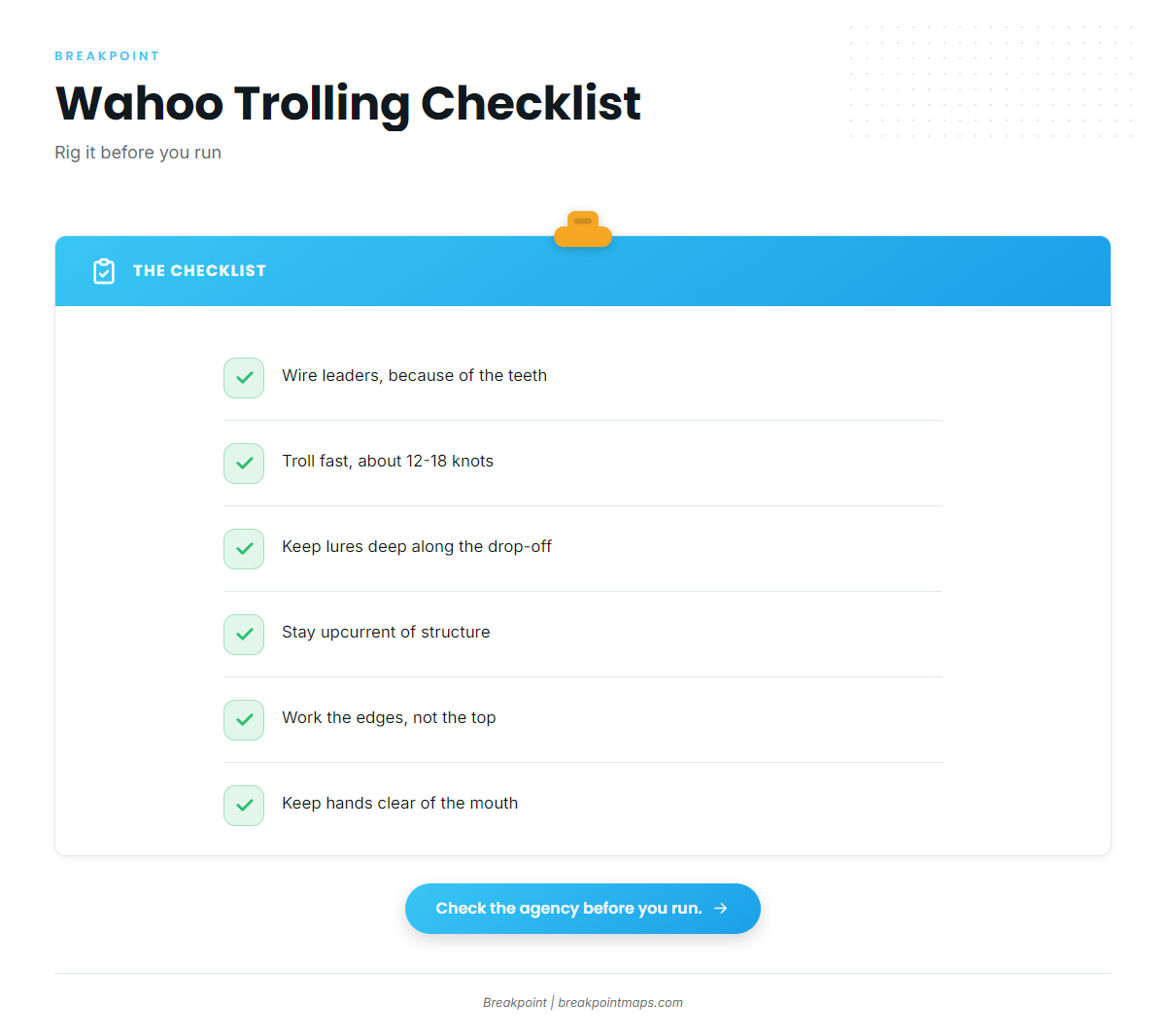
Troll fast, run wire, and keep lures deep along the drop-off. Standard offshore trolling tackle is enough to start.
Gear and Leaders
Wire leaders are standard because of the teeth. Fluorocarbon draws more strikes, but captains report that fewer of those fish reach the boat. Some Keys captains prefer titanium for its flexibility.
One captain quoted by Sport Fishing magazine runs 100 lb mono over Spectra on 50-wide reels with drag near 30 lb. That is one setup, not a rule.
To get lures down at speed, use one of two tools:
- Planers. Think of one as a diving board that pulls a line down.
- Trolling leads. Weighted leads add depth without changing your lure.
High-Speed Trolling
Most wahoo anglers troll between about 12 and 18 knots, and some push past 20. A captain quoted in Sport Fishing’s wahoo techniques favors 14 to 16 knots and has hooked fish at speeds as fast as 22 knots. He works water between 120 and 350 feet, sliding up and down a drop-off with abrupt turns.
Speed helps you cover water, and weighted heads and leads counter the lift the boat’s speed creates. Wahoo also often feed below the surface, so depth matters as much as pace.
The same captain’s sample spread runs six lures:
- Port side: 150, 250 and 350 feet back.
- Starboard side: 200, 300 and 450 feet back.
Lure types are generic here: wahoo bombs, jet heads, Marauder-style plugs, and swimming plugs built for speed.
Work the edges rather than the top. Stay upcurrent of the structure and troll along its edges, because bait drifts off the structure with the current. The Islamorada humps are a worked example of how to run that pattern.
Slow Trolling and Live Bait
Slow trolling with rigged ballyhoo earns its place where bait and structure concentrate fish. Live bait is the other option, and blue runners, speedos and cigar minnows are common choices.
Some Keys captains report that live bait beats trolling in the cooler winter months. That is one region’s opinion, so try both if the bite is slow.
Timing: Moon, Tide and Light
Many pros fish hard for the four or five days before and after a full moon, per Saltwater Sportsman. A Deerfield Beach mate favors the first and last hours of the tide around new and full moons. Captains disagree on light and weather:
- Morning bites, for those who say wahoo eat early.
- Cumulus cloud cover, which Capt. Ryan Van Fleet says can open a daytime bite.
- A steady barometer just before it starts to drop, which Capt. Boyle favors.
What we don’t know. Wahoo movement is hard to predict. Moon and tide correlations are dock wisdom with mixed evidence, so treat them as patterns worth testing rather than laws.
Landing and Handling
The teeth are the main hazard. Keep hands clear of the mouth, gaff decisively, and control the fish before it hits the cockpit.
Wahoo is excellent eating, with white, firm flesh. Get it on ice fast.
Ciguatera is a reported concern with some reef-associated fish in some regions. Check your state health or wildlife agency’s guidance.
Wahoo Regulations: Bag Limits and Who Manages Your Water
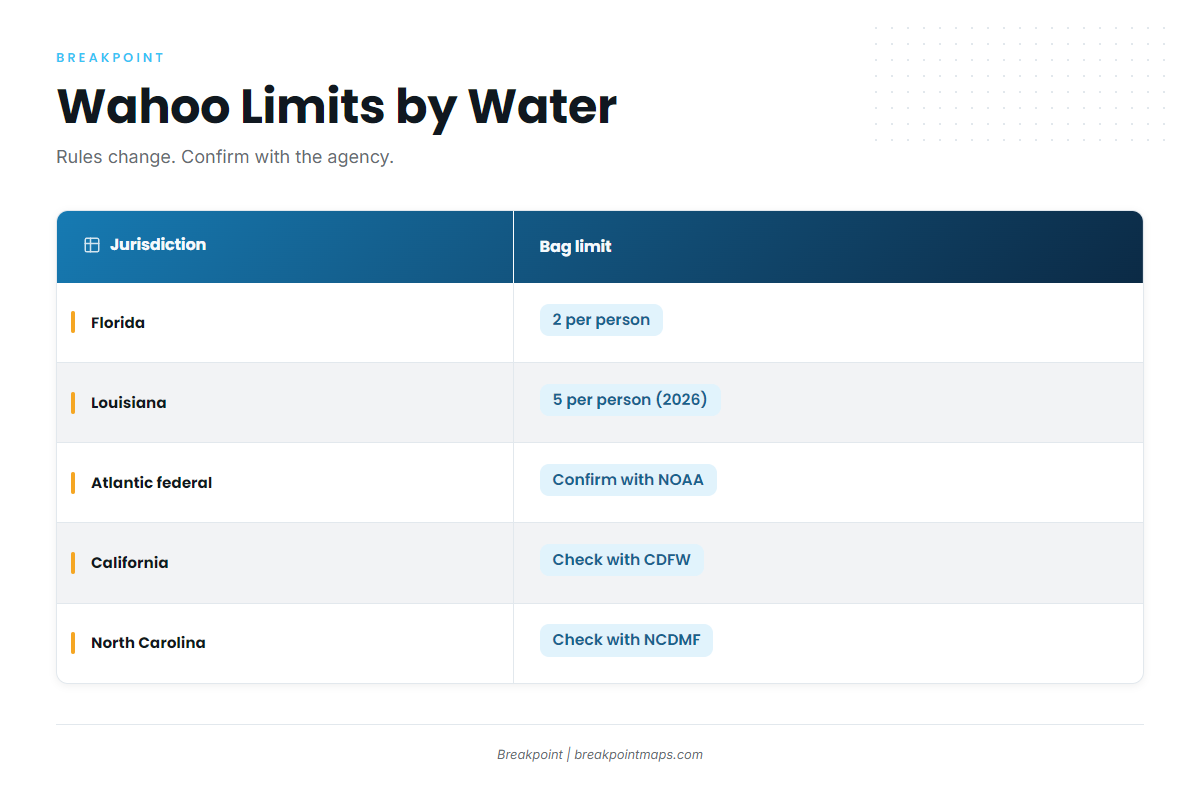
Sources are named in the table.
Which rules apply depends on where the fish is caught. State waters, federal waters and the state where you land can all matter.
Rules can change mid-trip. Crossing from state into federal water changes which rules apply, and landing in a different state can add that state’s rules. Atlantic federal waters fall under the Dolphin Wahoo Fishery Management Plan managed by the South Atlantic Fishery Management Council. Check with SAFMC and NOAA Fisheries for its geographic scope and the current recreational limit.
Confirm anything you rely on before you fish.
| Jurisdiction | Bag/vessel limit | Size | Permits | Source |
|---|---|---|---|---|
| Florida | 2 per person; open year-round | No minimum or maximum | Verify with FWC | FWC’s wahoo regulations page |
| Louisiana | 5 per person, per 2026 regulations | Verify with LDWF | Verify with LDWF | Louisiana’s 2026 fishing regulations |
| Atlantic federal waters | Check with SAFMC and NOAA Fisheries | Check with SAFMC | For-hire dolphin/wahoo permit; check with NOAA Fisheries | SAFMC, NOAA Fisheries |
| North Carolina | Check with NCDMF | Check with NCDMF | Check with NCDMF | NCDMF |
| South Carolina | Check with SCDNR | Check with SCDNR | Check with SCDNR | SCDNR |
| Georgia | Check with GA DNR CRD | Check with GA DNR CRD | Check with GA DNR CRD | GA DNR CRD |
| Texas | Check with TPWD | Check with TPWD | Check with TPWD | TPWD |
| California | Wahoo is not listed by name; general bag limits and Pacific highly migratory species rules may apply. Check with CDFW | Check with CDFW | Check with CDFW | CDFW post, dated 9/17/2026 |
Swipe the table sideways to see every column.
Wahoo trips often cross tuna and billfish water, and an Atlantic HMS angling permit may apply to those species. Check with NOAA Fisheries. Rules on landing wahoo whole or with fins intact also vary, so check with your agency.
Federal waters around Puerto Rico and the U.S. Virgin Islands carry separate limits. Under NOAA’s dolphin and wahoo rule, the recreational bag limit in federal waters around St. Croix and St. Thomas and St. John is 2 wahoo per person per day, not to exceed 10 per vessel per day.
Rules change. Confirm with the agency before you fish.
Frequently Asked Questions
Is wahoo good to eat?
Yes. Wahoo is widely considered excellent table fare, with white, firm flesh. Get it on ice quickly. Ciguatera is a reported concern with some reef-associated fish in some regions, so check your state health or wildlife agency’s guidance.
How do you tell a wahoo from a king mackerel?
Look at the first dorsal fin, which is long and starts just behind the head on a wahoo. Wahoo also carry vertical bars and a beak-like snout, while a king’s lateral line dips sharply. Confirm against FWC’s identification guidance.
How fast do you troll for wahoo?
Most anglers troll about 12 to 18 knots, and some go past 20. One captain quoted by Sport Fishing magazine favors 14 to 16 knots and has hooked fish at 22 knots. Start in that range and adjust.
What leader should you use for wahoo?
Wire is standard because of the teeth. Fluorocarbon can draw more strikes, but captains report fewer of those fish make it to the boat. Some Keys captains prefer titanium for its flexibility.
What is the wahoo bag limit?
It depends on the water. Florida is 2 per person with no size limit. Louisiana lists 5 per person in its 2026 regulations. See the Regulations table, and confirm with the agency before you fish.
When is wahoo season?
Somewhere, it is year-round. Commonly reported peaks are Keys winter, a Gulf summer peak, and Carolina fall. For the fall run, see fall wahoo off the Outer Banks. Treat all timing as a pattern, not a promise.
Conclusion
Wahoo fishing comes down to a short list: find warm water, edges, structure and bait; run fast and deep on wire; treat timing as probability; and remember that the rules follow the water.
Three next steps:
- Pick your region’s guide from the links above.
- Rig wire and a deep lure before you leave the dock.
- Check the agency for your state and federal waters before you run.
When you plan the run, Breakpoint’s hotspots and Fish Intel can narrow where to look before you burn fuel. The OBS SST, Chlorophyll and Chart Contours layers show temperature edges, color changes and the structure that holds bait. The data has limits: a cloud-blocked satellite pass leaves gaps, and the layers show the surface, not the thermocline. Chart layers are not for navigation.