


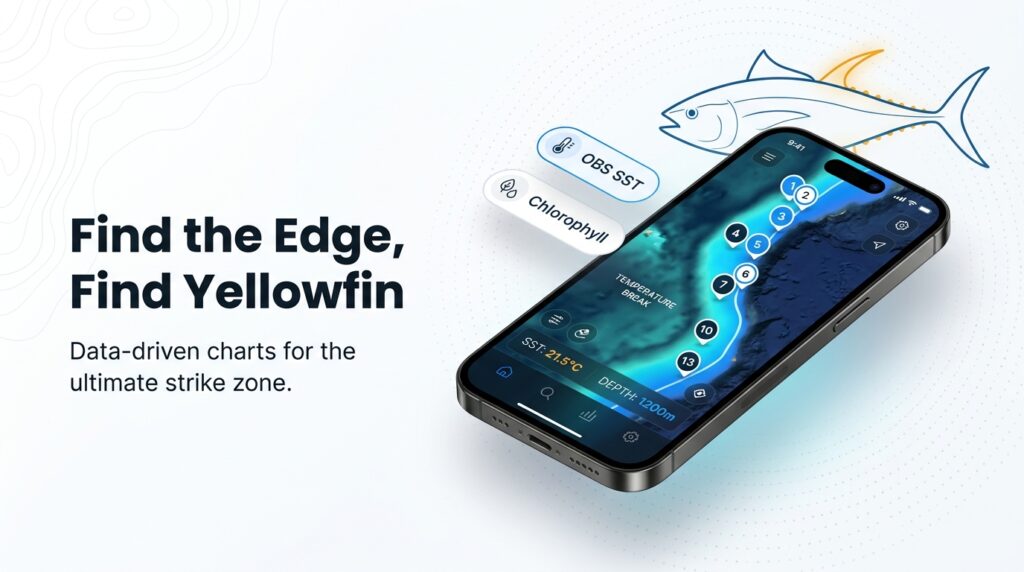
Yellowfin tuna (Thunnus albacares) is a fast, schooling, warm-water tuna found in all 4 regions Breakpoint covers. Anglers chase it for a hard, sustained fight and for some of the best table fare offshore. This guide covers how to identify the fish, where it lives in the Gulf, the Atlantic Southeast, the Atlantic Northeast and the Pacific Southwest, how to fish for it, and which rules apply. Where the science or the season is uncertain, we say so.
Overview: Identification and Behavior
The NOAA Fisheries yellowfin species profile describes Thunnus albacares as a highly migratory tuna of tropical and subtropical seas worldwide. It has a dark metallic blue back, a yellow side stripe, and bright yellow second dorsal and anal fins and finlets. It forms fast-moving schools and prefers warm surface water.
Runs to yellowfin water are often long and in deep water, so plan around weather windows and carry a fuel reserve.
How to Identify a Yellowfin
You can check most of these traits on deck in seconds:
- Finlets: yellow with thin black edges.
- Fin shape: on mature fish, the second dorsal and anal fins lengthen into sickle shapes.
- Pectoral fin: it typically reaches about the start of the second dorsal. On albacore it extends beyond it.
- Belly: often shows alternating broken lines and dots, per the IGFA Atlantic tuna ID notes in The Fisherman. Bigeye do not show this pattern.
Yellowfin vs. Bigeye, Blackfin and Albacore
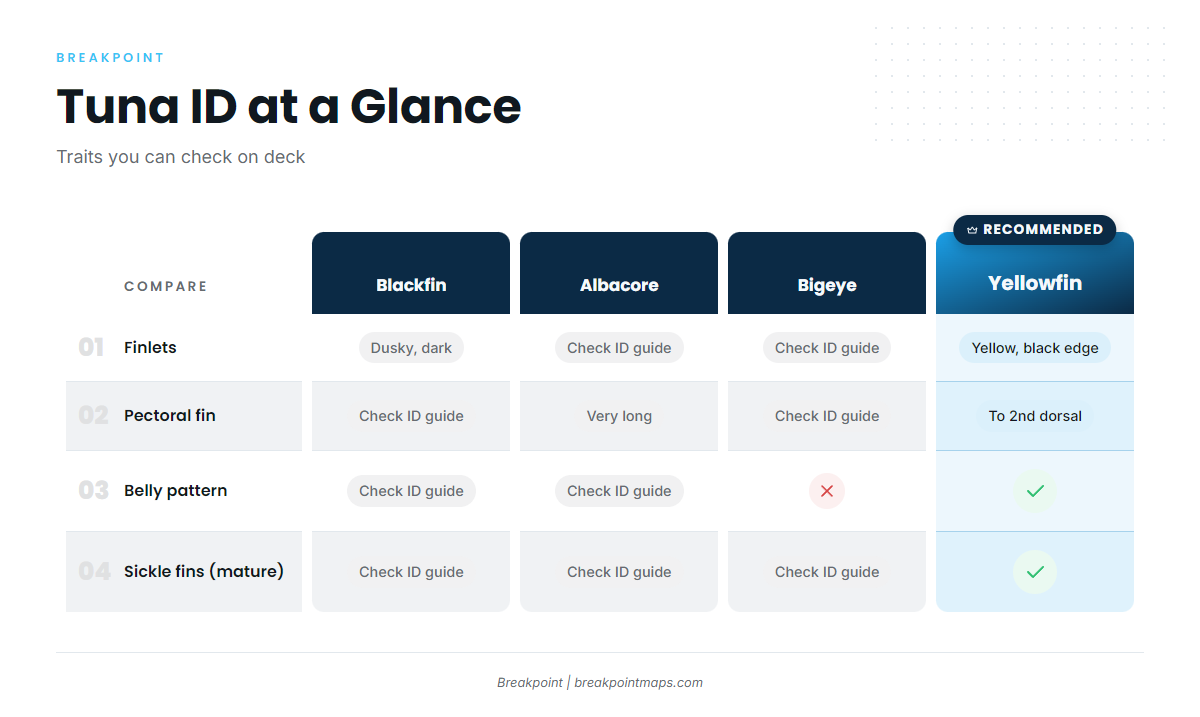
| Trait | Yellowfin | Bigeye | Blackfin | Albacore |
|---|---|---|---|---|
| Finlet color | Yellow with thin black edges | Varies; check agency ID guide | Dusky or dark, little yellow | Varies; check agency ID guide |
| Second dorsal and anal fins | Sickle-shaped and long on mature fish | Varies; check agency ID guide | Varies; check agency ID guide | Varies; check agency ID guide |
| Pectoral fin | Reaches about the start of the second dorsal | Varies; check agency ID guide | Varies; check agency ID guide | Very long, extends past the second dorsal |
| Belly markings | Alternating lines and dots | Lacks the yellowfin pattern | Varies; check agency ID guide | Varies; check agency ID guide |
| Typical size | Commonly 20 to 100+ lb | Varies; check agency ID guide | Varies; check agency ID guide | Varies; check agency ID guide |
Swipe the table sideways to see every column.
Small bigeye and small yellowfin are hard to tell apart, and federal Atlantic rules treat them differently. Verify the specifics with NOAA Fisheries HMS. If you can’t be sure, treat the fish as the more restricted species.
A dockside liver check settles most doubt. A yellowfin liver is smooth with a longer right lobe, while a bigeye liver is striated with lobes of roughly equal size. Bluefin is another Atlantic tuna, managed under separate HMS rules.
Size, Growth and the Record
Yellowfin grow fast and large, and the biggest fish are commonly associated with the Pacific coast of Mexico. The IGFA maintains the all-tackle record, so check the current listing there.
Behavior
- Schooling: yellowfin school tightly, sometimes mixed with skipjack or bigeye.
- Porpoise and birds: in the eastern Pacific especially, they feed with porpoise schools and under bird piles. In the Atlantic and Gulf, expect this less often.
- Time of day: they often sit deeper at midday and come closer to the surface at dawn and dusk.
- Diet: baitfish, squid and crustaceans.
- Temperature: the commonly cited range is roughly 65 to 82°F. It’s a tendency, not a guarantee, and fish gather on edges more than they follow a single number.
Habitat & Range
Yellowfin are found across the warm waters of all four regions, but they concentrate in predictable places. This section covers what holds them and how that plays out region by region.
What Holds Yellowfin
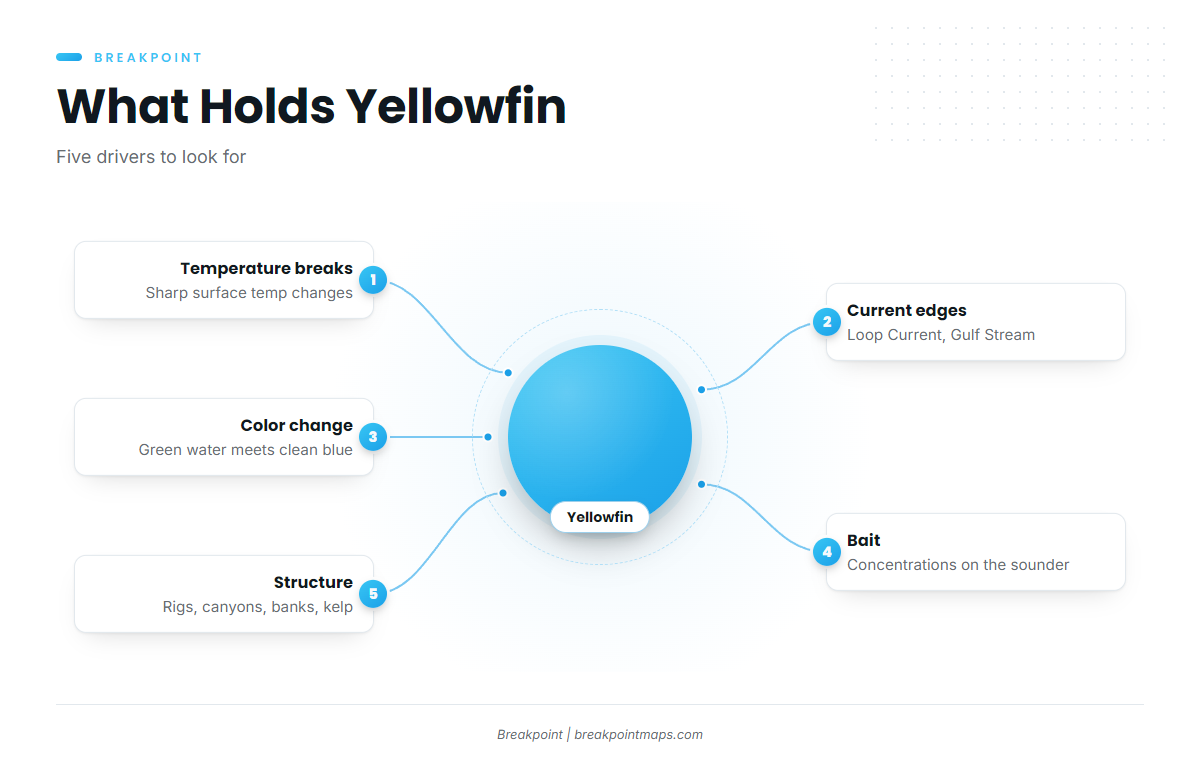
Five drivers explain most of where yellowfin stack up:
- Temperature breaks: sharp changes in surface temperature.
- Current edges: the Loop Current and the Gulf Stream, among others.
- Color change: green, productive water meeting clean blue.
- Bait concentrations: tuna go where the food is.
- Structure: rigs, canyon walls, banks, and floating kelp or debris.
Satellite sea surface temperature (SST) and chlorophyll maps show edges, not fish. Chlorophyll is a proxy for productivity, and cloud cover can block a satellite pass. An edge you find on a map still needs confirming on the water.
Gulf of Mexico
Oil and gas platforms and deepwater floaters act as bait magnets. Loop Current eddies can push warm, blue water toward the rigs. The fishery is commonly described as strongest in spring and fall, with night chunking at the rigs and daytime trolling. The winter fishery out of Venice is known for larger fish; see yellowfin off Venice, Louisiana for the specifics.
For run planning and rig specifics, see our guide to yellowfin tuna fishing in the Gulf of Mexico.
Atlantic Southeast
Look for Gulf Stream edges, temperature breaks along the western wall, weedlines and ledges. The Gulf Stream runs closer to shore off parts of the Carolinas and Florida than the Northeast canyons sit to their ports. The bite is commonly best in spring into early summer, though it varies by year. Anglers troll ballyhoo and skirted baits along the edges, and in Florida they also fish live bait on kites.
Details are in our Atlantic Southeast yellowfin guide.
Atlantic Northeast
Shelf-edge canyons such as Hudson and Baltimore concentrate bait along their walls and upwelling zones. Warm-core eddies shed from the Gulf Stream bring blue water inshore. A summer-to-fall bite is commonly cited.
Anglers report yellowfin showing farther north in some recent years. Treat that as reported and variable, not established. For canyon specifics, see Hudson Canyon yellowfin.
More in yellowfin in the Atlantic Northeast.
Pacific Southwest (Southern California and Baja)
Offshore banks, kelp paddies (floating structure that holds bait) and porpoise schools drive the fishery. Off Southern California, the Southern California seasonal pattern commonly runs from July through October as warm water pushes north.
In warm or El Niño years, fish can show earlier, closer or in greater numbers. That varies, so don’t plan a season around it. Anglers use live sardines, kite and balloon rigs, and trolling to find the fish, then fly-line bait once they’ve found them.
See the Pacific Southwest yellowfin guide for local detail.
Yellowfin by Region
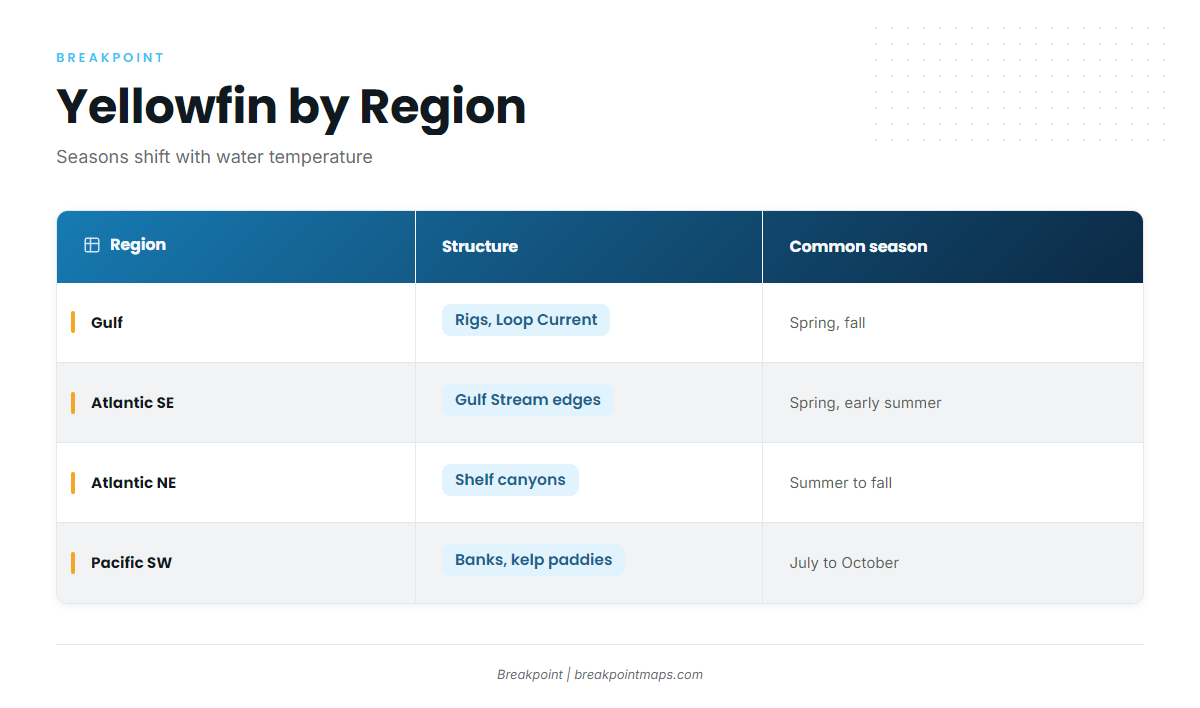
| Region | Signature structure | Commonly cited season (varies by year) | Primary tactics | Go deeper |
|---|---|---|---|---|
| Gulf of Mexico | Oil and gas platforms, floaters, Loop Current eddies | Spring and fall; Venice winter fishery | Night chunking, trolling | Gulf guide |
| Atlantic Southeast | Gulf Stream edges, weedlines, ledges | Spring into early summer | Trolling, kite fishing | Southeast guide |
| Atlantic Northeast | Shelf-edge canyons, warm-core eddies | Summer to fall | Chunking, trolling | Northeast guide |
| Pacific Southwest | Offshore banks, kelp paddies, porpoise schools | Commonly July through October | Live bait, kites, trolling | Pacific SW guide |
Swipe the table sideways to see every column.
Seasons shift with water temperature, so check current conditions before you commit fuel.
Tactics
Yellowfin reward a search-first approach: find the edge, confirm it on the water, then match the method to the fish and the region.
Finding Fish Before You Fish
Plan around edges. Confirm with water color and bait on the sounder, then watch for birds, porpoise and busting fish.
After a trolling strike, keep the boat in gear briefly. Yellowfin school tightly, so one hookup often leads to more.
Starter Tackle Baseline
Treat this as a starting point, not a rule. FishTrack’s yellowfin tackle baseline is a good reference:
- 50 lb class tackle
- 50 lb monofilament main line
- a wind-on leader of heavier mono (FishTrack cites a 25 ft, 150 lb leader)
- fluorocarbon and a smaller leader when fish turn line-shy
For larger fish, add stand-up gear and a harness. Make sure your reels hold enough line for long runs.
Trolling
Trolling covers ground and finds fish. A typical spread uses spreader bars, ballyhoo under skirts, cedar plugs and skirted lures. Skirt colors that work include blue and white, pink and white, and chartreuse and white, with darker colors on cloudy days.
Charter captains lean on classic yellowfin trolling baits: a blue and white Ilander over ballyhoo, and a spreader bar with a green machine trailer. Troll at typical tuna trolling speeds, and adjust to conditions.
Chunking and Chumming
Chunking means drifting or anchoring while feeding cut bait to build a slick, then drifting an unweighted chunk back in it. It’s the main method at Gulf rigs at night and in Northeast canyons when fish hold deep. See night chunking at Venice rigs and chunking Hudson Canyon.
Circle hooks are widely used when chunking and are required in some HMS situations. See Regulations.
Live Bait and Kite Fishing
Bait varies by region. Sardines and mackerel are the staples in the Pacific Southwest, and hardtails (blue runners) and goggle-eyes are common in the Gulf and Southeast. A kite keeps baits splashing at the surface, well away from the boat.
Topwater Popping and Jigging
Cast poppers and stickbaits at breaking fish. Vertical jig when fish show deep on squid or sand eels. Both suit experienced anglers when the trolling spread isn’t producing.
Handling: Bleed and Ice
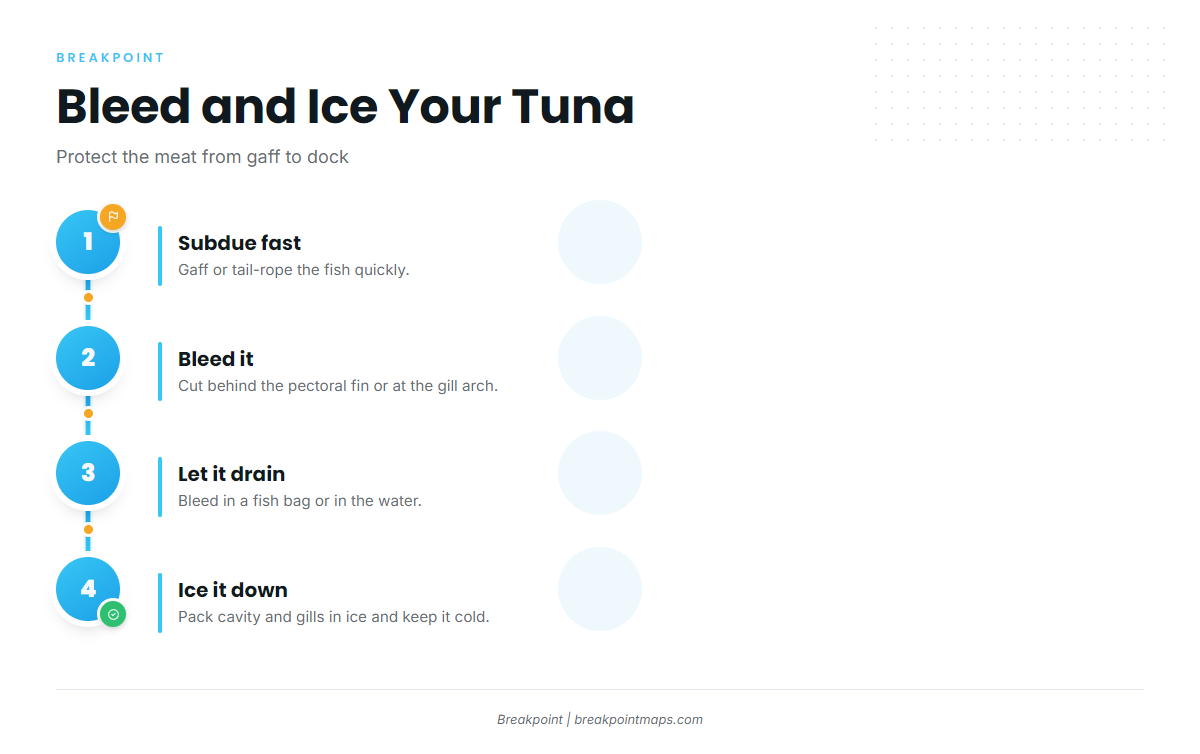
Good handling protects meat that NOAA describes as bright red when raw. This is generally accepted practice:
- Subdue quickly: gaff or tail-rope the fish and get it under control.
- Bleed it: cut behind the pectoral fin, or at the gill arch, while the heart still pumps.
- Let it bleed out: in a fish bag or in the water.
- Chill hard: pack the body cavity and gills with ice slurry or plenty of ice, and keep it cold to the dock.
Frequently Asked Questions: Yellowfin Tuna Fishing Guide Quick Answers
Do I need a permit to fish yellowfin tuna?
In federal Atlantic and Gulf waters, you need an HMS Angling permit from NOAA Fisheries, or a Charter/Headboat permit for for-hire vessels. California requires a state license under CDFW. Mexican waters require a CONAPESCA license. Verify the current rules with each agency before you go.
How do you tell yellowfin from bigeye?
Check the belly first. Yellowfin often show alternating lines and dots, and bigeye do not, per IGFA guidance published in The Fisherman. Mature yellowfin also have longer fins. At the dock, a smooth liver with a longer right lobe points to yellowfin. If you can’t be sure, treat the fish as the more restricted species.
What water temperature do yellowfin like?
The commonly cited range is roughly 65 to 82°F, and it’s a tendency, not a guarantee. Temperature breaks, color changes and bait concentrations tend to hold fish better than a target reading.
What’s the best bait for yellowfin?
It depends on region and method. Trolled ballyhoo under skirts, cut chunks in a slick, and live sardines or hardtails all produce. FishTrack notes that a mix of artificial and natural baits works well. Match the bait to where you fish and how you fish it.
When is yellowfin season?
It varies by region and year. The Gulf is commonly strongest in spring and fall, with a Venice winter fishery. The Southeast commonly runs spring into early summer. The Northeast runs summer to fall. Southern California is commonly July through October. See the regional table above.
How should I bleed and ice a yellowfin?
Subdue the fish quickly, then bleed it by cutting behind the pectoral fin or at the gill arch while the heart still pumps. Pack the body cavity and gills with ice slurry or plenty of ice, and keep it cold all the way to the dock.
Closing: Where to Start Looking
Yellowfin follow warm edges, bait and structure, and the rules differ by jurisdiction, so verify before you fish. Fish Intel lays OBS SST and Chlorophyll edges over hotspot history, so you can pick a smarter starting point. It can’t see fish, and cloud cover can blank a pass, but it narrows where to look. Chart layers are not for navigation.