




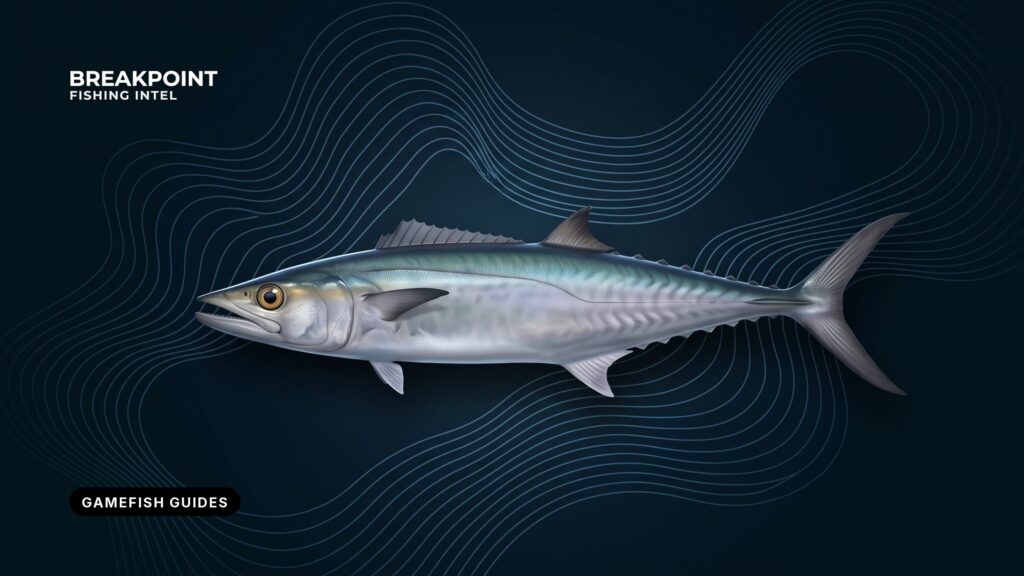
These guides cover gamefish that aren’t tuna, billfish or bottom fish: mahi, wahoo, cobia, king and Spanish mackerel, California yellowtail and striped bass. This page matches each fish to its water, separates the two pairs people most often confuse and points to the right guide. For tuna, billfish, reef and bottom fish, see our all saltwater species guides.
Seven gamefish at a glance
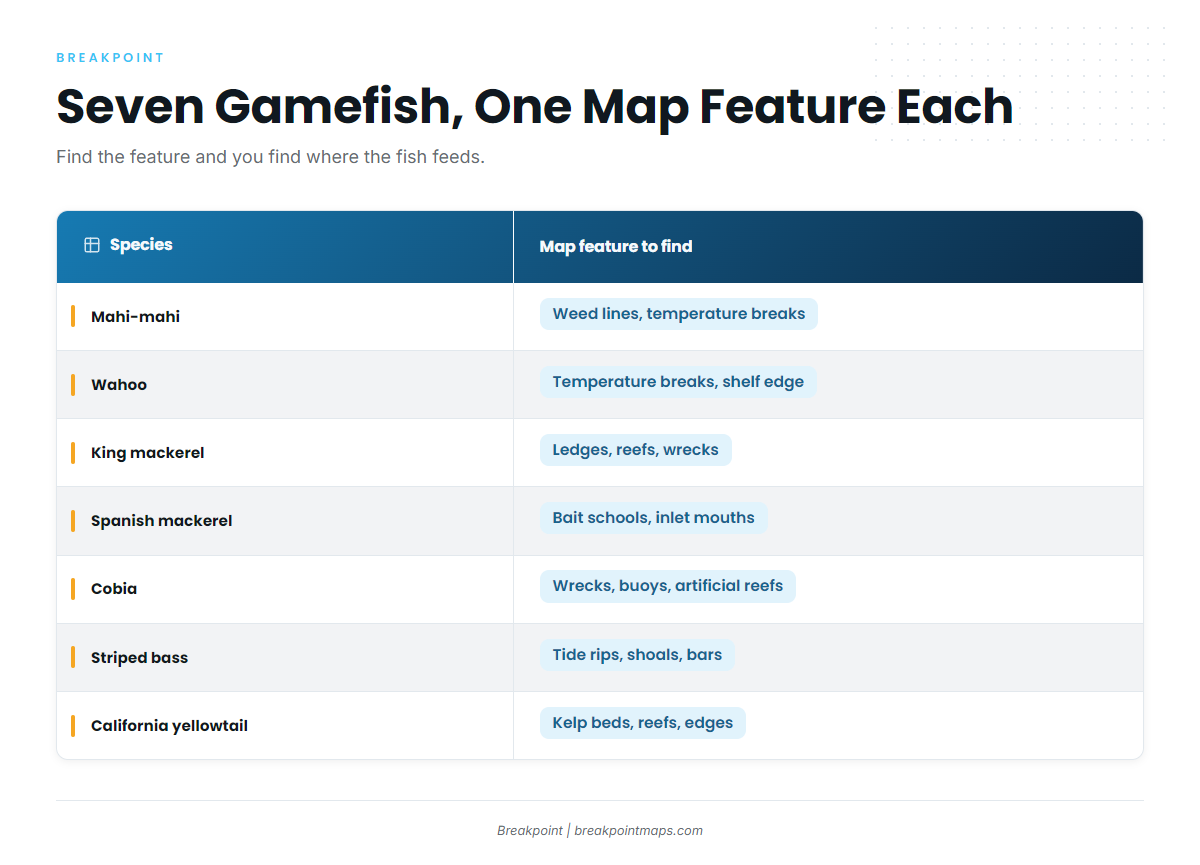
These pelagic gamefish and their nearshore cousins all feed along physical features, so finding the feature gets you most of the way to finding the fish.
| species | where | typical water | how it’s fished | map feature to look for | on the table |
|---|---|---|---|---|---|
| mahi-mahi | Atlantic, Gulf, Southern California (dorado) | offshore blue water | trolling, then casting to schools once found | weed lines and sargassum, floating debris, temperature breaks | mild white fillets, eaten fresh |
| wahoo | Atlantic and Gulf offshore | blue water along edges and drop-offs | high-speed trolling | temperature breaks, ledges and the shelf edge | firm white meat |
| king mackerel | Atlantic and Gulf | nearshore to offshore | slow-trolling live bait | ledges, reefs, wrecks, bait on the edges | richer, oilier meat, often smoked |
| Spanish mackerel | Atlantic and Gulf | inshore and nearshore | casting and trolling small lures through bait | bait schools, inlet mouths, color changes | mild when eaten very fresh |
| cobia | Atlantic and Gulf | nearshore | sight-casting cobia, live bait on structure | wrecks, buoys, artificial reefs | firm white fillets |
| striped bass | Atlantic coast | inshore, rips, shoals | casting, trolling, live and cut bait | tide rips, shoals, bars | firm white fillets, check slot rules |
| California yellowtail | Southern California islands and coast | kelp, reefs, open water | live bait and yo-yo or surface iron | kelp beds, reefs, temperature edges | firm meat, popular raw or grilled |
Swipe the table sideways to see every column.
Weed lines and temperature edges show up in OBS SST and Chlorophyll. Ledges and wrecks show up in Chart Contours. Cloud blocks the satellite pass, so a clear SST image isn’t available every day.
How do you tell a mahi from a wahoo?
Mahi have a blunt head, steep on bulls, and a single dorsal fin running from head to tail, in green-gold with blue flecks. Wahoo have a long, beak-like snout, vertical tiger bars, a long low first dorsal and razor teeth. Mahi vs wahoo is mostly a call on head shape and dorsal fin.
| mahi-mahi | wahoo | |
|---|---|---|
| head | blunt, steep forehead on bulls | long, pointed, beak-like snout |
| dorsal fin | one fin, head to tail | long, low first dorsal |
| color and pattern | green-gold with blue flecks | blue-gray with vertical tiger bars |
| mouth | small teeth | razor teeth |
Wahoo teeth cut, so handle the jaw with care.
Both fish work the same blue water and edges, so the ID usually happens at the boat. For tactics and water, open the mahi-mahi fishing guide and the wahoo fishing guide.
How do you tell a king mackerel from a Spanish mackerel?
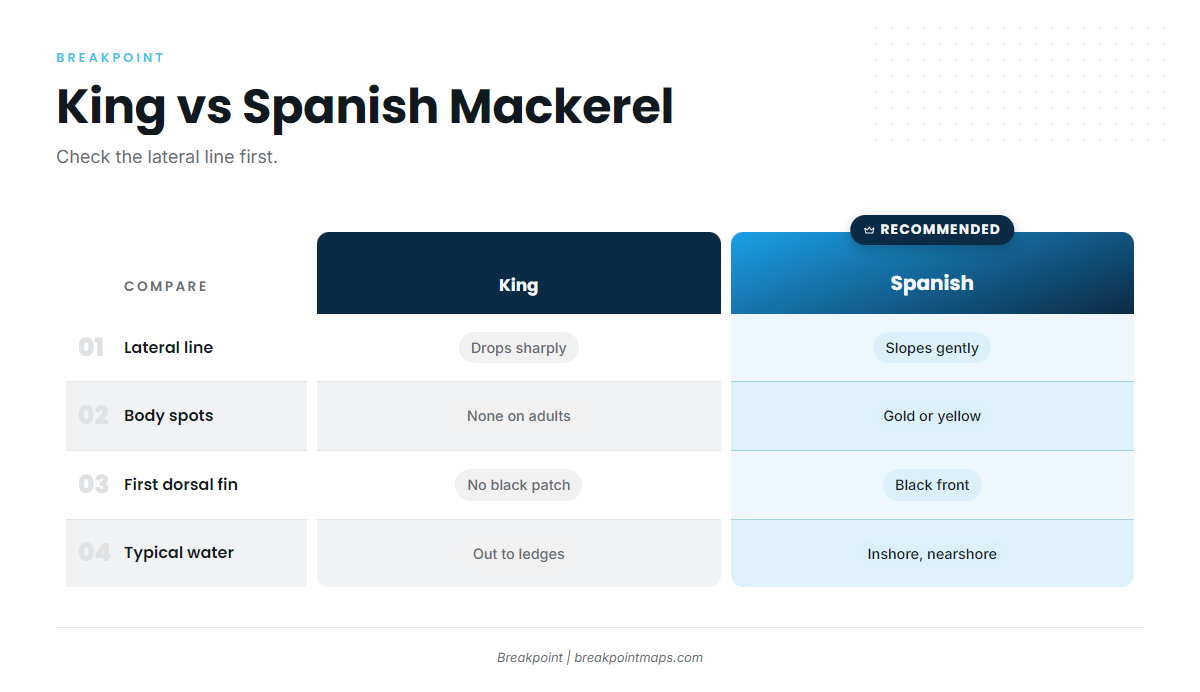
Check the lateral line first, the thin line running along each side of the fish. On a king it drops sharply below the second dorsal fin. On a Spanish mackerel it slopes gently. Spanish mackerel carry gold or yellow spots and a black front on the first dorsal fin. Adult kings have no spots and no black patch.
| king mackerel | Spanish mackerel | |
|---|---|---|
| lateral line | drops sharply below the second dorsal | slopes gently |
| spots | none on adults | gold or yellow spots |
| first dorsal fin | no black patch | black front |
| typical water | nearshore out to the ledges | inshore and nearshore |
Small kings can show faint spots, so rely on the lateral line. A wrong call can put you over a limit, which makes king mackerel vs Spanish mackerel the identification that matters most for staying legal.
Get the details in the king mackerel fishing guide and the Spanish mackerel fishing guide.
Rules
Each fish answers to a different agency:
- King and Spanish mackerel: NOAA Fisheries, with the South Atlantic and Gulf councils.
- Atlantic cobia: ASMFC and the states.
- Gulf cobia: NOAA Fisheries.
- Striped bass: ASMFC and the states.
- California yellowtail: CDFW.
- Mahi and wahoo: NOAA Fisheries plus state rules.
Limits change by season and quota, so check the agency’s rules before you fish.
Find your fish by region
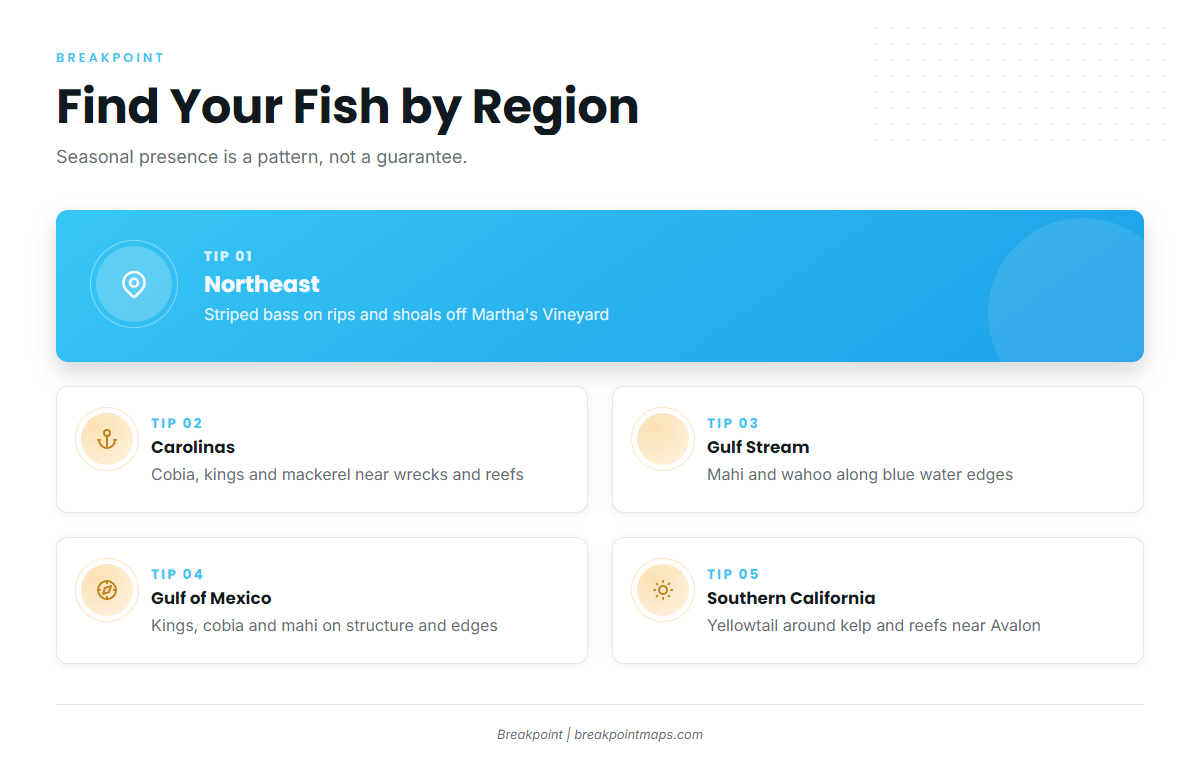
Seasonal presence is a pattern, not a guarantee.
Northeast and Mid-Atlantic
Martha’s Vineyard holds striped bass from spring through autumn, and mahi show offshore in summer. The rips off Gay Head and Wasque Shoals are striper water, and the striped bass migration moves fish past the island each year. The NOAA Coast Pilot for Vineyard Sound describes the strong tidal currents and shoals that build those rips. Use Chart Contours for shoals and rips, and OBS SST for summer edges.
Open the striped bass fishing guide and the mahi-mahi guide for offshore trips.
Carolinas and Southeast Florida Atlantic
Out of Sneads Ferry, cobia and Spanish mackerel show in spring, mahi and kings in summer, and wahoo and kings in autumn. The North Carolina artificial reef guide places New River Reef AR-355 9.9 nautical miles from the entrance in 60 ft. Treat it as nearshore structure for kings and cobia. Longer runs from the New River reach toward the Gulf Stream for mahi and wahoo.
Out of Mayport, wahoo run in winter, kings and cobia in spring and autumn, and mahi in summer. Reef, ledge and wreck grounds lie offshore to the east.
Read the NWS Newport/Morehead City marine forecast for wind and sea numbers before deciding to go. Then pick your guide: the cobia fishing guide, the king mackerel guide, the Spanish mackerel guide, the mahi guide and the wahoo guide.
Gulf of Mexico
Kings, Spanish mackerel and cobia work nearshore structure and bait. Mahi and wahoo work the blue water and edges. Gulf cobia fall under NOAA Fisheries. Use Chart Contours to find wrecks and other structure, and OBS SST and Chlorophyll for color and temperature edges.
The king mackerel, Spanish mackerel, cobia, mahi and wahoo guides cover the Gulf.
Southern California
Avalon on Catalina holds yellowtail year-round and dorado (mahi) in summer. Southern California yellowtail and kelp go together, so start with the kelp, reefs and Church Rock. Casino Point Dive Park and Lover’s Cove are closed to fishing.
The San Pedro Channel wave buoy gives wave height and period. Open the California yellowtail fishing guide, and the mahi guide for dorado.
Gamefish guides by group
Every guide on this page, grouped by water type.
Bluewater pelagics
- mahi-mahi-fishing-guideweed lines, sargassum and temperature edges, trolling and casting to schools.
- wahoo-fishing-guidetemperature breaks, ledges and the shelf edge, high-speed trolling.
Mackerels
- king-mackerel-fishing-guideledges, reefs and wrecks, slow-trolling live bait.
- spanish-mackerel-fishing-guidebait schools and inlet mouths, casting and trolling small lures.
Nearshore and inshore gamefish
- cobia-fishing-guidewrecks, buoys and artificial reefs, sight-casting and live bait.
- striped-bass-fishing-guidetide rips, shoals and bars, casting, trolling and bait.
Pacific coast
- california-yellowtail-fishing-guide – kelp, reefs and temperature edges, live bait and iron.
Before you run
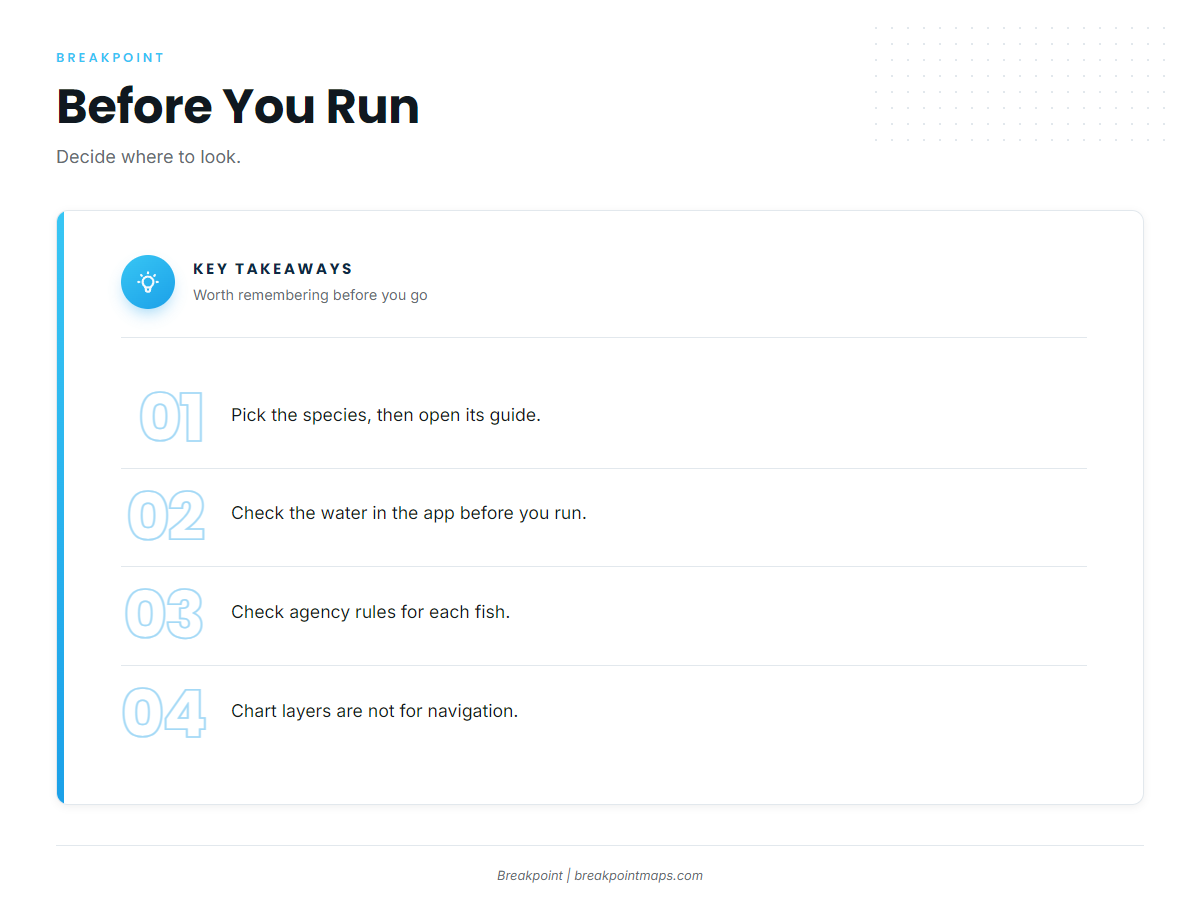
Tuna, billfish, reef and bottom fish are in our all saltwater species guides. Pick the species, open the guide, then check the water in the app before you run.
Chart layers are not for navigation. They help you decide where to look.