




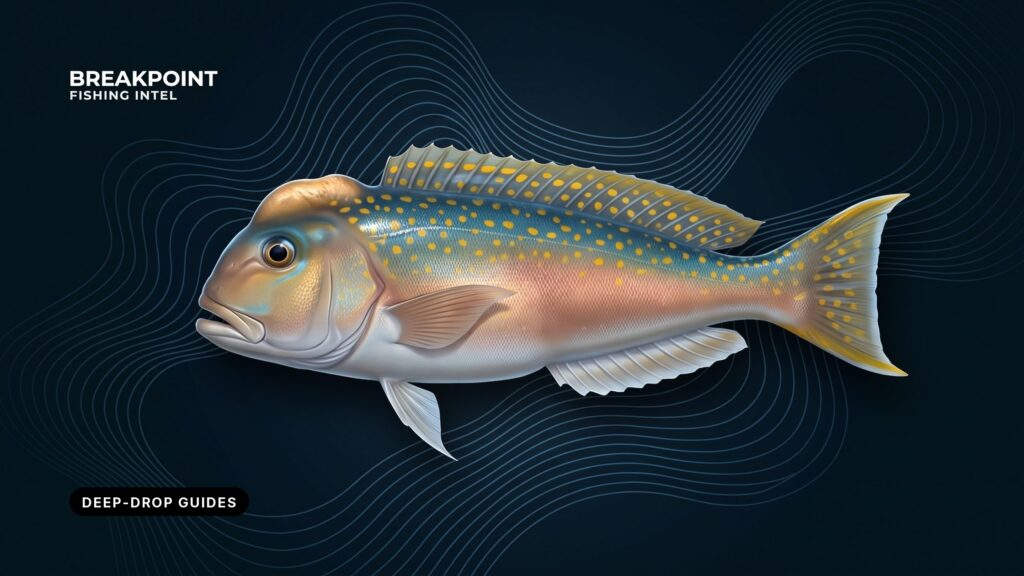
Deep-drop and bottom fish trips come down to five targets on two coasts, and the bottom under the boat decides where each one holds. Blueline and golden tilefish live on the Atlantic and Gulf slope. Lingcod, Pacific halibut and sablefish live on the Pacific coast and in Alaska. Reading structure comes first and tackle second. This page covers what deep-drop fishing is, what changes at depth, how bottom structure sorts the fish, a species table, regional routing and a guide for each species.
What Deep-Drop Fishing Is
Deep-drop fishing is bottom fishing past the shelf break, where depth and current dictate the whole setup. The line runs long, weights are measured in pounds rather than ounces, electric reels become the norm, and boat control matters as much as bait.
On the Pacific slope, sablefish adults live on mud deeper than 650 feet (NOAA), which shows how deep the West Coast version runs. Ordinary shelf bottom fishing, such as lingcod on rock, uses the same idea at shallower depths: find the bottom type, put the bait on it and hold position.
You will hear four terms: shelf break, upper slope, electric reels and descending devices. All of them trace back to one problem, which is getting a bait to a small piece of the right bottom a long way down.
How the Bottom Fish Species Split by Coast
Atlantic and Gulf. Blueline tilefish sit on the outer shelf, shelf break and upper slope. NOAA’s blueline tilefish profile puts them at 98 to 774 feet on irregular bottom with ledges, crevices, boulders and rubble piles. The SAFMC blueline tilefish page adds that they also use sand, mud and shell hash, and are frequently found in the same habitat as groupers and snappers. Golden tilefish are mud and clay specialists. They burrow in soft bottom on the shelf edge and upper slope, and they run deeper than bluelines on average. Snowy grouper share the same deep ground. Our blueline tilefish guide and the golden tilefish guide cover each fish in detail.
Pacific and Alaska. Lingcod are rock fish. Adults sit near rocks, most at 10 to 100 m (WDFW), while young fish use sand and mud. They are ambush predators that rest in crevices and stay close to their home reef, according to Animal Diversity Web. Pacific halibut work gravel and sand flats, and the edges where flat bottom meets harder bottom. Sablefish (black cod) live on mud bottom deeper than 650 feet (NOAA) and at 300 to 1,500 m (WDFW). Lingcod ground is also rockfish ground, which is why depth restrictions shape so much of the Pacific fishery. Start with the lingcod guide, then the Pacific halibut guide and the sablefish guide.
Bottom type sorts them:
- Mud: golden tilefish and sablefish
- Harder irregular bottom: blueline tilefish
- Rock: lingcod
- Flats and edges: Pacific halibut
What Changes When You Go Deep
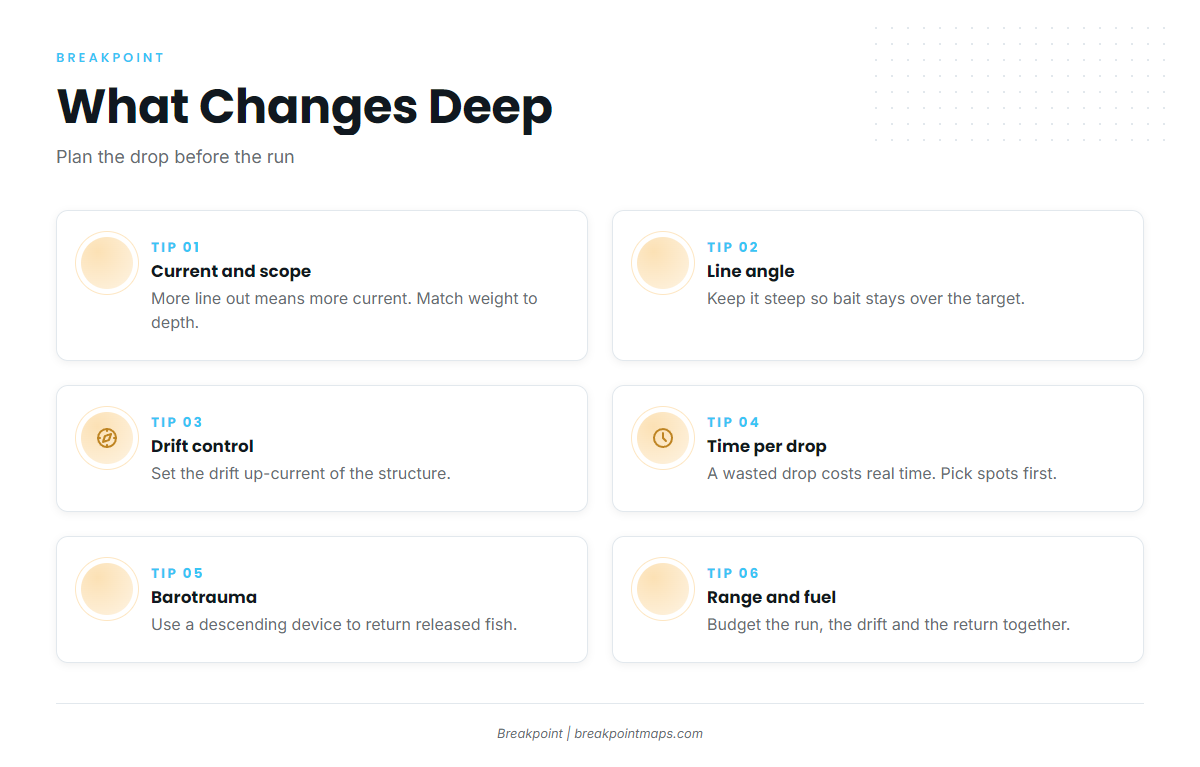
Depth changes the whole drop, not just the length of line.
- Current and scope: More line out means current pushes more of it. Weight has to match depth and current.
- Line angle and drift control: A steep angle keeps the bait over the target, while a blown-out angle drags it off the spot. Set the drift up-current of the structure so the rig reaches bottom on it.
- Line stretch and bite detection: Braid’s low stretch carries the bite up the line. Watch the rod tip.
- Time per drop: Each drop and retrieve takes long enough that a wasted drop costs real fishing time. Pick spots before the run.
- Barotrauma: Fish pulled from depth suffer pressure injury. A descending device returns released fish to depth, as covered in the safety section below.
- Range and fuel: Deep ground is often far from the inlet. Plan the run, the drift time and the return as one fuel budget.
Why Bottom Structure Matters Most
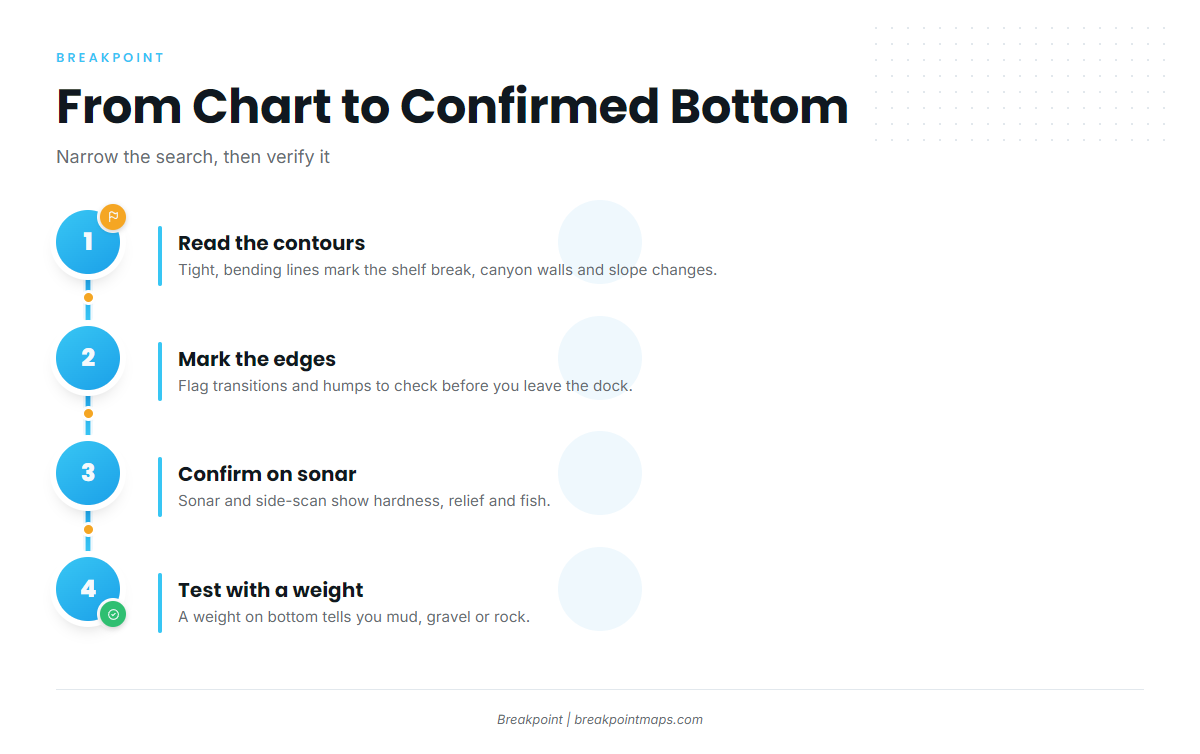
Each species keys to a bottom type, and the best water is often where two types meet.
The structure vocabulary, tied to the fish:
- Shelf break and canyon walls: tilefish and sablefish
- Ledges and rubble: blueline tilefish
- Humps and pinnacles: lingcod
- Gravel and sand flats and their edges: Pacific halibut
- Mud and clay burrow ground: golden tilefish and sablefish
Bottom transitions are where to start a drift. Rock to sand, hard bottom to mud and flat to slope are all edges where bottom type changes under the boat. Fish that hold on one type often feed along the border.
The data has limits. Many offshore areas were surveyed with sparse soundings decades ago, and contours show shape, not bottom composition. Mud versus gravel is confirmed by sonar and a dropped weight, not a chart.
Each tool has its own job. The chart narrows the search to slopes and edges. Sonar and side-scan confirm hardness, relief and fish. A weight on bottom tells you mud, gravel or rock.
In Breakpoint, Chart Contours shows the shelf break, canyon walls, humps and slope changes as tightening and bending contour lines. You can mark those edges and transitions and check them before you leave the dock. Chart layers are not for navigation.
Deep-Drop and Bottom Fish Species Compared
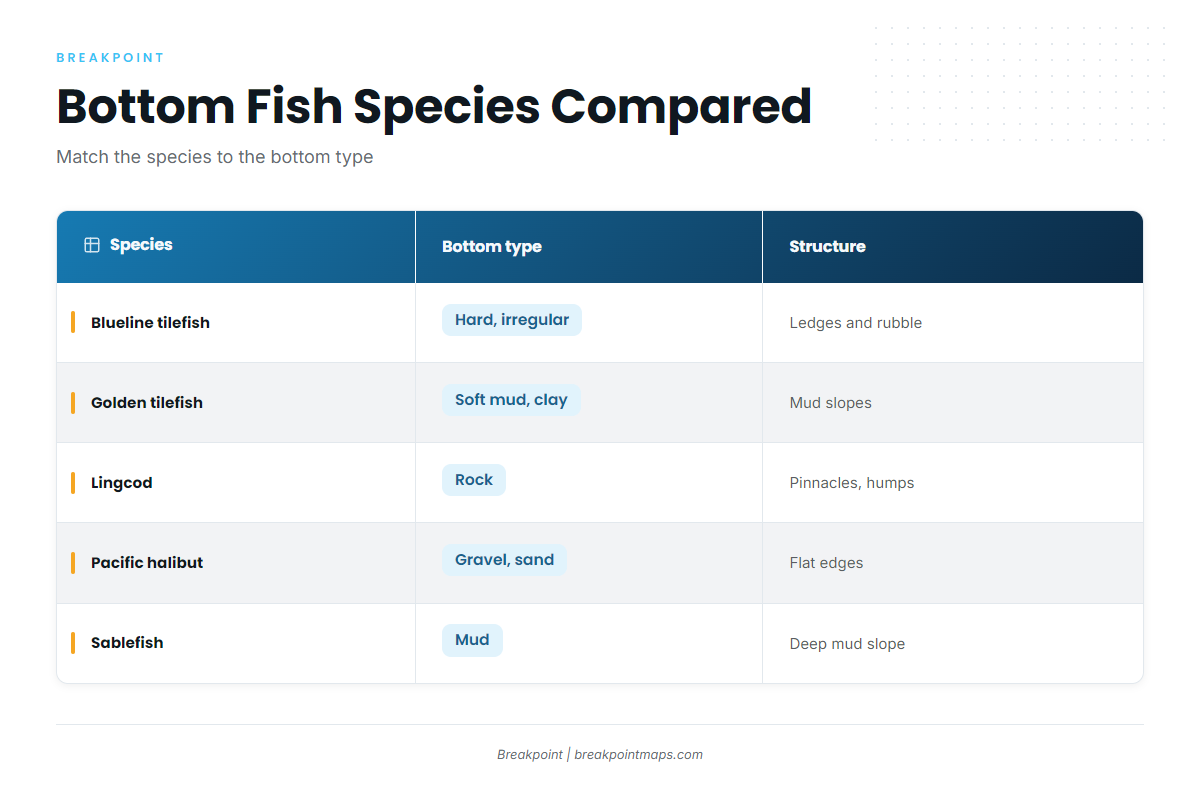
Five fish, two coasts, and each one tied to a bottom type.
| Species | Coast and region | Bottom type | Depth | Structure to look for | Guide |
|---|---|---|---|---|---|
| blueline tilefish | Atlantic and Gulf, Maine to Campeche (NOAA) | irregular hard bottom, also sand, mud and shell hash | 98 to 774 feet (NOAA) | ledges, crevices, boulders, rubble at the shelf break | Guide |
| golden tilefish | Atlantic and Gulf | soft mud and clay burrows | shelf edge and upper slope, deeper than bluelines on average | mud slopes along canyons and the shelf edge | Guide |
| lingcod | Pacific and Alaska | rock (adults), sand and mud (young) | most 10 to 100 m (WDFW) | pinnacles, humps, rocky reef, crevices | Guide |
| Pacific halibut | Pacific and Alaska | gravel and sand | flats and their edges | flat-to-slope edges, gravel patches | Guide |
| sablefish (black cod) | Pacific and Alaska | mud | deeper than 650 feet (NOAA) | deep mud slope | Guide |
Swipe the table sideways to see every column.
Route by Region
Mid-Atlantic and Northeast canyons. The blueline fishery concentrates between Hudson and Veatch Canyons (NOAA). Off Virginia, Norfolk Canyon bluelines come from hard-bottom areas, according to the SEDAR 32 assessment. Goldens hold on the mud slopes of the canyon systems. Check NOAA Fisheries and SAFMC rules before fishing.
South Atlantic and Gulf. Bluelines share ground with groupers and snappers, and snowy grouper hold the deep ground too. Tilefish rules follow seasons and quotas, so check NOAA Fisheries and SAFMC before fishing.
Washington, Oregon and California. Lingcod sit on rock, halibut on flats and edges, sablefish on deep mud. Depth restrictions shape where you can fish. Off La Push, the yelloweye rockfish conservation area is closed to halibut and bottomfish, and the Washington Marine Area 3 rules spell it out. Check WDFW for Washington, ODFW sport bottomfish seasons for Oregon and the CDFW groundfish regulations summary for California. For halibut, check IPHC and your state agency too.
Alaska. Halibut hold on flats and edges, and lingcod on rock. Sablefish are occasionally caught in Alaska recreational fisheries during summer migrations onto the shelf (NOAA). Check IPHC and ADF&G before fishing.
If your target is not on this page, the saltwater fish species guides cover the rest.
Gear at Category Level
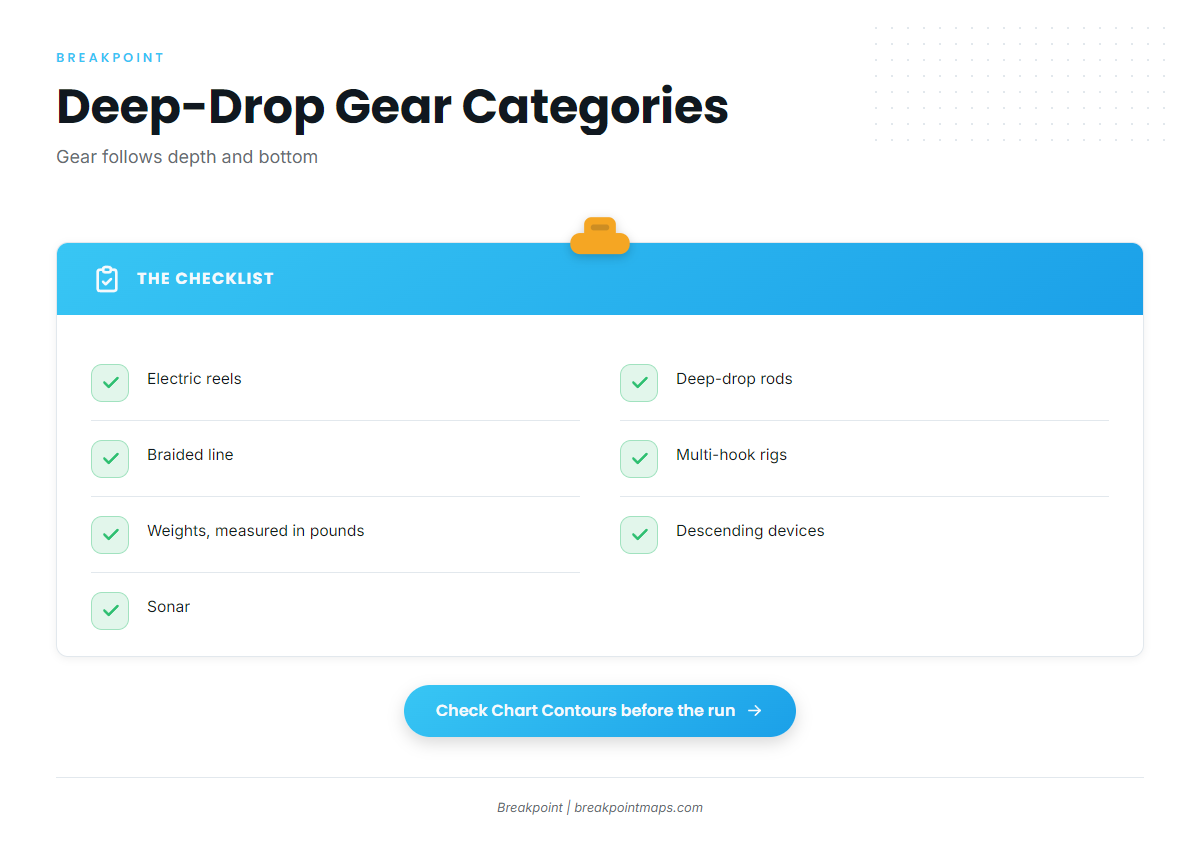
Gear follows the depth and the bottom. These are the categories that matter:
- Electric reels: do the cranking when the retrieve is long.
- Deep-drop rods: short, powerful and built to load under heavy weight.
- Braid: low stretch and high capacity for long drops.
- Multi-hook rigs: put several baits near bottom on each drop.
- Weights in pounds: hold the rig down against current.
- Descending devices: return released fish to depth.
- Sonar: confirms hardness, relief and fish under the boat.
Safety and the Law
Check the NWS marine forecast before the run. The numbers that matter are wind, wave height and period. Chart layers are not for navigation.
Barotrauma is the reason descending devices matter. WDFW halibut and bottomfish rules require a descending device on board and rigged for immediate use when fishing for or holding bottomfish or halibut.
Rules differ by state and between state and federal waters, and halibut and tilefish rules follow quotas and seasons. Name the agency for your water and check it before fishing.
Bottom Fish and Deep-Drop Guides
Every guide below covers one species or one group, with bottom type, structure and regional rules.
Atlantic and Gulf deep-drop
- Blueline tilefish guidehard bottom, ledges and rubble from the canyons to the Gulf.
- Golden tilefish guidemud and clay burrow ground on the shelf edge and upper slope.
Pacific and Alaska bottom fish
- Lingcod guiderocky reefs, pinnacles and working around rockfish rules.
- Pacific halibut guideflats, edges and quota-driven seasons.
- Sablefish guideblack cod on deep slope mud.
More species
- Saltwater fish species guides – every species we cover, offshore and inshore.
Open Chart Contours in Breakpoint before the run to pick where to drop.