




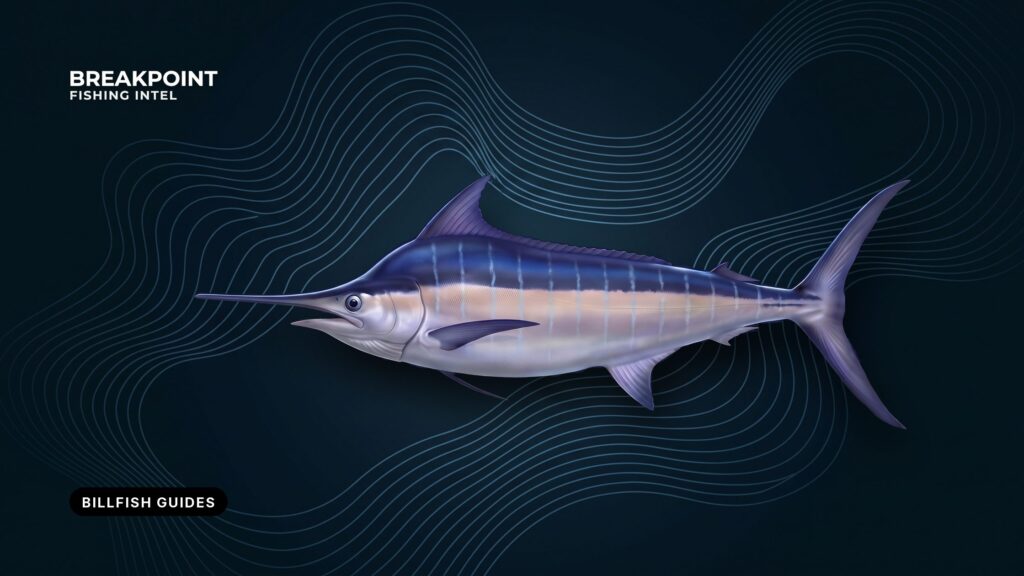
Billfish and swordfish fishing guides start with five fish: sailfish, blue marlin, white marlin, striped marlin and swordfish. This page compares them side by side, shows how to tell them apart beside the boat, summarizes how each is fished and released, and points to the right guide for your water. Use it for correct ID when you score or report a fish, for the release rule, and for where each species lives. The full species library is at saltwater fish species guides.
Billfish and swordfish compared
Marlin and sailfish belong to one family, Istiophoridae. Swordfish is the only member of its own family, Xiphiidae, which is why its ID cues and depth behavior differ.
| Species | Ocean | Dorsal fin | Bill shape | Daytime depth or water | Main recreational method | U.S. rules agency |
|---|---|---|---|---|---|---|
| sailfish | Atlantic and Indo-Pacific | Tall "sail," much higher than the body is deep | Round, slender | 120 to 300 feet off the Atlantic Southeast, usually above the thermocline | Trolled or live ballyhoo, mullet, blue runners | NOAA Fisheries, Atlantic HMS |
| blue marlin | Atlantic, Pacific, Indian | Pointed; first lobe lower than body depth | Round | Warm mixed layer above the thermocline, blue water | Heavy-tackle trolling with lures and teasers | NOAA Fisheries, Atlantic HMS |
| white marlin | Atlantic | Rounded tip | Round | See guide | Trolling with teasers and dredges, bait-and-switch | NOAA Fisheries, Atlantic HMS |
| striped marlin | Indo-Pacific | See guide | Round | Mostly above the thermocline, near islands, seamounts, boundary currents | Live bait, bait-and-switch, small lures | NOAA Fisheries (Pacific); local agency abroad |
| swordfish | Atlantic, Indian, Pacific | Rigid, does not fold down | Flat and broad | Below the thermocline by day | Daytime deep-drop, night drift under a light | NOAA Fisheries, Atlantic HMS; local agency in the Pacific and abroad |
Swipe the table sideways to see every column.
Sizes vary by source. One sourced figure: swordfish average 50 to 200 lb (NOAA).
How to tell them apart
Check the dorsal fin first, then the bill, then the fin positions. Each cue below can be checked with the fish beside the boat.
Marlin or sailfish
Sailfish are the easy call, and the rest of the checklist confirms it.
- Sailfish carry a sail-like first dorsal that runs much of the back and stands taller than the body is deep.
- On marlin, the dorsal is lower than body depth.
- Bigger marlin have a smaller dorsal relative to body size, so judge the fin against the body, not against other fish.
Swordfish or marlin
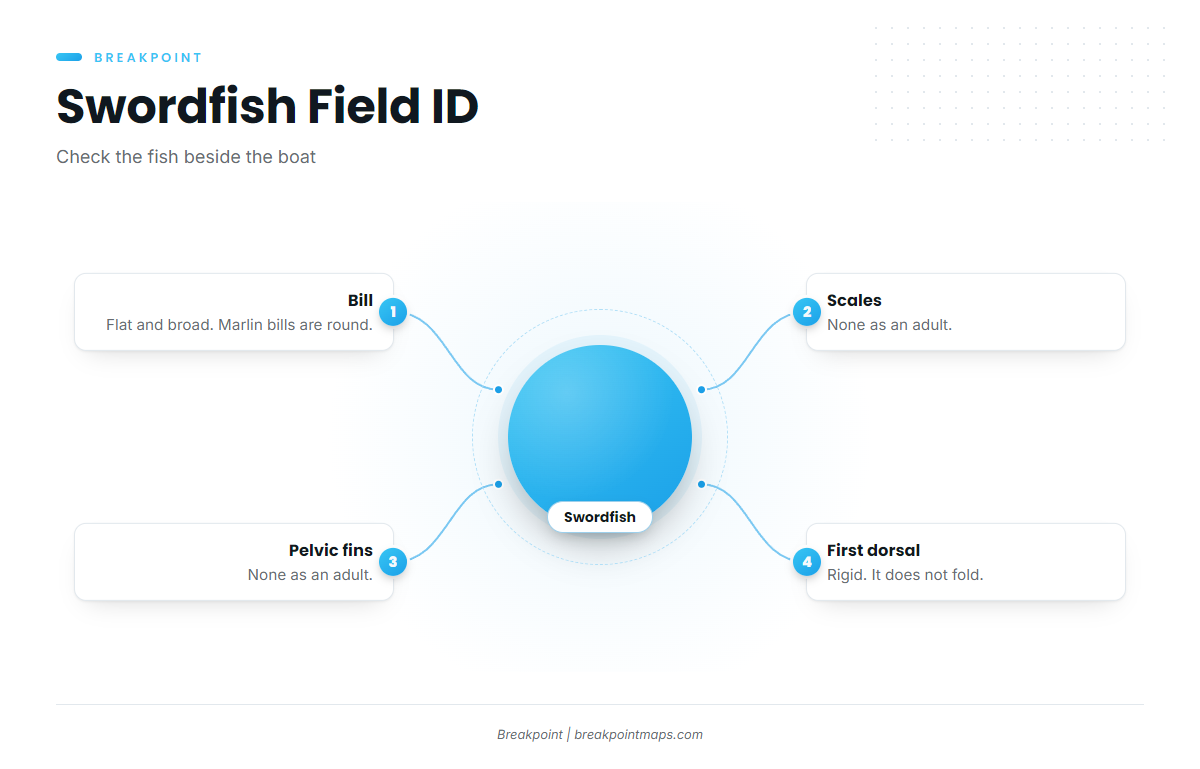
Swordfish is alone in Xiphiidae, so it lacks the marlin features.
- The bill is flat and broad. Marlin bills are round.
- Adults have no scales or pelvic fins.
- The first dorsal is rigid and does not fold.
Swordfish spend the day below the thermocline and rise at night, while marlin stay in the warm surface layer. That changes where your bait goes, and our swordfish fishing guide covers both methods.
Blue, white or striped marlin
Sort by ocean first. Striped marlin live in the Indo-Pacific and white marlin in the Atlantic. For blue against white, use these cues, which line up with The Billfish Foundation’s species ID:
- Blue marlin dorsal is pointed. White marlin dorsal is rounded.
- On blue marlin, the second dorsal fin origin sits behind the second anal fin origin.
- On blue marlin, the first dorsal lobe is lower than body depth.
The striped marlin guide carries the fin detail for the Pacific fish.
Spearfish are told apart from white marlin by the size of the anal fin and its distance from the vent, per Maryland DNR billfish identification. Longbill spearfish is a prohibited species.
How billfish fishing works
The methods below follow depth behavior. Marlin and sailfish ride the warm surface layer, so you bring them up with a spread. Swordfish sit deep, so you take the bait to them.
Trolling, teasers and dredges
Teasers set short in the wake raise fish. A dredge shows a bait-ball profile under the surface. Prospecting means free-spooling a hook bait over the dredge so it sinks as the boat moves away.
Bait-and-switch
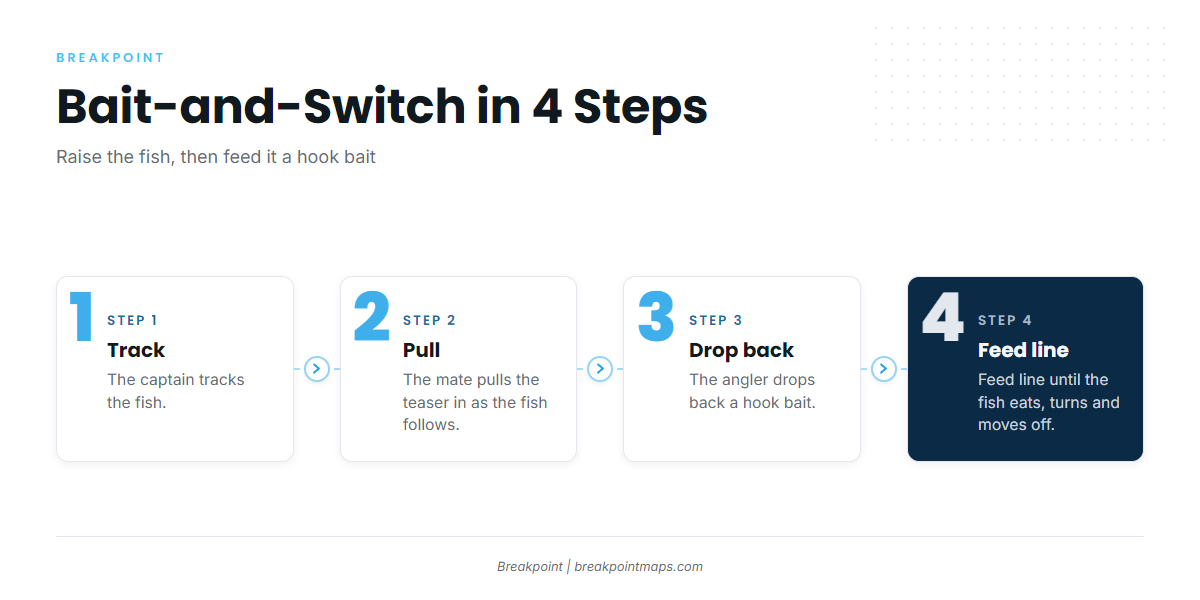
Once a fish follows a teaser, the sequence runs like this:
- The captain tracks the fish.
- The mate pulls the teaser in as the fish follows.
- The angler drops back a hook bait.
- The angler feeds line until the fish eats, turns and moves off.
Live bait
Sailfish respond to blue runners, pinfish, mullet, scads, ballyhoo and squid, per FWC. Striped marlin are fished with live bait and small lures. The striped marlin guide covers the Pacific details.
Circle hooks
Non-offset circle hooks set in the corner of the jaw and reduce deep hooking. In billfish tournaments, natural bait requires non-offset circle hooks.
Swordfish: daytime deep-drop and night drift
Swordfish feed below the thermocline by day, so the bait goes deep. At night they rise, so the bait is drifted shallower under a light.
In Southern California, deep-drop is preferred at 200 to 365 m (656 to 1,198 feet) near seamounts, ridges and submarine canyons. Gear is jumbo squid with battery or chemical lights near the hook. The CDFW deep-drop swordfish study lays out the method.
In the Atlantic, tagged fish in the western North Atlantic and Caribbean spent 83% of daytime below 500 m (1,640 feet), according to swordfish tagging depth research.
Finding the water
OBS SST, Chlorophyll and Chart Contours in Breakpoint help you read temperature breaks, color edges and the shelf break before the run. SST shows the surface, not the thermocline where swordfish spend the day. Chart layers are not for navigation.
Handling and release
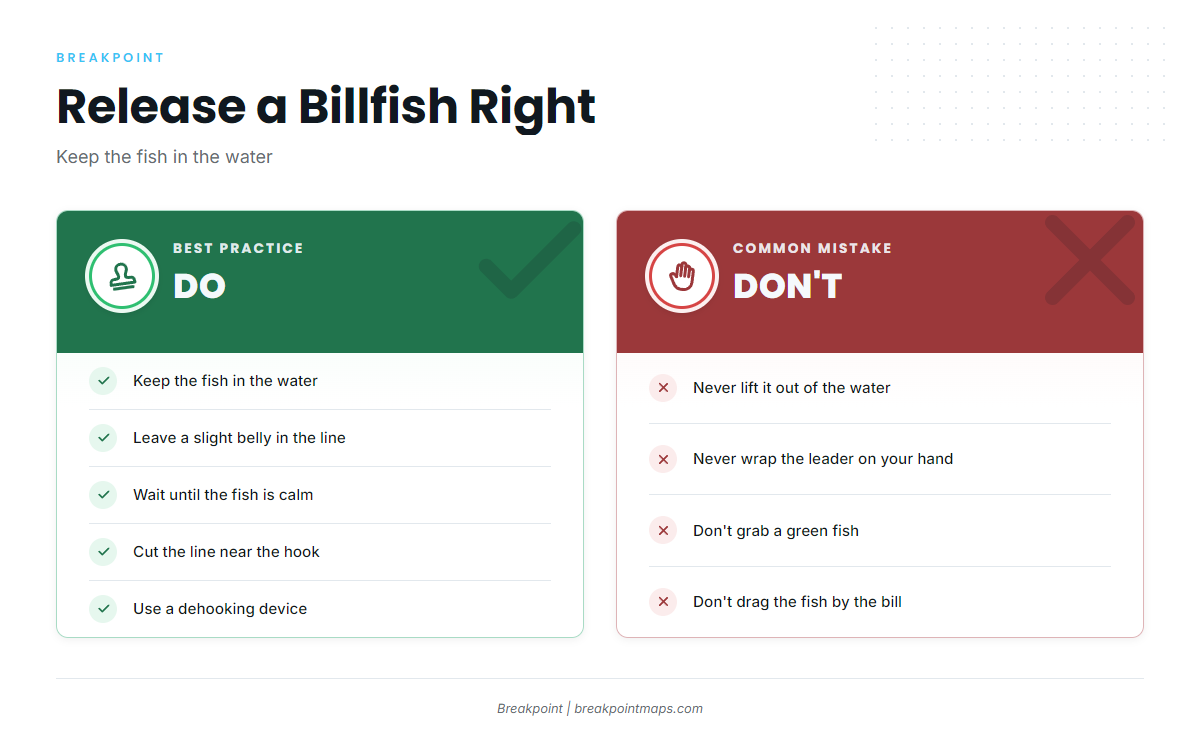
Released-fish survival depends on handling. Keep the fish in the water.
- Leave a slight belly in the line near the boat so the mate can reach the leader.
- Never wrap the leader around a hand.
- Do not grab the fish until it is calm.
- Do not remove the fish from the water.
- Cut the line near the hook or use a dehooking device.
NOAA requires that a billfish not kept be released without being removed from the water. The federal billfish release requirements carry the full text.
An HMS Angling or Charter/Headboat permit is required for vessels fishing recreationally for billfish and swordfish in federal waters. Marlin minimum sizes can be raised in season against a 250-fish annual landings limit. Swordfish retention varies by permit type. Check the NOAA Atlantic HMS compliance guides before fishing.
Longbill spearfish is prohibited. In the Pacific and in foreign waters, check the local fisheries agency.
Billfish by region
Each region below lists the species that work its water and one local detail to plan around.
Atlantic and Gulf
Blue marlin, white marlin, sailfish and swordfish all work these waters. Blue marlin occur near deep water off the Mississippi River. Sailfish sport landings off North Carolina run May through October.
Caribbean and Central America
Sailfish and blue marlin lead here. Blue marlin move seasonally between the Caribbean, Venezuela and the Bahamas.
Eastern Pacific and Baja
Striped marlin, blue marlin and sailfish are the targets. Juvenile striped marlin are abundant around the tip of Baja, per NOAA. Swordfish are deep-dropped off Southern California near seamounts.
Hawaii and the central Pacific
Blue marlin, striped marlin and swordfish are the fish. Tagged striped marlin around Hawaii held a median 44 m (144 feet) by day and 2 m (7 feet) by night.
Indo-Pacific and Australia
Striped marlin, blue marlin, sailfish and swordfish all occur. Striped marlin are most often seen near islands, seamounts and boundary currents.
Billfish and swordfish guides
These are Breakpoint’s billfish and swordfish fishing guides, grouped by fish.
Marlin
- Blue marlin fishing guideThe largest billfish: warm blue water, the mixed layer above the thermocline, heavy trolling tackle.
- White marlin fishing guideThe Atlantic’s smaller marlin: canyon edges, teasers and dredges, bait-and-switch.
- Striped marlin fishing guideThe Indo-Pacific marlin: seamounts, islands, boundary currents, live bait and small lures.
Sailfish and swordfish
- Sailfish fishing guideFish in 120 to 300 feet off the Atlantic Southeast, with kites, live bait and ballyhoo.
- Swordfish fishing guideDaytime deep-drop and night drift for broadbill.
All species
- Saltwater fish species guides – The full species library beyond billfish.
Open the guide for your water. It can’t promise fish, but it will help you decide where to look. To work with the data behind these guides, download Breakpoint from the App Store or Google Play.
Frequently Asked Questions
How do you tell a marlin from a sailfish?
Look at the dorsal fin. A sailfish carries a sail that rises taller than the body is deep. A marlin dorsal is lower than body depth, and it shrinks relative to the body as the fish gets bigger.
How do you tell a swordfish from a marlin?
A swordfish has a flat, broad bill, no scales or pelvic fins as an adult, and a rigid dorsal that does not fold. Marlin have round bills. Swordfish also hold below the thermocline by day, which marlin do not.
Do you have to release billfish?
A billfish not kept must be released without being removed from the water. Marlin minimum sizes can change in season against a 250-fish annual landings limit, and swordfish retention varies by permit. Check NOAA Atlantic HMS before fishing.