




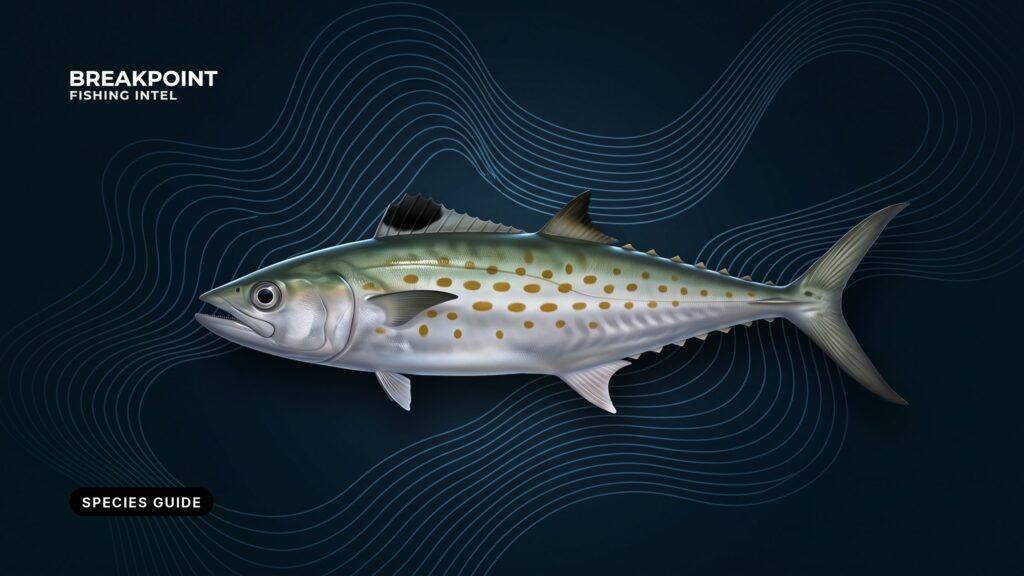
Spanish mackerel (Scomberomorus maculatus) is a fast, schooling member of the mackerel family. It ranges from the Gulf around Florida and up the Atlantic coast, following water above 68°F.
This guide covers the species in US waters: how to tell a Spanish from a king mackerel and a cero, where and when the fish show up by region, how they feed, how to catch them from a pier or a boat, and how state and federal rules divide.
How to Identify Spanish Mackerel
Three marks identify a Spanish mackerel: gold spots, no stripe, and a black patch on the front of the first dorsal fin.
The back is greenish to bluish. The sides and belly are silver, and the sides carry oval yellow to brassy spots. Each jaw has a single row of sharp, cutting teeth, which is why leaders matter later in this guide.
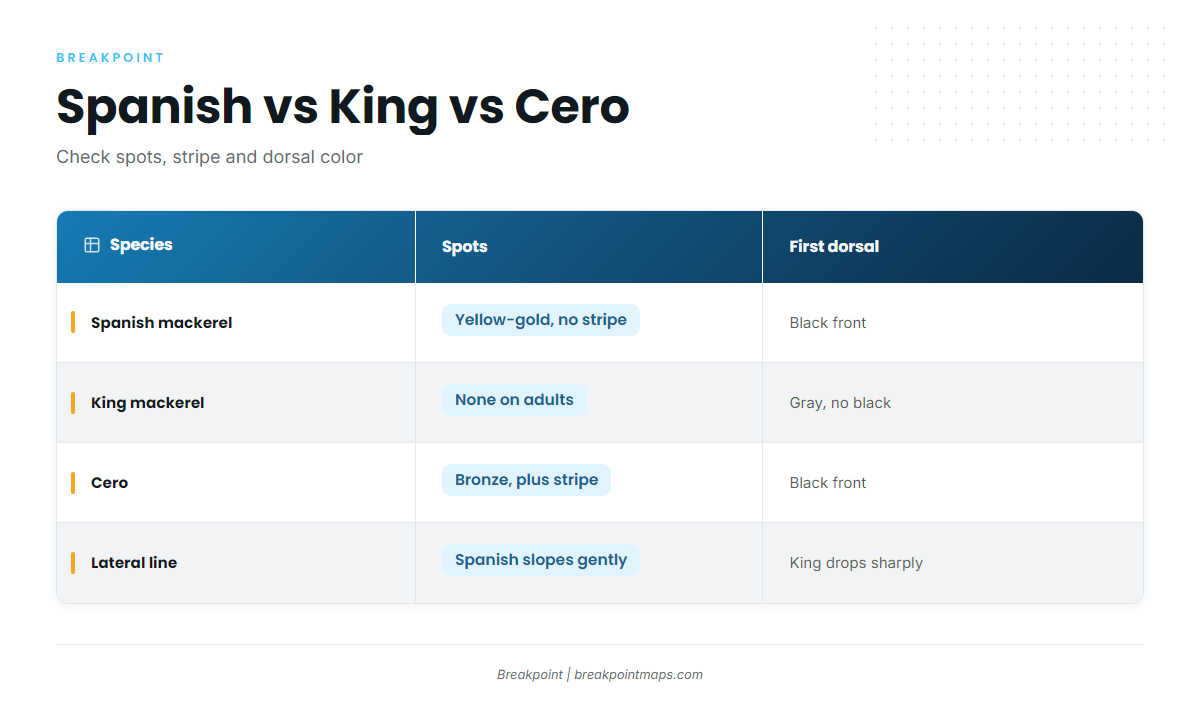
Spanish vs king mackerel: A Spanish mackerel has yellow-gold spots and a black front on the first dorsal fin. An adult king mackerel has no spots and a plain gray first dorsal. The king’s lateral line drops sharply below the second dorsal fin, while the Spanish line slopes gently. Kings grow much larger.
| Species | Spots | Stripe | Front of first dorsal | Lateral line |
|---|---|---|---|---|
| Spanish mackerel | Oval yellow-gold spots, no stripe | None | Black | Slopes gently toward the tail |
| King mackerel | None on adults (juveniles can show spots) | None | Gray, no black patch | Drops sharply below the second dorsal |
| Cero | Yellow-bronze spots | Yellow-bronze stripe along the side | Black | Slopes gently |
Swipe the table sideways to see every column.
Juvenile kings can carry spots, so check the dorsal color and the lateral line before keeping a small fish.
Cero is mostly a Florida and Keys fish, and the stripe is the quick giveaway. For full profiles of king mackerel, cero and the other pelagics found in the same water, see our coastal and offshore gamefish guides.
Spanish mackerel average 2 to 3 lb, according to SAFMC. They reach up to 13 lb (NOAA) and up to 36 in (FWC).
Where and When Spanish Mackerel Run
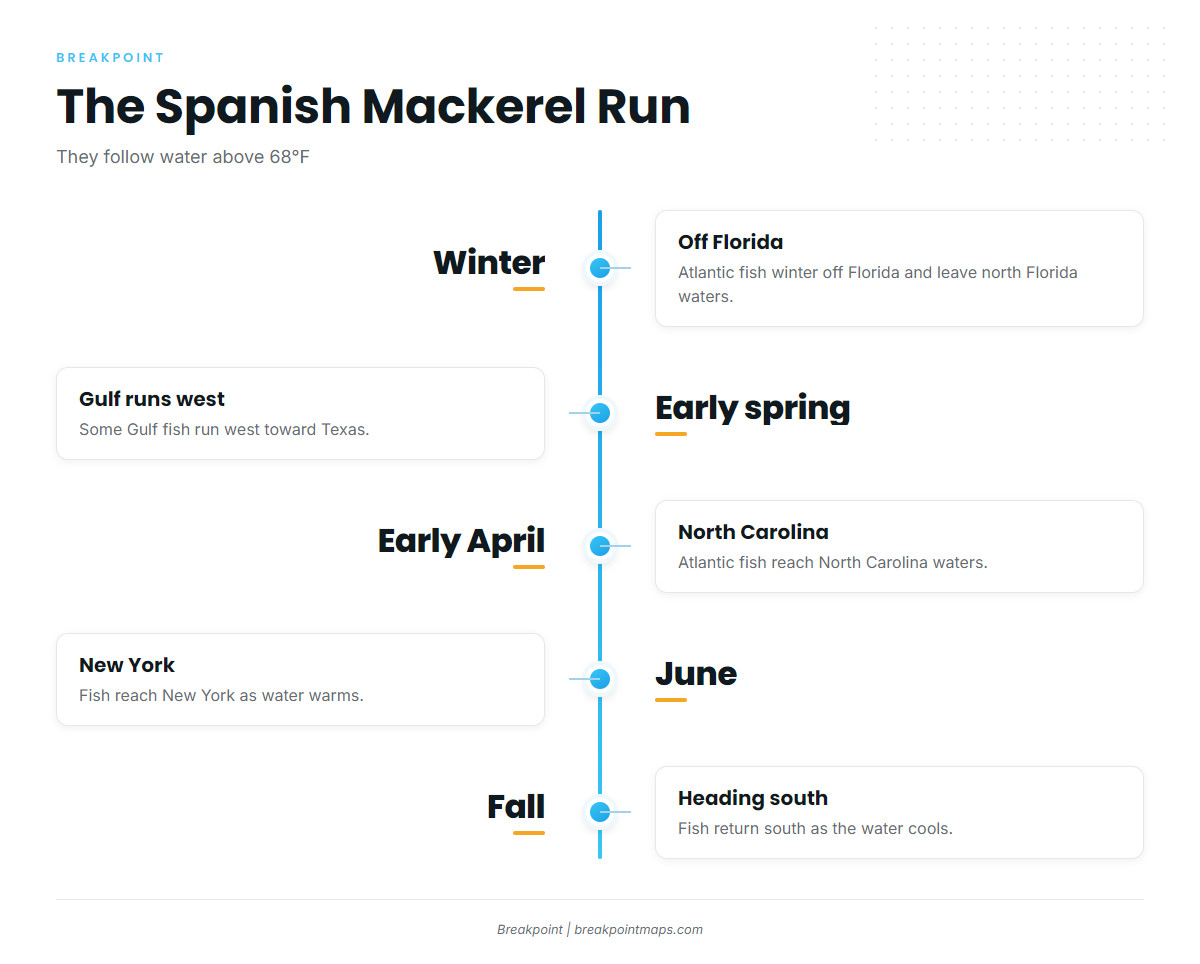
Spanish mackerel follow temperature rather than the calendar. They prefer water above 68°F, according to NOAA and SAFMC, and they move with that line.
The range runs from the Gulf and Florida up the Atlantic coast, with fish recorded north to Cape Cod in summer. They spawn from April to September: off North Carolina and Virginia on the Atlantic side, and in shallow coastal waters of the eastern Gulf.
The timing below is typical. A cold spring or late fall shifts it, so watch the water.
Gulf of Mexico
NOAA describes the Gulf pattern this way: fish move west of Cape San Blas, Florida, stay in the northern Gulf until September, then head south in fall. Some fish run west to Texas in early spring.
Schools hold off beaches, in shipping channels and passes, along barrier islands and offshore. The GCOOS Spanish mackerel profile lists the same structure types.
Pass-by-pass detail is in our guide to Spanish mackerel fishing in the Gulf of Mexico.
Atlantic Southeast: Florida to North Carolina
Atlantic fish winter off Florida and are absent from north Florida waters in winter, according to FWC. The rest of the year they are found inshore, nearshore and offshore, often over grass beds and reefs.
Atlantic fish form a separate subpopulation from Gulf fish. Unlike king mackerel, they do not appear to move freely around the Keys, according to SAFMC. That split is why the rules later divide into Atlantic and Gulf groups.
See Spanish mackerel fishing from Florida to North Carolina for inlet and pier-level detail.
Mid-Atlantic and Northeast
Fish reach North Carolina in early April and New York in June, then return south as the water cools. Some spawn as far north as New York and Massachusetts, according to the ASMFC Spanish mackerel profile.
In the Chesapeake Bay, structure such as the Chesapeake Bay Bridge-Tunnel draws bait and the mackerel that follow it.
For place-level guides along this stretch, browse our fishing guides by region.
How Spanish Mackerel Feed and Move
Spanish mackerel travel in large, fast-moving schools, and where the bait is, the mackerel are close behind. Feeding fish herd small baitfish into tight balls near the surface. Their forage is mostly herring, menhaden, sardines, mullet, needlefish and anchovies, with fewer shrimp, crabs and squid. In Florida, anglers also see them feeding on glass minnows.
Four cues point to feeding fish:
- Terns and pelicans diving on bait. FWC notes anglers find schools by watching for birds diving on baitfish.
- Bait showering on the surface.
- Passes, shipping channels and barrier islands that funnel bait.
- Grass beds and reefs, where schools often hold.
Dawn and dusk produce the most surface feeding.
Mackerel follow bait, birds and warm edges above 68°F. In Breakpoint, OBS SST shows where surface water crosses that line, Chlorophyll shows where bait-holding water sits, and Chart Contours show the passes, channels and reefs that bunch bait. None of that guarantees fish, but it improves your choice of where to look. SST is a surface reading, and cloud blocks a satellite pass. Chart layers are not for navigation.
How to Catch Spanish Mackerel
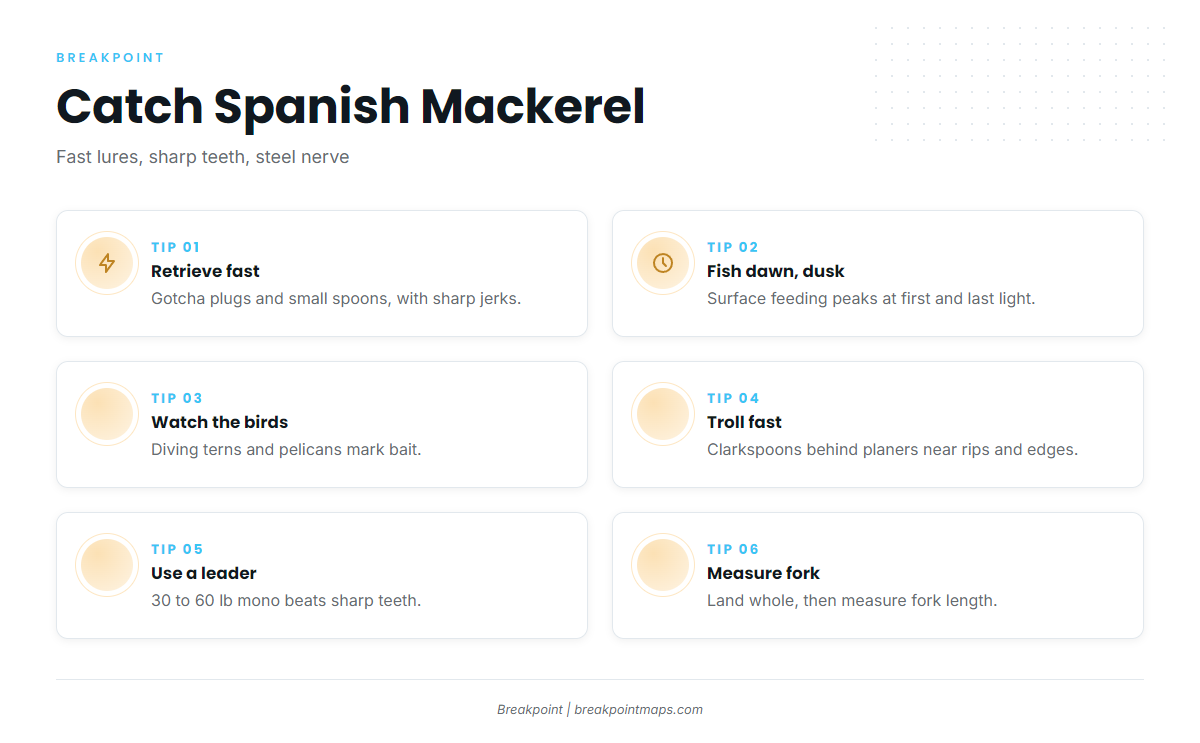
Spanish chase fast-moving bait, so retrieve and trolling speed matter more than almost anything else.
From the Pier and Surf
- Gotcha plugs and small shiny spoons: Cast them into bait or current and retrieve as fast as you can, with sharp jerks.
- Treble tip: Many pier anglers remove the rear treble when Spanish are around, because Spanish hit the head of a bait.
- Timing: Fish dawn and dusk. On a high pier, watch for fish flashing under the surface before they break.
Trolling
Pull small Clarkspoons behind planers or trolling sinkers, and troll faster than you would for most species. Work bird activity, bait schools, rips off passes, and reef or grass edges.
Live and Natural Bait
Spanish mackerel strike a wide variety of natural and artificial baits, according to FWC. Small live baitfish such as menhaden and finger mullet work, as do dusters and jigs. In Florida, glass minnows work as chum.
Leaders and Tackle
FWC’s tackle recommendations:
- Light spinning or bait-casting tackle.
- 10 to 15 lb monofilament line.
- 30 to 60 lb monofilament leader.
Sharp teeth cut light line, which is why FWC calls the leader required. Wire is an option where kings or bluefish mix in.
Handling Your Catch
Land each fish whole, with head and fins intact. In Florida, gutting and removing gills are allowed. Measure fork length right away and release shorts quickly.
Do not hand fish to another boat; Georgia bars that transfer on the water. See Regulations below.
Frequently Asked Questions
How do I tell a Spanish mackerel from a king mackerel?
Check three things. A Spanish has yellow-gold spots and a black front on the first dorsal fin. An adult king has no spots and a plain gray first dorsal. The king’s lateral line drops sharply below the second dorsal fin, while the Spanish line slopes gently.
How do I measure fork length?
Lay the fish flat and measure from the tip of the snout to the fork of the tail. The 12 in minimum applies in all four jurisdictions in the table: Florida state waters, Georgia state waters, federal Atlantic and federal Gulf.
Whose rules apply offshore?
Atlantic state waters run to 3 nm and Florida’s Gulf state waters to 9 nm. Beyond that, SAFMC or the Gulf Council sets the rules, carried out by NOAA Fisheries. Federal waters off Monroe County fall under the Gulf group.
Do I need a federal permit?
Private anglers need none. For-hire vessels need the federal coastal migratory pelagic charter/headboat permit. A state license may still apply, so check the state agency.
Why use a heavy leader?
Spanish mackerel have sharp teeth that cut light line. FWC lists a 30 to 60 lb monofilament leader as required.
When do Spanish mackerel arrive in the Carolinas and Chesapeake?
NOAA puts the fish in North Carolina in early April and New York in June, then south again as the water cools. Arrival follows water above 68°F, so the Chesapeake falls between those marks. Watch the water temperature rather than a date.
What is the best lure from a pier?
A Gotcha plug or small shiny spoon, retrieved fast, at dawn or dusk, near bait and birds.
How big do Spanish mackerel get?
They average 2 to 3 lb and reach up to 13 lb (NOAA) and 36 in (FWC).
Do they have to be landed whole?
Yes in Florida, where gutting and removing gills are allowed, and in Georgia, where heads and fins stay intact. Check other states with their agency.
To see where the 68°F line, bait-holding water and bottom structure line up before your next trip, download Breakpoint from the App Store or Google Play.