




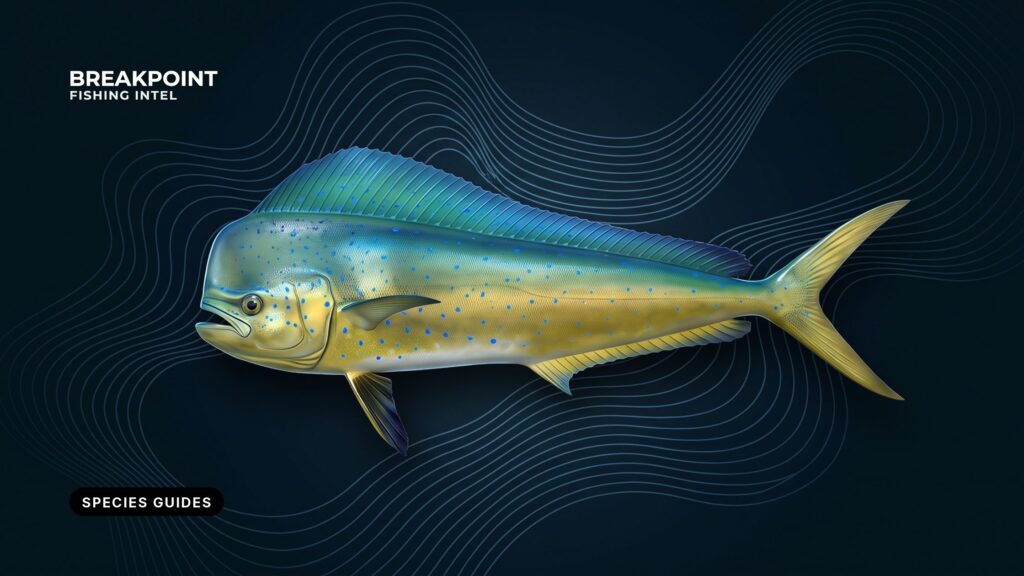
Anglers sort saltwater species by where they live, and that decides how far you run, how deep you fish and what gear goes on the boat. Pelagics follow temperature, current and bait. Reef fish hold on structure. Bottom fish sit in deep water that asks the most of your tackle. The groups below cover what each fishery demands and which guide to read next.
How Anglers Group Saltwater Species
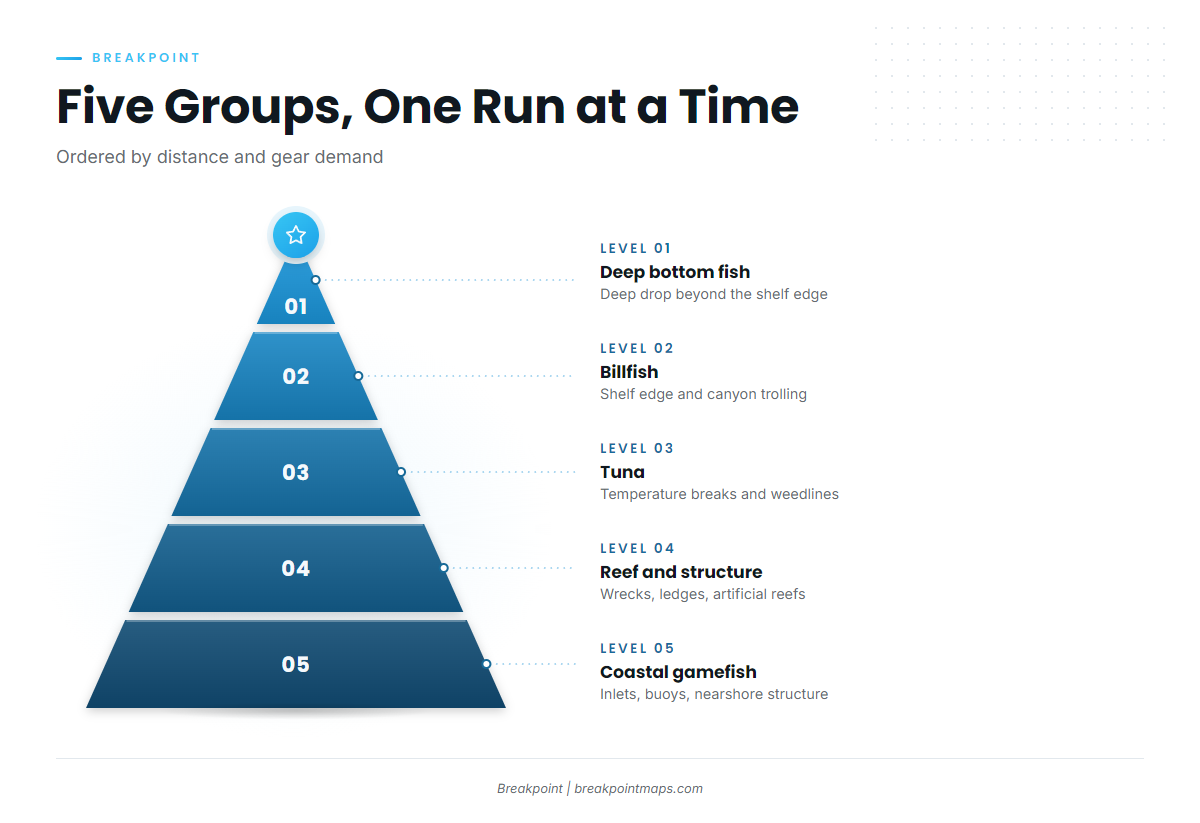
Anglers sort species by four things, in this order: distance from shore, bottom versus open water, depth, and technique. That gives four habitats: open-water pelagics, reef and structure fish, deep bottom fish, and coastal gamefish. The pelagics split into two guide groups, tuna and billfish, so the five groups below cover the four habitats.
Tuna
Yellowfin, bluefin and blackfin tuna are pelagic, meaning they live in open water, off the bottom. They roam the outer shelf, the shelf edge and the canyons, following bait along temperature breaks (an edge where surface water temperature changes over a short distance) and current edges such as the Gulf Stream. Trolling and jigging are the main methods. Mahi (dolphin) and wahoo work the same edges and weedlines, which are lines of floating sargassum weed that collect bait.
On the chart, look for a temperature break or weedline crossing the shelf edge, and for chlorophyll edges where clear blue water meets greener water.
Tuna fishing guides – yellowfin, bluefin and blackfin tuna, with the edges, canyons and trolling and jigging methods that find them.
Billfish
Sailfish, blue and white marlin, and swordfish are the billfish. Sailfish are found in roughly 120 to 300 feet of water, in water of 70 to 83°F, and they are taken by trolling ballyhoo or mullet. In summer, marlin and swordfish live in deep offshore water, as laid out in New Jersey’s saltwater fishing guide. That water sits along the shelf edge, where the continental shelf drops into deep water, and around canyons, deep cuts into the shelf edge such as Hudson Canyon. Swordfish are fished deeper, and they also show up in the deep-bottom group below.
On the chart, look for the shelf edge and canyon walls where warm water pushes over steep bottom.
Billfish fishing guides – sailfish, marlin and swordfish, from trolled baits on warm edges to deep swordfish work.
Reef and structure fish
Red snapper, gag grouper and amberjack live on the bottom over structure: any hard bottom or object that holds fish, such as reefs, wrecks, ledges and artificial reefs. They are found from nearshore water out across the shelf. Bottom fishing and jigging are the tools here; trolling doesn’t suit them. Georgia maintains 31 offshore artificial reefs, and those beyond 3 miles are federal special management zones. Georgia’s offshore artificial reefs are listed with coordinates on the state’s page.
On the chart, look for contour lines that bunch or kink, which mark ledges and hard bottom, and for charted wrecks and artificial reef sites.
Reef fish fishing guides – red snapper, grouper and amberjack, with how to find and fish wrecks, ledges and artificial reefs.
Deep bottom fish
Tilefish and daytime swordfish are the main deep-drop targets. Deep drop is bottom fishing in deep water off the shelf edge, usually with electric reels and heavy weights. These fish live on or near the bottom beyond the shelf edge and along canyon slopes. Of all the groups, this one demands the most gear: electric reels, heavy weights and lights on the rig.
On the chart, look for the slope below the shelf edge, the canyon walls and the soft-bottom flats where the contours spread out again.
Bottom fish and deep-drop guides – tilefish, deep grouper and daytime swordfish, with the deep-drop rigs and contours that put baits on the bottom.
Coastal gamefish
Striped bass, redfish, cobia and king mackerel feed nearshore along beaches, inlets, buoys and nearshore structure, mostly inside state waters or just beyond them. Methods mix trolling, casting, live bait and light bottom work. This group has the shortest run and the lightest tackle.
On the chart, look for inlets, shoals, nearshore hard bottom and the first contour drop off the beach.
Coastal and offshore gamefish guides – striped bass, redfish, cobia and king mackerel, from the beach out to nearshore structure.
Choosing a Starting Point
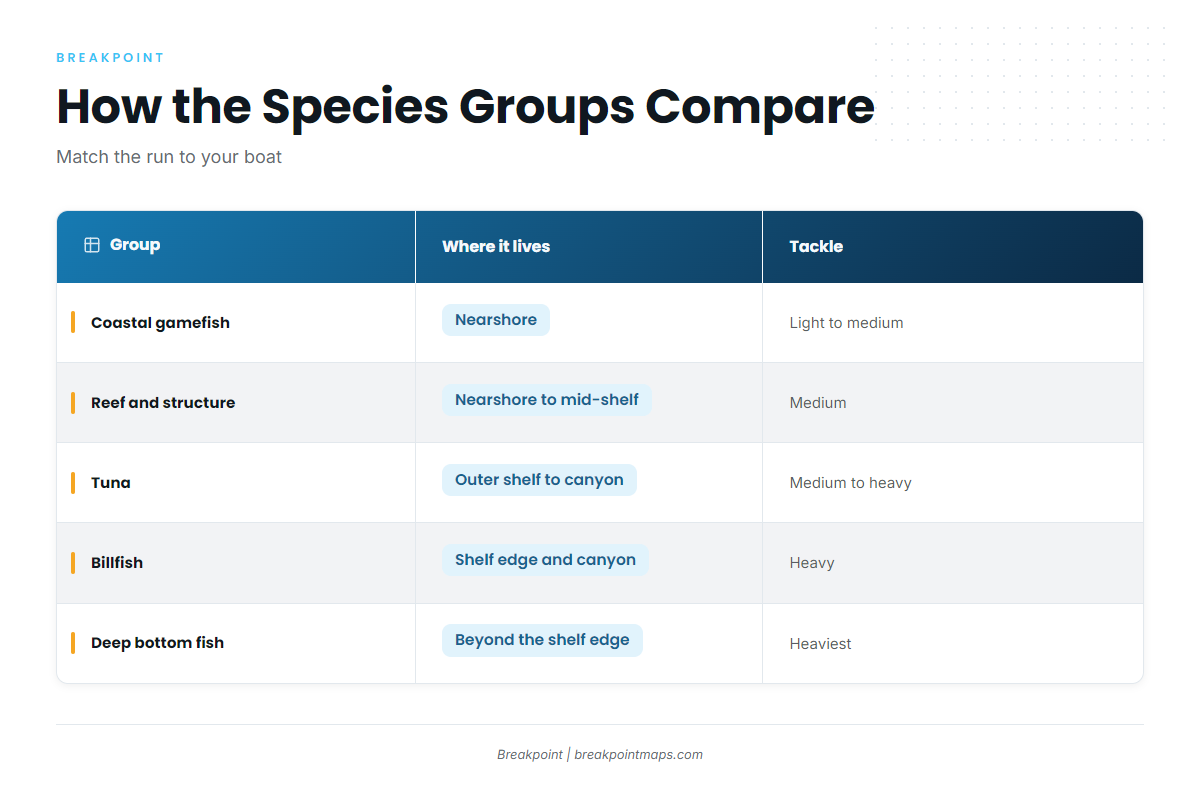
How the saltwater species groups compare:
| Group | Where it lives | Bottom or open water | Main methods | Tackle demand | Typical entry level |
|---|---|---|---|---|---|
| Coastal gamefish | Nearshore | Both, mostly mid-water | Trolling, casting, live bait | Light to medium | First trip |
| Reef and structure fish | Nearshore to mid-shelf | Bottom | Bottom fishing, jigging | Medium | First trip to intermediate |
| Tuna | Outer shelf to shelf edge and canyon | Open water | Trolling, jigging | Medium to heavy | Intermediate to advanced |
| Billfish | Shelf edge and canyon | Open water | Trolling, deep drop (swordfish) | Heavy | Advanced |
| Deep bottom fish | Beyond shelf edge, canyon slopes | Bottom | Deep drop | Heaviest | Advanced |
Swipe the table sideways to see every column.
Fuel and range decide the group before skill does, since the farther the habitat, the more fuel the trip needs. Start where the run fits your boat’s range with a reserve, and read the NWS marine forecast for wind, wave height and period before you commit.
Coastal gamefish and nearshore reef fish build the skills you use offshore: boat position, reading contours and fighting fish on the bottom. Move to the shelf edge when the boat and the crew are ready for the run.
Routing by Experience
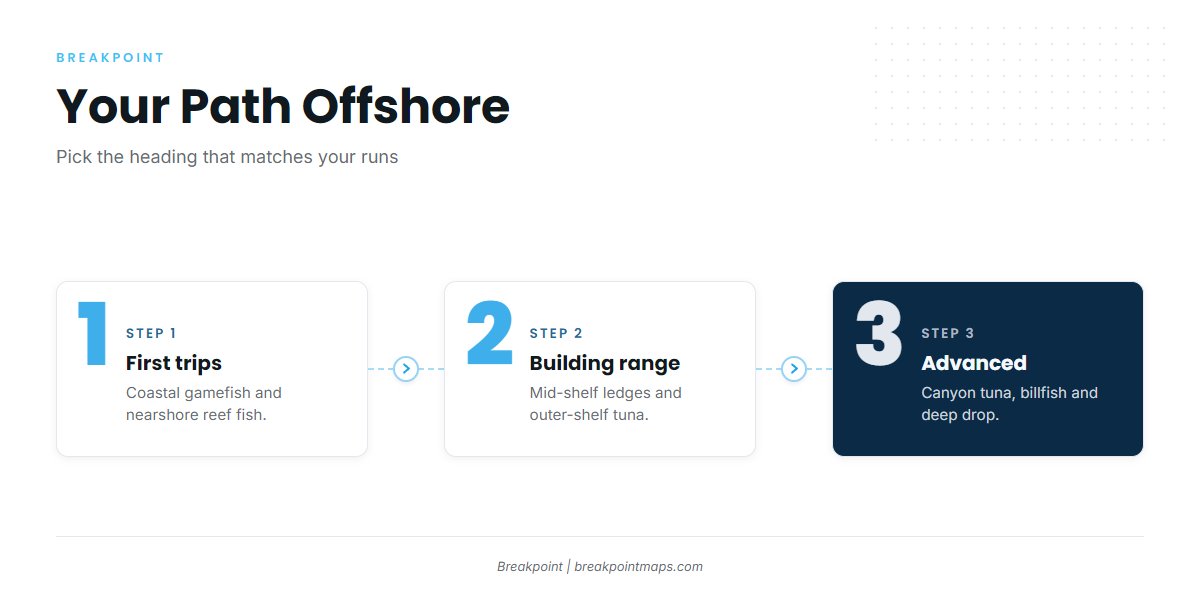
Pick the heading that matches the runs you already make.
First offshore trips
Short runs, close structure, lighter tackle.
- Coastal and offshore gamefish guidescobia and king mackerel on nearshore buoys, reefs and bait schools.
- Reef fish fishing guidesnearshore wrecks and artificial reefs within a short run.
Building range
Longer runs, deeper bottom, first work on the outer edge.
- Reef fish fishing guidesmid-shelf ledges and deeper reefs for snapper, grouper and amberjack.
- Tuna fishing guidesfirst trips to the outer shelf, where mahi and wahoo work the same weedlines.
Advanced offshore
The shelf edge, the canyons and the slope below.
- Tuna fishing guidescanyon and shelf-edge tuna on the temperature break.
- Billfish fishing guidesmarlin, sailfish and swordfish on the edge.
- Bottom fish and deep-drop guidestilefish and daytime swordfish below the shelf edge.
Routing by Region
Each region has a defining place or feature. Match yours to the guides below.
Northeast
Striped bass work the coast, and bluefin tuna work the offshore grounds.
- Coastal and offshore gamefish guidesstriped bass from the beaches, rips and reefs.
- Tuna fishing guidesbluefin on the offshore grounds and canyon edges.
Mid-Atlantic
The canyons define this coast, Hudson Canyon among them.
- Tuna fishing guidescanyon yellowfin and bluefin.
- Bottom fish and deep-drop guidestilefish on the canyon slopes.
Southeast and Florida
The Gulf Stream runs close, Georgia’s offshore artificial reefs hold the bottom fish, and Gray’s Reef sits about 19 miles off Sapelo Island. Gray’s Reef gear rules allow only rod and reel and handline.
- Reef fish fishing guidesledges, live bottom and artificial reefs.
- Billfish fishing guidessailfish and marlin along the Gulf Stream edge.
- Bottom fish and deep-drop guidesdeep drop beyond the shelf edge.
Gulf of Mexico
Reef and rig structure hold the bottom fish, and blue water sits offshore.
- Reef fish fishing guidesred snapper and grouper on reefs and wrecks.
- Tuna fishing guidesyellowfin and blackfin in blue water.
- Coastal and offshore gamefish guidesredfish, cobia and king mackerel nearshore.
Pacific coast
Pacific species follow the same habitat logic. Albacore are open-water pelagics, rockfish hold on bottom structure, and yellowtail work nearshore structure and bait. The methods in these guides carry over.
- Tuna fishing guidesthe edge-reading methods that apply to albacore.
- Reef fish fishing guidesstructure-fishing methods that carry over to rockfish.
Read the Water Before You Run
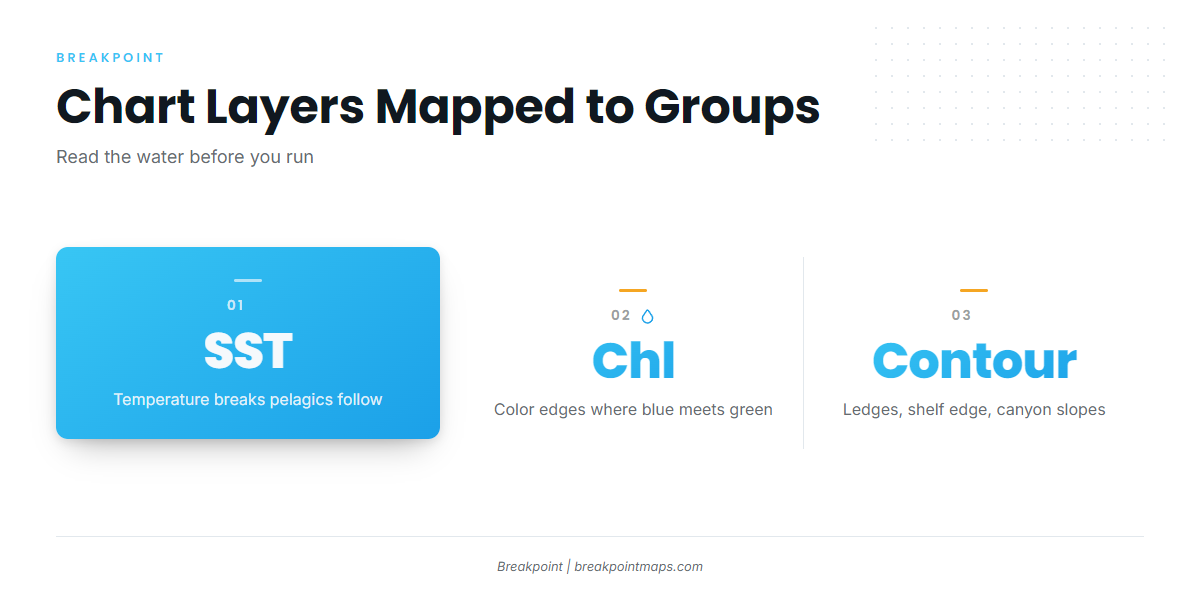
The groups above come down to what the water is doing. In Breakpoint, OBS SST and Chlorophyll show the temperature breaks and color edges that pelagics follow. Chart Contours show the ledges, the shelf edge and the canyon slopes that reef and deep-drop fishing depend on. Download Breakpoint from the App Store or Google Play and read both before you pick a heading.
Chart layers are not for navigation. Pick the guide that fits your run and start there.