




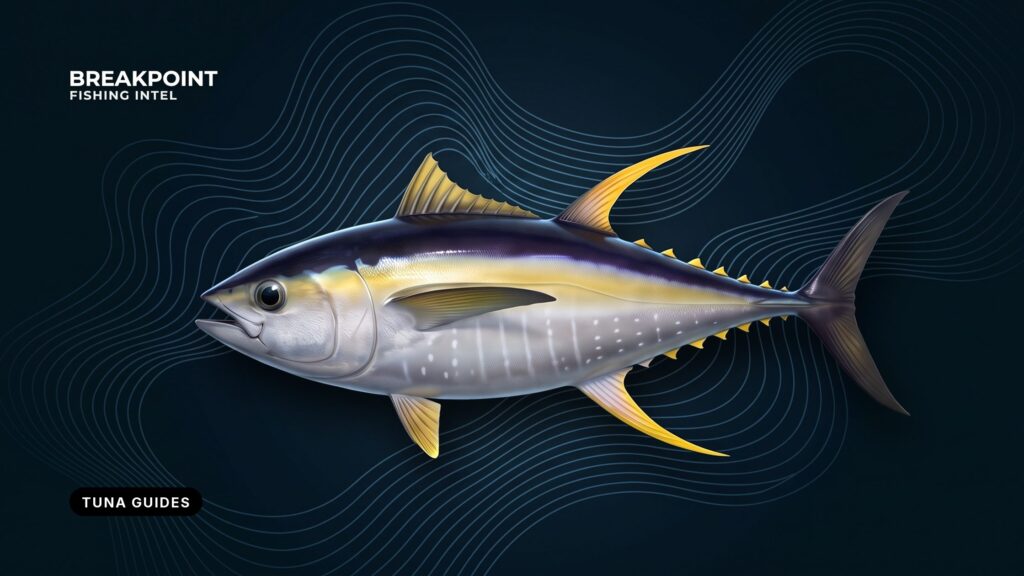
Blackfin and yellowfin are the usual first tuna. Bigeye and giant Atlantic bluefin are the hardest of the six to target on purpose. Blackfin live in Florida and the Gulf, and yellowfin range across both coasts and the Gulf. Atlantic bluefin and bigeye hold in the Northeast and Mid-Atlantic canyons. Pacific bluefin run from Southern California and Baja north, and albacore work the Pacific Northwest and California. The guides below go deep on each fish; use this page to pick which one to read.
Six tunas side by side
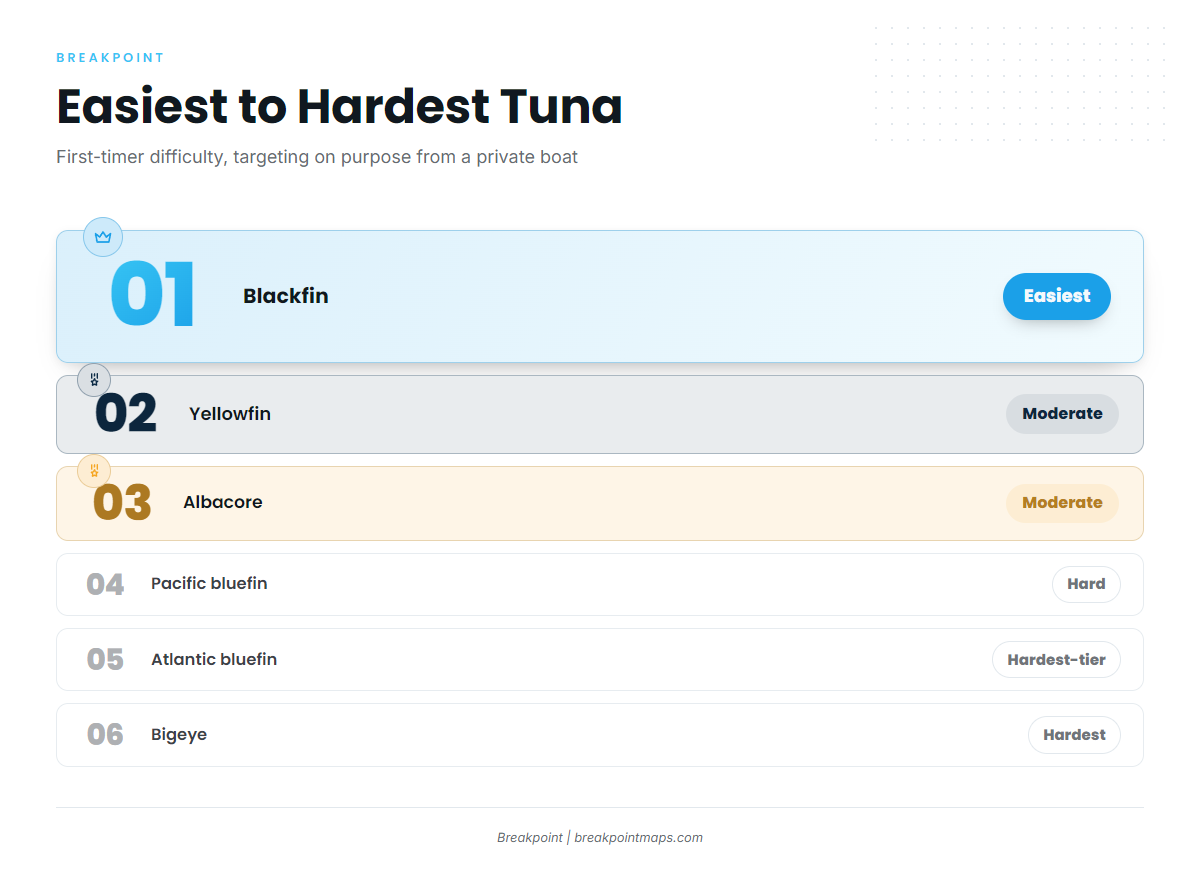
Each fish holds in different water, and that water decides how you fish it.
| Species | Region | Typical water | How it’s fished | First-timer difficulty |
|---|---|---|---|---|
| blackfin | Florida, the Carolinas, Gulf of Mexico | Warm water over reefs, wrecks and rigs | Chumming and small live baits, trolled lures, jigging, kite fishing in Florida | Easiest. Close to home across its range and takes many presentations. |
| yellowfin | Gulf, Gulf Stream, Mid-Atlantic canyons, Southern California | 59-88°F, mostly above 330 feet (Sea Grant). Oil rigs, floating debris, temperature and color edges. | Chunking, trolling spreader bars, kite fishing at rigs, popping | Moderate. Fishes the upper water column, but the run is offshore. |
| albacore | Pacific Northwest, California | Abundant in 15.6-19.4°C surface water (FishBase). Near oceanic fronts (NOAA). | Trolling jigs and plugs, then live anchovy or cut bait to hold the school | Moderate. The run is long, but they school up once found. |
| Pacific bluefin | Southern California and Baja, north to Washington | Mostly 18-20°C (ADW). Down to 1,800 ft (Sea Grant). | Flylining live sardines, surface iron, kite fishing, trolling and casting jigs (NOAA) | Hard. Wary fish that run large and need refined presentations. |
| Atlantic bluefin | Northeast and Mid-Atlantic | Inshore lumps out to the canyons | Trolling spreader bars and daisy chains, slow-trolling live mackerel or herring, chunking | Hard to hardest. Giants demand heavy tackle, and permits and quota rules add a layer. |
| bigeye | Mid-Atlantic canyons, Hawaii | 55-84°F (NOAA). Dives to about 800 ft by day (NOAA). Canyon walls, seamounts, eddy corners. | Night chunking, deep presentations, dawn and dusk trolling | Hardest. They sit deep by day, so they are the hardest of the six to target on purpose. |
Swipe the table sideways to see every column.
Difficulty ratings describe targeting each fish on purpose from a private boat, not luck on the day.
If you don’t have an offshore-capable boat, a charter is a reasonable way to fish any of the six for the first time.
Telling the look-alikes apart
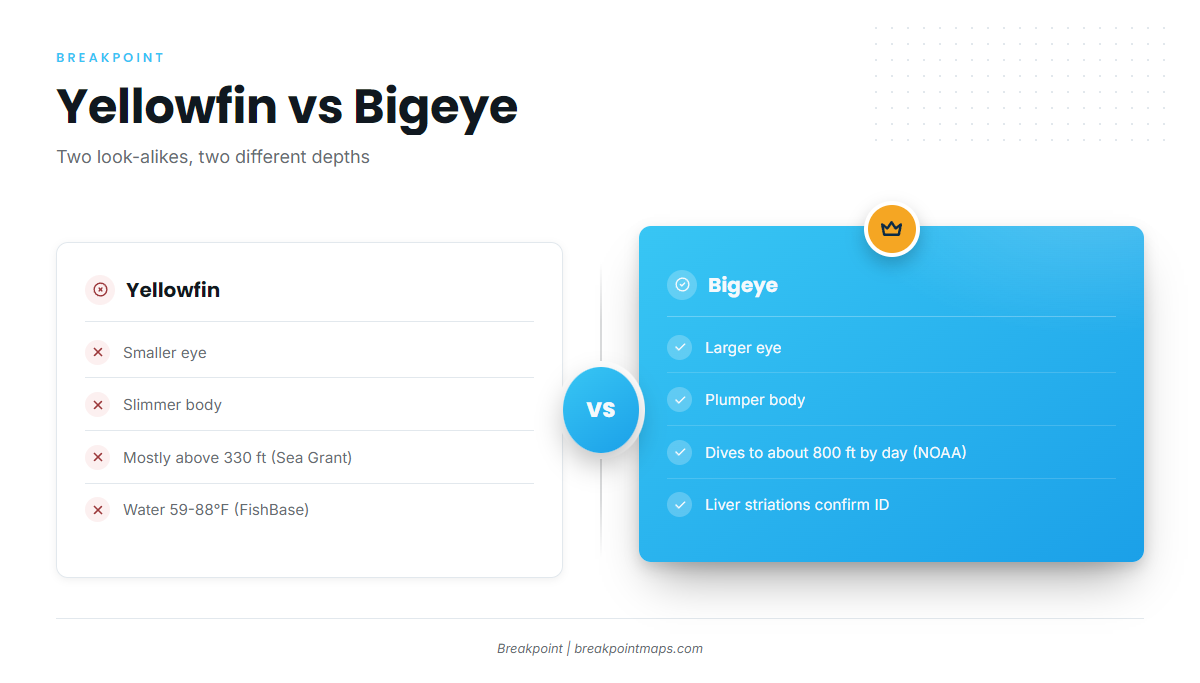
Correct ID decides what you can keep and what you must report. NOAA publishes a waterproof ID guide for the 5 regulated Atlantic tunas, covered in the rules note below.
Yellowfin vs bigeye
Check these in order:
- Eye size. Bigeye carry the larger eye.
- Body depth. Bigeye are plumper, which is what the scientific name obesus refers to.
- Pectoral fin length against the second dorsal fin. Compare them side by side.
- Liver striations. Bigeye show them, and they confirm the ID once the fish is cleaned.
The two fish also sit at different depths. Bigeye tolerate cooler water (55-84°F, NOAA) and dive to about 800 ft by day (NOAA), while yellowfin stay mostly above 330 ft (Sea Grant). Bigeye rise at night, which is why night chunking and deep presentations matter. SST shows only the surface, and bigeye feed below it by day.
Blackfin vs small yellowfin
- Finlet color. Blackfin finlets are dusky or dark. Yellowfin finlets are yellow.
- Side stripe. The bronze or gold on a blackfin is toned down.
- Overall color. Check the second dorsal and anal fin tone. Yellowfin run brighter yellow.
Albacore vs bigeye
An albacore has very long pectoral fins past the dorsal, extending beyond the second dorsal fin (ODFW). Small bigeye have long pectorals too, so check eye size and body depth alongside fin length.
Atlantic vs Pacific bluefin
These two are separated by ocean and by management rather than by field marks.
- Ocean. Atlantic bluefin live in the Atlantic. Pacific bluefin range from the Gulf of Alaska to Baja (FishBase).
- Management. Atlantic bluefin fall under NOAA HMS permits. Pacific bluefin fall under West Coast federal and state rules.
- Where you caught it. Your location tells you which species you hold.
Skipjack and little tunny turn up in tuna spreads and get mistaken for small tuna. Our guide to other species that turn up covers them.
Route by region
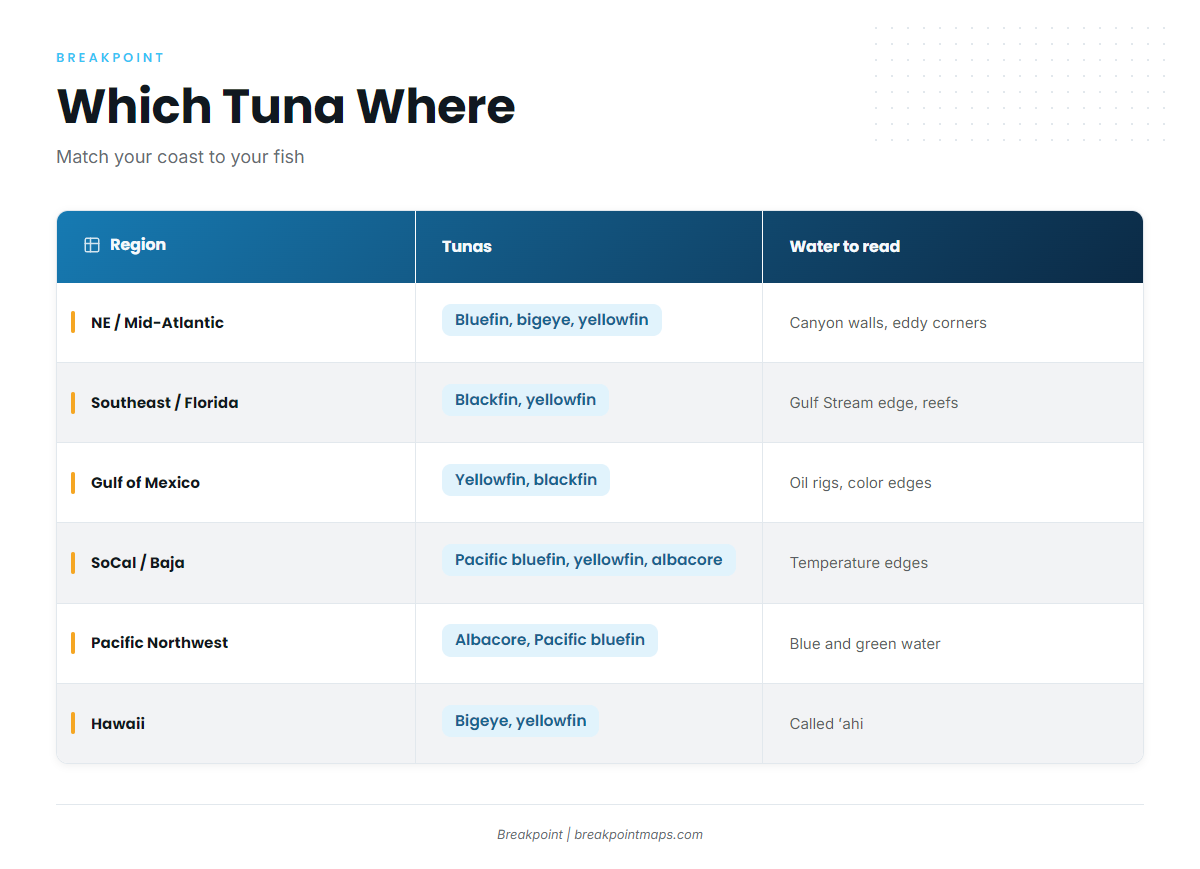
Start with blackfin if you fish Florida or the Gulf. Everywhere else, read the water first, then pick the fish.
Northeast and Mid-Atlantic canyons
Atlantic bluefin, bigeye and yellowfin share this water. Read the Hudson, Baltimore and Norfolk canyons, canyon walls, warm-eddy corners and the Gulf Stream edge. Troll spreader bars and chunk for bluefin, and chunk at night for bigeye. Start with the Atlantic bluefin guide, the bigeye guide and the yellowfin guide.
Southeast and Florida
Blackfin and yellowfin hold along the Gulf Stream edge and over reefs and wrecks. Kite fishing and chumming with live bait are the local methods. Blackfin are the natural first tuna here. Read the blackfin guide first, then the yellowfin guide.
Gulf of Mexico
Yellowfin and blackfin gather at oil rigs and along green-to-blue water edges where river outflow meets clear Gulf water. Chunk and kite fish at the rigs. The yellowfin guide and the blackfin guide cover both.
Southern California and Baja
Pacific bluefin, yellowfin and albacore share this coast. Pacific bluefin migrate north along Baja and California between June and September (FishBase). Flyline live sardines, throw surface iron and fish kites. See the Pacific bluefin guide, the yellowfin guide and the albacore guide.
Pacific Northwest
Most Pacific albacore landings come ashore in Washington and Oregon (NOAA). Out of Ilwaco and Westport, juvenile bluefin show up on albacore gear in blue water 40 or more miles out, and larger bluefin hold in outer green water off Washington 10 to 25 miles off the southwest coast (WDFW). Troll jigs and plugs, then switch to live anchovy to hold the school. Read the albacore guide and the Pacific bluefin guide.
Hawaii
Bigeye and yellowfin are both called ʻahi. Bigeye are fished there on hook-and-line and troll gear (NOAA). See the bigeye guide and the yellowfin guide.
Albacore and yellowfin stage on temperature and color edges, and canyon fish hold on walls. OBS SST, Chlorophyll and Chart Contours show those edges and walls in Breakpoint. Cloud cover blocks a satellite SST pass, and SST shows only the surface. Chart layers are not for navigation.
Rules before you fish
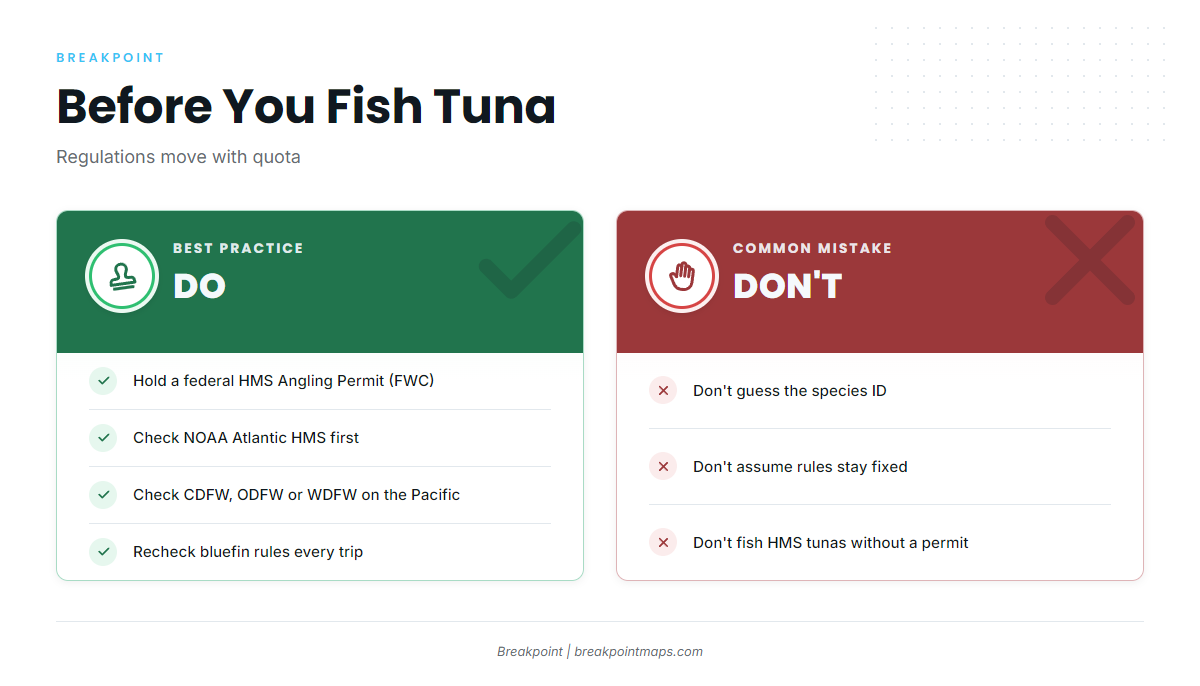
Atlantic tunas managed as HMS require a federal HMS Angling Permit in state and federal waters (FWC). The NOAA Atlantic HMS permits page lists the permit categories and the waterproof ID booklet for the 5 regulated Atlantic tunas. On the Pacific side, rules come from NOAA Fisheries West Coast, CDFW, ODFW and WDFW. Bluefin rules move with quota, so check the agency for your waters before every trip.
Tuna guides
Each guide below covers one species in depth, grouped by ocean.
Atlantic and Gulf tunas
- Atlantic bluefin tuna fishing guidegiants and school fish from New England to the Mid-Atlantic, methods and permits.
- Bigeye tuna fishing guidecanyon walls, night chunking and fishing deep.
- Blackfin tuna fishing guidethe usual first tuna in Florida and the Gulf.
- Yellowfin tuna fishing guiderigs, edges, chunking and kites on both coasts.
Pacific tunas
- Pacific bluefin tuna fishing guideSouthern California and Baja to Washington, flylining and surface iron.
- Albacore tuna fishing guidetemperature fronts and troll-to-bait tactics off the West Coast.
Yellowfin are also on the Pacific side. See the yellowfin guide above.
More saltwater species
- Saltwater fish species guides – the other offshore and inshore species.