




Connecticut fishes Long Island Sound and has no ocean coast, so every offshore run crosses New York or Rhode Island waters. Connecticut fishing regulations follow the fish, not the chart line. For where to look in Connecticut waters, see our maps. Each species below gives the rule, the agency that owns it, and the agency’s page to check before fishing.
Connecticut Fishing Official Government Organizations
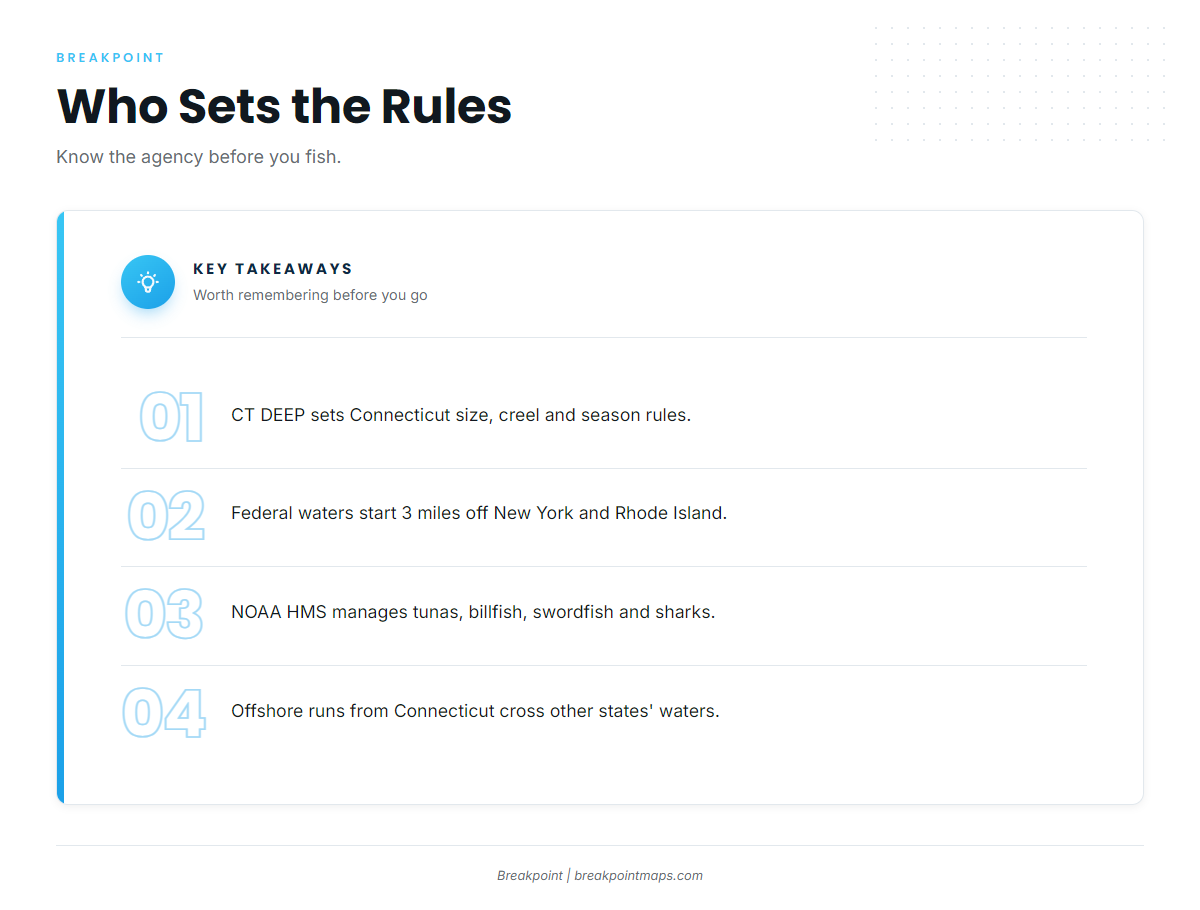
The CT DEEP Commissioner sets minimum lengths, creel limits and closed seasons by declaration, following ASMFC interstate plans and federal rules. Connecticut’s surveyed state-waters boundary runs through Long Island Sound as a line of points, from off Greenwich (40°59.32′ N, 73°39.62′ W) to off Stonington (41°19.76′ N, 71°50.92′ W). Federal law fixes a coastal state’s seaward boundary at 3 geographical miles from shore, so federal waters off New York and Rhode Island begin 3 miles from their coasts. A Connecticut boat running offshore crosses the waters of other states before it reaches the EEZ. Beyond that line, the federal councils and NOAA Fisheries manage the fishery, and NOAA’s Atlantic HMS office covers tunas, billfish, swordfish and sharks.
- CT DEEP Marine Fisheries Program – Sets and publishes Connecticut’s recreational size, creel and season rules from Old Lyme, and issues the Marine Waters Fishing License.
- CT DEEP Environmental Conservation Police – Enforces Connecticut’s marine fishing rules on the water and shore; the marine line is 860-434-9840.
- Atlantic States Marine Fisheries Commission (ASMFC) – Writes the interstate plans Connecticut adopts for striped bass, tautog, summer flounder, scup, black sea bass and sharks.
- Mid-Atlantic Fishery Management Council (MAFMC) – Develops federal plans for summer flounder, scup, black sea bass, bluefish and tilefish.
- New England Fishery Management Council (NEFMC) – Develops federal plans for Atlantic cod, haddock and pollock.
- NOAA Fisheries Greater Atlantic Regional Fisheries Office (GARFO) – Implements federal rules in the EEZ (3 to 200 nautical miles), published in 50 CFR parts 648 and 697, and posts federal recreational rules by species.
- NOAA Atlantic Highly Migratory Species (HMS) – Manages tunas, billfish, swordfish and sharks, and issues HMS permits.
Connecticut Offshore Fishing Regulations by Species
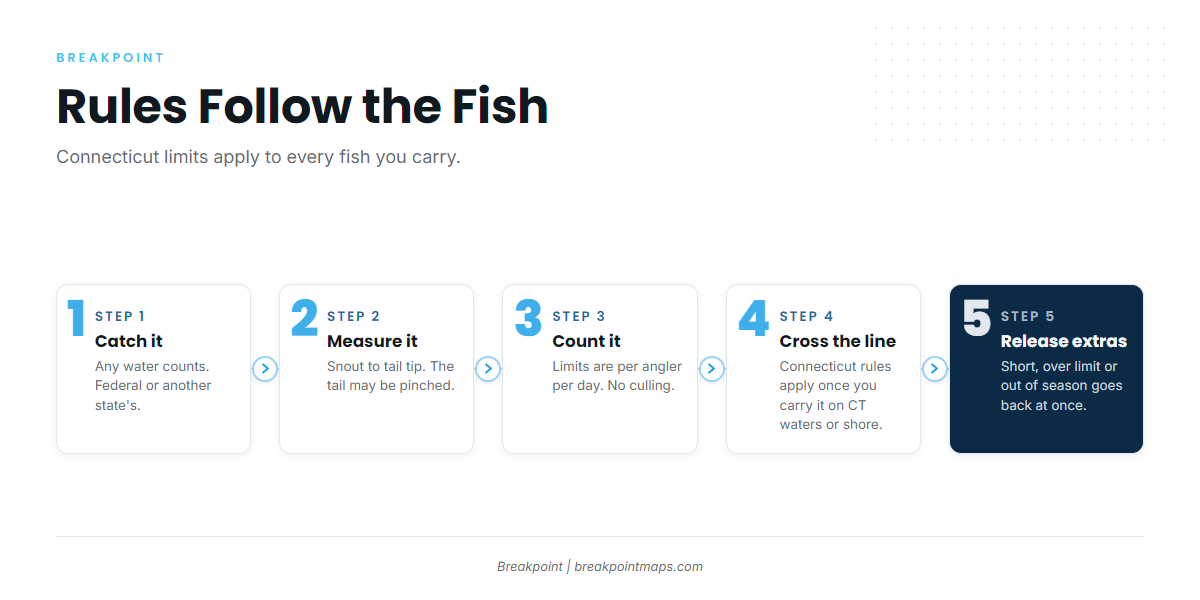
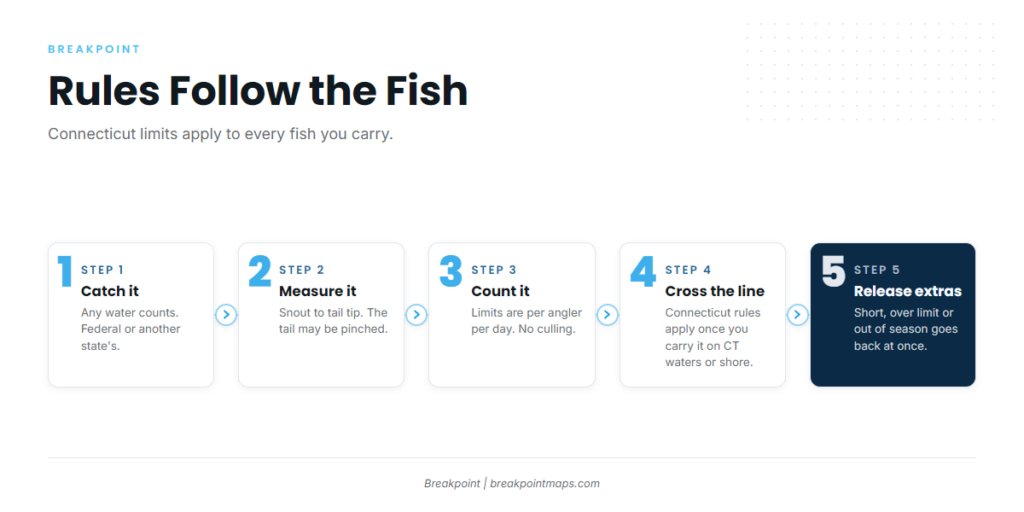
Connecticut size, season and creel limits apply to any fish you possess on Connecticut waters or the Connecticut shore, wherever it was caught, including federal waters or another state’s waters, and even in transit. A fish that is short, over the limit or out of season goes back immediately. For fluke and black sea bass, federal measures are waived, so the landing state’s rule governs.
Measure from the tip of the snout to the end of the tail; the tail may be pinched. Limits are per angler per day (24 hours, however many trips), with no pooling. Culling is prohibited, and fish on a stringer, in a cooler or in a live well count toward the limit.
Anglers age 16 and older need a Marine Waters Fishing License, including to land fish taken offshore. Licenses from Maine, Massachusetts, New York and Rhode Island are honored, paying passengers on a DEEP-registered party or charter vessel are exempt, and a Connecticut license exempts the holder from the federal National Saltwater Angler Registry. You can buy a license online. For-hire vessels need a DEEP Party or Charter Fishing Vessel Registration, or a Guide Service Registration when carrying 2 or fewer customers, plus the federal charter/party permit for each species taken in federal waters.
In-season changes post on the commissioner declarations page. For offshore runs in the Northeast, the same possession logic carries across state lines.
Striped bass
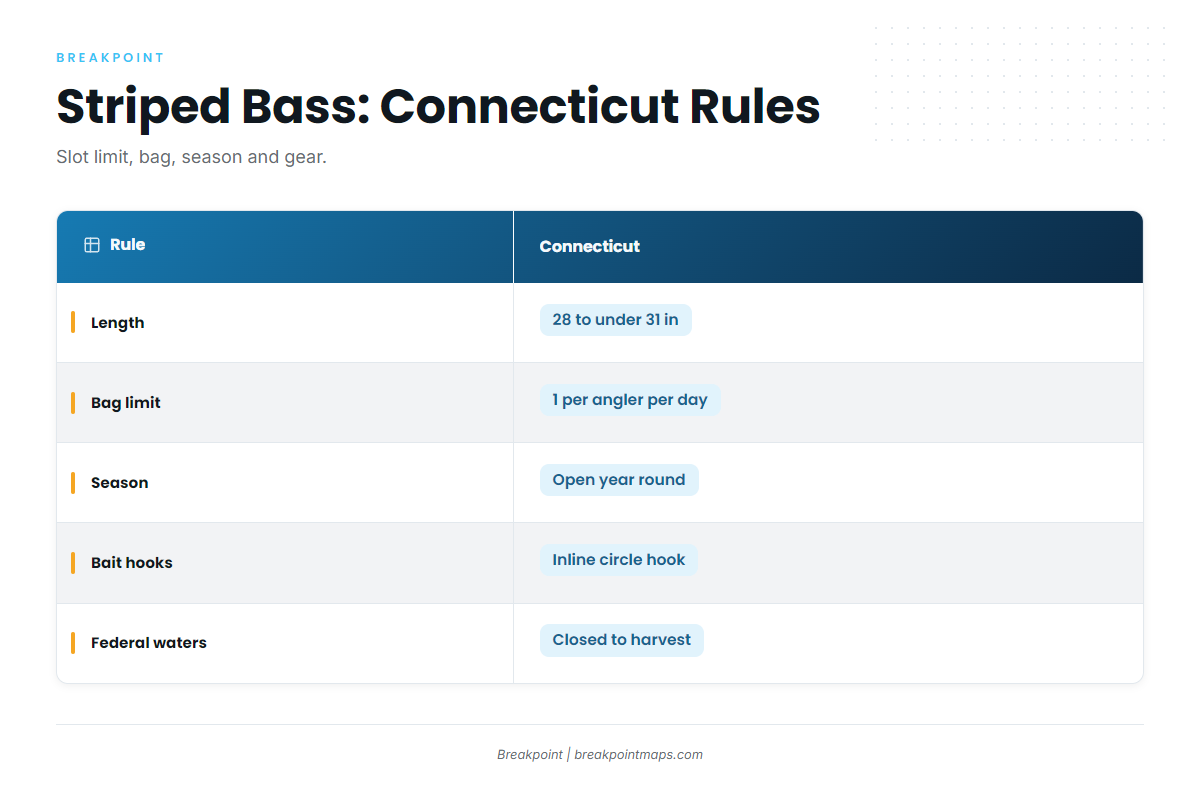
Connecticut runs a slot limit for striped bass, and a fish outside the slot is released. Federally, striped bass fishing, harvest and possession are closed in federal waters. The exception is Block Island Sound, north of a line from Montauk Light to Block Island Southeast Light and west of a line from Point Judith Light to Block Island Southeast Light. A vessel there may carry striped bass only in continuous transit, with no fishing from the vessel while in the EEZ.
- Length28 inches minimum. No striped bass of 31 inches or longer may be possessed (a slot of 28 to under 31 inches).
- Bag limit1 per angler per day.
- SeasonOpen year round.
- Gear and permitsAn inline circle hook is required with natural bait (live, dead or cut). Artificial lures, including a lure with bait attached, are exempt. A fish caught on bait with a non-circle hook is released, even at legal size. No spearing or gaffing. Head and tail stay on.
CT DEEP striped bass and circle hook rules
Summer flounder (fluke)
Fluke have a two-step size limit in Connecticut, with a smaller minimum at the Enhanced Opportunity Shore Fishing sites. Federal measures are waived, so fish landed in Connecticut follow Connecticut rules.
- Length19 inches from May 4 through August 1. 19.5 inches from August 2 through October 15. 17 inches at Enhanced Opportunity Shore Fishing sites.
- Bag limit3 per angler per day.
- SeasonMay 4 to October 15.
- Gear and permitsIf fluke are filleted aboard, each fillet must meet the minimum length, or the carcass is kept and must meet it. Filleting on shore or dockside is allowed.
CT DEEP species regulations
Black sea bass
Length excludes the tendril, the tail filament. Federal measures are waived, so the landing-state rule governs. Our black sea bass guide covers where they hold.
- Length15.5 inches minimum, excluding the tail filament (tendril).
- Bag limit4 per angler per day. Party and charter (paying passengers only): 4 per angler from May 16 to August 31, and 6 per angler from September 1 to December 31.
- SeasonMay 16 to November 25, with no mid-season closure. Party and charter: May 16 to December 31.
- Gear and permitsThe party or charter operator keeps a daily logbook for trips taking black sea bass. In federal waters, a for-hire vessel needs the federal black sea bass charter/party permit.
CT DEEP species regulations
Scup (porgy)
Scup minimums differ for boat and shore anglers. The federal limit is 10 inches and 40 fish per trip, and federal scup cannot be landed with the skin removed. A Connecticut landing from a boat means 11 inches and 30 fish.
- Length11 inches for boat anglers. 9.5 inches for shore anglers, including Enhanced Opportunity sites.
- Bag limit30 per angler per day. Party and charter (paying passengers): 40 per angler from September 1 to October 31, and 30 per angler otherwise.
- SeasonMay 1 to December 31.
- Gear and permitsIn federal waters, a for-hire vessel needs the federal scup charter/party permit. A federally permitted vessel follows the more restrictive of the federal and state measures.
CT DEEP species regulations
Bluefish
The Connecticut bag limit includes snappers. Federal limits match: 5 per person on private vessels, and 7 on vessels with a federal bluefish charter/party permit.
- LengthNo minimum length.
- Bag limit5 per angler per day, including snappers. Party and charter paying passengers: 7.
- SeasonOpen year round.
- Gear and permitsNo species-specific gear rule. The Marine Waters Fishing License applies. For-hire vessels in federal waters need the federal bluefish charter/party permit.
CT DEEP species regulations
Tautog (blackfish)
The tautog season opens in three separate windows, and the bag limit changes between them.
- Length16 inches minimum.
- Bag limit2 per angler from April 1 to 30. 2 per angler from July 1 to August 31. 3 per angler from October 10 to November 28.
- SeasonOpen only in those 3 periods.
- Gear and permitsNo species-specific gear rule. The Marine Waters Fishing License applies.
CT DEEP species regulations
Weakfish
Weakfish are also called sea trout. Connecticut sets a single minimum and a 1-fish limit.
- Length16 inches.
- Bag limit1 per angler per day.
- SeasonOpen year round.
- Gear and permitsNo species-specific gear rule. The license applies.
CT DEEP species regulations
Winter flounder
Winter flounder have a 12-inch minimum, a 2-fish limit and a season that opens April 1 and runs through December 31.
- Length12 inches.
- Bag limit2 per angler per day.
- SeasonApril 1 to December 31.
- Gear and permitsNo species-specific gear rule. The license applies.
CT DEEP species regulations
Red drum
Red drum have a maximum length rather than a minimum. Fish over 27 inches go back.
- Length27 inches maximum.
- Bag limit1 per angler per day.
- SeasonOpen year round.
- Gear and permitsNo species-specific gear rule. The license applies.
CT DEEP species regulations
Sharks
Smooth and spiny dogfish are the only sharks that may be taken without a federal permit, with no minimum length and no creel limit. No shark may be harvested from Connecticut waters when federal waters are closed for that species. Without the permit, release any other shark without removing it from the water.
- LengthSet by NOAA HMS under 50 CFR part 635. See the agency page.
- Bag limitSet by NOAA HMS. See the agency page.
- SeasonFollows federal closures.
- Gear and permitsAn Atlantic HMS permit with a shark endorsement is required. Rod and reel or handline only. Non-offset, non-stainless circle hooks, except with flies or artificial lures. Head, tail and fins stay naturally attached. Sharks may be gutted and bled at the tail base. No filleting at sea.
CT DEEP shark declaration
Atlantic cod, haddock and pollock
Connecticut points anglers to the federal rules for these species. Waters south of Connecticut are the Southern New England cod stock area.
- LengthHaddock 18 inches. Pollock 19 inches. No cod may be retained in Southern New England.
- Bag limitCod: none retained, all year, on private and party/charter vessels. Haddock and pollock: no possession limit.
- SeasonHaddock and pollock are open all year. Southern New England cod is closed to retention year round.
- Gear and permitsOne line per angler, with other gear stowed. Fillets keep at least 2 square inches of contiguous skin.
Federal groundfish recreational rules
Golden tilefish
Golden tilefish are federal only, and these rules cover waters north of the Virginia/North Carolina border.
- LengthNo minimum.
- Bag limit8 per angler per trip.
- SeasonOpen year round.
- Gear and permitsRod and reel only, with no more than 5 hooks per rod. Manual or electric reel. A federal private recreational tilefish permit is required, or a charter/party tilefish permit on for-hire vessels. Trip reporting is required.
NOAA Fisheries tilefish rules
Blueline tilefish
Blueline tilefish have a seasonal closure and bag limits that vary by vessel type.
- LengthNo minimum.
- Bag limit3 per person per trip on a private vessel. Party and charter: 5 on an uninspected for-hire vessel, and 7 on a Coast Guard inspected vessel.
- SeasonMay 15 through November 14.
- Gear and permitsA federal private recreational or charter/party tilefish permit is required. Trip reporting is required.
NOAA Fisheries blueline tilefish rules
Mahi-mahi and wahoo
Rules for mahi-mahi and wahoo are federal Atlantic rules. The 20-inch dolphin minimum applies only off Florida, Georgia and South Carolina.
- LengthNo minimum length off Connecticut.
- Bag limitMahi-mahi: 10 per person per day, not to exceed 54 per vessel, whichever is less. Headboat: 10 per paying passenger. Wahoo: 2 per person per day.
- SeasonNo closed season.
- Gear and permitsKeep fish with head and fins intact. Fish may be gutted, gilled and scaled. For-hire vessels need the Atlantic Dolphin and Wahoo charter vessel/headboat permit.
Federal dolphin and wahoo rules
Tunas, billfish and swordfish
NOAA Atlantic HMS manages these species. An angler taking them in federal waters needs the appropriate HMS permit, and for-hire vessels need the HMS Charter/Headboat permit. Retention depends on quota and permit category, so the figures live on the agency page. That covers Atlantic bluefin tuna, yellowfin tuna and bigeye tuna.
- LengthSet by NOAA HMS. See the agency page.
- Bag limitSet by NOAA HMS by quota and permit category. See the agency page.
- SeasonSet by NOAA HMS. See the agency page.
- Gear and permitsHMS Angling or HMS Charter/Headboat permit. See the agency page.