




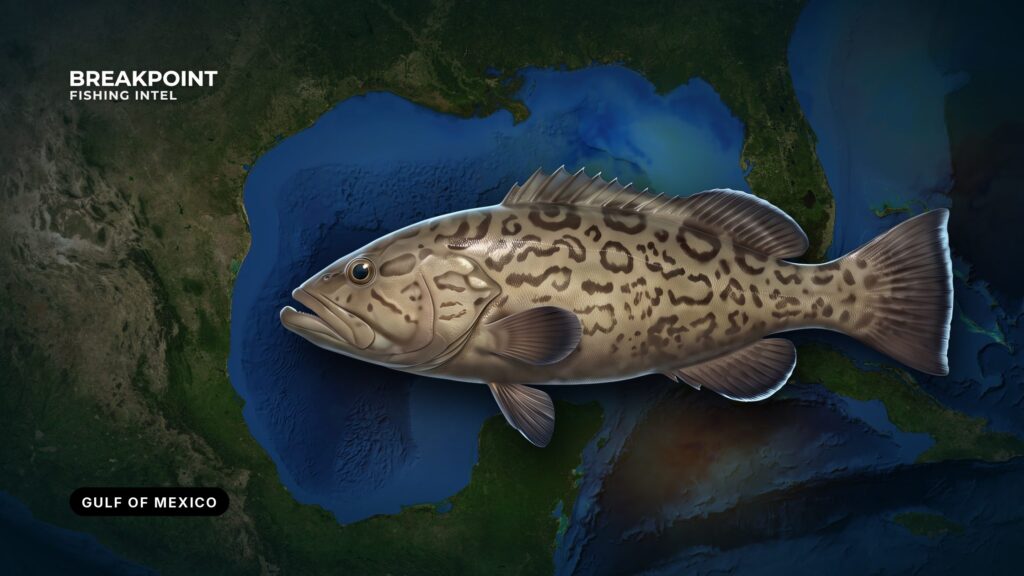
Run out of Orange Beach past 9 nautical miles and you are in federal water, yet the red snapper season you fish may still be Alabama’s. Under Gulf of Mexico federal reef fish rules, a line on the water can change who owns the season, and the species and the type of boat decide the rest.
Three questions sort out almost every rule:
- Which waters are you in?
- Which species is it?
- Are you on a private boat or a federally permitted for-hire boat?
Federal documents call the water the Gulf of America. The name change did not alter any regulation. This guide covers who sets the rules, which waters you are in, whose season applies, and which agency owns each number. Check that agency’s page before you fish. For seasons, species and ports beyond reef fish, see our Gulf of Mexico fishing guide.
Who Makes the Gulf Reef Fish Rules
Four layers sit behind every federal reef fish rule:
- The Magnuson-Stevens Act is the federal law that governs fishery management.
- The Gulf Council develops the Reef Fish Fishery Management Plan and its amendments. Its Gulf Council reef fish regulations page lists the rules that sit outside species limits, such as head-and-fins-attached and the for-hire rules.
- NOAA Fisheries Southeast Regional Office (SERO) puts the Council’s measures into effect.
- 50 CFR part 622, subpart B is where the rules live.
Amendment 50 delegated management of private recreational red snapper to each Gulf state, which is why the red snapper season you fish depends on the state you fish off.
Federal seasons also move. Each stock has an annual catch target and accountability measures, and when landings are projected to reach the target, NOAA closes the season. The end date is announced, not fixed. In-season changes appear in the NOAA Fisheries fishery bulletins, so check that page before every trip.
State vs. Federal Waters: Where the Line Sits
States manage their own waters. Federal waters, the exclusive economic zone (EEZ), run from the state line out to 200 nautical miles and are managed by the Gulf Council and NOAA Fisheries.
| State | Reef fish line | Other species line | Agency |
|---|---|---|---|
| Florida (Gulf coast) | 9 nm | 9 nm | FWC |
| Alabama | 9 nm | 3 nm | ADCNR |
| Mississippi | Check MDMR | Check MDMR | MDMR |
| Louisiana | 9 nm | Generally 3 nm | LDWF |
| Texas | 9 nm | 9 nm | TPWD |
Alabama’s line and the Reef Fish Endorsement are on the Alabama saltwater season notices page. For Mississippi, check the Mississippi Department of Marine Resources (MDMR). The Texas Parks and Wildlife Department (TPWD) holds Texas rules. Texas and Florida’s Gulf coast hold 3 marine leagues (9 nm) by historical boundary.
On the water, use the platforms. Platforms in state waters carry a placard with a state lease number; platforms in federal waters carry an OCS number. Louisiana explains the method on the LDWF state waters boundaries page.
Breakpoint maps show the 9 nm state line and depth contours, so you can see which side of the line a spot sits on before you run. Chart Contours is the layer for depth. Chart layers are not for navigation.
How Gulf of Mexico Federal Reef Fish Rules Interact with State Seasons
Red snapper is where the two systems meet.
Private anglers. Under delegated state management, the state sets the season, bag and size for private anglers in federal waters off that state.
- Florida: FWC sets the size, between 14 and 18 inches TL.
- Alabama: a private angler’s fish may not be smaller than 14 inches TL in federal waters.
- State dates: check the state page. Do not rely on a federal number.
Federal default. 16 inches TL, 2 per person per day, closed January 1 to May 31.
For-hire boats. NOAA sets a separate red snapper season each year for federally permitted for-hire vessels. When that season is closed, persons aboard may not fish for or possess red snapper in federal or state waters. They may fish recreationally during the private season if the vessel declares recreational fishing status. The NOAA bulletin has the details.
In practice, a private boat running out of Orange Beach past 9 nm fishes Alabama’s red snapper season, while a federally permitted charter on the same water fishes NOAA’s for-hire season.
In state waters, federally permitted for-hire vessels follow the more restrictive of the federal or state rule. Captain and crew keep zero grouper, red snapper and greater amberjack while under charter.
For other species, states can match the federal season or differ in state waters. Florida sets gag and amberjack dates by executive order to match the federal season. Check the state page.
Required Gear for Gulf Reef Fish
Carry these before you leave the dock:
- Non-stainless-steel circle hooks when fishing with natural bait. Florida state waters specify non-offset hooks.
- A dehooking device on board, used to remove hooks.
- A descending device or venting tool. Federal rules require one. For status and specifications, see NOAA’s "Continuation of management measures to reduce reef fish release mortality" page.
- In Florida state waters, a descending device or venting tool rigged and ready. The descending device needs at least a 16-ounce weight and 60 feet of line. See the FWC reef fish gear rules.
- Heads and fins intact through landing for fish from federal waters.
- No powerheads inside the reef fish stressed area.
- Off Alabama, reef fish gear is limited to 3 hooks in the special management zone.
Fish pulled from depth suffer expansion injuries from barotrauma. A descending device returns the fish to depth, and a venting tool releases the gas.
Species Rules in Federal Waters
Fork length (FL) is measured to the fork of the tail; total length (TL) to the tip. Three aggregates matter: 20 reef fish, 4 groupers and 10 snappers (gray, cubera, mutton, yellowtail).
| Species | Min. size | Bag | Aggregate | Fixed closed months |
|---|---|---|---|---|
| red snapper | 16 in TL (federal default) | 2 | none | Jan 1 to May 31. Private: state season. For-hire: set by NOAA, see bulletins |
| vermilion snapper | 10 in TL | max 10 | 20 reef fish | none |
| gag | 24 in TL | 2 | 4 groupers | Jan 1 to Aug 31. Close date set by NOAA, see bulletins |
| red grouper | 20 in TL | 2 | 4 groupers | see 622.34 and bulletins |
| black grouper / scamp / yellowfin grouper | 24 / 16 / 20 in TL | within 4 | 4 groupers | season set in 622.34, see bulletins |
| speckled hind / warsaw grouper | none | 1 per vessel | 4 groupers | none |
| goliath and Nassau grouper | none | no retention | none | none |
| greater amberjack | 34 in FL | 1 | none | Jan 1 to Aug 31 and Nov 1 to Dec 31. Early close set by NOAA, see bulletins |
| gray triggerfish | 15 in FL | 1 | 20 reef fish | Jan 1 to end of Feb and Jun 1 to Jul 31 |
| captain and crew on for-hire trips | n/a | 0 grouper, red snapper or greater amberjack | n/a | n/a |
Swipe the table sideways to see every column.
The fixed closed months come from the federal closed seasons, 50 CFR 622.34.
Red snapper
Private anglers follow the state season, and for-hire boats follow NOAA’s season. The federal default is 16 inches TL and 2 fish. The section above explains who owns which date.
Vermilion snapper
The federal minimum is 10 inches TL, inside the 20-fish aggregate, with no more than 10 vermilion. There is no closed season. In Florida state waters the limit is 10 per person, outside the 10-fish snapper aggregate, which is a federal versus state aggregate difference.
Greater amberjack
The minimum is 34 inches FL with a bag of 1 fish, and the fixed closed months are in the table. The September to October window closes early when NOAA projects the catch target will be met. The end date is announced, not fixed.
Gray triggerfish
The minimum is 15 inches FL with a bag of 1 fish, inside the 20-fish aggregate. The season is closed January 1 to the end of February and June 1 to July 31.
Gag
The minimum is 24 inches TL, with 2 fish within the 4-grouper aggregate. The season is closed January 1 to August 31, opens September 1, and NOAA announces the close.
Red grouper
The minimum is 20 inches TL, with 2 fish within the 4-grouper aggregate. For season status, see 50 CFR 622.34 and the NOAA bulletins.
Other groupers
Minimum sizes are 24 inches TL for black grouper, 16 for scamp and 20 for yellowfin grouper. Black, scamp, yellowfin and yellowmouth grouper have a recreational season set in 50 CFR 622.34; check it and the bulletins page. Speckled hind and warsaw grouper are limited to 1 per vessel. Goliath and Nassau grouper allow no retention.
Once you know what you may keep, the next question is how to fish for them. Our reef fish fishing guides cover that.
Permits and State Reporting
Private recreational anglers need no federal permit for Gulf reef fish. For-hire vessels need a federal charter vessel/headboat permit for Gulf reef fish.
Each state runs its own reporting or endorsement program:
- Florida: FWC, State Reef Fish Angler designation (State Reef Fish Survey).
- Alabama: ADCNR, Reef Fish Endorsement and Snapper Check.
- Louisiana: LDWF, Recreational Offshore Landing Permit (ROLP) and LA Creel.
- Mississippi: MDMR, Tails n’ Scales.
- Texas: TPWD, iSnapper.
Check each state’s page before you fish.
Species Outside the Reef Fish Plan
Tunas, billfish, swordfish and sharks in the Gulf are federal highly migratory species (HMS), with their own permit and reporting system. Start with HMS permits and reporting, then read the rules for tunas and for billfish and swordfish.
Frequently Asked Questions
Do I need a federal permit to fish for reef fish in Gulf federal waters?
Private anglers do not. For-hire vessels need the federal charter vessel/headboat permit. HMS species need their own permit, covered in HMS permits and reporting. State endorsements and reporting still apply, so check your state agency.
Where do state waters end for reef fish in the Gulf?
State waters end at 9 nm off Florida, Alabama, Louisiana and Texas for reef fish. For Mississippi, check MDMR. For other species, Alabama’s line is 3 nm and Louisiana’s is generally 3 nm.
Whose red snapper season applies in federal waters?
Private anglers follow the state season set by the state they fish off. Federally permitted for-hire boats follow NOAA’s for-hire season. Check the state agency and the NOAA fishery bulletins before you fish.
What gear must be on board for reef fish?
Non-stainless-steel circle hooks with natural bait, a dehooking device, and a descending device or venting tool. Florida state waters add rigging details for the descending device. The Gulf Council and FWC pages carry the full wording.
How do the reef fish aggregate bag limits work?
Federal waters use three aggregates: 20 reef fish, 4 groupers and 10 snappers (gray, cubera, mutton, yellowtail). Vermilion snapper counts in the 20-fish aggregate, with no more than 10 vermilion. Florida state waters count vermilion outside the 10-fish snapper aggregate.
Why did a season close before its scheduled date?
NOAA closes a season when landings are projected to reach the annual catch target. Accountability measures trigger the close, and NOAA announces the date through fishery bulletins, not in advance.
Can a charter captain keep fish?
No. Captain and crew keep zero grouper, red snapper or greater amberjack while under charter. In state waters, federally permitted for-hire vessels follow the more restrictive of the federal or state rule. The Gulf Council page has the rule.
Does the Gulf of America name change the rules?
No. The name change did not alter any regulation. Federal documents use Gulf of America, and anglers still search for Gulf of Mexico.
Where do I check Gulf federal reef fish regulations before a trip?
Start with the NOAA fishery bulletins for in-season changes, then 50 CFR part 622 for the standing rules. Then check your state agency’s page for state waters and reporting.
Before You Run
Work through it in order: which waters you are in, whose season applies, and what gear is on board. Then check the numbers. Open the NOAA bulletins page and your state agency page before each trip, since the end date is announced, not fixed.
To see where a spot sits relative to the 9 nm line and the structure around it, download Breakpoint from the App Store or Google Play and open the Gulf of America region.