




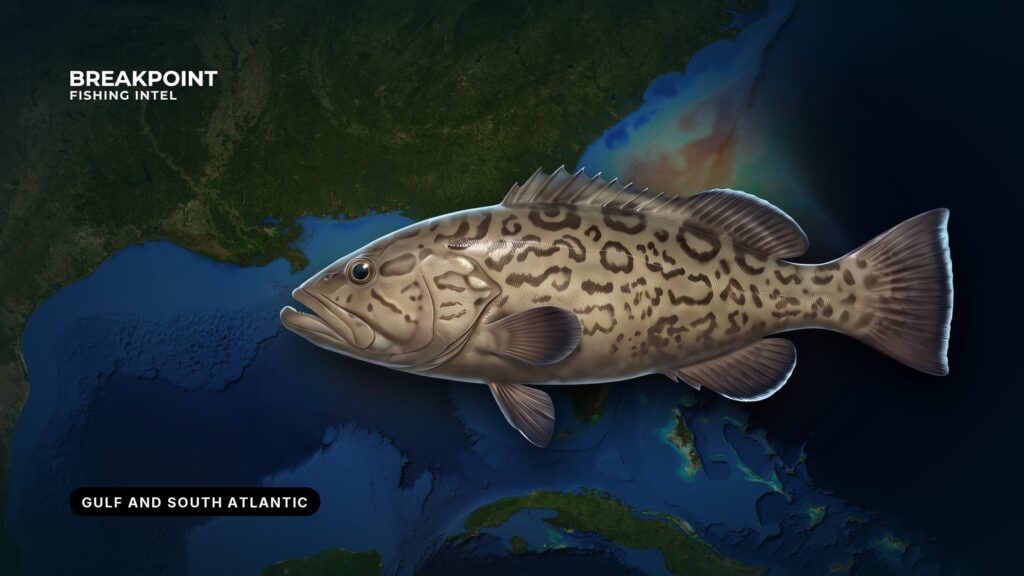
Fish for snapper or grouper in South Atlantic federal waters and you need a dehooking device and a descending device with at least 16 oz of weight and 60 ft of line. North of 28° N you also need non-offset, non-stainless circle hooks with natural bait. In the Gulf (Gulf of America), reef fish rules require non-stainless circle hooks with natural bait and a dehooking device. NOAA sets the Gulf release-tool rule. HMS has its own hook rules for sharks and billfish tournaments.
For size, bag and season by species, see our species-by-species reef fish rules.
The rules change with the water you fish and the fish you target, so this guide splits them by water. Three rule-setters matter. The NOAA Fisheries Southeast Regional Office, the Gulf Council and the SAFMC write the reef fish rules, and the NOAA Fisheries Atlantic HMS Management Division writes the rules for tunas, billfish, swordfish and sharks.
The guide includes a gear table, the boundary lines that decide which rule applies, what makes gear compliant, how to use a descending device, and a pre-trip checklist.
Release Gear and Hook Rules at a Glance
The table shows the federal rules side by side. Find your water, then read down.
| Gulf reef fish (federal) | South Atlantic snapper-grouper (federal) | Atlantic HMS | |
|---|---|---|---|
| Release device | Descending device or venting tool rigged and ready; continuation set by NOAA, check the action page | Descending device, at least 16 oz weight and 60 ft line, on board and ready | Not part of HMS hook rules; carry reef fish gear if you also bottom fish |
| Dehooking device | Required | Required | See HMS compliance guide |
| Hook type | Non-stainless circle hooks | Non-offset, non-stainless circle hooks north of 28° N | Circle hooks for sharks; non-offset circle hooks in billfish tournaments |
| Bait condition | Natural bait | Hook and line with natural bait | Natural bait (tournaments: natural bait or natural bait/artificial lure combination) |
| Where it applies | Federal waters (9 nm off FL Gulf coast and TX; 9 nm off LA for reef fish) | Federal waters, 3 to 200 nm | Federal waters of the Atlantic, Gulf and Caribbean; state waters for federal HMS permit holders |
| Legal text | 50 CFR 622.30 | 50 CFR 622.188 | 50 CFR part 635 |
Florida state Gulf waters also require non-offset circle hooks and the release tool. See State Differences below.
Which Rules Apply Where: State Lines, Council Lines and 28° N
Your rules depend on whose water you are in and what you are fishing for.
Take two boats, each 10 nm out. The boat off Destin is in federal Gulf water under Gulf Council reef fish rules. The boat off Jupiter is in federal South Atlantic water under SAFMC rules. Jupiter sits south of 28° N, so the non-offset hook requirement does not apply there, but the descending device requirement does.
State versus federal waters
State waters end and federal waters begin at different distances:
- Florida Gulf coast and Texas: state waters run to 9 nm.
- Louisiana: 9 nm for reef fish management, and generally 3 nm otherwise.
- Atlantic states: 3 nm.
- Federal waters: run out to 200 nm.
For Alabama and Mississippi, check the state agency.
The Keys council line
The council boundary runs along 83° W north to 24°35′ N, then east to the mainland. The SAFMC manages the Atlantic side, and the Gulf Council manages the other side.
The 28° N line
28° N is the east-west latitude line about 25 miles south of Cape Canaveral. North of it, South Atlantic snapper-grouper anglers using natural bait need non-offset, non-stainless circle hooks. The Federal Register rule notice describes the line and defines an offset hook.
HMS reaches across both
The HMS rules treat the "Atlantic Ocean" as including the Gulf and the Caribbean. See the HMS section below.
Gulf Reef Fish Rules
The Gulf Council and NOAA Fisheries Southeast Regional Office set the Gulf reef fish gear rules. The legal text is 50 CFR 622.30.
Carry this on board:
- non-stainless steel circle hooks when fishing with natural bait;
- at least 1 dehooking device, used to remove embedded hooks;
- a descending device or venting tool.
The Gulf rule has required a descending device or venting tool rigged and ready for reef fish, and NOAA sets whether that continues. Check NOAA’s release mortality action page before you fish. Rig the device before the first drop, not after the fish is on deck.
Federal Gulf text specifies non-stainless circle hooks. Florida state Gulf waters add non-offset. The offset test is in the compliant gear section below.
Fixed federal figures for three species:
| Species | Size limit | Bag limit |
|---|---|---|
| Gag | 24 in total length | 2 per person, inside the 4-grouper aggregate |
| Greater amberjack | 34 in fork length | 1 per person |
| Gray triggerfish | 15 in fork length | 1 per person |
Red snapper is handled differently. Private anglers fish under state-managed seasons, and NOAA, FWC and the state agencies set the dates. Season dates for every species are in the Gulf Council federal regulations. Our rundown of Gulf red snapper, gag, amberjack and triggerfish limits covers the rest. Check the agency page before you fish.
South Atlantic Snapper-Grouper Rules
The SAFMC and NOAA Fisheries Southeast Regional Office set these rules. The gear requirements came in under Regulatory Amendment 29. The gear spec is in the federal rule at 622.188.
Carry this on board:
- a descending device attached to at least 16 oz of weight and at least 60 ft of line, on board and ready for use;
- a dehooking device;
- north of 28° N, non-offset, non-stainless circle hooks with hook and line and natural bait.
The rules apply to anyone fishing for or possessing snapper-grouper in South Atlantic federal waters. You may vent a fish, but you must still have a descending device readily available. See the venting FAQ below.
Fixed federal figures for three species:
| Species | Size limit | Bag limit |
|---|---|---|
| Black sea bass | 13 in total length | 7 per person |
| Vermilion snapper | 12 in total length | 5 per person |
| Gag and black grouper | 24 in total length | See the agency page |
Red snapper is closed except for a short season NOAA announces each year, at 1 per person during the season. A descending device is required. SCDNR runs its own extended season under exempted fishing permits for registered participants. Season dates come from the agency. For everything else, see South Atlantic snapper-grouper limits and seasons. Check the agency page before you fish.
HMS Rules for Sharks, Billfish Tournaments and Permits
NOAA Fisheries Atlantic HMS Management Division sets these rules in 50 CFR part 635. They cover tunas, swordfish, billfish and sharks across the Atlantic, the Gulf and the Caribbean.
Federal HMS permit holders follow federal HMS rules in state waters unless the state rule is stricter. Federal retention limits do not stack on state limits.
Circle hooks are required when fishing for sharks with natural bait. The full text is in NOAA’s HMS Recreational Compliance Guide. Our guide to the HMS Angling permit and reporting rules covers permits.
Billfish tournaments have their own hook rule:
- Non-offset circle hooks are required with natural bait or a natural bait/artificial lure combination in Atlantic billfish tournaments.
- For permits, limits and reporting on marlin, sailfish and swordfish, see our billfish and swordfish federal rules.
A single trip can cross rule sets. Say you stop on bottom for reef fish, then run to the edge for tuna. The bottom stop triggers the reef fish release gear and hook rules, and the run to the edge triggers HMS rules. Carry both sets: the descending device and dehooker, the correct circle hooks for the bottom, and your HMS permit and rules for tuna. The Atlantic tuna federal rules cover the tuna side. Check the agency page before you fish.
What Counts as Compliant Gear
Compliance comes down to the right device, the right hook and the right material.
Descending devices
Descending devices come in four common types:
- inverted hooks;
- lip or mouth clamps;
- pressure-released clips;
- weighted crates or cages (fish elevators).
The South Atlantic spec is at least 16 oz of weight and 60 ft of line. The SAFMC guide is 1 lb of lead per 5 lb of fish, which is a recommendation, not a rule. See SAFMC best fishing practices. The SAFMC prefers descending devices to venting.
The offset test
A hook is offset if the point and barb are not in line with the shank. To test it:
- Lay the hook flat on the console.
- If the point bends out of the plane of the shank, it is offset.
- If the hook lies flat with the point in line, it is non-offset.
Non-stainless hooks
A non-stainless hook corrodes if a fish swallows it or the line breaks. Check the packaging and the material. The rule concerns material, not color.
Dehooking devices and venting tools
A dehooking device removes embedded hooks. A venting tool is a sharpened, hollow instrument. The SAFMC prefers descending because it does not puncture the fish.
How to Use a Descending Device
Gas expands as a deep fish comes up. Signs include bulging eyes and the stomach pushed out of the mouth. The council’s intent is that the device be used only when a fish shows barotrauma.
Follow these steps:
- Rig the device before the first drop.
- Check the fish for signs of barotrauma.
- Unhook the fish with the dehooker and handle it quickly.
- Clip or hook the fish according to the device type.
- Lower the fish steadily on the rig.
- Release it at depth. Pressure-release devices let go on their own. With an inverted hook, give a sharp upward jerk.
- Retrieve the device and re-rig it.
Know your depth before you need to release, since the depth you fish determines how much line and weight a release takes. The Chart Contours layer in Breakpoint shows bottom contours for planning the spots you fish. Chart layers are not for navigation.
State Differences
State waters can add to the federal rules. Check the state page for the water you fish.
- Florida (FWC): state Gulf waters require non-offset, non-stainless circle hooks with natural bait, a dehooking device, and a descending device or venting tool rigged and ready. See the FWC recreational gear rules.
- Louisiana (LDWF): federally permitted for-hire reef fish vessels follow the more restrictive rule in state waters. Louisiana law bars breaking federal reef fish, billfish or tuna rules in federal waters. See the Louisiana saltwater finfish rules.
- Alabama, Mississippi, Texas, Georgia, South Carolina, North Carolina: check the saltwater regulations page for ADCNR Marine Resources, MDMR, TPWD, GA DNR Coastal Resources, SCDNR and NC Division of Marine Fisheries.
Pre-Trip Checklist
Run this before you leave the dock:
- [ ] Confirm your water and fish: state, Gulf federal, South Atlantic federal, HMS.
- [ ] Descending device: 16 oz weight and 60 ft line, rigged.
- [ ] Venting tool, if fishing the Gulf (in addition to, not instead of, a descending device in the South Atlantic).
- [ ] Dehooking device.
- [ ] Non-stainless circle hooks, offset-tested if fishing north of 28° N or in Florida Gulf state waters.
- [ ] HMS Angling permit if targeting HMS species.
- [ ] Agency pages checked for seasons and closures.
Frequently Asked Questions
Do the hook rules apply when I fish lures?
The Gulf and South Atlantic circle hook rules apply with natural bait. Billfish tournaments also cover natural bait/artificial lure combinations. The release gear rules still apply whenever you fish for reef fish or snapper-grouper. Check the NOAA Fisheries Southeast Regional Office page for your water.
Can I vent instead of using a descending device?
In the Gulf, the rule names a descending device or venting tool, subject to NOAA’s continuation. In the South Atlantic you may vent, but you must still carry a descending device. The SAFMC prefers descending devices because they do not puncture the fish.
Do I need a descending device if I am only trolling for mahi?
The release gear rules attach to fishing for or possessing reef fish or snapper-grouper. If you stop on bottom, the rules apply. Rig before you leave the dock. NOAA Fisheries and the SAFMC publish the full text.
What is 28° N?
28° N is the latitude line about 25 miles south of Cape Canaveral. North of it, South Atlantic snapper-grouper natural-bait fishing needs non-offset, non-stainless circle hooks. The SAFMC and NOAA Fisheries set that requirement.
Do HMS rules apply in state waters?
Yes for federal HMS permit holders, who follow federal rules unless the state rule is stricter. The legal text is 50 CFR part 635. NOAA Fisheries Atlantic HMS Management Division publishes the rules and a recreational compliance guide.
Is an offset circle hook legal in the Gulf?
The federal Gulf text (50 CFR 622.30) specifies non-stainless circle hooks. Florida state Gulf waters require non-offset. Carry non-offset hooks if you cross lines, and check the NOAA and FWC pages before you fish.
What happens at a boarding?
NOAA Fisheries, the US Coast Guard and state marine officers such as FWC enforce these rules. Officers check gear against the rules for your water. Penalties depend on the agency and the violation, so check the agency page.
Rig the gear, know your water and read the agency page before you go. To find the bottom you are rigging for, download Breakpoint from the App Store or Google Play and see how the Chart Contours layer reads the ledges, humps and wrecks you plan to fish.