




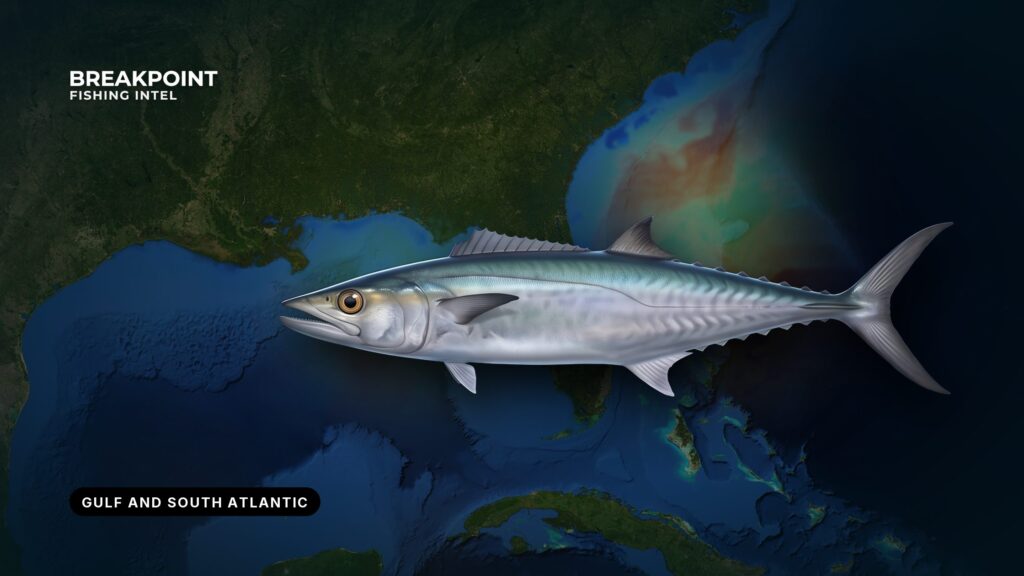
King mackerel, Spanish mackerel and cobia are all managed under the federal Coastal Migratory Pelagics plan, and the rules split by migratory group. Where you fish determines which group’s rules apply. This guide, part of our coastal and offshore gamefish guides, covers the Gulf of America and the Atlantic coast. It explains who manages the fish, which group you are in, where the group lines sit and which rule takes precedence in each area. It is a summary, and the agency pages are the authoritative source.
What are the federal limits for king mackerel, Spanish mackerel and cobia?
The federal recreational limits are set in federal rules in 50 CFR 622, subpart Q.
| Species | Group or area | Fork length | Bag/vessel limit | Season | Source |
|---|---|---|---|---|---|
| King mackerel | Gulf group, and Atlantic group off Florida’s east coast | 24 in | 3 per person per day | No closed recreational season | 50 CFR 622.380, 622.382 |
| Spanish mackerel | Same groups as king mackerel | 12 in | 15 per person per day | No closed recreational season | 50 CFR 622.380, 622.382 |
| Cobia | Gulf zone and Florida east coast zone (Gulf group) | 36 in | 1 per person per day, not to exceed 2 per vessel per trip | No closed recreational season | 50 CFR 622.380, 622.382 |
Swipe the table sideways to see every column.
Two notes on the table:
- The Atlantic group of king and Spanish mackerel off Florida’s east coast has the same size and bag limits as the Gulf group.
- NOAA Fisheries announces quota-driven and in-season changes. This page doesn’t track them, so check the Fishery Bulletins before you fish.
Cobia north of the Florida/Georgia line falls under the South Atlantic Council and the states. Use the state directory below.
Who sets the rules in federal waters?
NOAA Fisheries Southeast Regional Office administers the rules. The Gulf of America Fishery Management Council handles Gulf waters, and the South Atlantic Fishery Management Council (SAFMC) handles Atlantic waters. All three species are in the Coastal Migratory Pelagics plan, codified in 50 CFR 622.
Each council publishes its own regulations page:
- Gulf Council federal regulations cover Gulf waters.
- South Atlantic Council regulations cover Atlantic waters, including cobia north of the Florida/Georgia line.
Federal pages now say "Gulf of America," while older documents say "Gulf of Mexico." They refer to the same water.
Federal waters are the Exclusive Economic Zone, which extends to 200 nautical miles and begins where state waters end. The state section below gives those lines. Check the council page for your coast before fishing.
Which migratory group are you fishing in? Zone lines explained
Federal limits depend on the migratory group you are fishing in, which can differ from where you launched.
King mackerel and Spanish mackerel
Under 50 CFR 622.369, the Gulf migratory group of king mackerel is bounded by a line extending east of the U.S./Mexico border and a line extending east of the Miami-Dade/Monroe County, Florida, boundary.
- The zone boundaries stay in place year-round.
- Spanish mackerel use the same Monroe/Miami-Dade line in the EEZ.
- Federal waters off Monroe County on both coasts belong to the Gulf group.
- North of the county line off Florida’s east coast is the Atlantic group.
An angler fishing the Atlantic side off Key West is in the Gulf group for king mackerel.
Cobia
- The Gulf zone lies north and west of the Council boundary at 83° W longitude and 24°35′ N latitude.
- The Florida east coast zone runs south of the Florida/Georgia line and is part of the Gulf group of cobia.
- North of the Florida/Georgia line, see the SAFMC and the state pages.
Seeing the lines on the water
Chart Contours show depth. The boundary lines in this section are what determine your limits. Chart layers are not for navigation.
King mackerel federal rules
King mackerel, also called kingfish, follow the group rules above: Gulf group in the Gulf and off Monroe County, Atlantic group off Florida’s east coast.
- Size: 24 in fork length.
- Bag: 3 per person per day.
- Season: no closed recreational season.
Fork length is a straight line from the tip of the closed mouth to the center of the tail fork. Total length, which runs to the tail tip, is a longer measurement and is not what the rule uses.
Private boats need no federal permit. For-hire vessels need the CMP charter vessel/headboat permit for their coast. The multi-day rule is in the permits section below. For tactics, see how to find and fish kingfish. Check the agency page before fishing.
Spanish mackerel federal rules
- Size: 12 in fork length, measured from the nose to the center of the tail fork.
- Bag: 15 per person per day.
- Season: no closed recreational season.
The Gulf and Atlantic groups off Florida have identical limits. The for-hire permit requirement is the same as for king mackerel. Check the agency page before fishing.
Cobia federal rules
- Size: 36 in fork length.
- Limit: 1 per person per day, not to exceed 2 per vessel per trip.
- Season: no closed recreational season.
A single angler aboard keeps 1 cobia. With 2 or more aboard, the boat is limited to 2, whichever is less.
These figures apply in the Gulf zone and the Florida east coast zone. North of the Florida/Georgia line, see the SAFMC and the state pages. For finding and hooking fish, read our cobia fishing guide. Check the agency page before fishing.
How do federal and state rules fit together?
State waters end where federal waters begin, and the line varies by coast:
- 9 nm off Texas and Florida’s Gulf coast.
- 3 nm off Florida’s Atlantic coast and Georgia.
- Alabama: 3 nm for non-reef species and 9 nm for reef fish.
- Louisiana: generally 3 nm, with 9 nm used for reef fish.
In Texas, Texas mackerel bag limits from TPWD apply out to 9 nm, and federal law also regulates fish under a federal management plan from 9 to 200 nm.
In Louisiana, mackerel and cobia limits apply to fish possessed in state or federal waters. See the Louisiana recreational saltwater limits from LDWF.
In state waters, the state rule applies. Where a state rule is stricter or follows the angler, the state page controls. The directory below points to each one.
Do you need a federal permit? Private boats and for-hire
Private anglers need no federal permit for these three species. A state license still applies, so check your state page.
For-hire vessels need the CMP charter vessel/headboat permit for the Gulf or the Atlantic, as applicable.
Up to 2 daily bag limits of king and Spanish mackerel may be possessed when all of the following apply:
- The trip has 2 licensed operators.
- Each passenger has a receipt.
- The trip is longer than 30 hours in the Gulf, or longer than 24 hours in the Atlantic.
This does not extend to private boats or to cobia.
Tunas, billfish and swordfish follow separate HMS rules. See Atlantic HMS permits and reporting. In-season changes are posted on the NOAA Fisheries Fishery Bulletins page, which for-hire captains check first.
What these rules don’t cover
These rules do not cover dolphin, wahoo, reef fish or highly migratory species. For tunas, see Atlantic tunas federal rules. For billfish and swordfish, see billfish and swordfish federal rules.
Where does each state publish its limits?
The table below lists each state’s managing agency, how far its waters extend and where to find its regulations.
| State | Agency | State-water extent | Regulations page |
|---|---|---|---|
| Texas | TPWD | 9 nm | See link above |
| Louisiana | LDWF | 3 nm (9 nm for reef fish) | See link above |
| Alabama | ADCNR | 3 nm (9 nm for reef fish) | ADCNR saltwater page |
| Florida | FWC | 9 nm Gulf, 3 nm Atlantic | FWC saltwater regulations page |
| Georgia | DNR Coastal Resources Division | 3 nm | Georgia DNR saltwater finfishing rules |
| North Carolina | DEQ Division of Marine Fisheries | See agency page | North Carolina size and bag limits |
Before you go
Before every trip, check the NOAA Fishery Bulletins page and your state’s regulations page. This guide gives the structure, and the agencies have the final word.
To see where the fish and the water are before you plan the run, download Breakpoint from the App Store or Google Play. Pick your species and region, and the map shows ranked hotspots and why each one is there.
Frequently Asked Questions
Do state or federal limits apply offshore?
Beyond state waters, federal limits apply. State waters reach 9 nm off Texas and Florida’s Gulf coast and 3 nm off most other coasts. Some states, such as Louisiana, apply their limits to fish possessed in federal waters. Check NOAA Fisheries and your state agency.
Does the cobia vessel limit count everyone aboard?
The limit is 1 per person per day, not to exceed 2 per vessel per trip, whichever is less. A boat of 4 still keeps only 2. This comes from 50 CFR 622.382.
How do I measure fork length?
Measure a straight line from the tip of the closed mouth to the center of the tail fork. Total length is a different measurement and is not used. The federal minimums are 24 in for king mackerel, 12 in for Spanish mackerel and 36 in for cobia.
Is the Keys Gulf or Atlantic for king mackerel?
Gulf. Federal waters off Monroe County on both coasts belong to the Gulf group. The line extends east of the Miami-Dade/Monroe County boundary, per 50 CFR 622.369.
Do I need a federal permit on a private boat?
No. Private boats need no federal permit for these species. For-hire vessels need the CMP charter vessel/headboat permit. State licenses still apply. Tunas, billfish and swordfish follow separate HMS rules.
Can I keep two days’ limits on an overnight trip?
Only on qualifying for-hire trips with 2 licensed operators and passenger receipts, longer than 30 hours in the Gulf or 24 hours in the Atlantic. The rule covers king and Spanish mackerel only. Private boats get 1 daily bag.
Where are in-season closures announced?
NOAA Fisheries Fishery Bulletins, plus the Gulf Council and SAFMC pages. Federal tables list no closed recreational season for these species, but quota actions can change that. Check before every trip.