



Not for navigation. Breakpoint charts are for trip planning. Navigate with official charts and your vessel’s instruments.
Solunar tables are calculated bite times based on where the moon sits overhead, underfoot, rising or setting at your spot. Treat the windows as one timing input. They rank below the temperature break, the tide and the structure under the boat. The math is exact and the evidence is mixed. Below you get how the tables are built, what solunar theory does and does not show, how Breakpoint displays bite times, and a planning order you can use on a trip.
What are solunar tables?
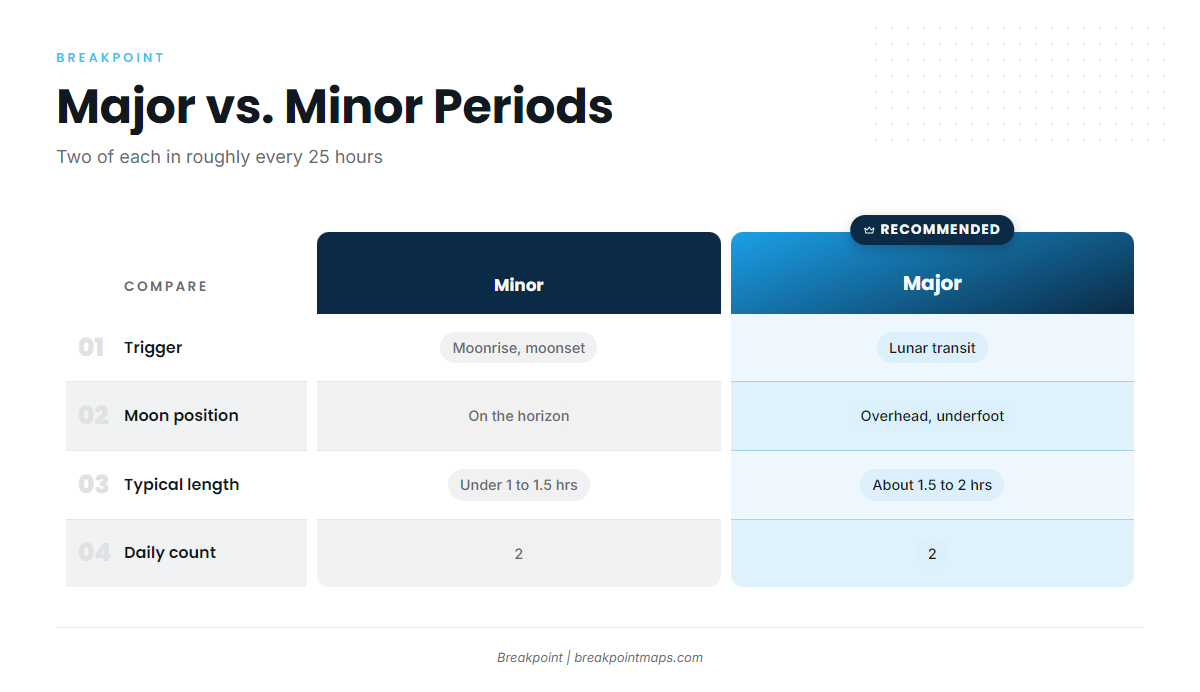
A solunar table forecasts major and minor feeding periods, calculated from the moon’s position and phase for a specific location. Each day lists two majors and two minors, and anglers use them to time a trip. It works something like a tide table for the moon’s position: precise about the moon, silent about the water.
| Period | Trigger | Moon position | Typical length |
|---|---|---|---|
| Major | Lunar transit | Overhead or underfoot | About 1.5 to 2 hours (some apps stretch to 3.5) |
| Minor | Moonrise and moonset | On the horizon (some tables describe this as the moon "to the sides") | Under 1 hour to about 1.5 hours |
Two majors and two minors fall in roughly every 25 hours, so the typical major and minor periods shift about 1 hour later each day. Most tables list the durations as ranges rather than fixed values.
Where did solunar theory come from?
John Alden Knight laid out the theory in 1926 and published the first table in 1936. John Alden Knight’s solunar theory combined angling folklore with the positions of the sun and moon.
Knight also reviewed record catches and reported that about 90% came near the new moon and inside solunar periods. That figure comes from Knight’s own record-catch analysis. It is his claim, not a measured result.
Hunters use the same tables to time deer movement. A solunar calendar is the same math laid out as a monthly view for long-range planning.
How are solunar tables calculated?
The astronomy is deterministic. Four inputs drive every table:
- Lunar transit, upper and lower. This sets the majors.
- Moonrise and moonset. These set the minors.
- Your latitude and longitude. The windows are calculated for a location.
- Your time zone. This puts the windows on your clock.
Location matters. A table for the inlet differs from one 60 miles out by minutes. Offshore, the window is calculated for the coordinates, not the ramp.
A solunar window is an astronomical calculation, not an observation of fish.
How do day ratings work?
Ratings turn the moon’s phase and position into a single score for the day. Apps show them as stars or 0 to 100 scores, and each provider weights the inputs differently, which is why two apps can disagree on the same day.
| Factor | Effect on rating |
|---|---|
| Phase near new or full moon | Raises it |
| Perigee or supermoon | Raises it in some tables |
| Window overlapping sunrise or sunset | Raises it |
| First or third quarter moon | Lowers it |
Perigee puts the moon closer and raises tide range. That is a tidal effect, and perigee itself is not shown to improve catches.
The dawn and dusk boost has a reason. Light change is a widely recognized feeding trigger, and many tables raise ratings when a window overlaps it.
A rating describes the moon, not the fish. So what does the evidence say?
Does solunar theory hold up?
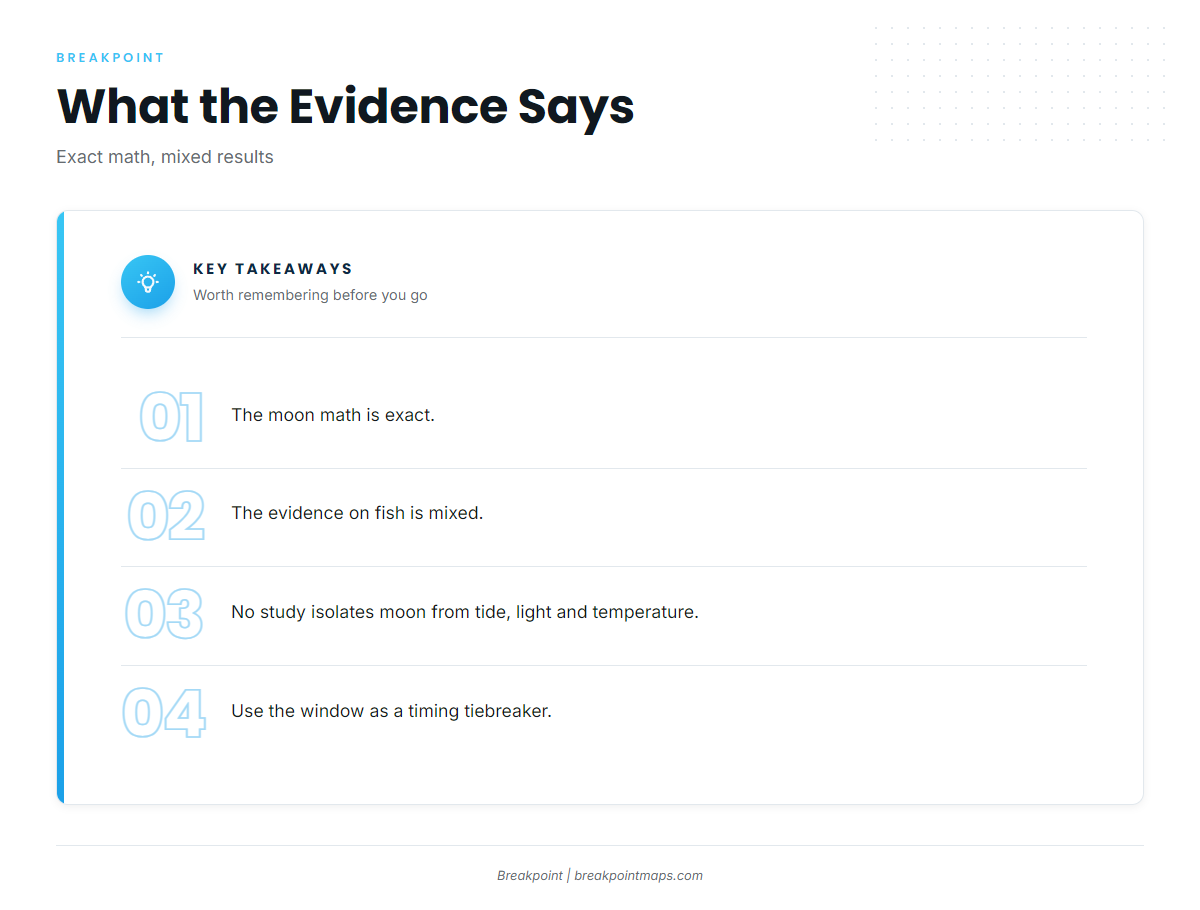
The evidence is mixed. A solunar rating tells you about the moon, and the research on whether it also tells you about the fish does not settle the question.
Two things hold across the research:
- No controlled study cleanly isolates moon position from tide, light, water temperature and bait.
- Results vary by species and water.
Experienced anglers split. Saltwater Sportsman argues that tables work offshore too, tying them to tides, currents and structure. Carolina Sportsman calls the tables a useful predictor but not the final word. Both are opinion, and neither is controlled evidence.
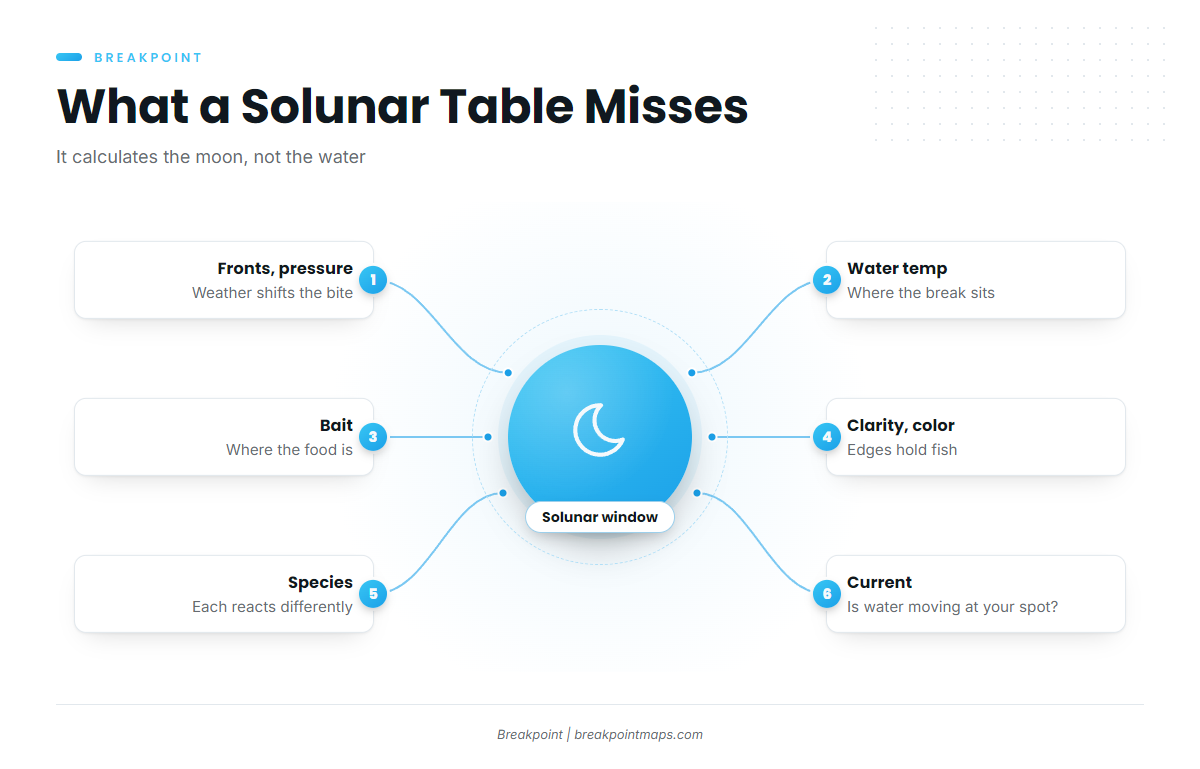
What a solunar table cannot see
The table knows the moon. It does not know:
- Weather fronts and barometric pressure
- Water temperature and where the break sits
- Bait
- Clarity and color
- Species differences
- Whether the current is moving at your spot
Why does it sometimes seem to work?
Three things explain most of it: tide, light and memory.
The moon’s real lever is the tide
New and full moons drive spring tides and stronger current. In-Fisherman notes that snook and redfish have spawns timed to lunar tides, because stronger tidal flow carries eggs to favorable habitat.
The same effect shows up on real water. The NOAA Coast Pilot current notes report strong current around Cape Romano Shoals off Marco Island, particularly on the seaward side during spring tides, with the flood setting south and the ebb north. The same publication describes very strong tidal current between Race Point and Highland Light off Provincetown. Both are readable on a tide table.
Light
Majors that land on dawn or dusk borrow credit from low light. The bite may be the light, with the moon getting the credit.
Memory
Anglers remember the hits and forget the misses. That is confirmation bias, and it props up every timing rule, solunar or not.
How does Breakpoint show bite times?
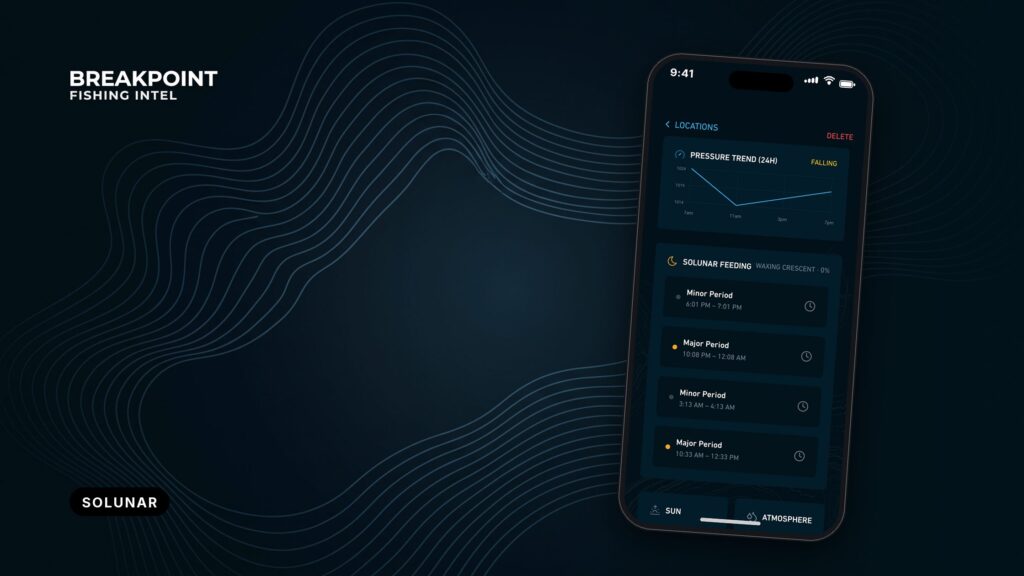
Breakpoint calculates bite windows for the spot you select. You read them alongside the conditions layers, not in place of them.
The two kinds of information differ. The bite window is calculated from the moon, while OBS SST, Chlorophyll and Chart Contours are observed or surveyed. The window tells you when the moon is in position; the layers show where the water is doing something.
Timing is not location. How Breakpoint scores fishing hotspots rests on temperature breaks, chlorophyll and structure, and the bite window only answers when. We never present the windows as a prediction of catches. They are a timing input.
Open the map, pick your spot, and read the bite window against OBS SST and the tide.
How to use bite times on a trip
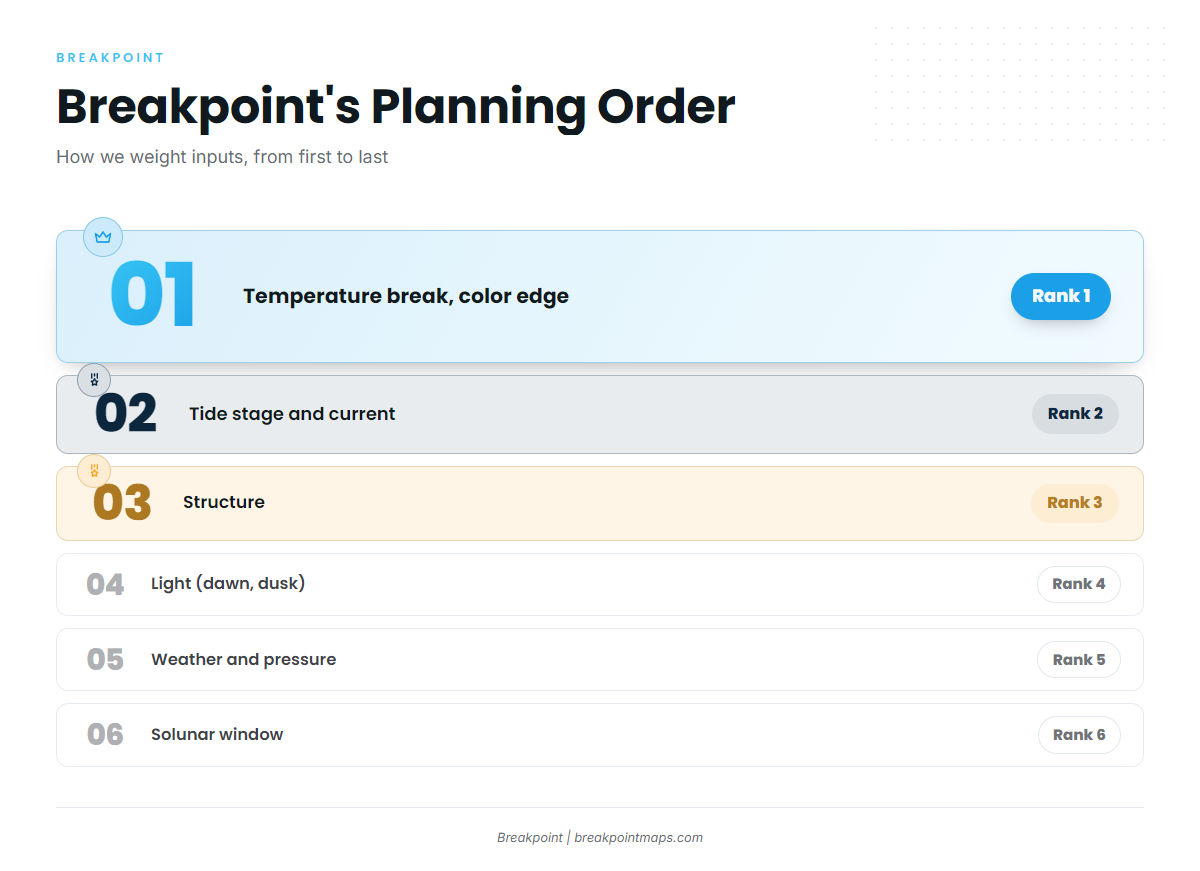
Below is Breakpoint’s planning order. It reflects how we weight inputs when planning a trip and is not a measured result.
| Rank | Input | What it tells you |
|---|---|---|
| 1 | Temperature break and color edge | Where bait and fish stage |
| 2 | Tide stage and current | When water moves over the spot |
| 3 | Structure | Where fish hold |
| 4 | Light (dawn, dusk) | Feeding trigger |
| 5 | Weather and pressure | Context, including fronts |
| 6 | Solunar window | Tiebreaker for timing |
A hypothetical shows how the tiebreaker works. Two days look equal, with the same 76-degree edge over the same ledge. On one, a major window overlaps first light and a moving tide. That day gets the nod. This is an illustration, not a report.
Work through it in this order:
- Find the break. Locate it on OBS SST and confirm color on Chlorophyll.
- Match it to structure. Check Chart Contours for the ledge, hump or edge.
- Check tide stage and current. Do it for that spot, not the nearest port.
- Read the marine forecast numbers. Get wind, wave height and period from the National Weather Service forecast.
- Note sunrise and sunset. Light change is a trigger worth lining up.
- Use the bite window as a tiebreaker. Choose between otherwise equal days or hours.
- Be set up early. Have lines in the water before the window opens.
A low rating is not a reason to skip a day when the water is right. Chart layers are not for navigation, so use your official charts and the forecast to run the trip.
Check the break first, then the clock.
Frequently Asked Questions
Do solunar tables work?
The evidence is mixed. The moon math is exact, but no controlled study isolates moon position from tide, light and temperature. Anglers report results, and the research does not settle it. Use the tables as a tiebreaker for timing, not as a reason to pick a day.
What is the difference between major and minor periods?
Majors follow lunar transit, when the moon is overhead or underfoot, and run about 1.5 to 2 hours. Minors follow moonrise and moonset and run under an hour to about 1.5 hours. Most tables give ranges, and some apps stretch the windows.
Are new and full moon the best days?
Tables rate them highest. The measurable effect is stronger spring-tide current, which moves more water over structure. Perigee raises ratings in some tables and raises tide range. Neither is shown to improve catches on its own.
Do solunar tables work offshore for tuna?
Experienced anglers report that they do, but no controlled evidence exists for pelagics. Offshore, the temperature break and the current decide where fish are. The window only refines when you fish that water.
Should I skip a low-rated day?
No, if the break, tide and structure line up. The rating describes the moon, not the water. A low-rated day over a clean temperature edge with moving current is still a day worth fishing.
Why do bite time apps disagree?
Each provider weights phase, perigee and dawn or dusk overlap differently, and some stretch the window lengths. The moon positions are the same, but the scoring on top of them differs.
Conclusion
The math is exact, the evidence is mixed, and the windows work best as a timing tiebreaker below temperature, tide and structure. That gives you a better decision about when to look, not a promise of fish.
If you want the break, the structure and the bite window on one map, download Breakpoint from the App Store or Google Play.
Check the break first, then the clock.