




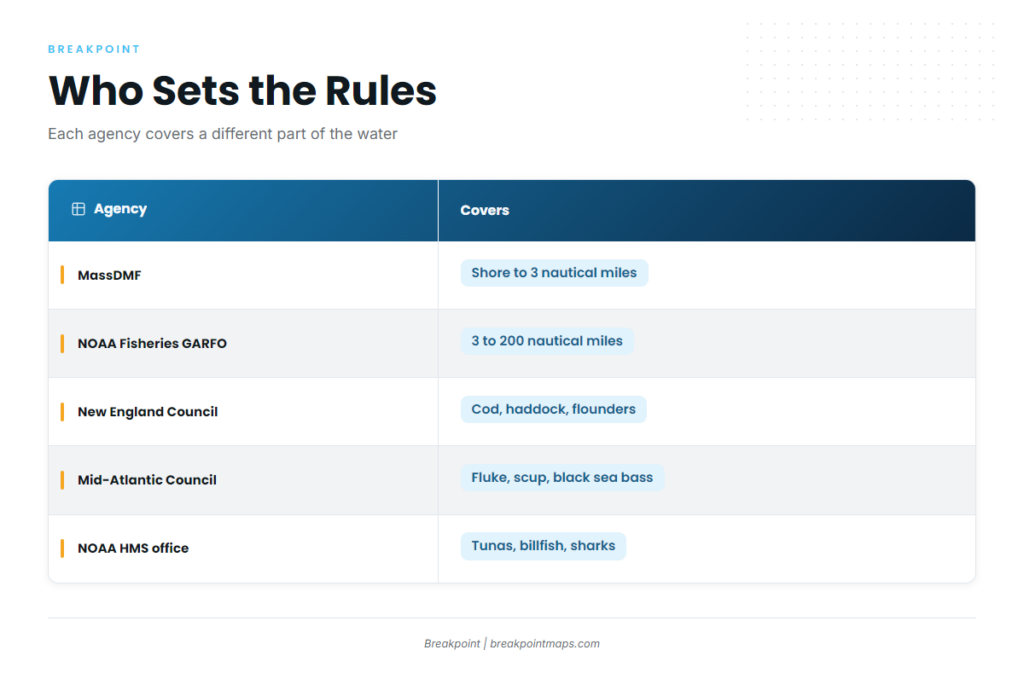
Massachusetts fishing regulations change at a line you can’t see, and the water runs from Stellwagen Bank, Cape Cod Bay, the Gulf of Maine and Georges Bank to the waters south of the Islands. The Massachusetts Division of Marine Fisheries (MassDMF) sets the rules from shore to 3 nautical miles. Federal agencies set them from 3 to 200 nautical miles, so the rule that applies depends on where the fish is caught. Below, each species lists its length, bag, season and gear rules, labeled by jurisdiction where they differ, with the agency page to check.
Massachusetts Fishing Official Government Organizations
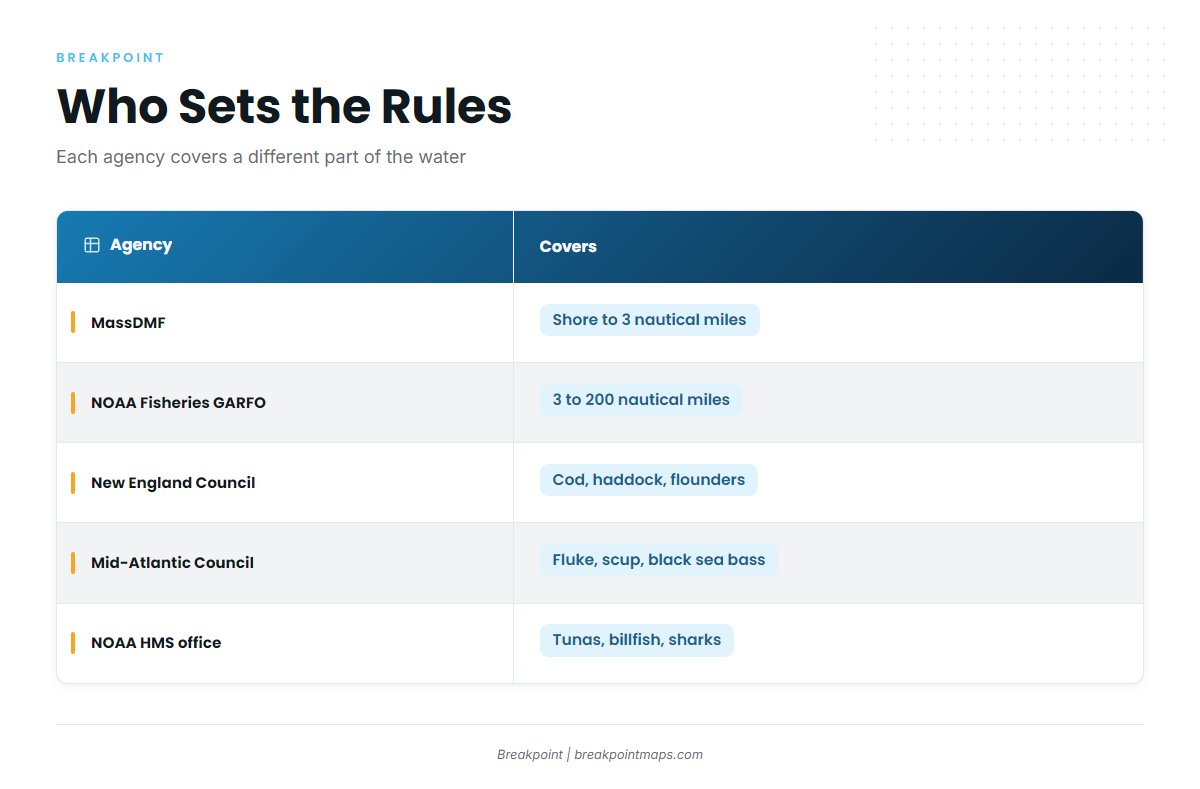
State water runs from shore to 3 nautical miles. MassDMF manages it under 322 CMR, and state water includes tidal water up to the first upstream bridge on rivers and streams. From 3 to 200 nautical miles is the federal Exclusive Economic Zone (EEZ), managed by NOAA Fisheries with two councils. The New England Fishery Management Council handles groundfish, and the Mid-Atlantic Fishery Management Council handles fluke, scup, black sea bass, bluefish, mackerel and tilefish. The rules sit in 50 CFR part 648, with dolphin and wahoo in part 622. Tunas, billfish, swordfish and sharks are highly migratory species (HMS) and fall to the NOAA HMS office.
Your Massachusetts recreational saltwater fishing permit also covers federal waters from 3 to 200 nautical miles. An HMS permit is separate, though, and the state permit does not replace it. The state permit is also honored in the marine waters of Maine, New Hampshire, Rhode Island and Connecticut under the terms below, and the other state regulation pages cover the neighbors. Rules change by season and quota, so check the agency page before you fish.
- Massachusetts Division of Marine Fisheries (MassDMF) – Sets state-waters rules under 322 CMR and issues the recreational saltwater permit to every angler age 16 and older, from shore or a private vessel. The permit costs $10 for ages 16 to 59, residents and nonresidents alike, and $0 at age 60 and over (still required). It is not needed on a permitted for-hire vessel or under age 16, and it expires December 31.
- MassDMF reciprocity – A Massachusetts permit covers Maine waters for any resident, New Hampshire waters for non-New Hampshire residents, Rhode Island waters for any resident, and Connecticut waters for Massachusetts residents. In return, New Hampshire and Rhode Island permits cover Massachusetts waters for non-Massachusetts residents, and a Connecticut permit covers Connecticut residents.
- MassDMF For-Hire Saltwater Fishing Permit – Every Massachusetts for-hire captain needs one, and in state waters captains report to MRIP when contacted.
- NOAA Fisheries Greater Atlantic Regional Fisheries Office (GARFO) – Sets federal-waters rules under 50 CFR 648 and 622. For-hire vessels need a federal charter/headboat permit and an operator permit for non-HMS species, and they file an eVTR within 48 hours of every trip, including trips in state waters.
- New England Fishery Management Council – Develops the groundfish rules for cod, haddock, pollock, flounders and halibut.
- Mid-Atlantic Fishery Management Council – Develops the rules for fluke, scup, black sea bass, bluefish, mackerel and tilefish.
- NOAA Highly Migratory Species office – Manages tunas, billfish, swordfish and sharks. Private boats need the HMS Angling permit and for-hire vessels need the HMS Charter/Headboat permit (see the NOAA HMS permits page), with catch reported to NOAA Fisheries within 24 hours of landing. An HMS permit holder fishing only federal waters needs no Massachusetts permit unless they transit state waters with the fish, fish state waters, or land in Massachusetts.
Massachusetts Offshore Fishing Regulations by Species
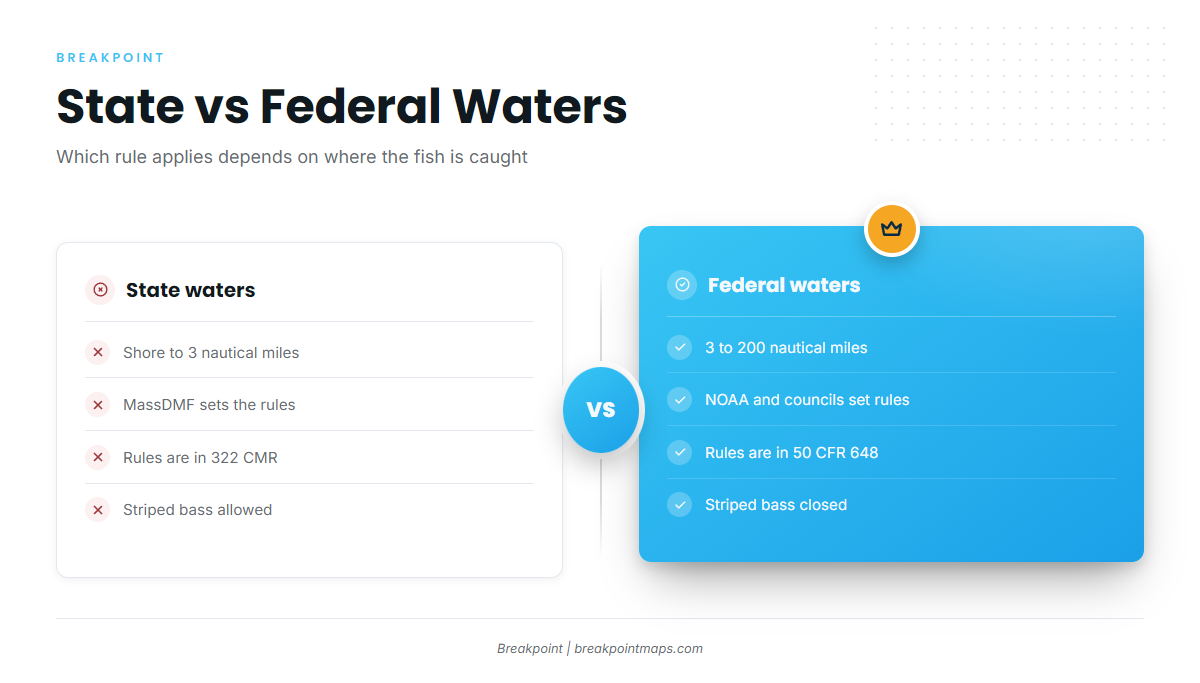
These regulations cover the grounds of the Gulf of Maine and Georges Bank, Stellwagen Bank and the waters south of the Islands. A species can be governed in five ways. Cod carries one rule shared by both jurisdictions. Haddock, scup and sharks carry different state and federal rules. Fluke and black sea bass are waived in federal waters to the landing state. Striped bass is closed in federal waters. Tunas, tilefish, mahi-mahi and wahoo are federal only.
Bullets are labeled "State waters:" and "Federal waters:" where the two differ. In state waters, lengths are total length unless stated, and limits are per angler per day unless stated. The Mass.gov recreational limits table is the primary source for every state figure below.
Cod and groundfish closures carry dates. In state waters, the Winter Cod Conservation Closure runs November 15 to January 31, and hook-and-line fishing is unlawful there. The Spring Cod Conservation Closure runs April 16 to July 21, and taking cod is unlawful there. In federal waters, the GOM Cod Spawning Protection Area closes April through June. The Winter Massachusetts Bay Spawning Protection Area closes November 1 to January 31, and the Spring Massachusetts Bay Spawning Protection Area closes April 15 to April 30. See 322 CMR 8.07 and 50 CFR 648.81 for the maps, the boundaries and the pelagic hook-and-line exemption conditions.
Striped bass
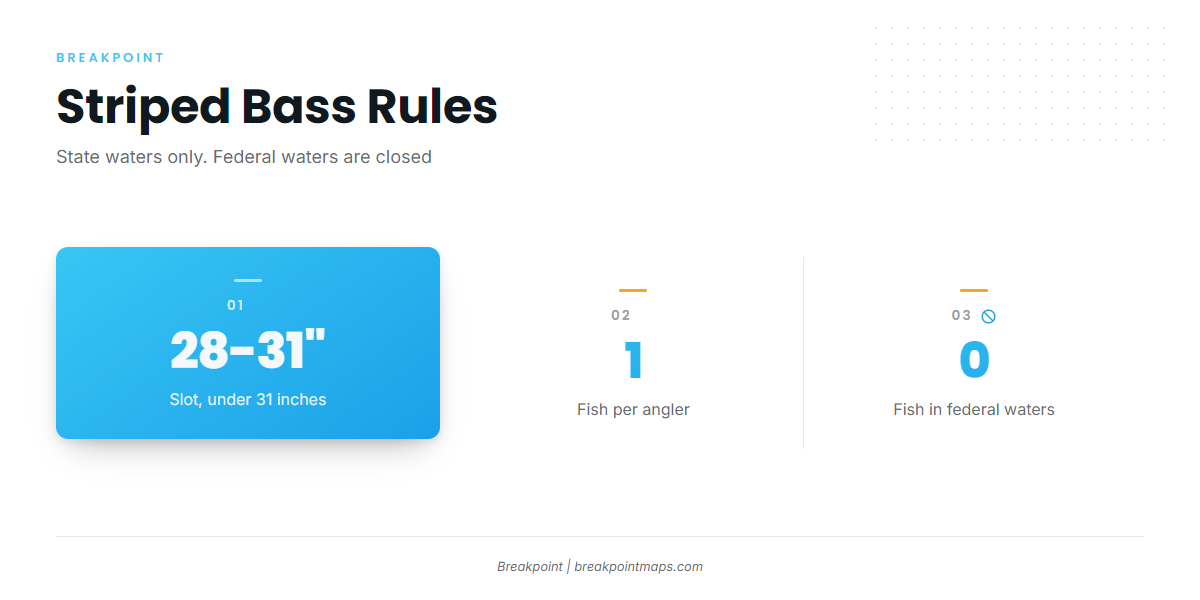
Striped bass stay inside 3 miles. Federal waters are closed to them, and fishing for, possessing or retaining striped bass in the EEZ is unlawful.
- LengthThe slot runs 28 inches to less than 31 inches. Measure from the snout or jaw tip, mouth closed, to the farthest tail extremity with the tail squeezed.
- Bag limit1 fish.
- SeasonYear round in state waters. Closed in federal waters.
- Gear and permitsInline circle hooks are required with whole or cut natural bait, but not with bait attached to an artificial lure such as a tube and worm. No gaffing; use a non-lethal device to lift fish from the water. Releasing a dead legal fish, high-grading, and holding a fish alive on a stringer, in a live well or in a holding car are all unlawful. Keep the fish whole until you are on shore with gear stowed, though gutting, bleeding and scaling are allowed. On shore, you may cut 2 fillets per angler, each with 2 square inches of skin. Spearfishing for striped bass is not allowed.
Mass.gov recreational limits table
Atlantic cod
Cod follows one rule shared by both jurisdictions. In state waters, the Western Gulf of Maine means water north of Cape Cod, down the backside of the Cape and east of Nantucket, west of the 70th meridian. Southern New England means water south and west of Cape Cod.
- Length23 inches.
- Bag limit1 fish per person per day.
- SeasonState waters: Western Gulf of Maine, September 1 to October 31. Federal waters: for private vessels, September 1 to October 31 in the Western and Eastern Gulf of Maine and Georges Bank stock areas. Southern New England is closed, with no retention, in both jurisdictions.
- Gear and permitsCharter and party vessels: see 50 CFR 648.89(c)(2). The state Winter and Spring Cod Conservation Closures apply in state waters, as covered above.
Haddock
State and federal rules differ, so check which side of the line you are on.
- LengthState waters: 17 inches in the Gulf of Maine, 18 inches in Southern New England. Federal waters: 17 inches inside the Gulf of Maine Regulated Mesh Area, 18 inches outside it.
- Bag limitState waters: 15 fish in the Gulf of Maine, no limit in Southern New England. Federal waters: Gulf of Maine haddock 15 per person per day, Georges Bank haddock no limit.
- SeasonState waters: Gulf of Maine, April 1 to February 28; Southern New England, year round. Federal waters: Gulf of Maine haddock is open May 1 to February 28 (or 29) and April 1 to April 30, and closed March 1 to March 31. Georges Bank haddock is open all year.
- Gear and permitsA vessel may transit between stock areas with legal cod and haddock if bait and hooks are off the rods and the fish are gutted and stored.
Mass.gov recreational limits table and federal rules in 50 CFR 648
Pollock, redfish, halibut and flounders
State waters set few minimums, and federal waters set more.
- LengthState waters: pollock, redfish, monkfish and spiny dogfish have no minimum. Atlantic halibut 41 inches, winter flounder 12, yellowtail flounder 13, dab (plaice) and gray sole 14. Federal waters: pollock 19 inches, redfish 9, winter flounder 12, yellowtail 13, American plaice and witch flounder 14, white hake no size, Atlantic halibut 41.
- Bag limitState waters: most are no limit. Atlantic halibut 1 fish. Winter flounder 8 in the Gulf of Maine and 2 in Southern New England. Federal waters: no possession limit. Atlantic halibut 1 per vessel.
- SeasonYear round, except Southern New England winter flounder in state waters, open March 1 to December 31.
- Gear and permitsProhibited, release: ocean pout, windowpane flounder and wolffish in state waters; northern and southern windowpane, ocean pout and Atlantic wolffish in federal waters. Federal gear rules: one line per angler, with other gear stowed. Federal fillets need 2 square inches of contiguous skin, and 2 fillets count as 1 fish. Selling recreational groundfish is unlawful.
Mass.gov recreational limits table
Summer flounder
Federal rules waive fluke to the landing state through conservation equivalency. Vessels fishing federal waters and landing in Massachusetts follow Massachusetts limits.
- Length17.5 inches from a vessel. 16.5 inches from shore.
- Bag limit5 fish.
- SeasonMay 24 to September 23.
- Gear and permitsParty and charter vessels carrying passengers for hire need a federal charter/party permit for the species (50 CFR 648.4).
Mass.gov recreational limits table
Black sea bass
The federal measures for black sea bass are waived to the landing state, as for fluke.
- Length16 inches, measured to the farthest tail extremity without the tail filament.
- Bag limit4 fish from May 16 to August 31. 2 fish from September 1 to October 14.
- SeasonMay 16 to October 14. Closed at other times.
- Gear and permitsFish may be filleted but not skinned at sea, with no more than 2 fillets per allowed fish. For-hire vessels need a federal charter/party permit.
Mass.gov recreational limits table
Scup
Limits differ by jurisdiction.
- LengthState waters: 11 inches from a private or for-hire vessel, 9.5 inches from shore. Federal waters: 10 inches total length.
- Bag limitState waters: 30 fish. For-hire vessels may keep 40 fish from May 1 to June 30, then 30. A private vessel with 5 or more anglers has a 150-fish vessel limit. Federal waters: 40 per person per trip.
- SeasonState waters: May 1 to December 31. Federal waters: January 1 to December 31.
- Gear and permitsFederal permit holders on a for-hire trip follow the more restrictive of the state and federal measures. Fish may be filleted but not skinned at sea, with 2 fillets per fish.
Mass.gov recreational limits table and federal rules in 50 CFR 648
Bluefish
The figures match across jurisdictions.
- LengthNo minimum size.
- Bag limit5 fish from shore or a private vessel. 7 fish on a for-hire vessel. In federal waters, the 7-fish figure applies to vessels holding a federal bluefish charter/party permit.
- SeasonYear round.
Mass.gov recreational limits table
Atlantic mackerel
Mackerel carries different state and federal bag limits.
- LengthNo minimum size.
- Bag limitState waters: 25 fish from shore or a private vessel, 50 on a for-hire vessel, as a daily and possession limit while fishing. Federal waters: 25 per person per trip on private vessels. 50 per person including captain and crew on vessels with a squid/mackerel/butterfish charter/party permit when carrying passengers for hire, and 25 when not.
- SeasonYear round.
Mass.gov recreational limits table
Atlantic bonito and false albacore
These are state-waters limits for fish caught and possessed in state waters.
- Length16 inches curved fork length, measured along the body contour from the upper jaw tip to the tail fork.
- Bag limit5 fish, both species combined.
- SeasonYear round.
Mass.gov recreational limits table
Golden and blueline tilefish
Tilefish is federal only, within the Tilefish Management Unit.
- LengthNo federal minimum size.
- Bag limitGolden tilefish, 8 per angler per trip. Blueline tilefish depends on the vessel: private vessels 3, uninspected for-hire vessels 5, Coast Guard inspected for-hire vessels 7.
- SeasonGolden tilefish all year. Blueline tilefish May 15 to November 14.
- Gear and permitsPrivate vessels need a federal recreational tilefish permit. For-hire vessels need a charter/party tilefish permit. Golden tilefish by rod and reel only, with at most 5 hooks per rod.
federal tilefish recreational rules
Mahi-mahi and wahoo
These species are not on the MassDMF table. Federal Atlantic rules apply in the EEZ.
- LengthNo federal minimum off Massachusetts. The 20-inch fork length minimum applies off Florida, Georgia and South Carolina.
- Bag limitDolphin, 10 per person per day, not more than 54 per vessel, whichever is less. On a headboat, 10 per paying passenger. Wahoo, 2 per person per day.
- SeasonYear round.
- Gear and permitsKeep heads and fins intact; eviscerating, gilling and scaling are allowed. A charter vessel or headboat needs an Atlantic dolphin and wahoo charter/headboat permit and must report electronically.
federal dolphin and wahoo limits
Sharks
Sharks are counted differently on each side of the line.
- LengthState waters: 54 inches. Hammerheads 78 inches. No minimum for Atlantic sharpnose, bonnethead, smooth dogfish, blacknose or finetooth. Federal waters: 54 inches fork length. Hammerheads 78 inches. No size limit for Atlantic sharpnose, bonnethead and smoothhound sharks. Head, tail and fins stay naturally attached.
- Bag limitState waters: 1 shark per trip. Atlantic sharpnose, bonnethead and smooth dogfish count in the total, plus 1 additional. Federal waters: 1 shark per vessel per trip from the permitted list, plus 1 Atlantic sharpnose and 1 bonnethead per person per trip.
- SeasonSee the NOAA HMS page. Shortfin mako is zero retention at the start of each fishing year unless NOAA adjusts it.
- Gear and permitsState waters: circle hooks are required on any line targeting sharks, except flies and artificial lures. Federal waters: non-offset, corrodible circle hooks are required, and an HMS permit with a shark endorsement is required. Prohibited, release at once: silky, sandbar, sand tiger, white, dusky, longfin and shortfin mako, bigeye thresher, oceanic whitetip and the others on the DMF list. From the northernmost point of Plymouth Beach around Cape Cod Bay and the Outer Cape, including Monomoy Island and Chatham Harbor, shore anglers may not fish a baited hook with a gap over 5/8 inch together with a wire or metal leader over 18 inches. Chumming from shore with that gear is prohibited statewide from sunrise to sunset. Do not possess oceanic whitetip or great, scalloped or smooth hammerhead sharks while holding tunas, billfish or swordfish.
Mass.gov recreational limits table and federal shark retention limits
Bluefin and other tunas, billfish and swordfish
Bluefin tuna and the other tunas, billfish and swordfish are managed by the NOAA HMS office. Massachusetts sets no separate limit on yellowfin tuna, bigeye tuna or the rest of these species.
- LengthSee the NOAA HMS page.
- Bag limitSee the NOAA HMS page.
- SeasonSee the NOAA HMS page.
- Gear and permitsPrivate boats need the HMS Angling permit. For-hire vessels need the HMS Charter/Headboat permit, reporting within 24 hours of landing. The Massachusetts permit does not replace either. Sharks and these species may not be held together where the shark prohibition above applies.
NOAA HMS permits page