




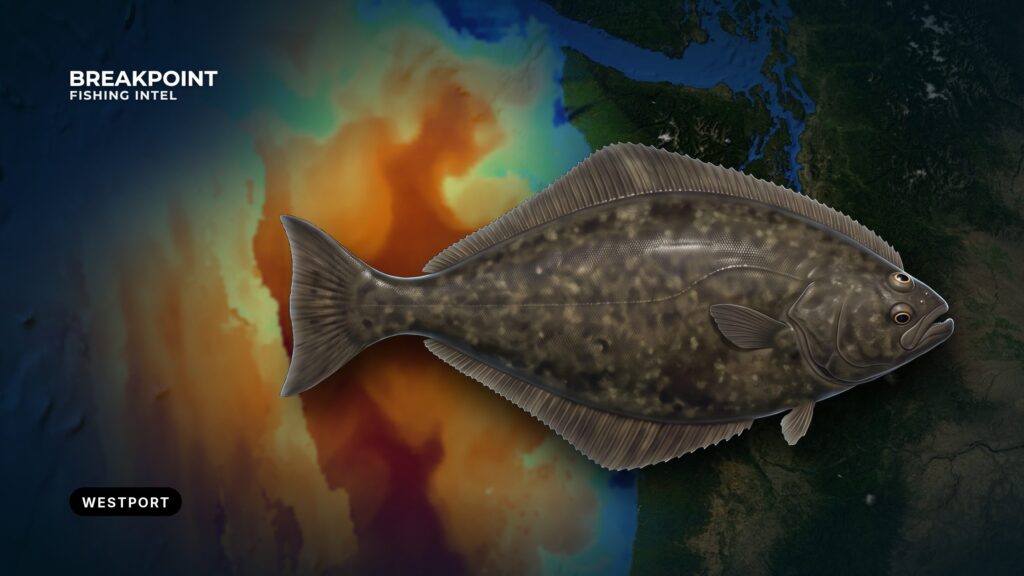
Pacific halibut fishing off Westport means running your own boat across the Grays Harbor Bar into Marine Area 2, the water WDFW manages from Leadbetter Point north to the Queets River. Westport Marina, at the mouth of Grays Harbor, is the main access. This page covers the launch and the bar, the grounds, how the season runs, tactics for this water, and the rules.
Biology, gear and coast-wide habits are in our Pacific halibut fishing guide. This page keeps to Westport. Three things decide the trip before the fishing starts: the bar, the run and the open day.
Westport and the water it opens
Westport Marina sits at the mouth of Grays Harbor and is described as Washington’s largest fish landing port. WDFW says Marine Area 2 is accessed primarily from the Port of Westport, and lists Pacific halibut among Westport’s summer species, alongside Chinook and coho salmon. According to WDFW’s port description, guided charters run roughly 25 to 50 miles offshore for halibut.
Two names describe the same water:
- Marine Area 2 (Westport-Ocean Shores): WDFW’s management area, from Leadbetter Point north to the Queets River.
- South Coast subarea of IPHC Area 2A: the name the federal Catch Sharing Plan uses for halibut in that water.
The official boundary runs from the Queets River at 47°31.70′ N to Leadbetter Point at 46°38.17′ N.
Launching and the Grays Harbor Bar
The bar decides whether the trip happens, so read it before planning any drift.
Launch and fuel
Two public options serve Marine Area 2 here:
- 28th Street Ramp on Grays Harbor, in Marine Area 2-2.
- Westport Marina, run by the Port of Grays Harbor, with fuel listed at the marina.
Launch lines at the Port of Westport can run long on weekend mornings when the fishing is good, so plan your launch time around that and around the tide. WDFW recommends a local experienced guide for first trips.
Reading the bar
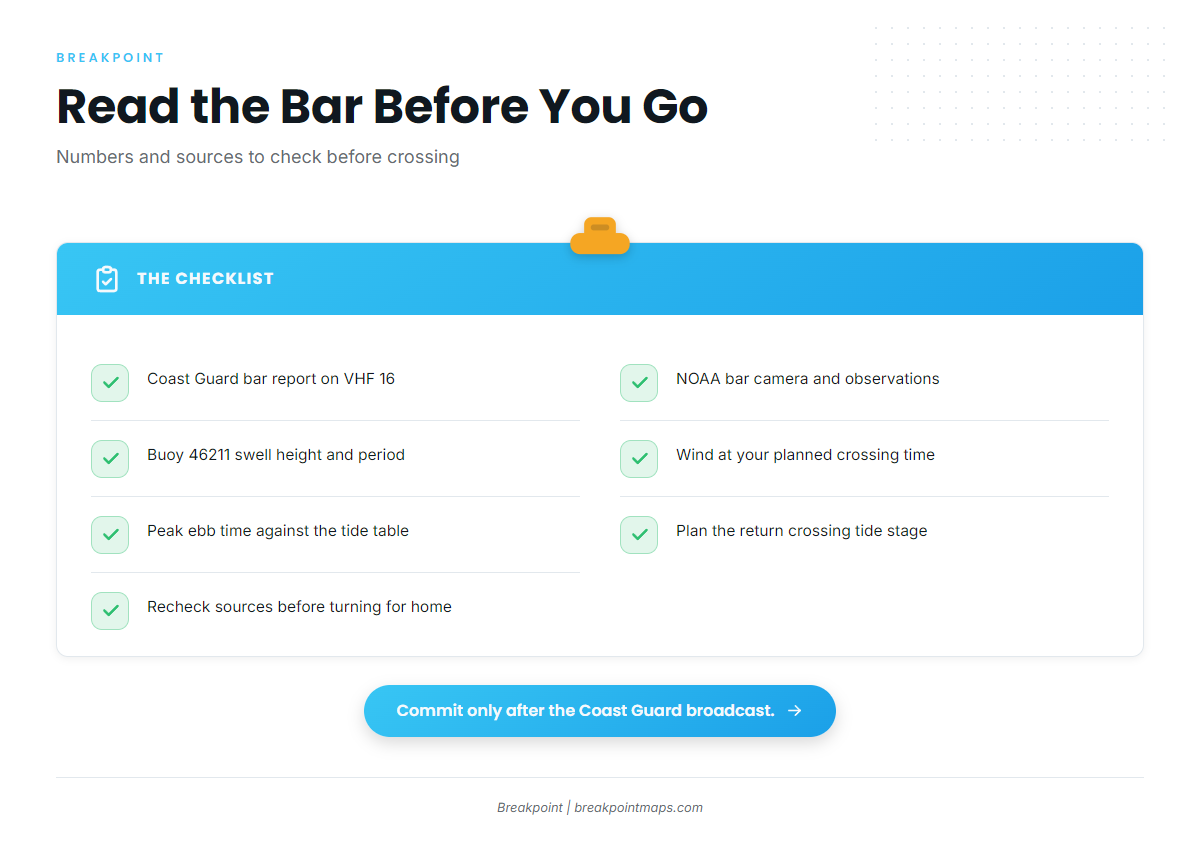
Experienced boaters plan around the Grays Harbor Bar and avoid crossing it during peak outgoing tide. The combination to watch is peak ebb with high swell, because an ebb running out against incoming swell steepens the seas on the bar. Check the outbound and return crossings against the tide table, not just the open day.
The sources to read are collected on the Port of Grays Harbor safety page:
- United States Coast Guard bar conditions and weather on VHF Channel 16.
- The NOAA bar camera images and latest observations.
- NOAA National Data Buoy Center Station 46211.
Read swell height and period at buoy 46211, the wind, and the time of peak ebb against your planned crossing. Then check the Coast Guard broadcast before you commit.
The return needs the same attention. On a long run, the afternoon tide stage and the wind matter as much as the morning ones, so check the sources again before you turn for home.
Where halibut hold off Westport
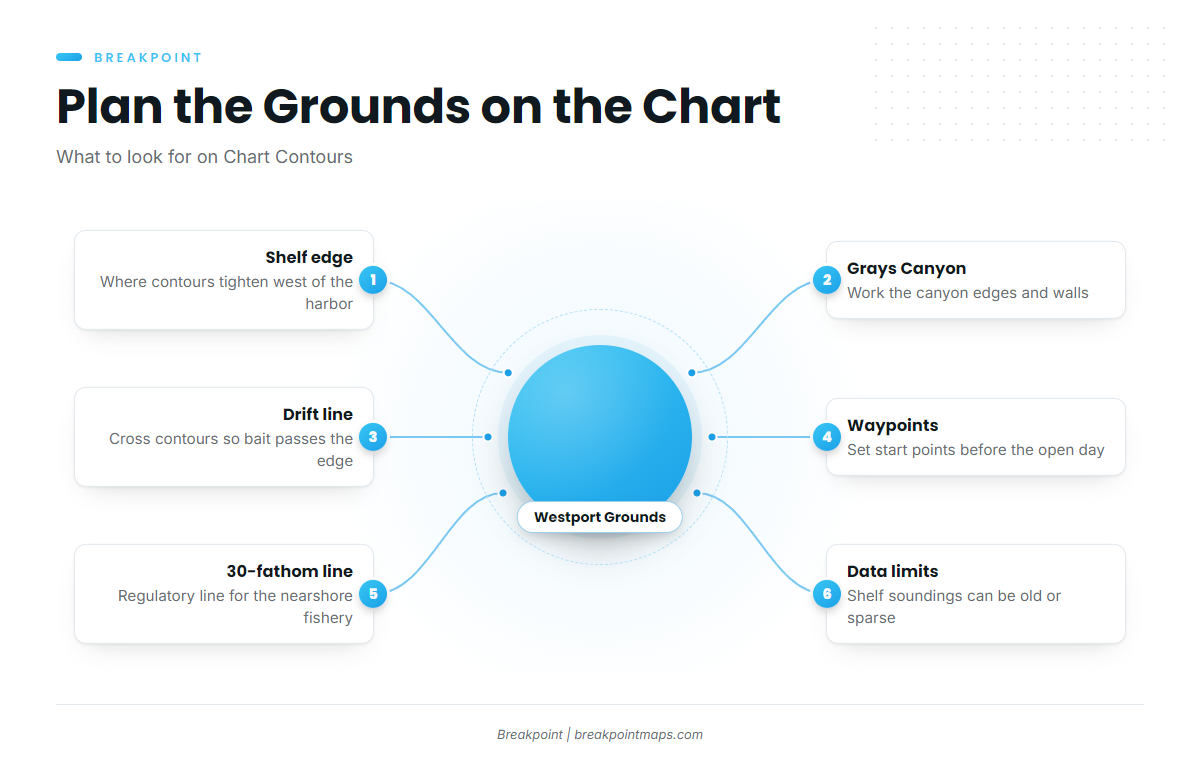
Halibut effort off Westport centers on the edge of the continental shelf and the edges of Grays Canyon, to the west and northwest of the harbor.
Edges matter for planning because they concentrate the places a drift can cross something. Look for where contours tighten along the shelf break and canyon walls, and for the transitions your drift line will pass over. A contour shows shape, not fish, but shape is where you start.
The South Coast subarea has two halibut fisheries:
- An all-depth fishery.
- A northern nearshore fishery between 47°31.70′ N and 46°58.00′ N, inside a line approximating the 30-fathom line.
WDFW sets each year whether and when each one opens. The Regulations section below points to where that is published.
Yelloweye rockfish conservation areas sit inside these grounds. Under the federal rule, halibut fishing is allowed inside the South Coast and Westport Offshore yelloweye rockfish conservation areas. Yelloweye retention is prohibited in all marine areas. Check WDFW for groundfish rules inside those areas before you fish them.
A chart cannot show where the fleet sits on a given open day, and offshore soundings along the shelf edge can be old or sparse. Treat every contour as a plan, not a promise.
Build the run and drift plan on the Chart Contours layer before the open day. Set waypoints along the shelf edge and canyon edges, and draw a drift line across the contours. How Fish Intel species pages work shows how we read structure for each species. Chart layers are not for navigation, but learning the grounds on the chart before you tow in saves fuel and time on a limited open day.
How the season works
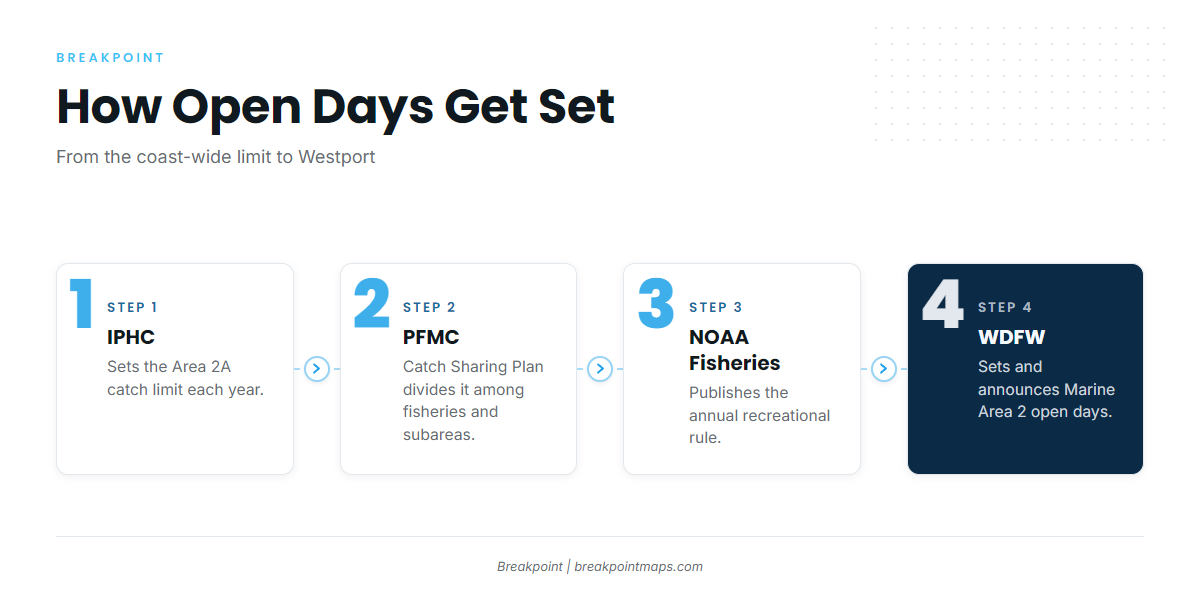
The limits flow down a chain:
- The IPHC sets the Area 2A catch limit each year.
- The Pacific Fishery Management Council’s Catch Sharing Plan divides it among fisheries and recreational subareas.
- NOAA Fisheries publishes the annual recreational rule, and WDFW sets Marine Area 2 open days inside the South Coast allocation.
The South Coast fishery is managed to a quota. Open days are limited and announced by WDFW, and the fishery closes when the quota is taken. If quota remains after the early season, WDFW may reopen it in late summer, at times up to 7 days a week.
Halibut count against the subarea of the port where they are landed, so a fish brought into Westport counts against the South Coast.
The open-day calendar changes every year. Plan the trip from the WDFW seasons page and emergency rules, then pick the day by bar and buoy numbers.
Tactics for this water
The tactics here follow the conditions: a long run, swell, current and a limited window.
Boat control and the drift
Drift across the shelf edge and canyon contours rather than along them, so the bait passes over the edge. A drift sock slows the boat in wind. When the drift carries you off the structure, pick up and re-run the line from your waypoint start. Keep the line near vertical, and when scope builds, pick up and reset.
Bait versus jig
Choose by drift speed and your ability to hold bottom contact:
- Bait on a spreader bar is the standard drift rig on this coast.
- Heavy metal jigging is a common alternative.
Gear is limited to one line with up to 2 hooks. Rig and gear detail is in the species guide.
Tide and wind windows
Tie your fishing time to your bar crossing times. Slack and softer tide stages make drifts more manageable, while wind against current speeds the drift. Watch swell and period at buoy 46211 through the day to plan the return.
Landing and release
- A gaff may be used only on halibut or lingcod that will be kept.
- Rockfish come up on the halibut grounds. A descending device must be on board and rigged for immediate use when fishing for or holding bottomfish or halibut. Use it to return released rockfish to depth.
- Yelloweye must be released.
FAQ
Do I need a charter to fish halibut out of Westport?
No. Private boats fish the same open days. WDFW recommends a local experienced guide for a first trip, mainly because of the Grays Harbor Bar. Read the Coast Guard, bar camera and buoy 46211 sources before any crossing.
Who announces the open days?
WDFW sets the days inside the federal South Coast allocation and announces openings and closures. The WDFW seasons and quotas page and its emergency rules are the places to check before each trip.
Can I keep lingcod on a halibut day?
Lingcod may not be fished seaward of the line approximating 30 fathoms in some months. Retention seaward of that line is allowed on days the primary halibut season is open. Confirm the months on the WDFW South Coast page.
Do Oregon anglers need a Washington license?
Anglers 16 and older need a valid Washington license, and nonresident licenses are available. You also need a catch record card with the halibut option. Fish delivered into Washington fall under Washington rules. Oregon and Washington license reciprocity applies only within 3 miles of shore between Cape Falcon and Leadbetter Point, so it does not cover Westport’s halibut grounds. WDFW licensing is at (360) 902-2464.
What if I land at Ilwaco, La Push or Neah Bay instead?
Halibut count against the subarea of the landing port. Ilwaco is in Marine Area 1, the Columbia River subarea. La Push and Neah Bay are in the North Coast subarea, where halibut fishing is prohibited inside the North Coast Yelloweye Rockfish Conservation Area. Halibut may not be landed at a port in an area closed to halibut.
Is a descending device required?
Yes. It must be on board and rigged for immediate use when fishing for or holding halibut or bottomfish. Under federal groundfish rules, it must also be available to show an enforcement officer.
How do I record my fish?
Record each kept halibut in ink on the card, or in the electronic card, before you fish again. Do not record released fish. Return the card by April 30, even if you caught nothing.