




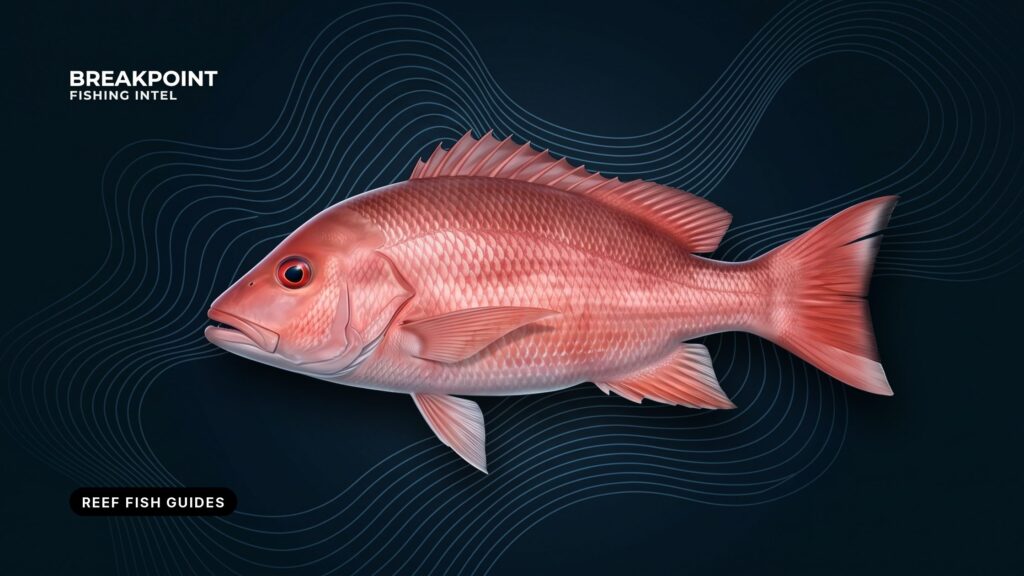
These guides cover fish caught on wrecks, rigs, artificial reefs and hard bottom in US waters. They do not cover coral reef or aquarium fish. The species are red snapper, vermilion snapper, gag, red grouper, gray triggerfish, greater amberjack and black sea bass. This page shows which structure and depth each fish uses, how to tell it from the fish you cannot keep, which agency sets the rules and which guide to read next. For pelagics or inshore fish, start with the saltwater fish species guides.
How the Main Reef Fish Compare
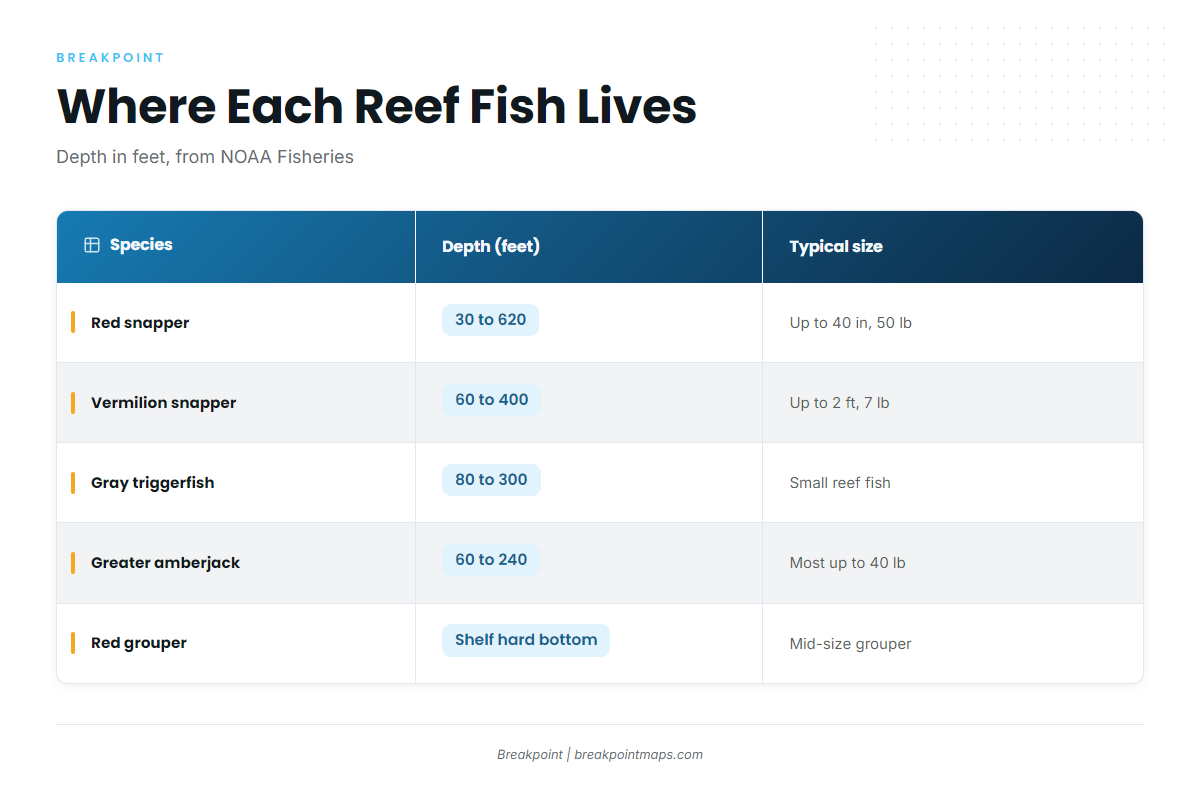
The table shows where each fish lives, how big it gets and how it is usually fished.
| Species | Family | Typical structure | Depth (feet) | Typical size | Common approach | Eating notes | Where it’s found |
|---|---|---|---|---|---|---|---|
| Red snapper | snapper (Lutjanidae) | Artificial reefs, rocks, ledges, wrecks, limestone. | 30 to 620 in the Gulf. | Up to 40 inches and 50 pounds. Lives up to 57 years. | Dead sardines or cigar minnows on a bottom rig. | Prized table fish, mild and white. | Gulf and South Atlantic. Rare north of the Carolinas. |
| Vermilion snapper | snapper (Lutjanidae) | Rock, ledges, live bottom, gravel near the shelf edge. | 60 to 400. Most abundant shallower than 180. | Up to 2 feet and 7 pounds. | Small hooks and small cut bait. Schools come up off the bottom. | Good eating. | Gulf and South Atlantic. |
| Gag | grouper (Serranidae) | Ledges and hard bottom. | Inshore hard bottom to deep ledges. | Large grouper. | Big live bait, heavy tackle, pull it away from the hole. | Firm white fillets. | Gulf and South Atlantic. |
| Red grouper | grouper (Serranidae) | Ledges, crevices, limestone reef, low-profile live bottom. | Shelf hard bottom. | Mid-size grouper. | Live or cut bait on the bottom. | Firm white fillets. | Strongest on the eastern Gulf and west Florida shelf. |
| Gray triggerfish | triggerfish (Balistidae) | Hard bottom, reefs, ledges, artificial reefs. Almost always found with red snapper. | 80 to 300 for adults. | Small reef fish. | Squid or cut bait, small very sharp hook, 20 to 50 pound line. | Tough skin, sweet meat. | Gulf and South Atlantic. |
| Greater amberjack | jack (Carangidae) | Reefs, rocky outcrops, wrecks. Oil and gas platforms in the northern Gulf. | 60 to 240. | Most up to 40 pounds, can reach 200. | Vertical jigs or big live bait. | Edible. Tapeworms may be cut away before cooking. | Gulf and South Atlantic. |
| Black sea bass | sea bass (Serranidae) | Wrecks, rock piles, nearshore hard bottom. | Nearshore hard bottom to offshore wrecks. | Small. | Bottom rig with squid or clam. | Fine white fillets. | Mid-Atlantic, Northeast and South Atlantic. |
Swipe the table sideways to see every column.
Depths and sizes are from the NOAA Fisheries red snapper profile. Triggerfish tackle is from FWC. Platform habitat is from LSU Sea Grant. Amberjack handling notes are from the Florida Museum amberjack profile.
Depth ranges show where a species lives, which doesn’t mean it will be at your particular spot.
Most anglers rank red snapper and the groupers first for eating, with triggerfish close behind. If you plan to keep large amberjack or grouper, follow official health guidance on ciguatera.
Grouper vs Snapper: How to Tell Them Apart
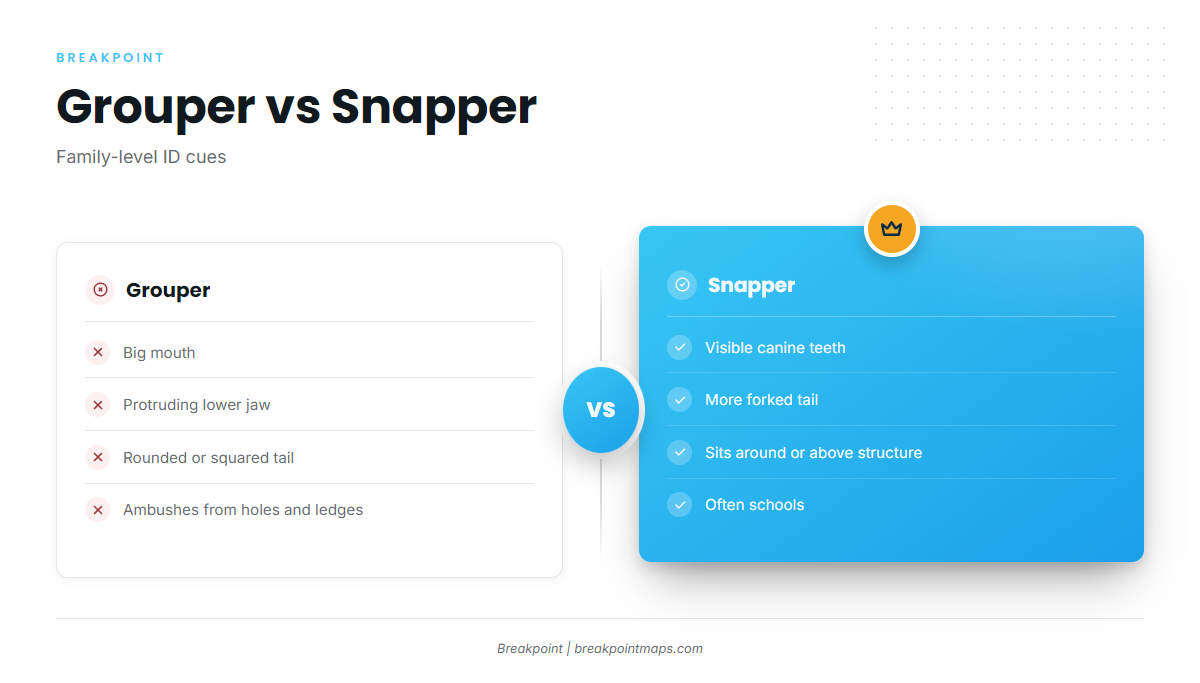
Two families account for most of the fish on structure, and they can be separated at a glance.
Groupers:
- Big mouth with a protruding lower jaw
- Rounded or squared tail
- Ambush prey from holes and ledges
- Heavy, thick-bodied build
Snappers:
- Visible canine teeth
- More forked tail
- Sit around or above structure rather than inside it
- Often school
The rest of the table fits neither group. Amberjack is a jack, triggerfish belongs to Balistidae, and black sea bass sits in the grouper family, Serranidae.
Once the fish is hooked, its behavior tells you more than its shape. Groupers head for the hole on the hookset, so the first few feet of line decide the fight. Snapper come to the bait from above structure.
Common Look-Alikes: Know What You Caught
A wrong ID can cost you a ticket. Check each pair below on deck, before you reach the dock.
Red vs Vermilion vs Lane Snapper
- Red snapper: deep red all over, red eye, triangular head, no strong side stripes. The red snapper guide covers it in full.
- Vermilion snapper: slimmer, with a more forked tail, thin yellow or blue lines along the sides and a short, upturned mouth. See the vermilion snapper guide.
- Lane snapper: pinkish, with yellow horizontal stripes and a dark spot on the side below the dorsal fin.
- Practical rule: a dark spot on the side means the fish is not a red snapper.
Gag vs Black Grouper vs Scamp
- Gag: gray body with dark, worm-like markings and a squared tail with a pale edge. The gag grouper guide goes deeper.
- Black grouper: rectangular dark blotches and brassy spots, with a squared-off tail edge.
- Scamp: brown with clustered spots and ragged, broom-like tips on the tail rays.
Gag and black grouper get mixed up at the dock. Check the markings before the fish goes on ice.
Red Grouper vs Gag
- Red grouper: brick red-brown, with a high, flat-topped spiny dorsal fin and small pale blotches. The inside of the mouth is red-orange. The red grouper guide has the habitat detail.
- Gag: gray, with a more even dorsal profile and worm-like marks.
- Sex change: red grouper are protogynous. They start as females and some change to males, according to NOAA.
Gray vs Ocean Triggerfish
- Gray triggerfish: drab gray-olive and deep-bodied. The gray triggerfish guide covers rigs and cleaning.
- Ocean triggerfish: more elongated, with a dark spot at the base of the pectoral fin and none of the gray’s mottling.
- Spine: both lock the first dorsal spine. Handle the fish carefully.
- Habitat: according to the FWC gray triggerfish profile, gray triggerfish are almost always found with red snapper.
Greater Amberjack vs Almaco, Lesser Amberjack and Banded Rudderfish
- Greater amberjack: the largest of the group. The dark band through the eye runs to the front of the dorsal fin, and the second dorsal lobe is fairly short. The greater amberjack guide covers the full approach.
- Almaco jack: deeper body, with tall, sickle-shaped second dorsal and anal lobes.
- Lesser amberjack: small, with a large eye and a steeply slanted eye band.
- Banded rudderfish: small, with vertical bars when young and white tips on the tail lobes.
- Practical rule: compare the dorsal lobe height first.
The SAFMC managed species reference lists almaco jack, banded rudderfish, lesser amberjack and ocean triggerfish alongside the main species.
Black Sea Bass vs Bank Sea Bass
- Black sea bass: dark, with a three-lobed tail. Large males carry a blue hump and a long dorsal filament. The black sea bass guide covers wrecks and rock piles.
- Bank sea bass: browner, with a rounded tail edge and different fin edging.
- Rules point: both turn up on the same bottom in the South Atlantic, and the rules can treat them differently. Check before keeping.
Wrecks, Rigs, Artificial Reefs and Ledges
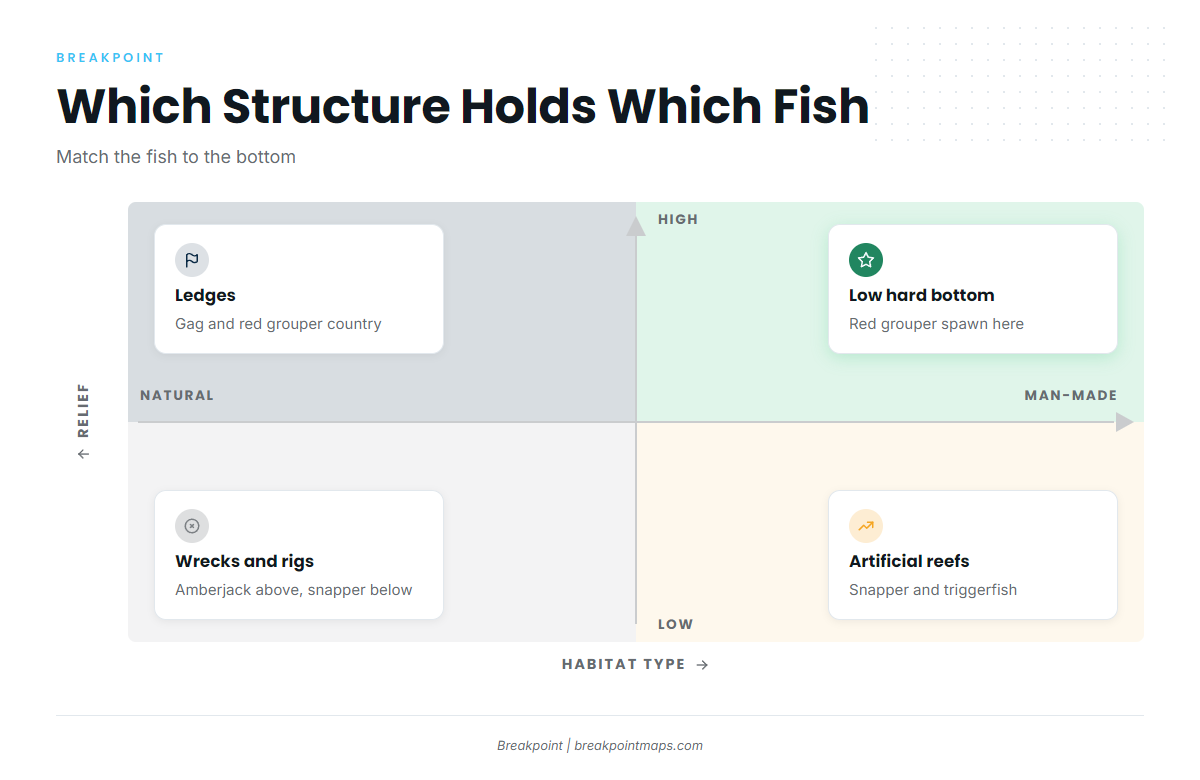
Each structure type holds a different mix of fish, so match the bottom to the target before you run.
Wrecks have high relief that stacks fish by layer. Amberjack hold above the structure, snapper work around it and black sea bass sit on it.
Oil and gas rigs are northern Gulf amberjack water. According to LSU Sea Grant amberjack notes, amberjack spend much of their time in the upper water column around platforms. Snapper sit lower on the legs. Jigging and live bait are covered in the amberjack guide.
Artificial reefs are placed by state programs and hold snapper and triggerfish. Reef sites are usually public, so check the state agency for locations.
Hard bottom and ledges are grouper country. Natural limestone, ledges and low-profile live bottom hold red grouper and gag. Red grouper spawn on low-relief hard bottom and limestone solution holes, according to the GCOOS red grouper profile.
Low relief is easy to drive past and hard to see on old surveys, so mark it before you fish it.
Finding Structure on Breakpoint Maps
Breakpoint Maps shows wrecks, artificial reef sites and ledges, with the Chart Contours layer for depth. Bottom data quality varies by survey, some shelves were last surveyed decades ago, and low relief can go uncharted. Chart layers are not for navigation.
Releasing Deep-Water Fish
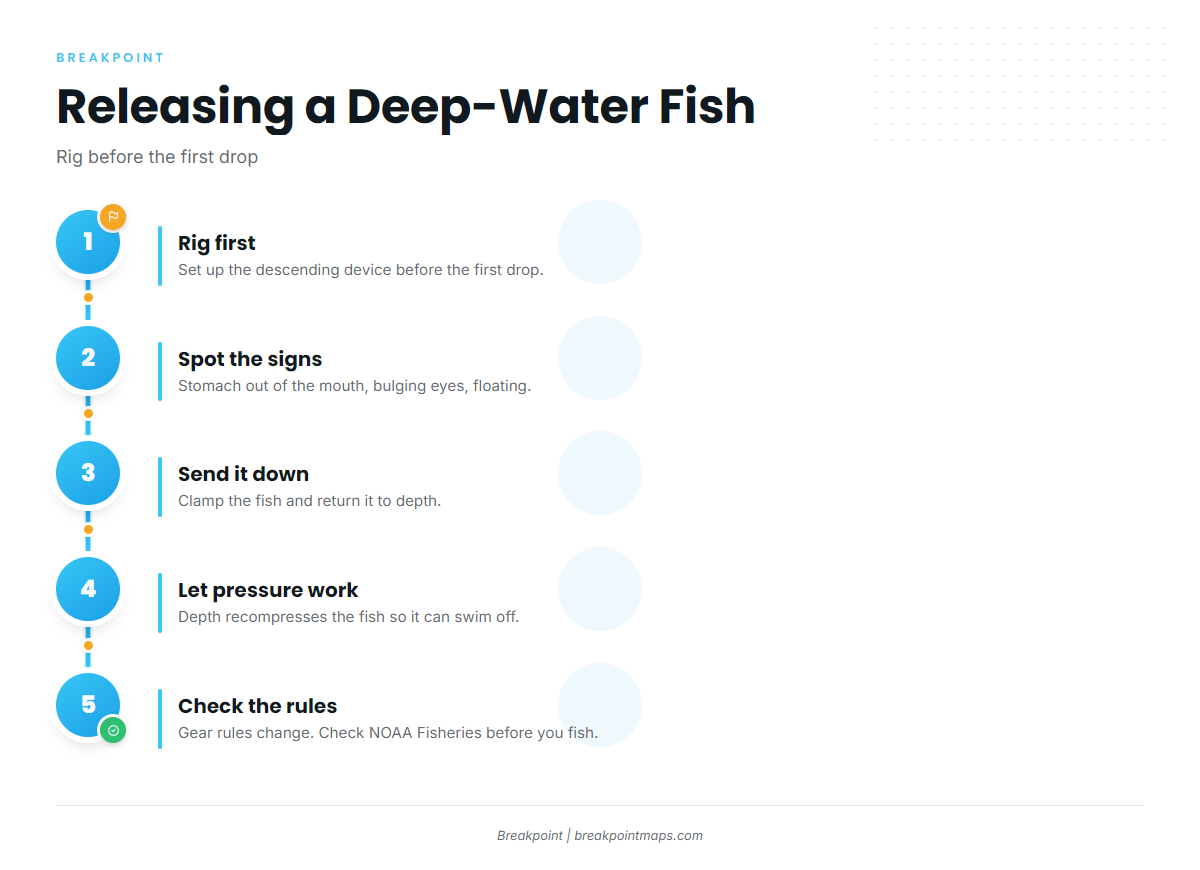
A fish brought up from depth expands as the pressure drops. Barotrauma shows as a stomach pushed out of the mouth, bulging eyes and a fish that floats at the surface.
Two tools help a fish you are releasing:
- Descending device: clamps the fish or holds it by the lip and returns it to depth, where pressure recompresses it.
- Venting tool: a hollow needle that releases gas from the body cavity.
NOAA encourages venting tools and recompression devices for fish showing barotrauma. Federal and state rules on carrying them change, so check NOAA Fisheries before you fish. Rig the descending device before the first drop, since the first floater is too late to start.
The rules for descending devices and circle hooks, which apply to most deep-water reef fish, are in the descending device and circle hook rules guide.
Who Sets the Rules
Seasons, bag limits and size limits change with quota and by jurisdiction. Each agency below publishes its own numbers, so check it before you fish.
- NOAA Fisheries: federal waters and species profiles.
- Gulf Council: federal-water reef fish management in the Gulf.
- South Atlantic Fishery Management Council (SAFMC): snapper grouper complex from North Carolina through the east coast of Florida.
- Mid-Atlantic Fishery Management Council and Atlantic States Marine Fisheries Commission (ASMFC): black sea bass.
- State agencies: Florida Fish and Wildlife Conservation Commission (FWC), Alabama Department of Conservation and Natural Resources (ADCNR), Mississippi Department of Marine Resources (MDMR), Louisiana Department of Wildlife and Fisheries (LDWF), Texas Parks and Wildlife Department (TPWD), North Carolina Division of Marine Fisheries (NCDMF), South Carolina Department of Natural Resources (SCDNR), Georgia Department of Natural Resources (GADNR) and the Mid-Atlantic state agencies.
Gulf recreational red snapper is managed state by state, and seasons for red snapper and gag move with quota. State and federal waters can carry different rules, so check both.
Route by Region
Gulf: Texas to the Florida Keys
Red snapper, gag, red grouper, gray triggerfish and greater amberjack all work here. Rigs dominate off Louisiana and Texas, and artificial reefs carry the Alabama and Panhandle effort. Red grouper is strongest on the west Florida shelf hard bottom.
Start with the Gulf red snapper guide. The gag and red grouper guides, listed in the directory below, cover the grouper side.
NOAA lists red snapper at 30 to 620 feet in the Gulf of America (Gulf of Mexico). Gulf red snapper rules differ enough between states to name each agency: TPWD, LDWF, MDMR, ADCNR and FWC.
South Atlantic: North Carolina to the East Coast of Florida
Vermilion snapper, gag, gray triggerfish, black sea bass and amberjack work here. Red snapper seasons are short. Hard bottom and ledges carry most of the effort.
The vermilion snapper guide, listed in the directory below, covers the shelf-edge schools. Rules come from SAFMC, NCDMF, SCDNR, GADNR and FWC.
Mid-Atlantic and Northeast
Black sea bass on wrecks and rock piles is the main fishery. Red snapper are rare north of the Carolinas, according to NOAA. Black sea bass now occur farther north than they once did. The black sea bass guide in the directory below covers it. Rules come from the Mid-Atlantic Council, ASMFC and the state agencies.
Open the map for your region and mark structure before the trip, then check the agency rules before you fish.
Frequently Asked Questions
What is the difference between grouper and snapper?
Groupers have a big mouth with a protruding lower jaw, a rounded or squared tail and an ambush habit around holes and ledges. Snappers show canine teeth, a more forked tail and a tendency to school above structure. Black sea bass is a grouper-family fish.
How do you tell red snapper from vermilion snapper?
Red snapper are deeper red with a triangular head and no strong side stripes. Vermilion snapper are slimmer, with thin yellow or blue side lines and a more forked tail. A dark spot on the side means the fish is not a red snapper.
What is a descending device?
A descending device returns a fish to depth so pressure reverses barotrauma. It clamps the fish or holds it by the lip and drops it on a line. NOAA encourages these tools. Rules on carrying them change, so check NOAA Fisheries before you fish.
Where do I find red snapper seasons?
Seasons move with quota, so go to the agency. In the Gulf, check your state agency. In the South Atlantic, check SAFMC and NOAA Fisheries. Federal and state waters can carry different rules, so check both before you fish.
Reef Fish Guides by Species
Snappers
- Red snapper fishing guideGulf structure, depth, rigs and state rules.
- Vermilion snapper fishing guideSchooling fish of the shelf edge and how to target them.
Groupers
- Gag grouper fishing guideLedges, live bait and pulling fish off the bottom.
- Red grouper fishing guideWest Florida shelf hard bottom.
Triggerfish and Jacks
- Gray triggerfish fishing guideSmall hooks, tough mouths and cleaning.
- Greater amberjack fishing guideJigging and live bait on wrecks and rigs.
Sea Bass
- Black sea bass fishing guide – Wrecks and hard bottom from the Carolinas north.
More Species
- Saltwater fish species guides – Pelagics, inshore fish and the full index.