




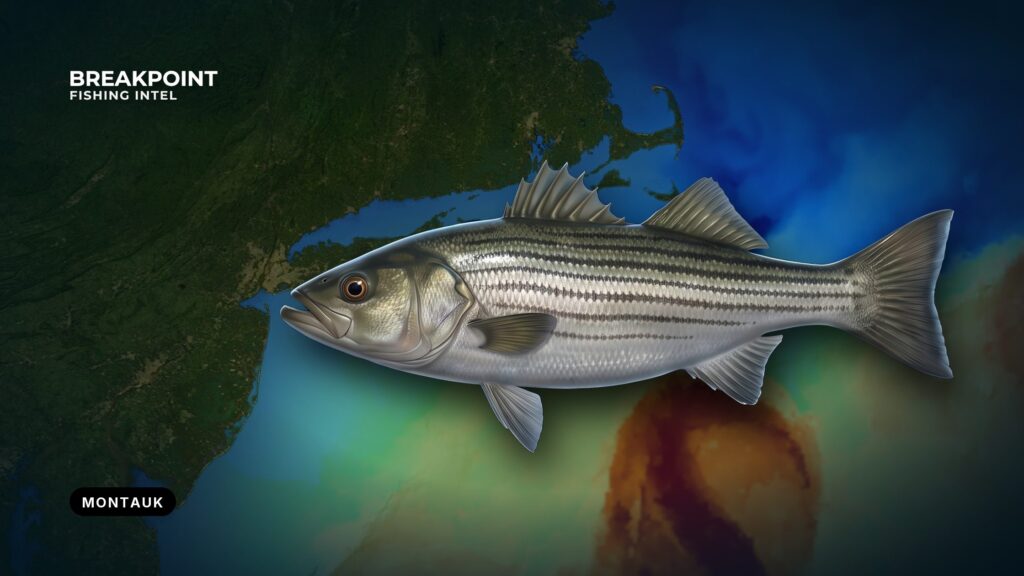
Montauk Point fishes because of current running over broken bottom. The shoals show as rips at the strength of the current, and striped bass sit on those seams and feed on whatever the tide carries past.
This page covers where the grounds are, how the tide sets them up, when the runs come, how boats fish the rips with bait and lures, and which rules apply on this water. For biology and general tackle, see the species guide. Everything here is specific to the Point.
Where striped bass hold around Montauk Point
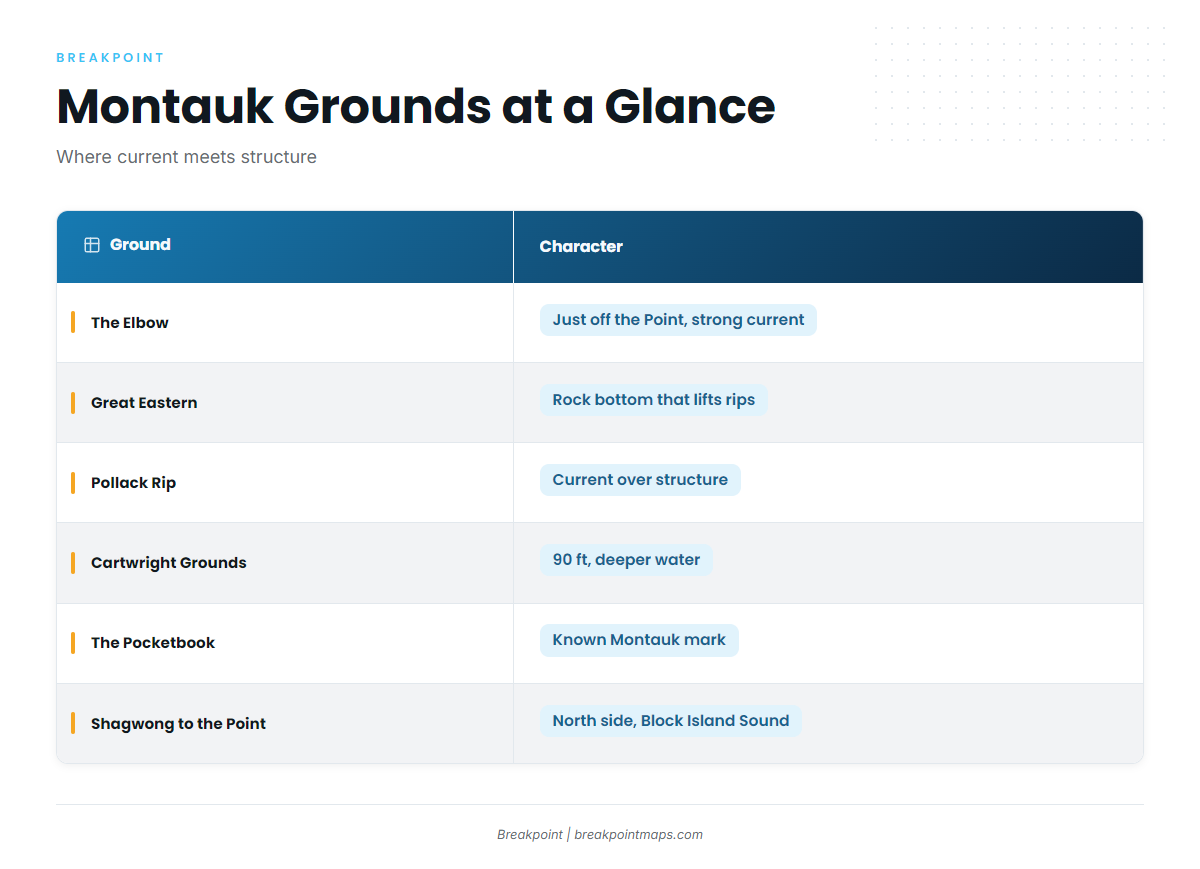
The U.S. Coast Pilot 2 describes the bottom as very broken for about 4 miles around the Point. Current at the Point can reach about 2.8 knots, and the shoals over that bottom throw rips whenever it runs.
Block Island Sound meets the open Atlantic here, and bass and bluefish work the water where the two push against each other.
| Ground | Character | What to know |
|---|---|---|
| The Elbow | Classic striper ground just off the tip of the Point | Strong current. Bass and bluefish feed in it. |
| Great Eastern | Rock | Hard bottom that lifts the current into rips |
| Pollack Rip | Named rip ground | Fish it by the same rule as the other rips: current over structure |
| Cartwright Grounds | 90 ft | Deeper water than the Point rips. Suits deep presentations. |
| The Pocketbook | Named ground | A known Montauk mark |
| North side, Shagwong to the Point | Shoreline stretch along Block Island Sound | School bass, bluefish and albies on jigs in the fall |
Each shoal throws its own rip, and rip strength varies across broken bottom, so read the water on the day. The Frisbees off Ditch Plains is a fluke and sea bass spot, so leave it for another trip.
Studying the broken bottom on Chart Contours before the run shows where the shoals will throw rips. Chart layers are not for navigation; use NOAA charts.
Tide and current at the Point
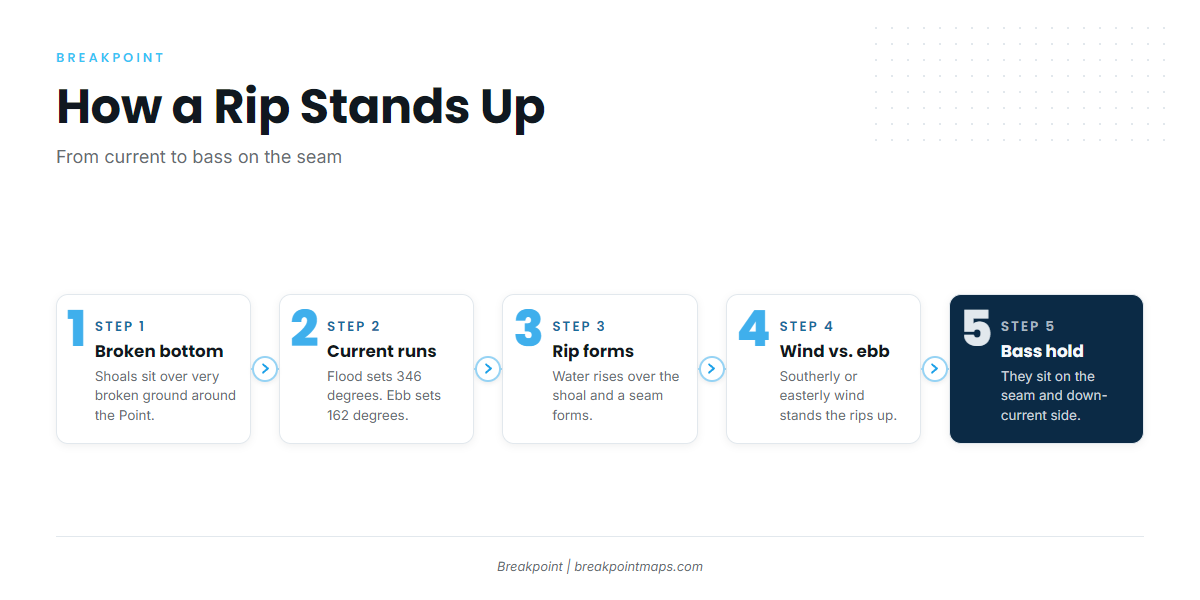
The Coast Pilot gives these current facts for the Point:
- Current reaches about 2.8 knots about 1.2 miles east of the Point.
- Flood sets 346 degrees. Ebb sets 162 degrees.
- The bottom is very broken for about 4 miles around the Point, and the shoals show as rips at the strength of the current.
- Southerly or easterly winds against the ebb "can make almost any rip stand up."
The outgoing tide carries bait out of the bays and Block Island Sound past the Point, and bass set up to intercept it.
Rips form where current meets structure. Water rises over the shoal and a seam forms behind it, the way water piles up at a bridge piling. Bass hold on the seam and on the down-current side of the rip, so position the boat to work that water.
The ebb sets toward the south-southeast, so a southerly or easterly wind blows straight into it. Seas steepen and the rips stand up. Check wind, wave height and period on the ANZ350 marine forecast before you leave the dock. NDBC station MTKN6 reports water level at Montauk. Current figures are predictions at one point, and rip strength varies shoal by shoal.
The spring run
Bass show in the shallows and bays of the East End first, and fishing is in full swing by mid-to-late May. Early fishing works inside waters and structure, and boats run outside the Point when conditions allow.
The same rule applies in spring as in fall: fish where the current crosses structure. The northeast striped bass migration is covered coastwide elsewhere, so this page stays on Montauk.
The fall run for striped bass off Montauk
Fall is the peak. The run builds from September into November, and blitzes form as bait gathers in open water.
The forage changes through the run:
- Bay anchovy is the key bait as the run starts.
- Sand eels take over by mid-to-late October.
- Big bunker spill out of Peconic Bay in late October.
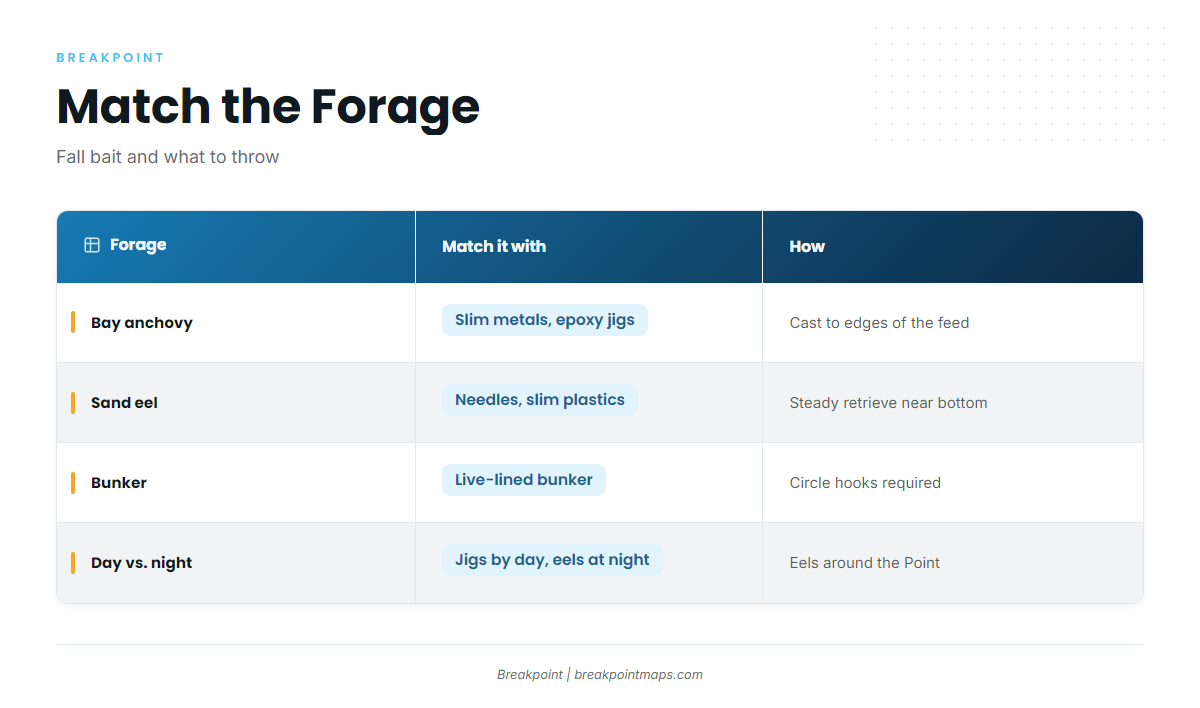
Match the lure to the bait:
| Forage | Match it with | How |
|---|---|---|
| Bay anchovy | Slim metals, epoxy jigs, teasers | Cast to the edges of the feed |
| Sand eel | Needles, slim plastics, bucktails with straight tails | Steady, deliberate retrieve near the bottom |
| Bunker | Live-lined bunker | Circle hooks (see Regulations) |
Daytime fishing is mostly jigging. At night, live eels around the Point are the standard.
Fishing the rips with bait
Live eels are the signature Montauk rip bait, especially at sunset and after dark. When bunker are present in late fall, live-line them.
Set the drift so the current does the work:
- Start the drift up-current of the shoal.
- Let the current carry the bait over the structure so it swings through the seam on the down-current side.
- Reset and run the same line again.
A harder current means a faster drift and a shorter window over the shoal.
New York requires non-offset (inline) circle hooks with bait. With a circle hook, you do not set hard. Let the fish load the rod so the hook rolls into the corner of the jaw. This changes eel fishing, which traditionally drops back and sets with a J hook.
Fishing the rips with lures
Bucktails, diamond jigs and parachutes fish deep in current. Drop up-current, hold bottom contact through the seam, and jig the lift.
Wire line and umbrella rigs are the traditional way to reach deep fish in current. Troll across the rip line, not down it.
When fish blitz on the surface:
- Cast into the windward edge of the blitz and retrieve quickly.
- Hold the boat off the fish rather than running through them.
- Be ready for instant strikes.
Circle hooks are not required with an artificial lure, even when it is tipped with bait.
Getting out of Montauk
Montauk Harbor sits in the north part of Lake Montauk, about 3 miles west of the Point. You enter through a jettied, dredged channel on the north shore. A lighted bell buoy sits about 0.3 mile north of the entrance.
Entrance current is about 1.2 knots on the flood and 0.5 knot on the ebb. The federal project depth is 12 ft in the channel and 10 ft in the boat basin northwest of Star Island.
Ramps and marinas:
- West Lake Launching Ramp (Town of East Hampton) is the public ramp for trailer boats. See the Long Island boating access guide.
- Fort Pond Bay Park ramp is kayak and canoe size.
- Marinas: Star Island Yacht Club (fuel listed), Montauk Anglers Club & Marina, and Westlake Marina.
Fog is heaviest with southeast winds and usually lasts 4 to 12 hours, with spells of 4 to 6 days on record. June visibility drops below half a mile nearly 9% of the time.
Check ANZ350 and MTKN6 before leaving. Montauk also fishes for fluke, sea bass, albies and tuna, and the Atlantic Northeast fishing guide covers them.
Frequently asked questions
What is the best tide for striped bass at Montauk Point?
Moving current, especially the ebb, which sets bait past the Point. A southerly or easterly wind against the ebb stands the rips up, so check wind direction and force before you commit to a drift.
When is the Montauk fall run?
The run builds from September into November. Bay anchovy are the early bait, sand eels arrive by mid-to-late October, and bunker spill out of Peconic Bay in late October. Match your lure or live bait to whichever forage is in the water.
Can I fish for striped bass near Block Island?
Not in federal waters beyond 3 miles. Possession in Block Island Sound is allowed only in continuous transit, north of the Montauk Light to Block Island Southeast Light line, with no fishing from the boat in the EEZ.
Do I need circle hooks with live eels?
Yes. New York requires non-offset (inline) circle hooks with any bait, including live eels. They are not required with artificial lures, even when tipped with bait. Let the fish load the rod rather than setting hard.
Do I need a license to fish Montauk?
No license is required, but anglers 16 and older must enroll in the free Recreational Marine Fishing Registry. Connecticut and Rhode Island license holders are exempt, as are anglers on licensed party or charter boats.
Where can I launch a boat in Montauk?
The public ramp is West Lake Launching Ramp (Town of East Hampton). Montauk Anglers Club & Marina and Montauk Yacht Club have private ramps. Fort Pond Bay is for kayaks and canoes only.
How often does fog shut down Montauk?
Fog is heaviest with southeast winds and usually lasts 4 to 12 hours. June visibility drops below half a mile nearly 9% of the time. Check ANZ350 before you leave.