



California offshore fishing runs from the Oregon border to Mexico. The rules change as you move down the coast and again when you cross the 3-mile line into federal waters. This page sorts out who sets each rule and gives the size, bag, season and gear rules species by species, with the agency page for each. If you are still choosing where to fish, start with fishing in California, or compare other US states before you plan the run.
California Fishing Official Government Organizations
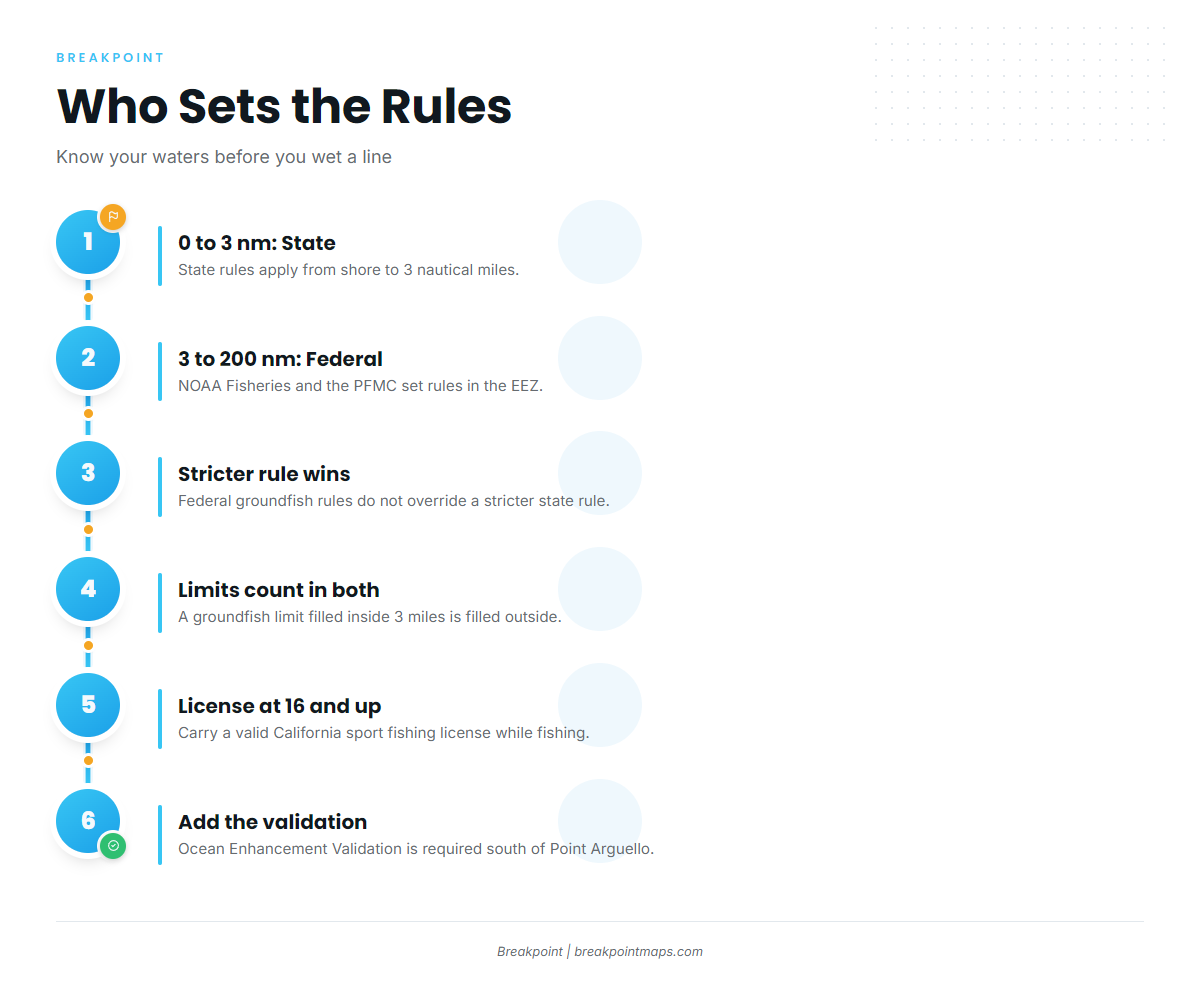
State waters run from shore to 3 nautical miles. Federal waters, the exclusive economic zone, run from 3 to 200 nautical miles, as NOAA explains on the seaward limit of state waters. State rules apply inside the line, and NOAA Fisheries and the Pacific Fishery Management Council set federal rules beyond it. Federal groundfish rules do not override a stricter state rule, and federal groundfish bag limits count fish taken in both state and federal waters. A limit filled inside 3 miles is still filled outside.
Anyone 16 or older needs a valid California sport fishing license and must carry it while fishing. The exceptions are fishing from a public pier in ocean or bay waters and CDFW free fishing days, when all other rules still apply. An Ocean Enhancement Validation is also required in ocean waters south of Point Arguello, except under a one-day or two-day license. License types and fees are on the CDFW sport fishing license page.
The bodies that write and enforce the rules:
- California Department of Fish and Wildlife (CDFW) – Runs and enforces ocean sport fishing rules, publishes the ocean regulation pages, and posts in-season changes. Marine Region: (831) 649-2870. Start at the CDFW fishing regulations page and check CDFW in-season ocean changes before you launch.
- California Fish and Game Commission – Adopts the ocean sport fishing regulations in Title 14 of the California Code of Regulations, including the Title 14 general bag limit in §27.60.
- NOAA Fisheries West Coast Region – Publishes federal groundfish rules for federal waters under 50 CFR Part 660 and the annual Pacific halibut rule. See the federal recreational groundfish rules at 50 CFR 660.360.
- Pacific Fishery Management Council – Develops federal groundfish and highly migratory species management, including the Catch Sharing Plan that divides Pacific halibut among Washington, Oregon and California.
- International Pacific Halibut Commission (IPHC) – Sets the Area 2A Pacific halibut catch limit, which NOAA Fisheries applies through 50 CFR 300.63.
California Offshore Fishing Regulations by Species
California starts from a general limit of 20 finfish per person in combination, with no more than 10 of any one species unless a species has its own limit. Licensed anglers aboard a boat may keep fishing until the boat limit is reached. The boat limit is the number of licensed anglers times the daily limit, and every person aboard can be cited for over-limit, prohibited or undersized fish.
Boat anglers must carry a landing net with an opening of at least 18 inches in diameter to land undersize fish of species with minimum sizes. A gaff may not be used on finfish under the minimum size. A descending device must be ready for immediate use on any vessel taking or possessing federal groundfish.
Some species may not be taken at all: giant (black) sea bass, garibaldi, gulf and broomtail grouper, green sturgeon, coho salmon, white shark, cowcod, and yelloweye, quillback and bronzespotted rockfish. Marine protected area take restrictions vary by area, so check the California marine protected areas page for maps and rules.
On multi-day trips, up to 3 daily bag and possession limits of saltwater finfish are allowed when the owner or operator files a Declaration for Multi-Day Fishing Trip with CDFW. Only 1 daily limit may be taken per calendar day. Salmon, steelhead, striped bass and sturgeon are excluded.
If you are running out of Southern California, our guide to Southern California offshore fishing covers the water. Check the agency page linked under each species before you fish.
Rockfish, cabezon and greenlings
California splits the coast into 5 Groundfish Management Areas:
- Northern:Oregon border (42°00′ N) to Cape Mendocino (40°10′ N).
- Mendocino:40°10′ N to Point Arena (38°57.5′ N).
- San Francisco:38°57.5′ N to Pigeon Point (37°11′ N).
- Central:37°11′ N to Point Conception (34°27′ N).
- Southern:Point Conception (34°27′ N) to the Mexico border.
If you fish the Northern Management Area near the Oregon border, our Pacific Northwest fishing guide covers the water just north. CDFW can change groundfish seasons, depths, bag limits and size limits during the year, with a news release at least 10 days ahead.
- LengthNo minimum size for any rockfish, cabezon or greenling. Fillets kept aboard a vessel must have the entire skin attached.
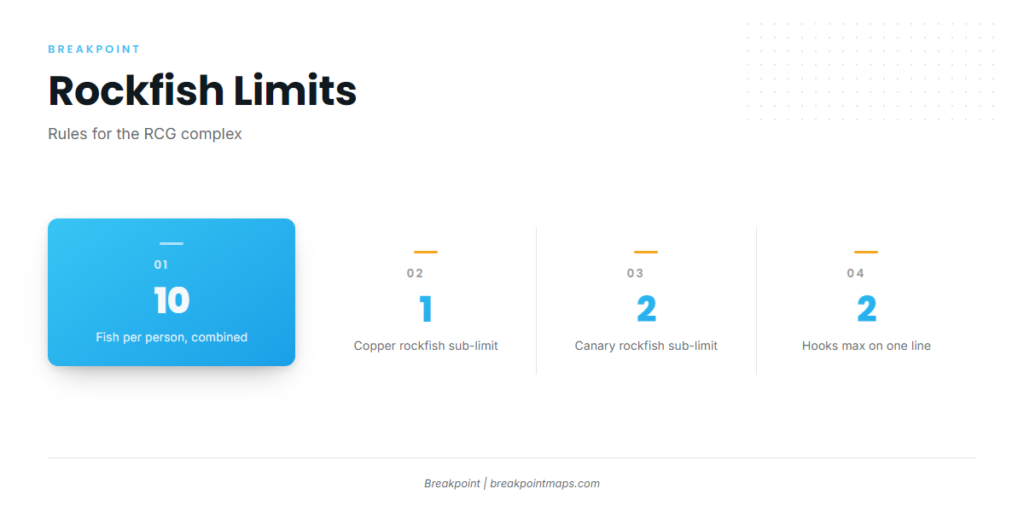
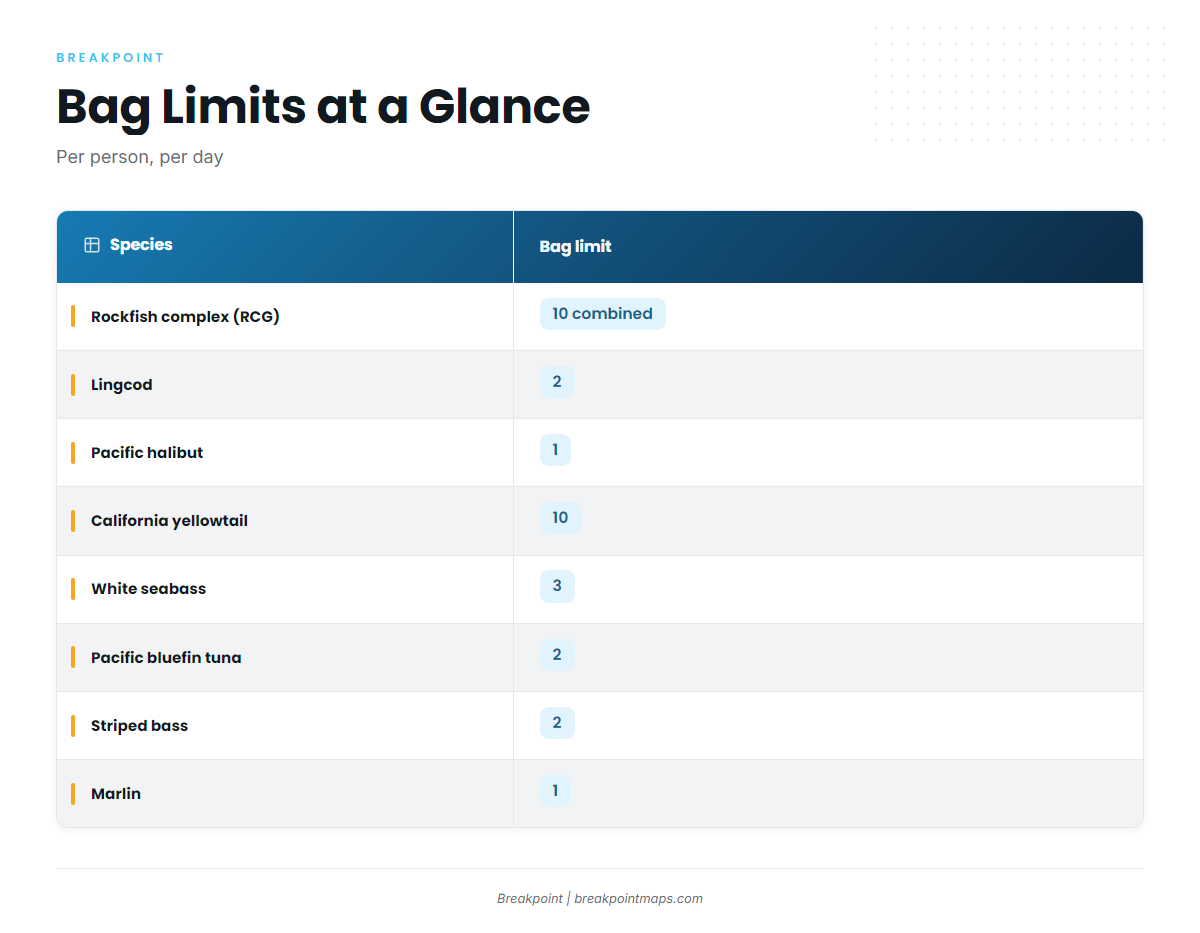
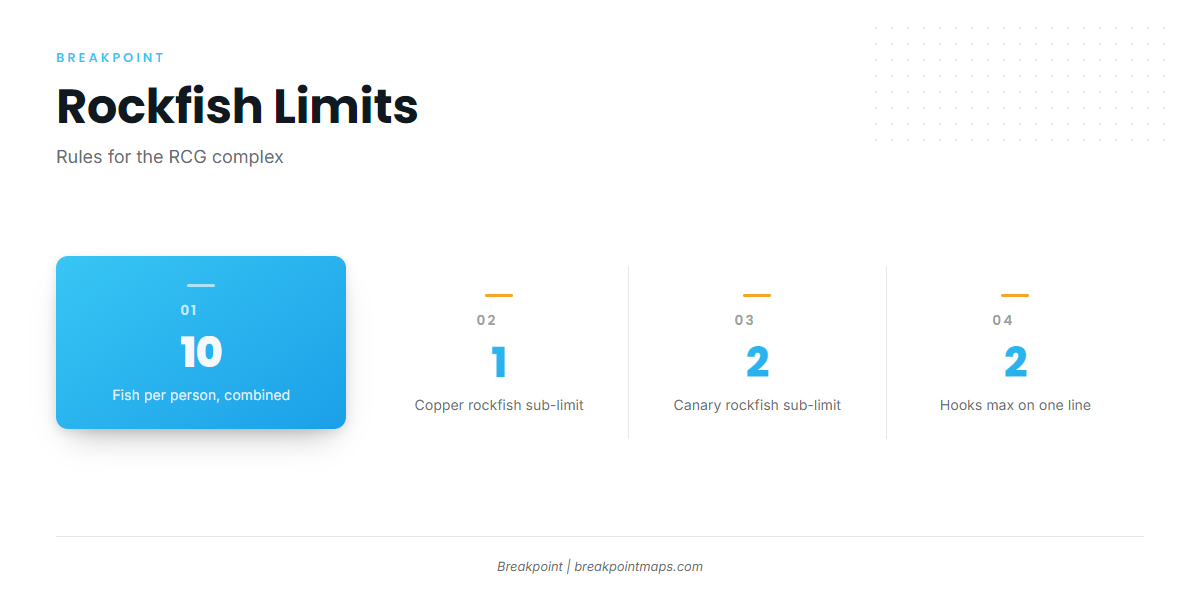
- Bag limit10 per person per day in combination for the rockfish, cabezon and greenling complex. Sub-limits inside the 10: copper rockfish 1, canary rockfish 2, vermilion/sunset rockfish 4 in the Northern Management Area and 2 in all other areas. Zero retention at all times and all depths: bronzespotted rockfish, cowcod, quillback rockfish and yelloweye rockfish.
- SeasonIn the Northern, Mendocino, San Francisco and Central areas, closed January 1 through March 31, and possession is unlawful in those waters during the closure. Open at all depths April 1 through December 31. In the Southern Management Area, closed January 1 through March 31, open at all depths April 1 through June 30, open July 1 through September 30 only shoreward of the 50-fathom Rockfish Conservation Area line, and closed October 1 through December 31. Cordell Bank is closed to all groundfish fishing. Eight Groundfish Exclusion Areas restrict groundfish fishing in the Southern Management Area. Shore anglers and divers are exempt from seasons and depths. Fish may be aboard a vessel that is anchored, drifting or transiting a closed area, with no gear in the water. Depths and seasons move by in-season action, so see the CDFW page linked below.
- Gear and permitsWith these species aboard, one line with no more than 2 hooks. A descending device must be in possession and ready for immediate use.
CDFW groundfish regulation summary
Lingcod
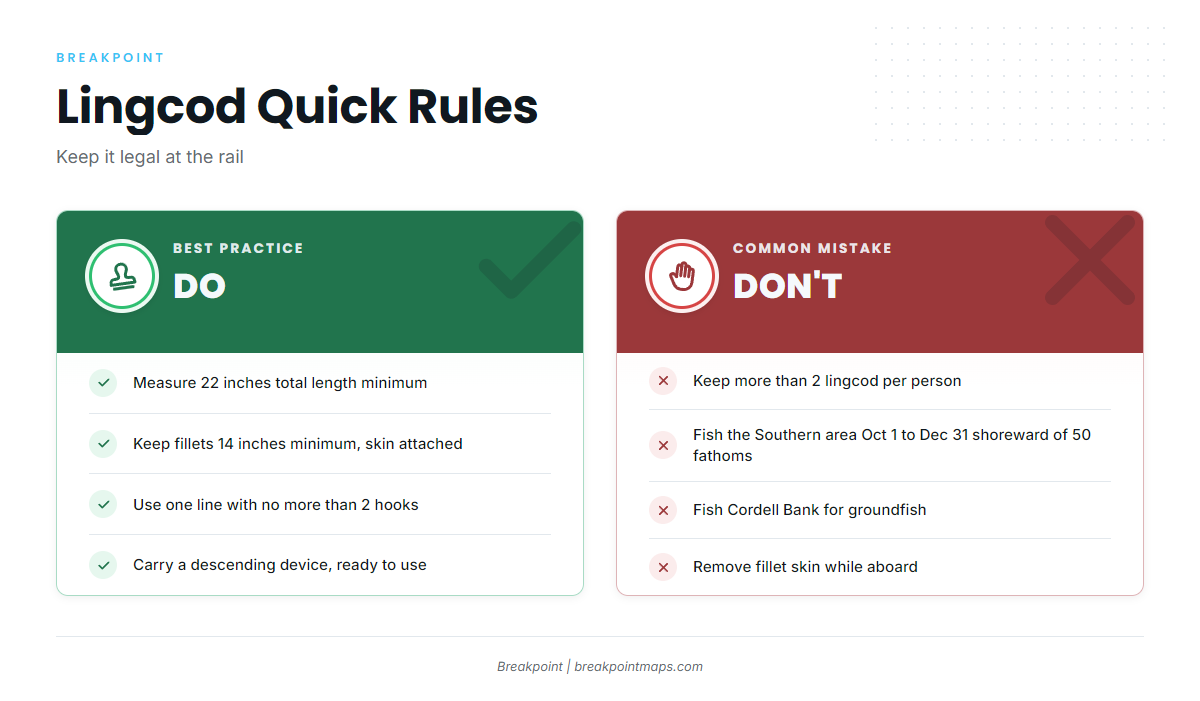
Lingcod follow the same management areas and seasons as the rockfish complex, with one Southern difference. Our lingcod fishing guide covers where and how to fish for them.
- Length22 inches total length minimum. Fillets 14 inches minimum, with the entire skin attached.
- Bag limit2 per person per day.
- SeasonFollows the rockfish season in each management area. In the Southern Management Area, October 1 through December 31, lingcod are open only seaward of the 50-fathom line. Seasons and depths move by in-season action, so see the CDFW page linked below.
- Gear and permitsOne line, no more than 2 hooks. Descending device aboard.
CDFW groundfish regulation summary
Sablefish and other federal groundfish
This group covers sablefish, Pacific cod, longspine and shortspine thornyheads, Pacific whiting, Dover sole, English sole, arrowtooth flounder, spiny dogfish, skates, ratfish and grenadiers.
- LengthNo minimum size.
- Bag limit10 per species, counted within the 20-fish general limit. Soupfin shark 1.
- SeasonYear-round at all depths, except inside the Groundfish Exclusion Areas.
- Gear and permitsOne line, no more than 2 hooks. Descending device aboard.
CDFW groundfish regulation summary
Pacific halibut
The IPHC sets the Area 2A catch limit, and the Pacific Fishery Management Council’s Catch Sharing Plan divides it among the 3 states. The season is set each year with NOAA Fisheries. For where and how to fish them, see our Pacific halibut fishing guide.
- LengthNo minimum size.
- Bag limit1 per person per day.
- SeasonOpens April 1. North of Point Arena (38°57.5′ N), it runs through November 15 or until the quota is reached, whichever is earlier. South of Point Arena, it runs through December 31. Hotlines: CDFW (831) 649-2801 and NOAA Fisheries (800) 662-9825.
- Gear and permitsWhen angling, one line with no more than 2 hooks. A harpoon, gaff or net may be used to land a fish legally caught by angling. Spearfishing is allowed under the diving rules.
CDFW Pacific halibut page
California yellowtail
Yellowtail are a Southern California staple. Our California yellowtail fishing guide covers the fishery, and the limits below are the ones that keep you legal.
- Length24 inches fork length minimum. Up to 5 fish under 24 inches fork length may be kept within the limit. Fillets at least 17 inches long, each with a 1-square-inch skin patch attached. No more than 10 fillets may be shorter than 17 inches.
- Bag limit10 per person per day, inside the 20-fish limit.
- SeasonYear-round.
- Gear and permitsNot specified in the species rule. See the Title 14 section linked below.
Title 14 yellowtail rule
White seabass
White seabass are managed under their own Title 14 section, with a size minimum and a seasonal limit change south of Point Conception.
- Length28 inches total length minimum. Fillets at least 19 inches long, with a 1-inch-square patch of silver skin attached.
- Bag limit3 per person per day. Only 1 south of Point Conception (34°27′ N) from March 15 through June 15.
- SeasonOpen all year.
- Gear and permitsSee the Title 14 section linked below.
Title 14 white seabass rule
Albacore
The limit splits at a line due west of Point Conception. Albacore is in addition to the 20-fish limit. Our albacore tuna fishing guide covers the fishery.
- LengthNo minimum size. South of Point Conception, each tuna is bagged individually and the bag marked with the common name. The fish is cut into 6 skin-on pieces: 4 loins, the collar as 1 piece with both pectoral fins attached, and the belly including the vent with both pelvic fins attached.
- Bag limit10 per person south of the Point Conception line, 25 per person north of it.
- SeasonYear-round.
- Gear and permitsSee the Title 14 section linked below.
Title 14 tuna rule
Pacific bluefin tuna
Bluefin have their own limit on top of the 20-fish limit. Our Pacific bluefin tuna fishing guide covers the fishery.
- LengthNo minimum size. The same tuna fillet rule applies south of Point Conception.
- Bag limit2 per person per day, in addition to the 20-fish limit. It applies to all bluefin possessed, regardless of where taken.
- SeasonYear-round.
- Gear and permitsSee the Title 14 section linked below.
Title 14 tuna rule
Yellowfin, bigeye and other tunas
For the fish itself, see our yellowfin tuna fishing guide.
- LengthNo minimum size. The tuna fillet rule applies south of Point Conception.
- Bag limit10 per person, counted within the 20-fish limit. Skipjack has no limit.
- SeasonYear-round.
- Gear and permitsSee the Title 14 section linked below.
Title 14 tuna rule
Swordfish
Swordfish rules center on gear restrictions.
- LengthNo minimum size stated. See the Title 14 section linked below.
- Bag limit2 per person.
- SeasonYear-round.
- Gear and permitsSpears, harpoons and bow-and-arrow tackle may not be used to take broadbill swordfish. Those gear types may not be aboard on a day or trip when swordfish or marlin have been taken. Divers may not take broadbill.
Title 14 swordfish rule
Marlin
Marlin are limited to one fish per person, with the same gear restriction that applies to swordfish.
- LengthSee the Title 14 section linked below.
- Bag limit1 per person, all species including striped marlin.
- SeasonSee the Title 14 section linked below.
- Gear and permitsSpears, harpoons and bow-and-arrow tackle may not be aboard on a day or trip when marlin have been taken.
Title 14 marlin rule
Dorado
Also called mahi-mahi or dolphinfish, dorado count within the general 20-fish limit.
- LengthNo minimum size.
- Bag limit10 per person per day, inside the 20-fish limit.
- SeasonYear-round.
- Gear and permitsSee the CDFW page linked below.
Striped bass
Striped bass have a size minimum that applies only north of Point Conception, and they are excluded from multi-day extra limits.
- Length18 inches total length minimum north of Point Conception (34°27′ N). No minimum south of it.
- Bag limit2 per person per day. Excluded from multi-day extra limits.
- SeasonAll year.
- Gear and permitsNo sinker over 4 pounds and no power gurdy or winch. Take by angling, spearfishing or bow and arrow only.
CDFW ocean regulations booklet
Sharks
Shark limits vary by species, and white shark take is prohibited.
- LengthNo minimum size for shortfin mako, thresher or blue shark.
- Bag limitShortfin mako, thresher and blue shark: 2 of each species per person. Sixgill and broadnose sevengill shark: 1 of each species. White shark: take and possession prohibited.
- SeasonSee the CDFW page linked below.
- Gear and permitsUsing bait, lure or chum to attract a white shark is prohibited.
CDFW ocean regulations booklet