




Oregon’s ocean fisheries cover bottomfish and halibut on the shelf, albacore offshore, and salmon on the troll. ODFW writes the state’s sport rules, and they apply out to 50 miles from shore. Federal rules apply off Oregon as well. Where you fish determines which rules govern, and each species below links to the agency page to check before you go.
Oregon Fishing Official Government Organizations
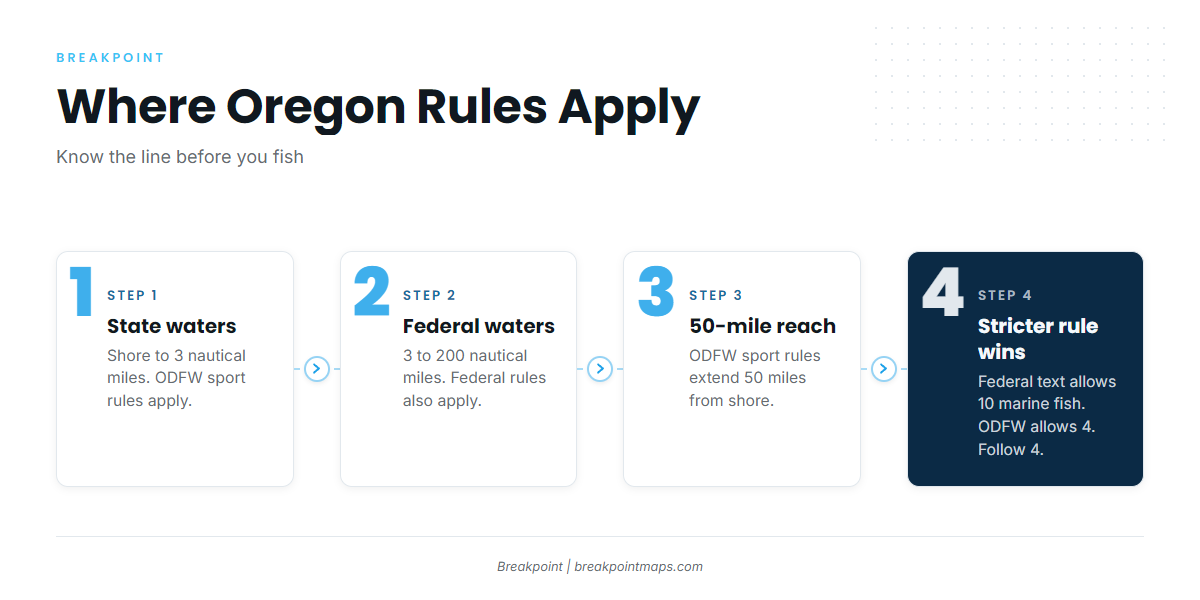
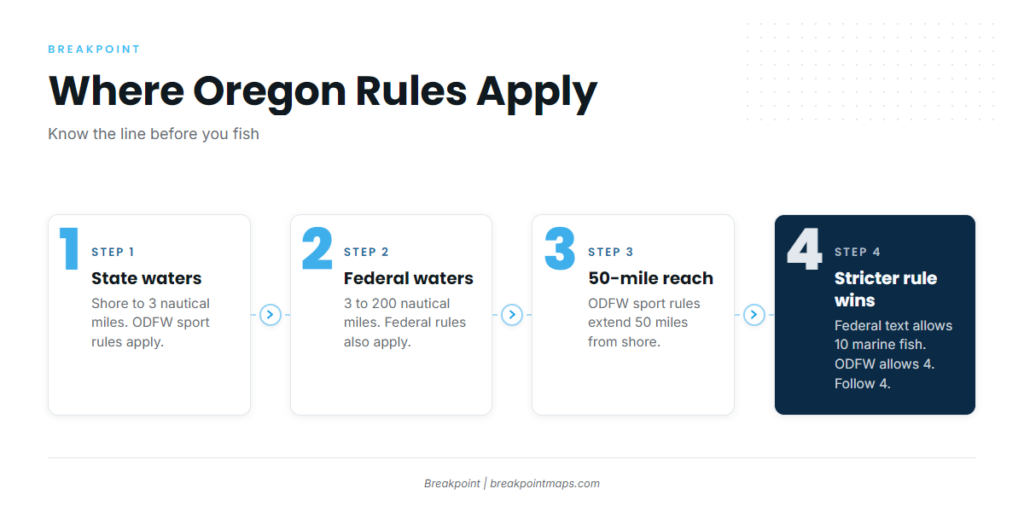
State waters run from shore to 3 nautical miles. Federal waters, the exclusive economic zone, run from 3 to 200 nautical miles. ODFW sport rules apply within the state’s Fisheries Conservation Zone, which reaches 50 miles from shore and extends into federal water. Federal groundfish rules also apply off Oregon. The federal text allows 10 marine fish a day, but ODFW’s general marine limit is 4, and 4 is the limit to follow. If you come ashore in Oregon with ocean-caught fish, Oregon sport and licensing rules apply. Each state draws its line differently, and the rules for other U.S. states follow the same layout. "Ocean" begins at the visible ends of jetties, at the high tide line on beaches without jetties, and at a north-south line through Buoy 10 on the Columbia River.
These bodies write and enforce the rules:
- ODFW – The Oregon Department of Fish and Wildlife Marine Resources Program writes and posts Oregon’s sport ocean rules and in-season changes.
- Oregon Fish and Wildlife Commission – The commission adopts the state’s fishing regulations that ODFW carries out.
- Pacific Fishery Management Council – The council recommends federal groundfish, salmon and highly migratory species rules and divides the Area 2A halibut catch through its Catch Sharing Plan.
- NOAA Fisheries West Coast Region – NOAA Fisheries publishes the federal rules for waters 3 to 200 miles off Oregon, including annual halibut seasons and in-season changes.
- International Pacific Halibut Commission – The IPHC sets the yearly Pacific halibut catch limit for Area 2A, which covers Washington, Oregon and California.
- Oregon State Police Fish and Wildlife Division – The division enforces Oregon’s fish and wildlife laws.
Oregon Offshore Fishing Regulations by Species
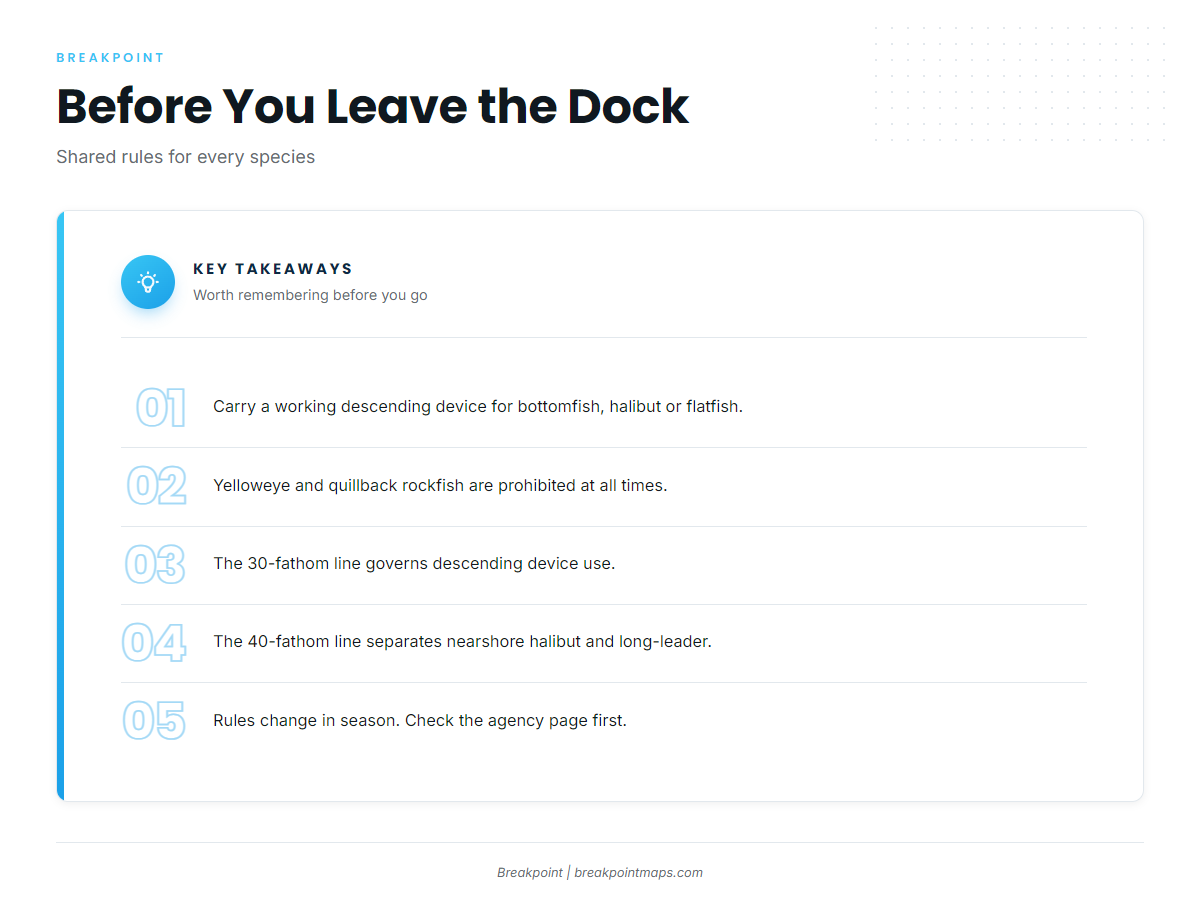
Oregon groups ocean fish into the same bottomfish, halibut, tuna and salmon fisheries found across the Pacific Northwest. Every vessel fishing for or holding bottomfish, Pacific halibut or flatfish must carry a working descending device, at any depth. Use it on any rockfish released seaward of the 30-fathom regulatory line. The 40-fathom line separates the nearshore halibut fishery from the offshore long-leader fishery. ODFW publishes waypoints for both lines.
"General marine species" covers rockfish, cabezon, kelp greenling, skates, spiny dogfish, leopard and soupfin shark, Pacific cod, sculpins, and other marine fish not listed separately. Lingcod, sablefish and flatfish have their own limits. The Stonewall Bank Yelloweye Rockfish Conservation Area, about 15 miles west of Newport, is closed to bottomfish, long-leader and Pacific halibut fishing. A vessel with halibut aboard may transit the area but may not fish there. Oregon’s marine reserves and marine protected areas allow no take of fish, with limited exceptions at some protected areas.
It is unlawful to fish for or keep salmon, Pacific halibut or marine fish while holding any species not open in that area at that time. Anglers may keep fishing until the combined boat limit is reached, but no one may exceed a personal bag limit. Anglers 12 and older need an Oregon angling license. The Ocean Endorsement is required to keep marine finfish. The Combined Angling Tag is required at any age for salmon and Pacific halibut. Fees are on the ODFW fee schedule. Rules change during the year, so check the agency page linked under each species before you fish, and call the NMFS and ODFW hotline at (800) 662-9825 for in-season changes.
Lingcod
Lingcod is a bottomfish taken in state and federal waters off Oregon. It has its own bag limit, separate from the general marine species limit. If you keep a lingcod, you cannot fish the offshore long-leader fishery on that trip.
- Length22 inches minimum, total length.
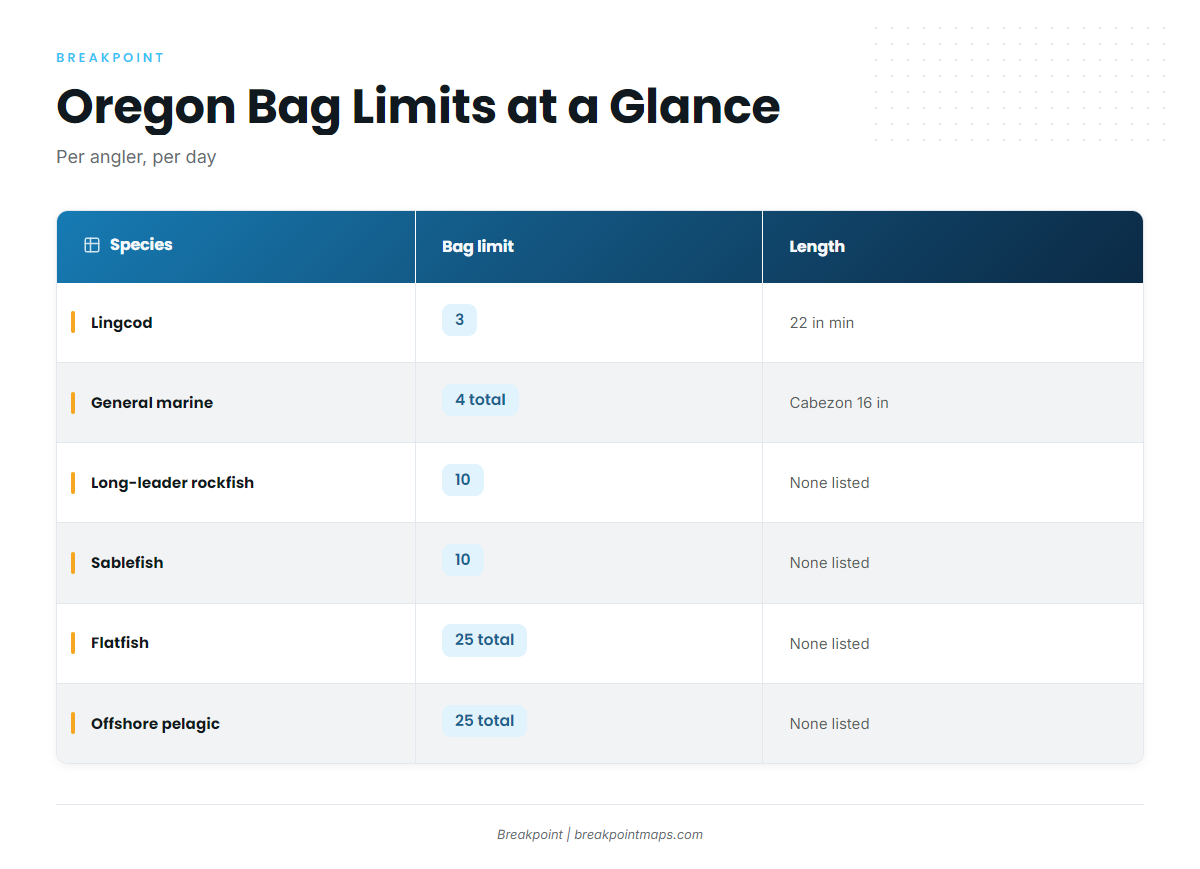
- Bag limit3 per angler per day. Lingcod do not count toward the general marine species limit.
- SeasonOpen year-round at all depths.
- Gear and permitsDescending device on board. Angling license and Ocean Endorsement required to keep lingcod. Keeping a lingcod rules out long-leader fishing for the rest of that trip.
Check the ODFW bottomfish seasons page before you fish.
Rockfish, cabezon and other general marine species
These species share a single 4-fish general marine bag. Yelloweye rockfish and quillback rockfish are prohibited at all times and in all waters. The bag limit can be cut during the year if black rockfish catch nears its cap.
- LengthCabezon 16 inches minimum. None listed for rockfish; see ODFW.
- Bag limit4 general marine species per angler per day in total, with no more than 2 canary rockfish and no more than 1 cabezon.
- SeasonOpen year-round at all depths. Cabezon retention is closed January 1 through June 30 and opens July 1.
- Gear and permitsDescending device on board, used on any rockfish released seaward of the 30-fathom line. Yelloweye and quillback rockfish may not be kept. Angling license and Ocean Endorsement required. A 4-fish bottomfish trip and a separate long-leader trip after offloading on the same day may total no more than 10 general marine fish, with no more than 2 canary.
Check the ODFW bottomfish seasons page before you fish.
Offshore long-leader rockfish
This is a mid-water rockfish fishery seaward of the 40-fathom line, in state and federal waters. The 10-fish limit applies only when every angler on the vessel uses long-leader gear. Allowed species are yellowtail, widow, canary, redstripe, greenstriped, silvergray, chilipepper, blue, deacon and bocaccio rockfish. Lingcod and other rockfish may not be kept on the same trip.
- LengthNone listed; see the ODFW long-leader FAQ.
- Bag limit10 rockfish per angler per day, with no more than 2 canary rockfish.
- SeasonOpen year-round, only seaward of the 40-fathom regulatory line.
- Gear and permitsUp to 3 hooks. A non-compressible float above the top hook. At least 30 feet of line between the lowest hook and the weight. No natural bait. Combines with sablefish, Pacific cod, flatfish, tuna, crab, salmon and all-depth halibut. It does not combine with a traditional bottomfish trip.
Check the ODFW offshore long-leader FAQ before you fish.
Sablefish (black cod)
Sablefish, also called black cod, is a deep bottomfish with its own limit outside the general marine group. It can be kept with all-depth halibut and with either bottomfish fishery.
- LengthNone listed; see ODFW.
- Bag limit10 per angler per day, not part of the general marine species limit.
- SeasonOpen year-round at all depths.
- Gear and permitsHook-and-line or spear in federal waters. Descending device on board. Angling license and Ocean Endorsement required.
Check the ODFW bottomfish seasons page before you fish.
Flatfish
Flatfish means sanddabs, soles and flounders. Pacific halibut is excluded and has its own rules. Skates and rays are not flatfish; they count as general marine species.
- LengthNone listed; see ODFW.
- Bag limit25 flatfish per angler per day in total.
- SeasonOpen year-round at all depths.
- Gear and permitsDescending device on board any vessel fishing for or holding flatfish. Combines with halibut and either bottomfish fishery. Angling license and Ocean Endorsement required.
Check the ODFW bottomfish seasons page before you fish.
Pacific halibut
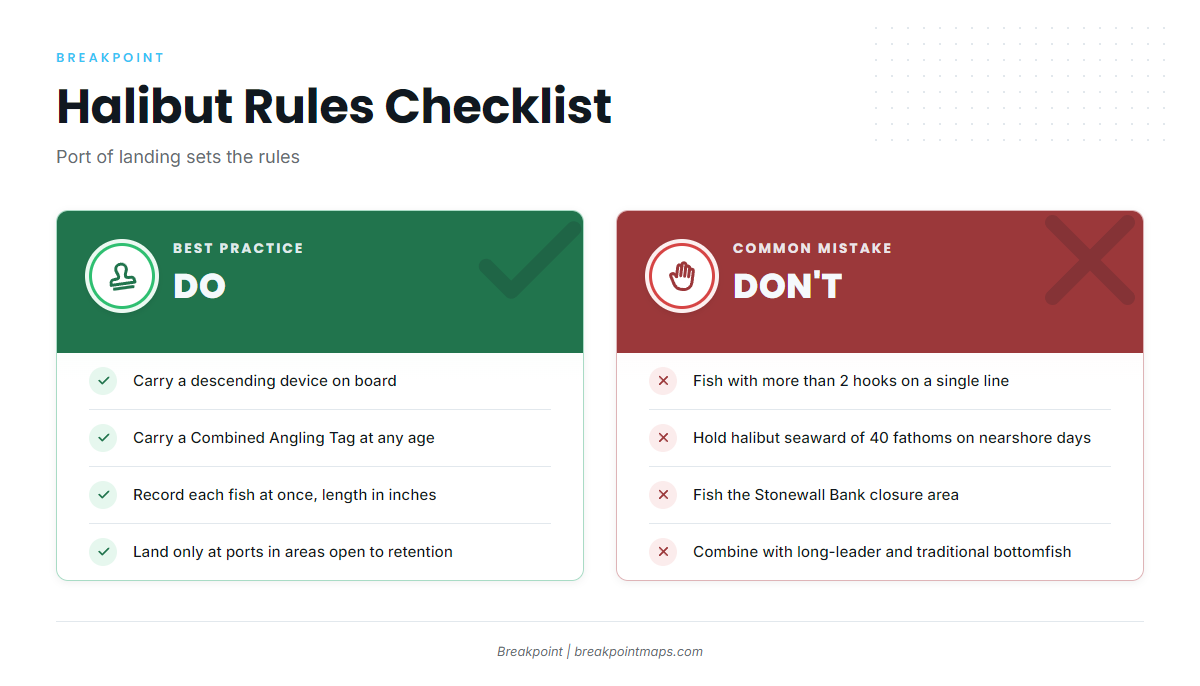
The IPHC sets the Area 2A catch limit. The council and NOAA divide that limit among three Oregon subareas: Columbia River (Leadbetter Point, Washington to Cape Falcon), Central Oregon Coast (Cape Falcon to Humbug Mountain) and Southern Oregon (Humbug Mountain to the California border). Pacific halibut count against the subarea of the port where they are landed, and that subarea’s rules apply wherever the fish was caught. They may be landed only at ports in areas open to retention.
- LengthNo length limit.
- Bag limit2 per angler per day in the Central Oregon Coast and Southern Oregon subareas. 1 per angler per day in the Columbia River subarea. Annual limit 6. Possession limit is 1 daily limit at sea and 3 on land.
- SeasonCentral Oregon Coast has a spring all-depth season, a summer all-depth season, and a nearshore season inside the 40-fathom line. Southern Oregon has a single season. Columbia River all-depth days are set each year and can be added. Each season closes when its quota is caught. Open days are on the ODFW halibut page.
- Gear and permitsSingle line with no more than 2 hooks, or spear. Descending device on board. A Combined Angling Tag for every angler of any age. Record each fish at once with its length in inches, in the MyODFW app or on the paper tag. Ocean Endorsement required. On all-depth days, halibut combines with either the long-leader fishery or the traditional bottomfish fishery, not both. Sablefish, Pacific cod and flatfish combine with either. On nearshore-only days, no halibut may be held seaward of the 40-fathom line.
Check the ODFW Pacific halibut regulations before you fish.
Albacore and other offshore pelagic species
The offshore pelagic group covers all tuna and mackerel species, swordfish, billfish, jacks, opah, dorado, pomfret, and sharks other than leopard, spiny dogfish and soupfin. Albacore and Pacific bluefin fall under Oregon’s 25-fish aggregate. The federal 2-fish bluefin limit is written for California only.
- LengthNone listed; see ODFW.
- Bag limit25 offshore pelagic fish per angler per day in aggregate. The federal albacore limit is also 25 per angler per 24 hours at sea, and the vessel operator is responsible for it. White shark, basking shark, megamouth shark and oceanic whitetip shark are prohibited.
- SeasonOpen all year.
- Gear and permitsAngling, spear, gaff, snag hook or herring jig. Seaward of 3 miles, you may chum with squid, herring, sardine, anchovy, smelt or Pacific mackerel, and fish any number of rods, if nothing but offshore pelagic species has been kept. Ocean Endorsement required when tuna is kept. Albacore may be partly cleaned at sea: head and entrails only, with the collar and tail left on. A federal HMS permit is required only for charter and commercial vessels. Tuna may be aboard with halibut seaward of the 40-fathom line.
Check the ODFW marine zone regulations before you fish.
Ocean salmon
The Pacific Fishery Management Council sets ocean salmon seasons each year, and ODFW posts them. The barbless hook rule also applies to any other species you fish for while a salmon is on board. Many salmon seasons are quota-based and may close early.
- LengthSet each year; see the ODFW ocean salmon page.
- Bag limitSet each year; see the ODFW ocean salmon page.
- SeasonSet each year by the Pacific Fishery Management Council. For in-season changes, call the Ocean Salmon Hotline at (800) 662-9825.
- Gear and permitsNo more than 2 single-point barbless hooks, and one line per angler. A Combined Angling Tag is required at any age. The Ocean Endorsement is not required when fishing for and keeping only salmon or steelhead.
Check the ODFW ocean salmon regulations before you fish.