




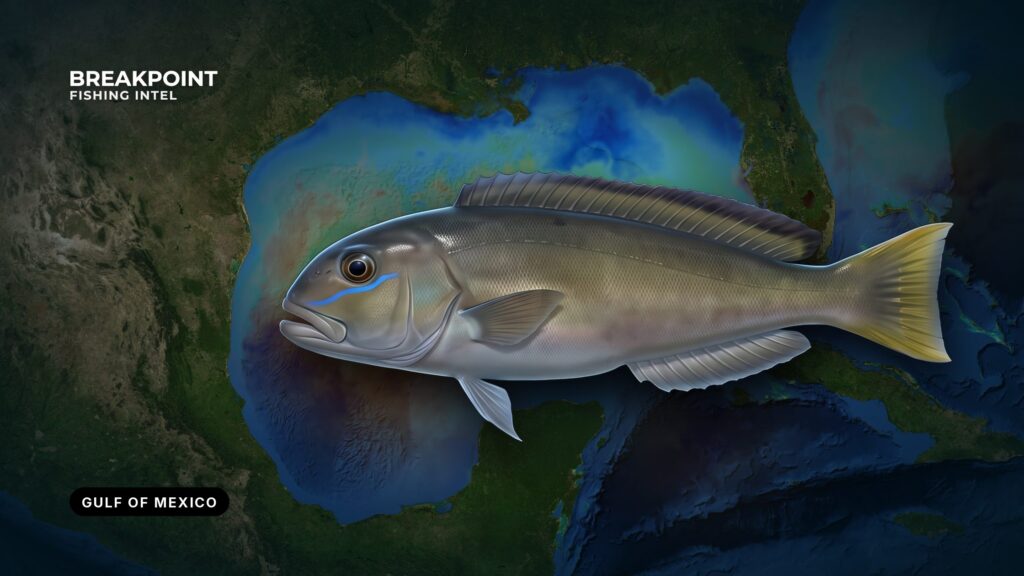
Blueline tilefish in the Gulf live on the outer shelf and upper slope, 150 to 840 feet, per the SEDAR blueline tilefish information document. They are open year-round in Gulf federal waters.
This guide covers where to look for blueline tilefish in the Gulf of Mexico, how they’re fished, and which rulebook applies. It ties the fish to features you can find on a chart, then sorts out the rules by distance from shore. You get a depth band and a bottom type to search, a federal-versus-state rule split, and an answer on whether Atlantic seasons apply. They don’t. For the wider picture, start with our Gulf of Mexico fishing guide.
Identification and biology
Look for a blue or violet line under the eye, an olive-gray to bluish body fading to a white belly, and no crest of the kind the golden tilefish carries. For ID detail and general biology, use the full blueline tilefish species guide.
Fish from the eastern Gulf through the Mid-Atlantic appear to be one genetic stock. NOAA’s species profile says the Gulf stock has not been assessed and population levels are unknown, and the Seafood Watch blueline tilefish rating says the same about stock status and fishing levels in the Gulf. The biology is not well studied.
Where blueline tilefish live in the Gulf
Blueline tilefish hold on the outer shelf, the shelf edge and the upper slope, in 150 to 840 feet of water. That is the band to search.
The northeastern Gulf shelf edge and the DeSoto Canyon are places where the shelf break and slope sit within reach of the coast. The documented range runs from the eastern Gulf, and the fishery is concentrated there. There is no single best spot to name, because the data does not support one.
NOAA lists blueline tilefish as available year-round in the Gulf, meaning the fish are present and legal to keep in federal waters. The bite is not necessarily the same every month.
The Chart Contours layer shows the shelf break and upper-slope contours across the 150 to 840 foot band. Look for places where contours pinch together, which marks the break and canyon walls. Chart layers are not for navigation, and some offshore bathymetry rests on old or sparse surveys, so confirm the bottom on your own sounder.
Quick reference:
- Depth band: 150 to 840 feet
- Zones: outer shelf, shelf edge, upper slope
- Features to chart: contour pinch points, canyon walls, the DeSoto Canyon area
Bottom and water
Blueline tilefish want hard bottom: rocky ledges and boulders on the break and canyon walls. Golden tilefish hold on soft mud, so a muddy flat that produces goldens is not where to start for blueline.
Water temperature is 59 to 73°F (15 to 23°C). On the sounder, slow down over anything harder or broken inside the depth band.
What to match:
- Depth: 150 to 840 feet
- Bottom: hard, rocky, broken, with ledges and boulders
- Temperature: 59 to 73°F (15 to 23°C)
How anglers fish for them
Gulf anglers fish blueline tilefish on vertical lines and handlines. The common setup is deep-drop gear: braid for low stretch and good feel at depth, and enough lead to hold bottom in the current.
Bait is cut squid or firm fish strips, since soft baits wash off the hook on the way down. Blueline tilefish do not chase, so the bait has to sit on the bottom. Drift along the break and bounce bottom as you go. Electric reels are common at these depths.
Circle hooks are required, as covered in the gear rules below. Snowy grouper, yellowedge grouper and golden tilefish share this water and fall under different limits. The groupers count toward the grouper aggregate described under Regulations.
Fish brought up from these depths suffer barotrauma, which is why a descending device is required release gear. For rigs, reels and drift technique, see our deep-drop guides.
How the Gulf differs from the South Atlantic
Atlantic tilefish seasons do not apply in the Gulf. The two regions sit under different councils and rulebooks, even though the fish appear to be one genetic stock.
| Gulf | South Atlantic | |
|---|---|---|
| Management body | GMFMC and NOAA Fisheries | South Atlantic council and NOAA Fisheries |
| Season type | Open year-round in federal waters | Seasonal opening |
| Aggregate | 20-fish reef fish aggregate | Tighter grouper/tilefish aggregate |
| Where to check | GMFMC, NOAA, FWC (Gulf) | FWC and our Atlantic guide |
For Atlantic dates and limits, use our guide to Atlantic blueline tilefish rules and seasons.
Regulations
Check the agency before you fish. Federal documents and NOAA now use the name "Gulf of America" for these waters, so you will see both names in official sources.
How federal and state rules divide
The line between state and federal water differs by state:
- Off Florida’s Gulf coast, state waters run from shore to 9 nautical miles, and federal waters run beyond that.
- Off Louisiana, state waters generally run to 3 nautical miles, but 9 nautical miles for reef fish management.
- Off Alabama, Mississippi and Texas, federal waters begin at the state line. Check each state’s agency for the exact distance.
- Federal waters are managed by the Gulf of Mexico Fishery Management Council and NOAA Fisheries under 50 CFR part 622.
- In-season changes come through NOAA. Check the NOAA Gulf seasonal closures page before you go.
The federal rule for blueline tilefish
Blueline tilefish are a Gulf reef fish in the tilefish complex. Every reef fish without its own limit counts toward 20 per person per day. The federal rule, per the Gulf Council blueline tilefish regulations:
- No minimum size.
- Counts inside the 20-fish reef fish aggregate.
- Open year-round.
The Gulf stock is unassessed. Private anglers need no federal permit. For-hire vessels need a federal Gulf reef fish charter vessel/headboat permit under the charter vessel/headboat permit rule. In Mississippi, a federally permitted for-hire vessel follows the more restrictive of federal or state reef fish rules in state waters too. For the bigger picture, see how the Gulf reef fish rules work.
Federal gear rules
Under the federal reef fish gear rule, you need:
- non-stainless-steel circle hooks when fishing with natural bait
- a dehooking device on board and used
- a descending device or venting tool rigged and ready
Florida state waters add two requirements:
- non-offset circle hooks
- a descending device with at least a 16-ounce weight and 60 feet of line
State by state
| State | State-water line | Agency | Blueline rule |
|---|---|---|---|
| Florida | 9 nm | FWC tilefish regulations page | No minimum size; 100 pounds or 2 per person per day, whichever is greater; open year-round |
| Alabama | See agency | ADCNR Marine Resources | See agency |
| Mississippi | See agency | MDMR | Federal: in the 20-fish aggregate, no size limit listed |
| Louisiana | 3 nm, 9 nm for reef fish | LDWF | See agency |
| Texas | See agency | TPWD | See agency |
Each state’s page pairs with its agency:
- Florida Fish and Wildlife Conservation Commission: see our Florida fishing regulations.
- Alabama Department of Conservation and Natural Resources, Marine Resources Division: see our Alabama fishing regulations.
- Mississippi Department of Marine Resources: see our Mississippi fishing regulations.
- Louisiana Department of Wildlife and Fisheries: see our Louisiana fishing regulations. Louisiana’s federal descending-device rule refers to NOAA, so check NOAA for the current requirement.
- Texas Parks and Wildlife Department: see our Texas fishing regulations.
FAQ
Is blueline tilefish open in the Gulf?
Yes, year-round in federal waters. Florida Gulf state waters are also open year-round. Check NOAA bulletins for in-season changes before you fish.
Do Atlantic tilefish seasons apply on Florida’s Gulf coast?
No. The Gulf is a separate rulebook, managed by the Gulf council and NOAA Fisheries. On Florida’s Gulf coast, state waters run to 9 nm, and federal Gulf rules apply beyond that.
Is there a size limit on blueline tilefish in the Gulf?
There is no minimum size in federal waters or in Florida Gulf state waters. Check the agency for Alabama, Mississippi, Louisiana and Texas state waters.
What gear must be on board for blueline tilefish?
Non-stainless-steel circle hooks with natural bait, a dehooking device, and a descending device or venting tool rigged and ready. Florida state waters add non-offset circle hooks and a descending device with a 16-ounce weight and 60 feet of line.
Do I need a permit to fish blueline tilefish in the Gulf?
Private anglers need no federal permit. For-hire vessels need the federal Gulf reef fish charter vessel/headboat permit. State license requirements are on each state’s regulations page.
How deep do blueline tilefish live in the Gulf?
They live in 150 to 840 feet, on hard bottom at the shelf edge and upper slope.
How are blueline tilefish different from golden tilefish?
Blueline hold on hard, rocky bottom, while goldens hold on soft mud. Both sit in the tilefish complex under the same Gulf federal rule.
Find the band on the chart, then confirm the rules on your state’s page before you run for blueline. If you want the contours and bottom structure in one place, download Breakpoint from the App Store or Google Play.