




Ocean fishing rules in Washington change by species, by marine area and by the port where the fish is landed. This page covers fishing in Washington across 4 coastal marine areas, run from Ilwaco, Westport, La Push and Neah Bay, where one trip can mix halibut, bottomfish, salmon and tuna. It lists each species’ size, bag, season and gear rules and links the agency page that governs it.
Washington Fishing Official Government Organizations
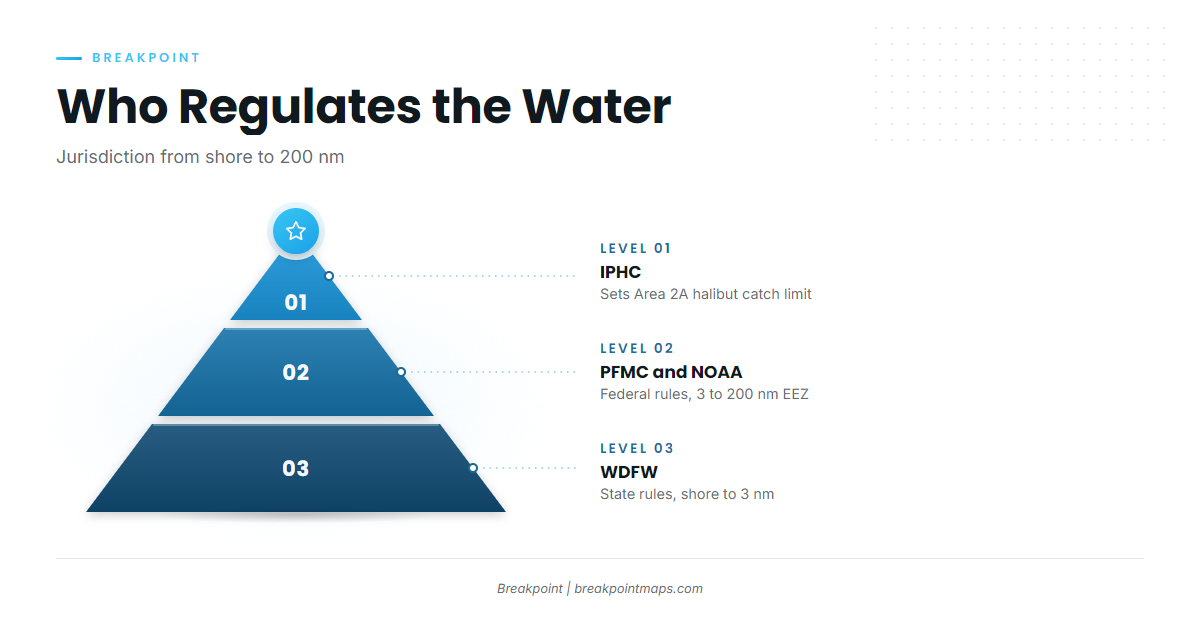
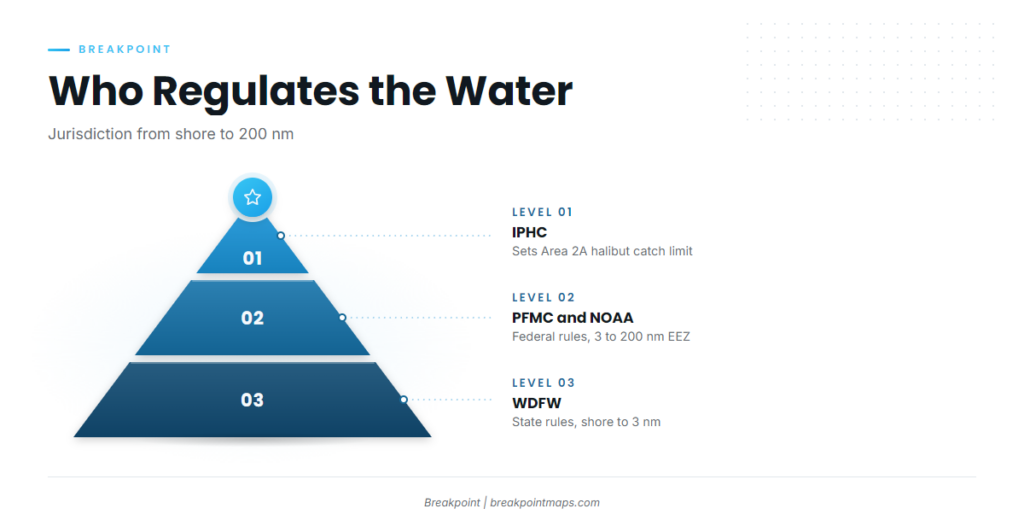
State waters run from shore to 3 nautical miles, and the federal exclusive economic zone runs from 3 to 200 nautical miles. That is the seaward limit of state laws, and every coastal state splits authority at the 3-nautical-mile line. Anyone who delivers fish caught in Pacific Ocean waters into Washington is subject to all Washington personal-use fishing, possession and licensing rules under Washington’s ocean landing rule, so fish landed in Washington must be legal in Washington wherever they were caught. Federal groundfish and highly migratory species rules are not intended to supersede more restrictive state rules, which means Washington regulations stack on top of the federal ones. Emergency rules replace pamphlet rules, so check the WDFW emergency rules page before you fish.
- Washington Department of Fish and Wildlife (WDFW) – Sets and enforces recreational rules for Marine Areas 1 to 4 and publishes them in the Washington Sport Fishing Rules pamphlet.
- Pacific Fishery Management Council – Sets groundfish and highly migratory species frameworks for federal waters and writes the halibut Catch Sharing Plan.
- NOAA Fisheries West Coast Region – Implements Council rules in the exclusive economic zone under 50 CFR 660 and publishes the annual recreational halibut rule.
- International Pacific Halibut Commission (IPHC) – Sets the yearly halibut catch limit for IPHC Area 2A, which covers Washington, Oregon and California.
Washington Offshore Fishing Regulations by Species
The coast is divided into Marine Areas 1 to 4: Area 1 Ilwaco, Area 2 Westport-Ocean Shores, Area 3 La Push and Area 4 Neah Bay. The Bonilla-Tatoosh line splits Area 4 into ocean waters to the west and Strait waters to the east.
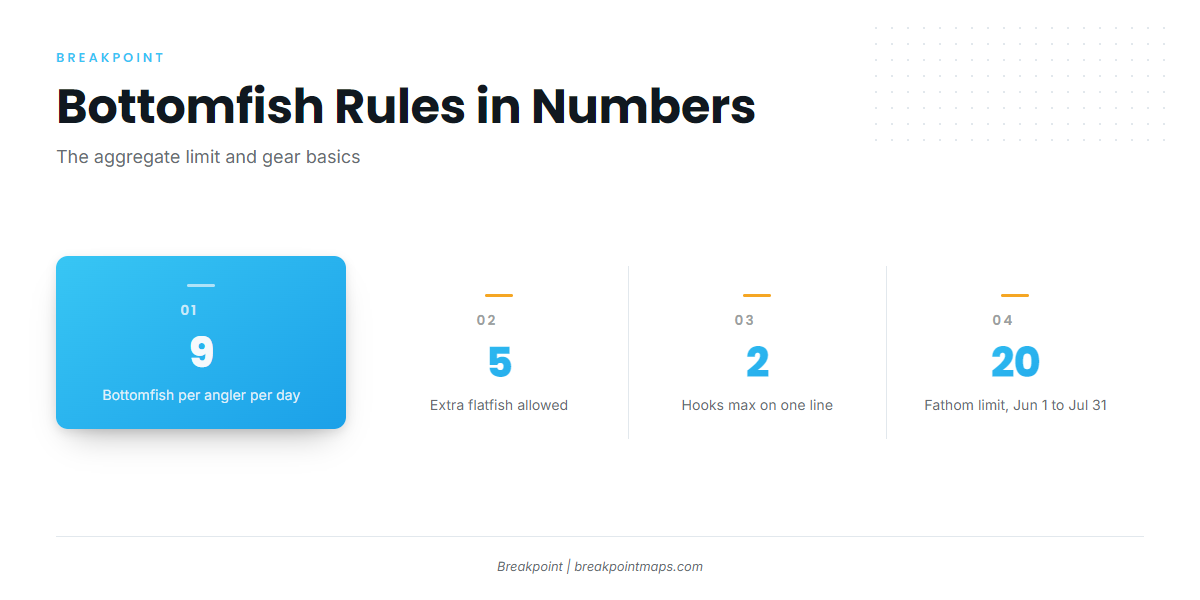
Bottomfish are managed under an aggregate limit of 9 per angler per day in total, within the individual limits below. You may keep 5 flatfish in addition to the 9. Bottomfish includes lingcod, sablefish, cabezon, rockfish, Pacific cod, greenling, sculpins, wolf-eel, spiny dogfish, skates and flatfish other than halibut. The season runs from the second Saturday in March through the third Saturday in October in Areas 1 to 3 and Area 4 west. Area 4 east is open year-round.
Allowed methods are hook and line, spearfishing, and bow and arrow, with one line and up to 2 hooks. A descending device must be on board and rigged for immediate use when you fish for or hold bottomfish or halibut. Areas 3 and 4 west have a 20-fathom depth restriction from June 1 to July 31. Other lines, months and halibut-day exceptions are on the marine area pages.
Fishing may continue until the combined daily limit of everyone aboard is reached. In Areas 1 to 6, one daily limit is allowed aboard a vessel, and two daily limits in any form on land. Halibut and salmon are managed by quota and close when the quota is taken.
Pacific halibut
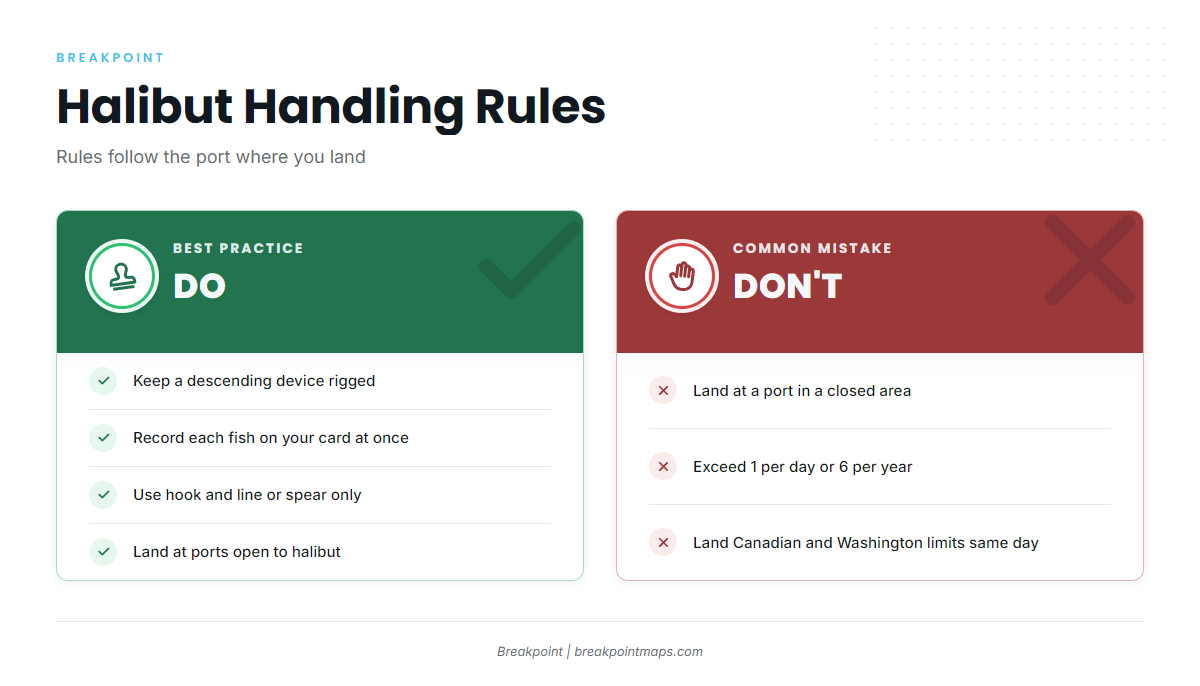
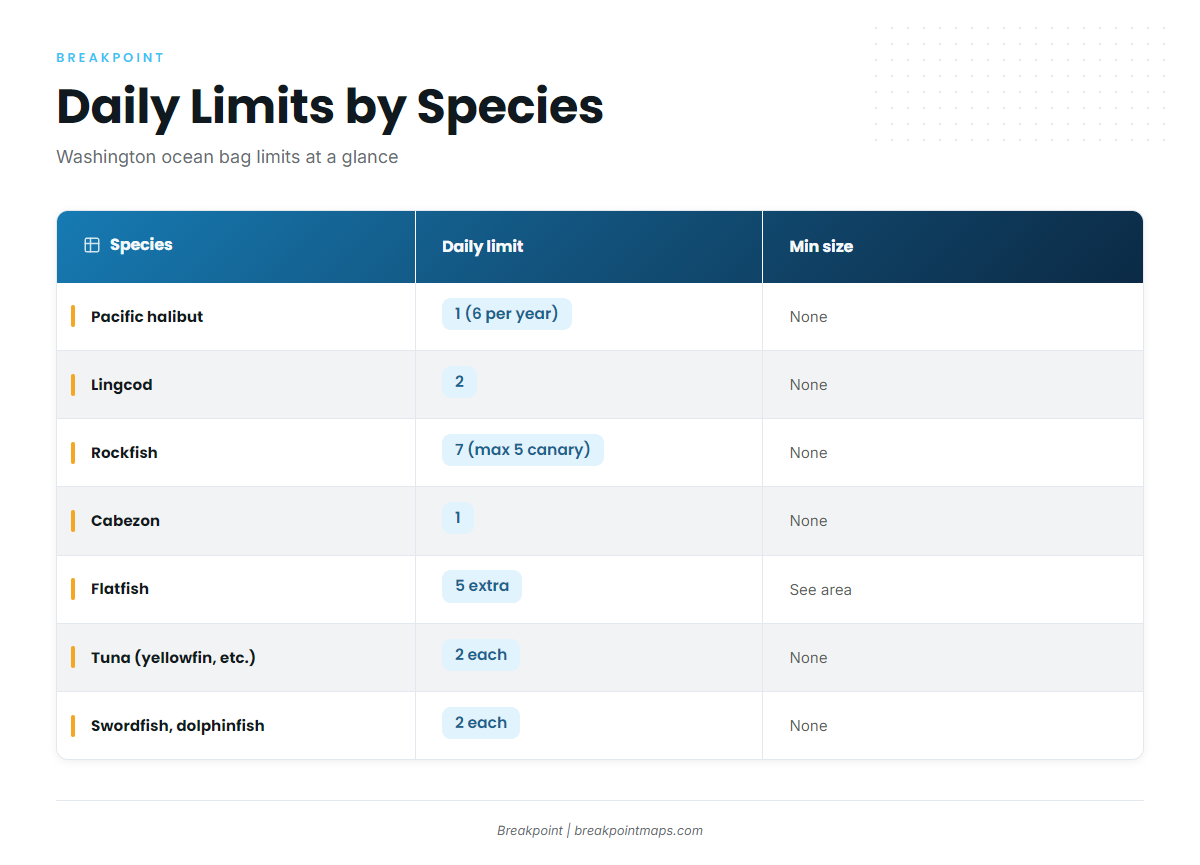
Pacific halibut off Washington have no minimum size and a limit of 1 per day and 6 per year.
Our Pacific halibut guide covers where to fish them. Rules follow the port where the fish is landed. Halibut may not be fished for, kept or landed at a port in an area closed to halibut, except that halibut lawfully kept in Area 5 may be landed in Area 4. A Canadian limit and a Washington limit may not both be landed on the same day. The IPHC sets the Area 2A catch limit, and the Pacific halibut Catch Sharing Plan divides it.
- LengthNo minimum size.
- Bag limit1 per day and 6 per year. One daily limit is allowed aboard, and two daily limits on land.
- SeasonSet each year for each area and managed to a quota. The areas are Area 1 Columbia River, Area 2 South Coast and Areas 3 and 4 North Coast. See the WDFW halibut seasons page.
- Gear and permitsHook and line or spear only, with one line and up to 2 hooks. A descending device on board. Record every halibut kept on the halibut catch record card immediately, in ink or in the electronic card.
WDFW halibut seasons and quotas
Ocean salmon
Ocean salmon seasons, limits and minimum lengths off Washington are set each year and listed by marine area. Salmon are managed to quota, and a fishery closes when its quota is taken.
- LengthSee the Salmon section of each marine area page.
- Bag limitSee the marine area pages.
- SeasonSet each year by quota. See the marine area pages and emergency rules.
- Gear and permitsSingle-point barbless hooks and a hand-held rod and line.
Lingcod
Lingcod off Washington’s coast have no minimum size and a limit of 2 per day.
Our lingcod guide covers the structure they hold on. Depth lines determine where lingcod can be kept, with exceptions on days open to halibut. A gaff may be used to land lingcod in Areas 1 to 3 and Area 4 west.
- LengthNo minimum size.
- Bag limit2 per day, inside the 9-bottomfish limit.
- SeasonSecond Saturday in March through third Saturday in October.
- Gear and permitsHook and line, spear, and bow and arrow, with a descending device on board. For depth lines and months, see the Area 1 to 4 pages.
WDFW north coast bottomfish rules
Rockfish
Rockfish off Washington’s coast have no minimum size and a limit of 7 per day, with no more than 5 canary rockfish.
Yelloweye rockfish are prohibited in all marine areas. The "C" shaped yelloweye rockfish conservation area off La Push is closed to halibut and bottomfish fishing. Its coordinates are 48°00′ N to 48°18′ N and 124°59′ W to 125°18′ W. Keep the carcass of rockfish and length-restricted fish until ashore. Federal sub-limits in the EEZ match the state’s, as set out in the federal groundfish rules 660.360.
- LengthNo minimum size.
- Bag limit7 per day with no more than 5 canary, inside the 9-bottomfish limit. Area 4 east allows black, blue/deacon, yellowtail and widow only.
- SeasonSecond Saturday in March through third Saturday in October. Area 4 east is open year-round. Copper, quillback and vermilion rockfish may not be possessed in May, June and July.
- Gear and permitsA descending device on board. Sub-limits for the following season are set each year, so see WDFW.
WDFW coastal rockfish rules
Cabezon
Cabezon off Washington’s coast have no minimum size and a limit of 1 per day. They count inside the 9-bottomfish aggregate, and Area 4 east is open year-round at the same limit.
- LengthNo minimum.
- Bag limit1 per day, inside the 9-bottomfish limit.
- SeasonSecond Saturday in March through third Saturday in October. Area 4 east is open year-round.
- Gear and permitsHook and line, spear, and bow and arrow, with a descending device on board.
Marine Area 3 bottomfish rules
Sablefish and Pacific cod
Sablefish and Pacific cod have no separate daily limit off Washington and count toward the 9-bottomfish total. Seaward of the depth lines, both may be kept on days open to halibut.
- LengthSee the marine area pages.
- Bag limitNo separate limit, inside the 9-bottomfish limit.
- SeasonSecond Saturday in March through third Saturday in October.
- Gear and permitsHook and line and spear, with a descending device on board.
WDFW north coast rules
Flatfish
Washington allows 5 flatfish per day in addition to the 9-bottomfish limit in Areas 1 to 3 and Area 4 west. Flatfish means dabs, sole and flounder, but not halibut. Area 4 east has a flatfish limit of 9.
- LengthSee the marine area pages.
- Bag limit5 per day in addition to the 9, or 9 in Area 4 east.
- SeasonBottomfish season. Area 4 east is open year-round.
- Gear and permitsHook and line, spear, and bow and arrow, with one line and up to 2 hooks.
marine area rules and definitions
Albacore tuna
WDFW sets no daily limit, possession limit or minimum size for albacore.
The albacore tuna guide covers how to find them. The federal rule is different: it allows no more than 25 albacore per 24 hours if any part of the trip is in the EEZ, and the vessel operator is responsible for staying within it.
- LengthNo minimum size.
- Bag limitNo state limit. The federal albacore limit 660.721 is 25 per 24 hours when any part of the trip is in the EEZ.
- SeasonYear-round.
- Gear and permitsHook and line, spear, and bow and arrow, and a gaff for tuna that will be kept. Charter vessels fishing highly migratory species in the EEZ need a Pacific HMS permit and a logbook.
WDFW albacore species page
Yellowfin, skipjack and Pacific bluefin tuna
Yellowfin, skipjack and Pacific bluefin tuna have a limit of 2 each per day off Washington. Other tunas and mackerel have no listed daily limit.
- LengthNo minimum size.
- Bag limit2 each per day. There is no possession limit, but only one daily limit may be held aboard in Areas 1 to 6.
- SeasonYear-round.
- Gear and permitsHook and line, spear, and bow and arrow. A gaff is allowed for tuna that will be kept.
Marine Area 1 tuna limits
Swordfish, striped marlin, dolphinfish and California yellowtail
Washington allows 2 per day of each of swordfish, striped marlin, dolphinfish and California yellowtail. WDFW lists them as "Other Food Fish," along with opah, barracuda, white sea bass, bonito and pomfret.
- LengthNo minimum size.
- Bag limit2 per day of each species.
- SeasonYear-round.
- Gear and permitsSee the WDFW definitions and rule text.
WDFW other food fish definitions
Prohibited sharks: sixgill, sevengill and thresher
Sixgill, sevengill and thresher sharks are closed to retention in Washington. Release them.
- LengthRetention closed.
- Bag limitRetention closed.
- SeasonClosed.
- Gear and permitsSee the WDFW statewide rules.
WDFW statewide prohibited species