




South Carolina fishing regulations split at the 3-mile line, and the rule that applies depends on where the fish was caught. Boats out of Charleston, Murrells Inlet, Georgetown and Hilton Head run to the ledges and reefs inside the Gulf Stream, where wahoo, mahi-mahi and billfish work the edge. Breakpoint covers South Carolina as one of the states we cover, and South Carolina offshore fishing runs from nearshore reefs to the blue water past the shelf.
South Carolina Fishing Official Government Organizations
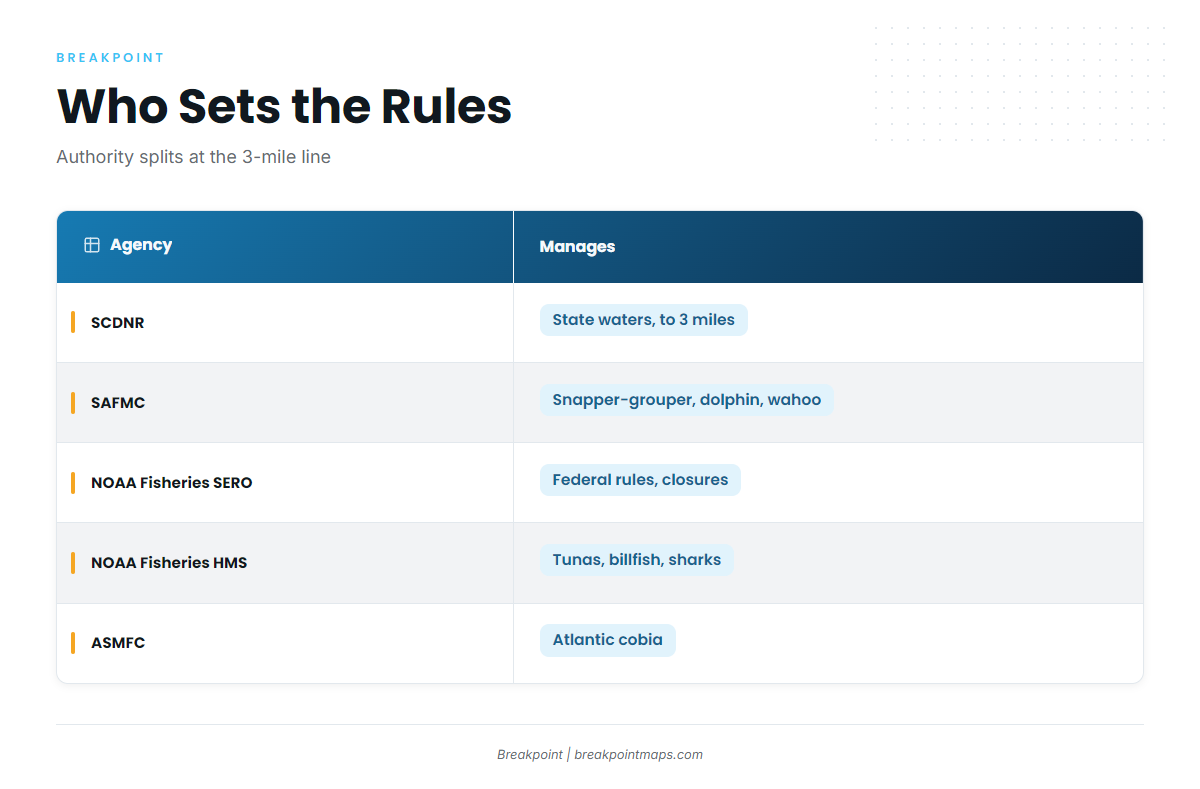
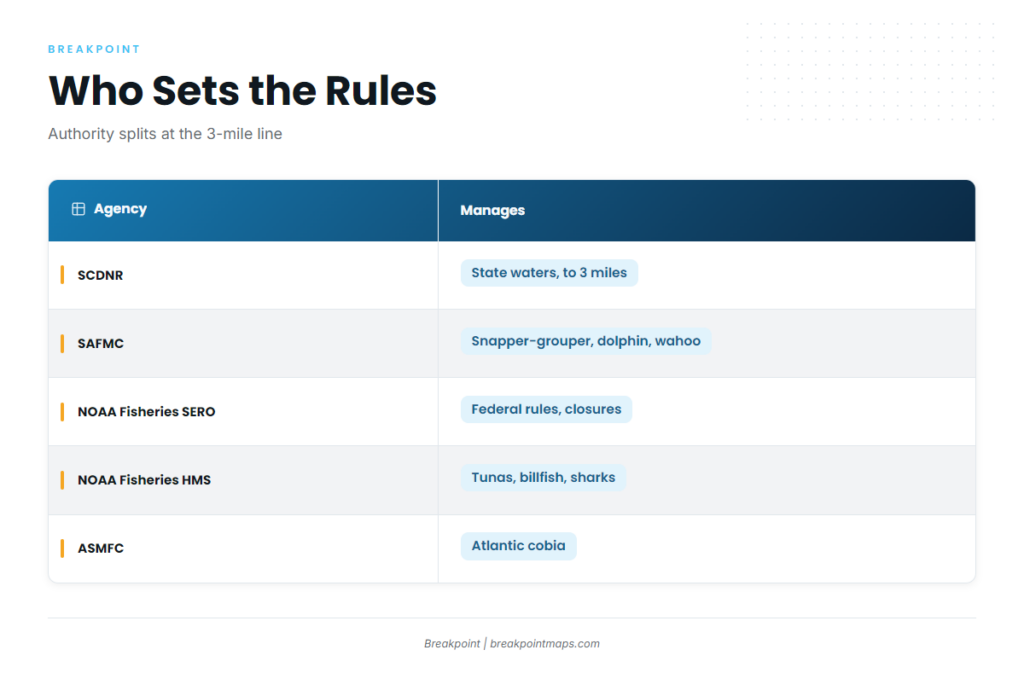
State waters run from the saltwater/freshwater dividing line out to 3 miles. Federal waters run from 3 to 200 miles. SCDNR sets the rules inside the line. The South Atlantic Fishery Management Council and NOAA Fisheries set them outside it, and the council writes the plans for the South Atlantic region.
S.C. Code 50-5-2730 makes federal seasons, size limits and bag limits state law in state waters, unless the statute sets something else. The statute sets its own rules for black sea bass and red snapper. For every other snapper-grouper species, the state bag limit is the higher of the SCDNR guide or the federal limit, and the minimum size is the lower of the two. State waters have no closed season for snapper-grouper. A for-hire vessel with a federal snapper-grouper permit also follows federal closures and prohibitions in state waters, under the federal rules in 50 CFR 622.
South Carolina’s current rules are in the SCDNR regulations guide; check it before fishing. Tunas, billfish, swordfish and sharks are Highly Migratory Species, managed federally by NOAA.
The bodies that write and enforce the rules:
- SCDNR Marine Resources Division – sets and enforces saltwater rules in state waters and sells the Saltwater Recreational Fishing License. Anyone 16 and older who harvests marine resources needs it, except on a licensed public pier, on a licensed charter or headboat while under hire, or when using 3 or fewer drop nets, fold-up traps or hookless handlines. Resident fees are $45 for 3 years, $15 annual and $10 for 14 days. Nonresident fees are $75 annual, $35 for 7 days and $10 for 1 day, and you can buy through GoOutdoorsSC.
- South Atlantic Fishery Management Council (SAFMC) – writes the federal plans for snapper-grouper, dolphin, wahoo and coastal migratory pelagics, posted on SAFMC’s federal regulations page. Private recreational anglers need no federal permit for snapper-grouper, dolphin, wahoo or mackerel.
- NOAA Fisheries Southeast Regional Office – puts council rules into effect in 50 CFR part 622 and announces in-season closures on NOAA’s seasonal closures page.
- NOAA Fisheries HMS – manages tunas, billfish, swordfish and sharks, and issues the federal HMS permit.
- Atlantic States Marine Fisheries Commission (ASMFC) – manages Atlantic cobia across states, so a landed fish must meet the stricter limit of the state where it is landed.
South Carolina Offshore Fishing Regulations by Species
Most reef fish share one set of gear and aggregate rules, stated here once. In state and federal waters, you need a dehooking tool and a descending device ready for use. The descending device must be attached to at least 16 ounces of weight and at least 60 feet of line. Use non-offset, non-stainless circle hooks with hook and line and natural bait. Fish with a size limit must be landed with head and tail intact. Selling snapper-grouper caught under the recreational bag limit is prohibited.
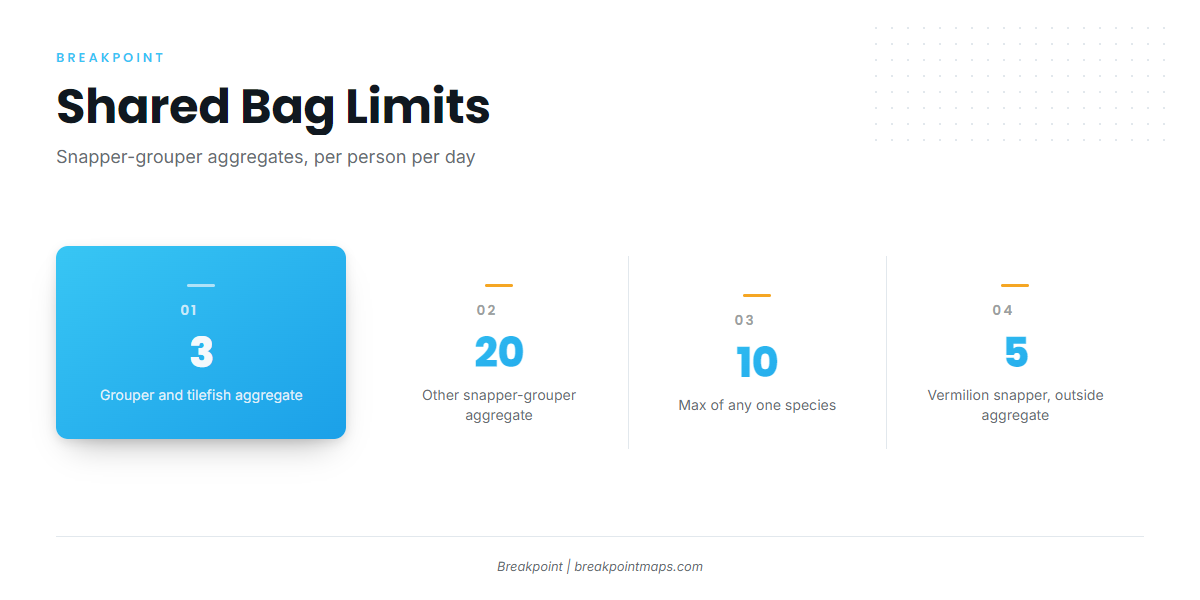
"Aggregate" means a shared daily limit across several species. Groupers and tilefish share a 3-fish aggregate per person per day. Most other snapper-grouper share a 20-fish aggregate, with no more than 10 of any one species. Vermilion snapper carries its own 5-fish limit outside the aggregate.
South Carolina’s artificial reefs are declared special management zones. Harvest of snapper-grouper and coastal migratory pelagics there is limited to the recreational bag limit, and some zones allow only handheld hook and line and spearfishing gear. Powerheads are prohibited in these zones except for safety. The spawning special management zones are Devil’s Hole, Area 51 and Area 53. The marine protected areas are Snowy Grouper Wreck, Northern SC, Edisto and Charleston Deep Artificial Reef. In these areas, fishing for or possessing snapper-grouper is prohibited unless gear is stowed, and trolling for pelagics is permitted. Know where a spawning zone or protected area sits before you drop a bait, and do not use chart layers for navigation.
The species follow in the order anglers ask about them.
Red snapper
SCDNR and NOAA Fisheries treat red snapper very differently, and it is the largest split between state and federal rules on this page.
- Length20 inches total length in state waters; no minimum size during the federal season.
- Bag limit2 per person per day in state waters; 1 per person per day during the federal season, zero when it is closed.
- Seasonno closed season in state waters under state law. Federal waters are closed except for a short season NOAA announces each year in the Federal Register. SCDNR’s Red Snapper Project runs its own season under a NOAA exempted fishing permit, with terms set each year. Registered participants cannot also fish the federal season.
- Gear and permitsdescending device, circle hooks and dehooking tool. The Red Snapper Project requires a free permit, an SCDNR trip declaration and a report. A for-hire vessel with a federal snapper-grouper permit may not keep red snapper outside the federal season, including in state waters.
SCDNR’s red snapper page holds the live rules. Check it before fishing.
Black sea bass
SCDNR and SAFMC set the same size and bag figures for black sea bass in state and federal waters.
- Length13 inches total length in state and federal waters.
- Bag limit7 per person per day in state and federal waters. State law sets the floor at 5 or the federal limit, whichever is higher.
- Seasonno closed season in state and federal waters.
- Gear and permitssnapper-grouper gear rules apply, and sale of the recreational catch is prohibited.
SAFMC’s black sea bass rules are the live source. Check them before fishing.
Vermilion snapper
Vermilion snapper carries its own limit and sits outside the snapper aggregate.
- Length12 inches total length in state and federal waters.
- Bag limit5 per person per day in state and federal waters, outside the snapper aggregate.
- Seasonno closed season in state and federal waters.
- Gear and permitssnapper-grouper gear rules apply.
SAFMC’s vermilion snapper rules are the live source. Check them before fishing.
Gag and black grouper
State waters stay open for gag and black grouper, and federal gag is driven by a quota.
- Length24 inches total length in state and federal waters.
- Bag limit1 gag or black grouper (not both) per person per day, inside the 3-fish aggregate, in state and federal waters. Federal vessel limit: 2 combined per private vessel per day, or per for-hire vessel per trip.
- Seasonno closed season in state waters. In federal waters, all shallow-water groupers close January 1 to April 30. Gag opens May 1 and closes when NOAA projects the annual catch limit is reached, with the end date announced by NOAA bulletin.
- Gear and permitszero gag or black grouper for captain and crew on a for-hire trip. Federal snapper-grouper permit holders follow the shallow-water grouper closure in state waters.
SAFMC’s gag grouper rules are the live source. Check them before fishing.
Red grouper, scamp and other groupers
These groupers share the 3-fish aggregate, and several have their own caps.
- Length20 inches total length for red, scamp, yellowmouth and yellowfin grouper in state and federal waters.
- Bag limitall count inside the 3-fish aggregate. Scamp and yellowmouth: 3 within the aggregate in state waters; 1 combined in federal waters. Snowy grouper: 1 per vessel in federal waters. Misty and yellowedge count in the aggregate. No retention of warsaw grouper, speckled hind, Nassau grouper or goliath grouper in state and federal waters.
- Seasonno closed season in state waters. In federal waters, red grouper is closed January 1 to May 31 off South Carolina, and scamp, yellowmouth and yellowfin are closed January 1 to April 30.
- Gear and permitssnapper-grouper gear rules apply. For-hire boats with a federal snapper-grouper permit follow the May red grouper closure in state waters.
SAFMC’s red grouper rules are the live source. Check them before fishing.
Gray triggerfish
Gray triggerfish counts toward the 20-fish aggregate.
- Length12 inches fork length in state and federal waters.
- Bag limitpart of the 20-fish aggregate, no more than 10 of any one species, in state and federal waters.
- Seasonno closed season in state and federal waters.
- Gear and permitssnapper-grouper gear rules apply.
SAFMC’s gray triggerfish rules are the live source. Check them before fishing.
Greater amberjack
Greater amberjack has a federal closure that state waters do not share.
- Length28 inches fork length in state and federal waters.
- Bag limit1 per person per day in state and federal waters.
- Seasonno closed season in state waters. Federal waters close April 1 to April 30, with no fishing for, harvest or possession.
- Gear and permitsfederal snapper-grouper permit holders follow the April closure in state waters.
SAFMC’s greater amberjack rules are the live source. Check them before fishing.
Golden tilefish
Golden tilefish counts inside the grouper aggregate.
- Lengthno minimum size in state and federal waters.
- Bag limit1 per person per day inside the 3-fish aggregate, in state and federal waters.
- Seasonno closed season in state waters. Federal waters open January 1 and close when NOAA projects the recreational annual catch limit is reached, with the end date announced by bulletin.
- Gear and permitssnapper-grouper gear rules apply.
SAFMC’s golden tilefish rules are the live source. Check them before fishing.
Blueline tilefish
Blueline tilefish has a higher bag limit in state waters than in federal waters.
- Lengthno minimum size in state and federal waters.
- Bag limit3 per person per day in state waters; 2 in federal waters. Both counts sit inside the 3-fish aggregate.
- Seasonno closed season in state waters. Federal waters close January 1 to April 30 and September 1 to December 31.
- Gear and permitszero for captain and crew on a for-hire trip in federal waters. Snapper-grouper gear rules apply.
SAFMC’s blueline tilefish rules are the live source. Check them before fishing.
Mahi-mahi (dolphin)
SAFMC and SCDNR set matching size and bag figures for mahi-mahi, with a boat cap that headboats handle differently.
- Length20 inches fork length in state and federal waters.
- Bag limit10 per person per day, no more than 54 per boat, in state and federal waters. Headboats: no boat limit in state waters; 10 per paying passenger in federal waters.
- Seasonno closed season in state and federal waters.
- Gear and permitssale of the recreational catch is prohibited. For-hire vessels need the federal Dolphin Wahoo permit. An operator or crew member needs a valid Operator Card when underway fishing for dolphin.
SAFMC’s dolphin rules are the live source. Check them before fishing.
Wahoo
Wahoo has no size limit and a 2-fish bag.
- Lengthno minimum size in state and federal waters.
- Bag limit2 per person per day in state and federal waters.
- Seasonno closed season in state and federal waters.
- Gear and permitssale is prohibited. For-hire vessels need the Dolphin Wahoo permit and an Operator Card.
SAFMC’s wahoo rules are the live source. Check them before fishing.
King and Spanish mackerel
Both mackerel follow the same rules in state and federal waters, including king mackerel.
- Lengthking mackerel 24 inches fork length; Spanish mackerel 12 inches fork length; both in state and federal waters.
- Bag limitking mackerel 3 per person per day; Spanish mackerel 15 per person per day; both in state and federal waters. Inside a special management zone, harvest is limited to the recreational bag limit.
- Seasonno closed season in state and federal waters.
- Gear and permitsfor-hire vessels need the Coastal Migratory Pelagics permit in federal waters. On a federal-waters charter or headboat trip longer than 24 hours, with two licensed operators and a trip receipt, up to two daily bag limits may be possessed.
SAFMC’s king mackerel rules are the live source. Check them before fishing.
Cobia
ASMFC manages Atlantic cobia. A landed fish must meet the stricter limit of the state where it is landed. State zones split at 32°31.0′ N (Jeremy Inlet, Edisto Island), and federal waters follow the northern rule.
- Length36 inches fork length in state and federal waters.
- Bag limitsouth of 32°31.0′ N in state waters, 1 per person per day and no more than 3 per boat. North of that line in state waters, and in federal waters, 1 per person per day and no more than 6 per boat.
- Seasonclosed May 1 to May 31 in state waters south of 32°31.0′ N. No closed season north of that line or in federal waters.
- Gear and permitsin state waters, rod and reel or gig only. Cobia is a state game fish, so native-caught cobia cannot be sold or taken with nets. With natural bait on a hook of 4/0 or larger, use a non-offset, non-stainless circle hook. For-hire vessels need the Coastal Migratory Pelagics permit in federal waters.
SAFMC’s cobia rules are the live source. Check them before fishing.
Tunas, billfish, swordfish and sharks
South Carolina fishing regulations defer to NOAA Fisheries for these species. That covers blue marlin, white marlin and sailfish, along with tunas, swordfish and sharks.
- Lengthset by NOAA Fisheries HMS; see the agency page.
- Bag limitset by NOAA Fisheries HMS; see the agency page.
- Seasonset by NOAA Fisheries HMS; see the agency page.
- Gear and permitsa federal HMS permit is required to fish for these species in federal waters, and to possess them in state waters, except sharks. Sharks need a federal shark endorsement in federal waters. South Carolina makes the purchase, trade or sale of billfish (marlin, sailfish, spearfish) unlawful regardless of where taken or landed.
NOAA’s HMS permits site is the live source. Check it before fishing.