




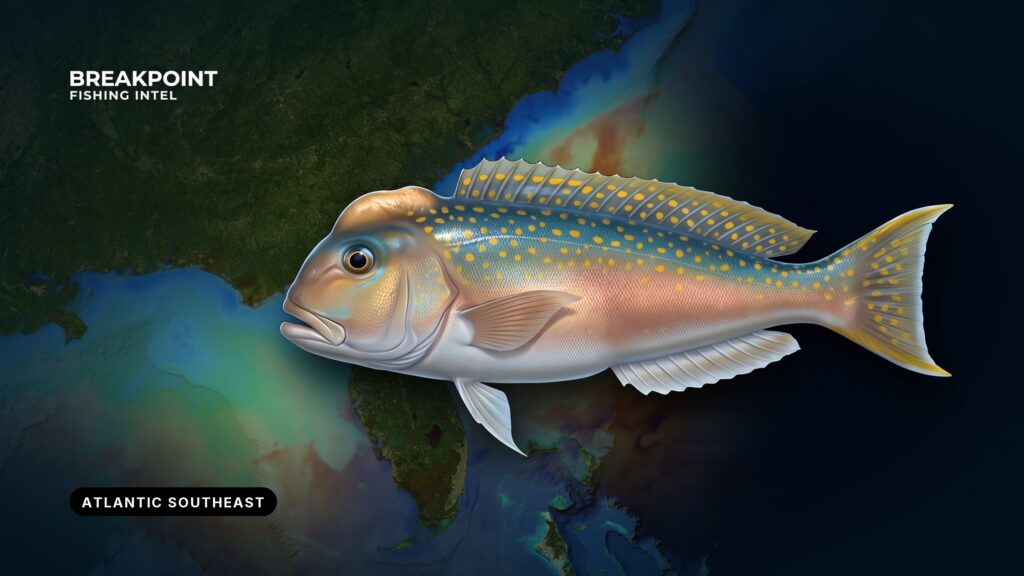
Golden tilefish fishing in the Atlantic Southeast happens on soft mud at the upper slope, from North Carolina to the Florida Keys. The ground starts at the shelf edge and runs down a gentle slope where the bottom turns to sediment and the fish dig their own burrows. The Gulf Stream runs over all of it and determines whether you can hold bottom.
The rules limit the fishing more than the fish do. The recreational limit is 1 golden tilefish per person per day, inside the 3-fish grouper and tilefish aggregate. The season opens and closes on the recreational annual catch limit, and it is short. This page covers where the mud is, how deep, how the drift works, how anglers fish it, and which rules apply south of the NC/VA line.
What golden tilefish are
Golden tilefish are slow-growing, bottom-dwelling fish. Each one digs and enlarges its own vertical burrow in the sediment, and the burrows sit close together. In the South Atlantic, spawning runs April to June according to NOAA.
Goldens do not migrate. The burrow keeps them in place, so your access changes with weather and season openings rather than fish movement. The golden tilefish species guide covers identification, age and growth.
Where golden tilefish live in the Atlantic Southeast
Goldens hold on the shelf edge and upper slope off North Carolina, South Carolina, Georgia and Florida’s Atlantic coast. Anglers talk about these grounds by name:
- The Charleston Bump region off South Carolina, where the slope and the Gulf Stream interact.
- Offshore Jacksonville and St. Augustine, where the shelf edge sits well out and the slope runs gently below it.
- Cape Canaveral, a long-standing deep-drop jumping-off point.
- Southeast Florida, where the slope sits close to shore and the Gulf Stream runs directly over it.
Deep-drop ground off the Middle Keys holds goldens alongside snowy grouper. Blueline tilefish sit shallower, on harder bottom and ledges, while goldens sit deeper, on soft sediment. Both count toward the same aggregate.
When you can fish them
Timing depends on whether the recreational season is open and whether a weather window lines up. The season opens and closes on the annual catch limit, so it can end early. Because the fish do not migrate, there is no run to chase. NOAA Fisheries bulletins carry the opening and closing notices.
Runs, inlets and Gulf Stream behavior along this coast are covered in our Atlantic Southeast fishing guide.
The bottom and water that hold them
Golden tilefish live where soft sediment, cold bottom water and a manageable drift line up. Checking all three before you leave the dock saves fuel and time.
Depth, temperature and burrow fields
Goldens live at 250 to 1,500 feet, in bottom water of 49 to 58 °F, according to NOAA. The habitat is mud or sand with vertical burrows that sit close together. Read the bottom in this order:
- Find the shelf break. It is where the contour lines tighten.
- Look past it for a gentle upper-slope gradient over soft sediment.
- Skip steep hard bottom. That is blueline country.
- Plan drifts across a burrow field. Fish concentrate in the burrows, so a drift that crosses the same gentle mud repeatedly beats prospecting cliffs.
Cold bottom, warm fast surface
The water column is layered. Cold water sits on the bottom, and the warm, fast Gulf Stream runs over it. Gulf Stream set plus wind decides your drift speed and line angle.
When wind opposes the current, the drift can slow and hold. When wind and current run together, the boat can blow off the ground. Check the official marine forecast for wind and wave numbers before you commit to the run.
Reading the chart, and what it cannot show
Slope bathymetry resolution varies by survey, and some deep ground is coarsely surveyed. Bottom type on charts is inferred, not observed, so confirm it with sonar on the drift.
Chart Contours in Breakpoint shows the shelf break and the gentle upper-slope gradients where mud tends to lie. OBS SST shows where the inshore wall of the Gulf Stream sits, which tells you how hard the drift will push before you run. Chart layers are not for navigation.
How anglers fish them here
The rig has one job: get baits to the mud and keep them there while the Gulf Stream pushes. The usual kit:
- Electric reel with braided main line
- Multi-hook bottom rig with dropper loops
- Heavy weight, scaled to current and depth
- Lights on the rig
- Squid and cut bait
- Drift sock
Set up up-current of the mud, drop, and use the drift sock or reposition often to keep crossing the burrow field. Off Southeast Florida, some anglers also catch blackbelly rosefish on the same ground and cut the small ones for bait.
Full rigging and electric reel setup are in our deep-drop guides.
Releasing fish caught deep
Barotrauma at these depths is the reason for the release rule. A descending device must be rigged with at least 16 oz of weight and 60 ft of line, per SAFMC and FWC. Use it on every fish you cannot keep, which means every fish once the season closes or the aggregate is full.
Mark the slope ground on Chart Contours before you leave the dock, and check the Gulf Stream edge on OBS SST the morning of the run.
How the rules here differ from other regions
Three councils manage golden tilefish. The South Atlantic boundary with the Mid-Atlantic is the VA/NC line at 36°33′ N. The regions compare as follows:
| South Atlantic | Mid-Atlantic | Gulf of America | |
|---|---|---|---|
| Council or plan | SAFMC, Snapper-Grouper FMP | MAFMC Tilefish FMP | Gulf Council, managed separately |
| Bag limit | 1 per person per day, within 3-fish grouper/tilefish aggregate | 8 per angler per trip | See Gulf guide |
| Minimum size | None | None | See Gulf guide |
| Season mechanism | Opens and closes on recreational annual catch limit | No closed season set | See Gulf guide |
| Permit and reporting | No federal tilefish permit | Federal private recreational tilefish vessel permit; eVTR within 24 hours of returning to port | See Gulf guide |
| Gear limits | Descending device rigged (16 oz, 60 ft) | Rod and reel only, max 5 hooks per rod | See Gulf guide |
The "no federal tilefish permit" cell refers only to the Mid-Atlantic-style tilefish permit. Florida’s State Reef Fish Angler designation is covered under Regulations below.
The Mid-Atlantic fishery centers on canyon ground between Hudson Canyon and Veatch Canyon, and its rules are in the federal Mid-Atlantic tilefish rule. In the South Atlantic the ground is open slope mud under the Gulf Stream.
Gulf rules and ground are in our Gulf golden tilefish guide.
Guides to golden tilefish fishing from specific ports: Lower Keys, Murrells Inlet, Pompano Beach and Sebastian Inlet.
Regulations
State waters run 0 to 3 nm. Federal waters (the EEZ) run 3 to 200 nm. Golden tilefish depths sit in federal water, so federal rules govern almost all of this fishing.
Federal rules (South Atlantic)
The SAFMC manages golden tilefish under the Snapper-Grouper Fishery Management Plan. The SAFMC golden tilefish regulations page lists the current limits.
- The South Atlantic recreational limit is 1 golden tilefish per person per day, within the 3-fish grouper and tilefish aggregate.
- There is no minimum size.
- A descending device must be on board, rigged with at least 16 oz of weight and 60 ft of line.
- The recreational season closes when the annual catch limit is projected to be met.
More on how these rules fit together is in our South Atlantic snapper-grouper federal rules guide.
North Carolina
Federal rules apply in federal waters. Check the North Carolina Division of Marine Fisheries for state-water rules. The VA/NC line marks the Mid-Atlantic boundary, which matters if you fish the northern edge. Details are in North Carolina fishing regulations.
South Carolina
Federal rules apply in federal waters. Check the South Carolina Department of Natural Resources for state-water rules. Details are in South Carolina fishing regulations.
Georgia
Federal rules apply in federal waters. Check the Georgia Department of Natural Resources, Coastal Resources Division, for state-water rules. Details are in Georgia fishing regulations.
Florida (Atlantic)
The FWC tilefish rules list 1 golden tilefish per person within the 3-fish grouper/tilefish aggregate. The aggregate applies to fish possessed in or outside Florida waters, per the Florida reef fish rule chapter.
- The State Reef Fish Angler designation is required.
- With natural bait north of 28° N, use non-stainless-steel non-offset circle hooks. South of 28° N, use non-stainless-steel hooks.
- A dehooking device must be on board.
- A descending device rigged with 16 oz and 60 ft, or a venting tool, must be on board.
Details are in Florida fishing regulations.
Rules here change by quota. Check the NOAA Fisheries golden tilefish page and the agency pages before every trip.
Frequently Asked Questions
Is the golden tilefish season open, and where do I check?
The recreational season opens and closes on the annual catch limit. NOAA Fisheries announces openings and closures in fishery bulletins. Check them before you plan the run.
Does the 1-fish limit count against my grouper?
Yes. The golden tilefish counts inside the 3-fish grouper and tilefish aggregate, along with blueline tilefish and snowy grouper.
Do I need a descending device?
Yes, in South Atlantic federal waters. It must be rigged with at least 16 oz of weight and 60 ft of line, and be ready for use.
Do I need a federal tilefish permit like in the Mid-Atlantic?
No. The private recreational tilefish permit and eVTR apply north of the VA/NC line. Florida anglers need the State Reef Fish Angler designation.
Which rules apply near the NC/VA line?
South of 36°33′ N, South Atlantic rules apply: 1 fish within the aggregate. North of it, Mid-Atlantic rules apply: 8 per angler per trip, plus the permit and eVTR.
How do golden and blueline tilefish differ for planning?
Goldens sit deeper, on soft burrowed mud. Bluelines sit shallower, on harder bottom. Both count in the aggregate. The species guide covers identification in detail.
What is Florida’s State Reef Fish Angler designation?
It is a required designation for anglers fishing for reef fish, including tilefish, from a private boat in Florida. FWC administers it.
How deep do golden tilefish live here?
They live at 250 to 1,500 feet, on mud or sand with burrows, in bottom water of 49 to 58 °F.
Conclusion
Find the gentle mud past the shelf break, plan around Gulf Stream set, carry a rigged descending device, and keep 1 golden inside the aggregate. Check NOAA bulletins for the season before you plan the run, since the opening determines whether golden tilefish fishing in the Atlantic Southeast is possible at all in a given year.
To plan the drift, download Breakpoint from the App Store or Google Play and look at the slope on Chart Contours and OBS SST before you leave the dock.