




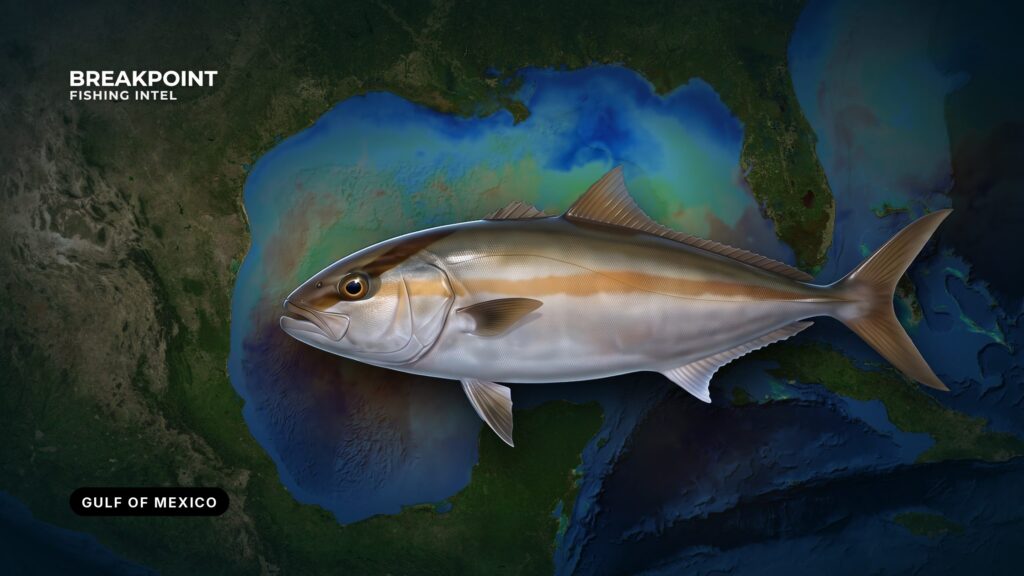
Greater amberjack in the Gulf live on high-relief structure: platforms, wrecks, artificial reefs and ledges. The recreational open window is short and set by quota. This guide covers where to look, what water to look for, and which rules apply where you drop.
Full identification and biology are in our greater amberjack guide; this page covers the Gulf. It takes in structure, water, technique, release, how the Gulf differs from the South Atlantic, and state-by-state rules.
Greater amberjack ID summary: the size-limit risk
Greater amberjack is the largest of the Gulf amberjacks. Three relatives share the same structure and carry different limits: lesser amberjack, almaco jack and banded rudderfish. The species guide has the visual ID.
Greater amberjack is measured in fork length, from the snout to the fork of the tail rather than the tip. The Gulf minimum is 34 inches fork length. A fish that tapes over 34 inches to the tail tip can still be short at the fork, so measure it the legal way before it goes in the box.
| Species | Federal Gulf size | Federal Gulf bag |
|---|---|---|
| greater amberjack | 34 inches fork length minimum | 1 per person per day |
| lesser amberjack | 14 to 22 inches fork length (slot) | 5 per person per day, combined with banded rudderfish |
| banded rudderfish | 14 to 22 inches fork length (slot) | 5 per person per day, combined with lesser amberjack |
| almaco jack | no size listed | inside the 20-fish reef fish aggregate |
A small greater amberjack and a large lesser amberjack can sit on the same wreck, and the rules run opposite ways: one has a minimum size, the other a maximum slot. When in doubt, check the species guide.
Where and when to find greater amberjack in the Gulf
The Gulf of Mexico fishing guide treats the Gulf as one basin. For amberjack it breaks into three bottom types from west to east: platforms, artificial reefs and wrecks, and natural ledges. NOAA Fisheries and the Gulf Council title their documents "Gulf of America." The water is the same.
- West: oil and gas platforms off Texas and Louisiana.
- North-central: permitted artificial reefs and wrecks off Alabama, Mississippi and the Florida Panhandle.
- East: natural ledges and hard bottom off Florida’s Gulf coast.
Western and central Gulf: platforms
Off Louisiana and Texas, oil and gas platforms are the signature amberjack structure. The legs give vertical relief from the bottom to the surface, and bait holds on them. Platforms are working industrial sites, so give them room and follow posted rules.
North-central Gulf: artificial reefs and wrecks
Off Alabama, Mississippi and the Florida Panhandle, permitted artificial reefs and wrecks carry much of the fishing. Anglers run to them from ports like Orange Beach, Destin, Venice and Galveston. Well-known public numbers get fished hard during a short window, so less obvious relief nearby is worth a look.
Eastern Gulf: natural ledges and hard bottom
Along Florida’s Gulf coast, natural ledges, limestone hard bottom and relief edges add to the wrecks and reefs.
Timing: spring spawn, fall season
Greater amberjack spawn in spring. The federal recreational season is built around the spawn, with fixed closed periods through winter and summer and an open window that starts in September. NOAA Fisheries closes that window early once the recreational catch target is projected to be met. The Regulations section explains how.
| Zone | Typical structure | Where anglers run from |
|---|---|---|
| Western and central Gulf | oil and gas platforms | Louisiana and Texas ports such as Venice and Galveston |
| North-central Gulf | artificial reefs and wrecks | Orange Beach, Destin |
| Eastern Gulf | natural ledges and hard bottom | Florida Gulf coast ports |
Structure and water that hold amberjack
Amberjack key on vertical relief and the edges of structure rather than flat bottom. A ledge lip, a wreck’s high point or a platform leg concentrates current and bait.
- Current edges: current pushing across structure sets up a down-current side where bait stacks. Fish position relative to that flow.
- Clean blue water: clear blue water over structure is generally more productive than green, dirty water. Treat it as a tendency, not a guarantee.
- Bait: schools of blue runners, hardtails and other bait over structure are the signal to stop and look.
- Temperature breaks: an edge where warm and cool water meet over relief adds to the case for a spot.
Reading the water before you run
Three layers do most of the work, and each has limits.
- Chart Contours show surveyed bottom: ledges, drop-offs and relief. They do not show where fish are holding on a given day, and some areas rest on old surveys.
- OBS SST shows surface temperature breaks from satellite passes. Cloud blocks the pass, and it reads the surface, not the bottom.
- Chlorophyll marks the line between green water and the clean blue edge. It is also satellite data and carries the same cloud limits.
Stack the three to shortlist structure where relief, a temperature edge and clean water line up. That improves the decision about where to look but doesn’t promise fish. Chart layers are not for navigation.
How anglers fish greater amberjack in the Gulf
Vertical jigging
Position over the structure and drop to the fish. Get the jig off the bottom right away to avoid snags. Work it with hard upward strokes and let it flutter on the fall. Fast-falling jigs suit aggressive fish. Slow-pitch and butterfly styles suit fish holding tight and not feeding hard.
Live bait: blue runners and hardtails
Blue runners and hardtails are the standard Gulf live baits. Fish them in the water column above the structure rather than on the bottom.
Federal Gulf reef fish gear rules require non-stainless-steel circle hooks with natural bait. Florida state waters add "non-offset." The Regulations section covers the detail.
Heavy tackle and the first run
A hooked amberjack heads straight for the structure, so the fight is won or lost in the first seconds. Heavy conventional tackle, abrasion-resistant leader and a drag set before the drop let you turn the fish’s head away. Light snapper leader does not survive contact with steel.
Sharing structure with red snapper and other reef fish
Amberjack often share wrecks and reefs with red snapper, gag and other species covered in our reef fish fishing guides. Each species has its own season and limits, so check every species you might boat, not just the target.
Releasing amberjack and the gear you must carry
Fish pulled from depth suffer expansion injuries from barotrauma. A descending device returns the fish to depth so it can recover.
Required release gear differs by jurisdiction:
- Federal Gulf waters off Florida and Mississippi: non-stainless-steel circle hooks with natural bait, a dehooking device, and a descending device or venting tool rigged and ready for use.
- Federal waters off Louisiana: circle hooks and a dehooking device are listed. For the descending device requirement, confirm with NOAA Fisheries.
- Florida Gulf state waters: the descending device needs at least a 16-ounce weight and 60 feet of line.
The federal gear rules are covered in the Regulations section below.
Gulf vs. South Atlantic greater amberjack
The rules differ considerably by region. The table compares the Gulf with greater amberjack in the South Atlantic, using the FWC greater amberjack regulations for the Atlantic figures.
| Gulf | South Atlantic | |
|---|---|---|
| Minimum size | 34 inches fork length | 28 inches fork length |
| Bag limit | 1 per person per day | 1 per person per day |
| Closed period | fixed closures before and after a fall window, with the window closed early when the catch target is projected to be met | April (spawning closure) |
| Managing council | Gulf Council, with NOAA Fisheries | South Atlantic council, with NOAA Fisheries |
Because of the 6-inch size gap, a fish that is legal off the Atlantic coast can be short in the Gulf.
In Monroe County (the Keys), FWC applies the Atlantic grouper rules in all state waters, Gulf side included. That documented rule covers grouper. For amberjack in the Keys, check FWC before you fish.
Plan around structure, then check the rules
Build the trip around structure and water first. Layering Chart Contours, OBS SST and Chlorophyll on one map gets you to a shortlist fast. Then check the agency page for the waters you will fish before you run, because the window moves with the quota.
Guides to greater amberjack fishing from specific ports: Dauphin Island, Apalachicola, Cocodrie, Biloxi, Corpus Christi, Orange Beach, Boca Grande and Grand Isle.
Regulations
Federal and state authority divide by distance from shore. The sections below cover that split, the federal rules, and each Gulf state’s rules with links to the agencies.
How federal and state rules divide
Federal waters are managed by the Gulf Council and NOAA Fisheries under federal rules in 50 CFR 622. State waters are managed by each state.
- Florida Gulf coast: state waters run from shore to 9 nautical miles.
- Louisiana: state waters are generally 3 nautical miles, with 9 nautical miles for reef fish management.
- Texas, Mississippi and Alabama: see the agency and state page below for each boundary.
Open state waters don’t mean open federal waters, so know which side of the line you are on.
The rules are tight because NOAA Fisheries describes the Gulf stock as overfished and undergoing overfishing, under a rebuilding plan.
Federal waters
The federal Gulf reef fish rules page covers gear rules and how far federal rules reach. For greater amberjack in federal waters:
- Minimum size: 34 inches fork length.
- Bag limit: 1 per person per day.
- Captain and crew on for-hire vessels: zero.
- Fixed closed periods: January 1 to August 31 and November 1 to December 31.
NOAA Fisheries announces each year how much of the open window is used, and closes it early when the catch target is projected to be met. Read the NOAA greater amberjack season announcement before you plan a trip. The Gulf Council also posts its own Gulf Council season announcement.
After the federal closure, a vessel with a federal charter vessel/headboat permit for Gulf reef fish may not possess greater amberjack in state waters either. In Mississippi, such vessels follow the more restrictive of federal or state rules in state waters.
State summary table
| State | State-waters boundary | Agency | Amberjack size and bag |
|---|---|---|---|
| Texas | see Texas Parks and Wildlife Department | Texas Parks and Wildlife Department | see agency |
| Louisiana | generally 3 nm; 9 nm for reef fish management | Louisiana Department of Wildlife and Fisheries | federal rules documented; state rules see agency |
| Mississippi | see Mississippi Department of Marine Resources | Mississippi Department of Marine Resources | federal: 34 in fork length, 1 per day |
| Alabama | see ADCNR Marine Resources Division | ADCNR Marine Resources Division | see agency |
| Florida | shore to 9 nm | Florida Fish and Wildlife Conservation Commission | 34 in fork length, 1 per day, state and federal |
Texas
Texas Parks and Wildlife Department manages Texas state waters. Federal rules apply beyond them. See Texas fishing regulations and check the agency before you fish.
Louisiana
The Louisiana Department of Wildlife and Fisheries manages state waters, which are generally 3 nautical miles, with 9 nautical miles for reef fish management. See Louisiana fishing regulations.
Federal gear in waters off Louisiana includes circle hooks and a dehooking device. Confirm the descending device requirement with NOAA Fisheries. Check the agency before you fish.
Mississippi
The Mississippi Department of Marine Resources manages state waters. See Mississippi fishing regulations.
Federal waters off Mississippi carry these rules:
- Minimum size: 34 inches fork length.
- Bag limit: 1 per person per day.
- Captain and crew on charter vessels and headboats: zero.
- Gear: a descending device or venting tool rigged and ready.
After the federal closure, a vessel with a federal charter vessel/headboat permit may not possess greater amberjack in state waters. Check the agency before you fish.
Alabama
The Alabama Department of Conservation and Natural Resources, Marine Resources Division, manages state waters. See Alabama fishing regulations and check the agency before you fish.
Florida
The Florida Fish and Wildlife Conservation Commission manages state waters, and the Florida Administrative Code chapter, Florida reef fish rule chapter, is the final authority. See Florida fishing regulations.
- Minimum size: 34 inches fork length.
- Bag limit: 1 per person per day.
- Closed periods: set in the rule, with FWC setting the open dates each year by executive order to match the federal season, which can end before October 31.
- Private vessels need the State Reef Fish Angler designation.
- Gulf reef fish gear rules apply, including the descending device spec of at least a 16-ounce weight and 60 feet of line.
Check the agency before you fish.
FAQ
How is greater amberjack measured in the Gulf?
By fork length, measured from the snout to the fork of the tail, not the tip. The Gulf minimum is 34 inches fork length in federal waters and in Florida Gulf state waters.
Can I keep a greater amberjack in state waters when federal waters are closed?
It depends on the state, so check that state’s agency. In Florida, FWC matches the federal dates. A vessel with a federal charter vessel/headboat permit for Gulf reef fish may not possess greater amberjack in state waters after the federal closure.
Why is the Gulf amberjack season so short?
NOAA Fisheries describes the stock as overfished and undergoing overfishing, under a rebuilding plan. The season has fixed closed periods, and NOAA ends the fall window early once the catch target is projected to be met.
Do I need a descending device for amberjack in the Gulf?
Federal rules, as documented for waters off Florida and Mississippi, require a descending device or venting tool rigged and ready when fishing for reef fish. Florida state waters require the device to have at least a 16-ounce weight and 60 feet of line. Off Louisiana, confirm the requirement with NOAA Fisheries.
How do I tell a lesser amberjack from a greater amberjack?
The greater amberjack guide covers the visual ID. The rule difference is clear: lesser amberjack and banded rudderfish have a 14 to 22 inch fork length slot and a limit of 5 combined, against a 34 inch minimum for greater amberjack.
Is the size limit different in the Gulf and the Atlantic?
Yes. It is 34 inches fork length in the Gulf and 28 inches fork length in the South Atlantic. The bag limit is 1 per person in both regions, and the Atlantic closes in April.
Can charter captain and crew keep a greater amberjack?
No. In the Gulf, the bag limit for captain and crew on for-hire vessels is zero.
Is the Gulf of America the same water as the Gulf of Mexico?
Yes. NOAA Fisheries and the Gulf Council title their documents "Gulf of America," and the rules described here apply to the same waters.
Closing
Decide in order: structure first, then water, then the rules for the exact waters you will fish. The window is short, and the quota decides when it ends.
If you want to see relief, temperature edges and water color on one map before you run, download Breakpoint from the App Store or Google Play. Check the agency page before you fish.