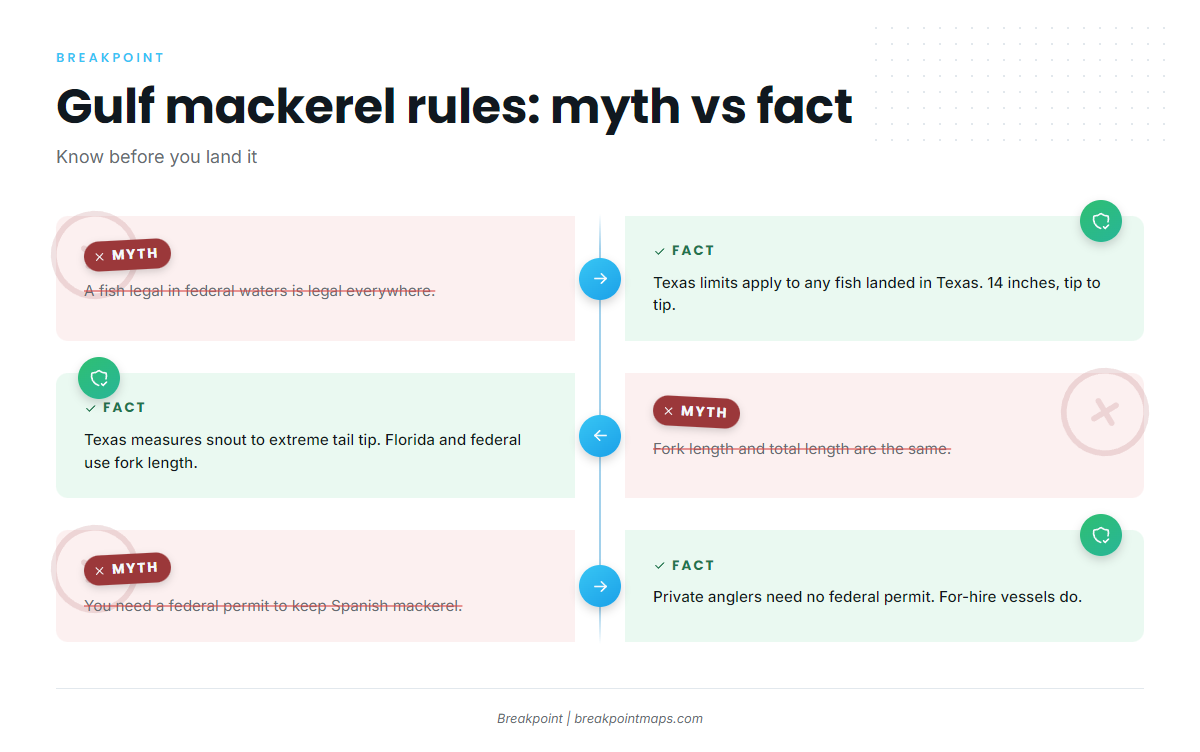




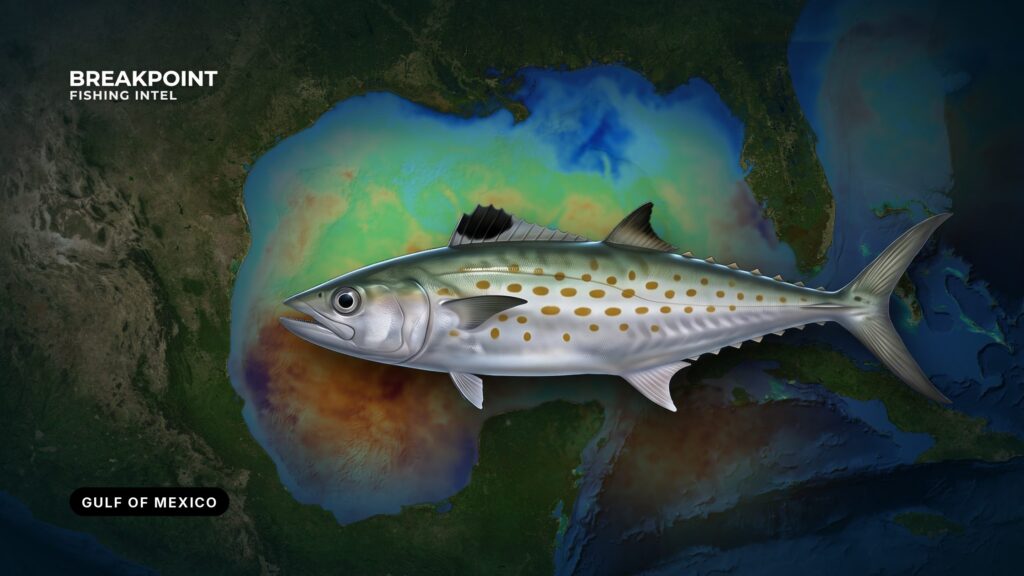
Spanish mackerel follow warming water up the Florida west coast in spring, spread across the northern Gulf to Texas, and slide back south as fall fronts cool the beach. This guide covers Spanish mackerel fishing in the Gulf of Mexico, a body of water federal agencies call the Gulf of America. It is a working guide for fishing the Gulf of Mexico: where the fish set up, what water and structure hold them, how anglers fish for them, and which rulebook applies at which distance from the beach. A fish that is legal 10 miles out can be short at a Texas dock, and the Regulations section explains why.
Identification and biology, briefly
Gulf fish (Scomberomorus maculatus) belong to the Gulf migratory group, one of 2 stocks along with the South Atlantic. NOAA Fisheries lists the Gulf stock as not overfished and not subject to overfishing. The fish is slim and silvery, with yellowish-gold spots along the sides and sharp teeth. King mackerel are the bigger cousin, with different size and bag limits. Cero carry a stripe among the spots and turn up mostly in South Florida. The comparison is in the Spanish mackerel species guide.
Where and when Spanish mackerel run in the Gulf of Mexico
The run is a moving front of warm water and bait. It starts in South Florida and the Keys and works north and west through these areas:
- Tampa Bay and the Florida west coast
- The Big Bend and the Florida Panhandle, including Destin
- Alabama’s Gulf Shores and the Mississippi and Louisiana coasts
- Galveston, Port Aransas and the Texas jetties
Spring run up the Florida west coast
Fish follow warming water north from South Florida and the Keys, pass Tampa Bay, and push toward the Big Bend and the Panhandle. Arrival tracks warming beach water and arriving bait rather than a calendar date, so watch the water.
Across the northern Gulf to Texas
Fish push west along Alabama, Mississippi and Louisiana to the Texas coast. They hold off barrier islands and passes and rarely stay in low-salinity water, so work the outer beaches and passes instead of the upper bays.
Summer residency
Through the warm months, fish settle near bait-rich passes, piers, jetties and nearshore reefs and rigs.
Fall run and winter
The bite slows as fall fronts cool the beach water. Fish feed heavily, then move back south and east, wintering off South Florida and the Keys. For the other side of the peninsula, see Spanish mackerel on the Atlantic and Southeast coast. In federal waters off Monroe County, on both the Gulf and Atlantic sides, Spanish mackerel fall under Gulf migratory group rules.
Water and structure that hold Spanish mackerel
Clean green water, color breaks and tide lines
Fish favor clean green water over muddy or off-color water. Color breaks and tide lines stack bait, so work the clean side of the edge.
Bait schools
Glass minnows, scaled sardines and threadfin herring pull mackerel close, and finding the bait usually means finding the fish. Signs to look for:
- Diving birds
- Surface spray and skipping bait
- Nervous water and flickering flashes below a high pier
- Bait balls pushed tight to the surface
Piers, jetties and passes
Moving tide through passes funnels bait. Jetty tips and pier ends reach the clean water. Kayak anglers work pass mouths and beach troughs. Check the official forecast for wind, wave height and period before you go.
Nearshore artificial reefs and oil and gas platforms
Reefs and platforms hold bait columns. Fish ride the up-current side and the edges. King mackerel and cobia use the same structure.
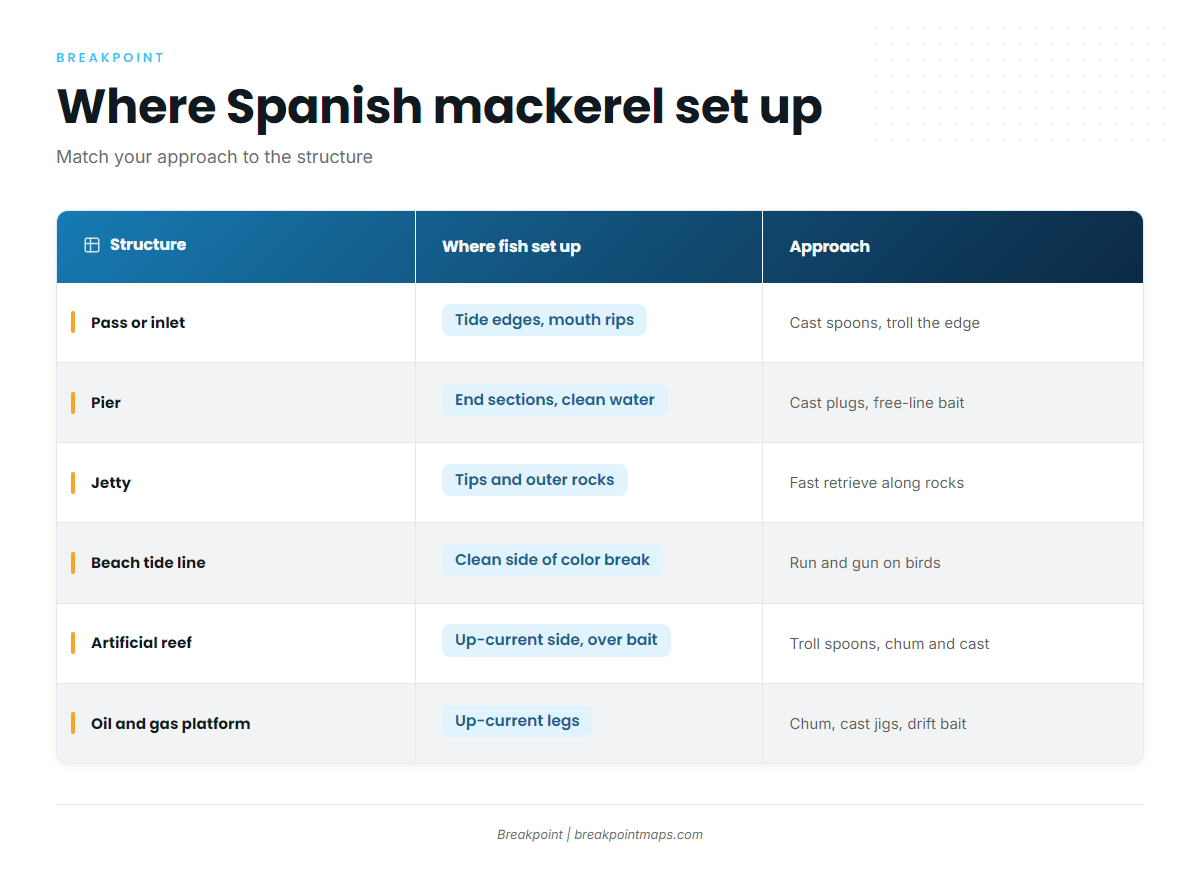
Structure and approach
| Structure | Where fish set up | Best approach |
|---|---|---|
| Pass or inlet | Tide edges, rips at the mouth | Cast spoons across the current; troll the edge |
| Pier | End sections in clean water | Cast plugs or spoons fast; free-line live bait |
| Jetty | Tips and outer rocks | Cast and retrieve fast along the rocks |
| Beach and tide line | Clean side of color breaks, bait schools | Run and gun on birds; cast into the breaking fish |
| Artificial reef | Up-current side, over bait | Troll small spoons around it; chum and cast |
| Oil and gas platform | Up-current legs, bait columns | Chum, cast jigs and spoons, drift live bait |
Use the Chlorophyll layer to compare clean green water with off-color water and to find the edge where bait stacks. OBS SST shows beach water warming in spring or cooling behind fall fronts. Chart Contours mark reef and platform edges and channel drops. Cloud cover blocks satellite passes, so a cloudy day leaves gaps in the data. The chart layers are not for navigation; they help you decide where to look.
How anglers fish for Spanish mackerel in the Gulf
Casting spoons and plugs
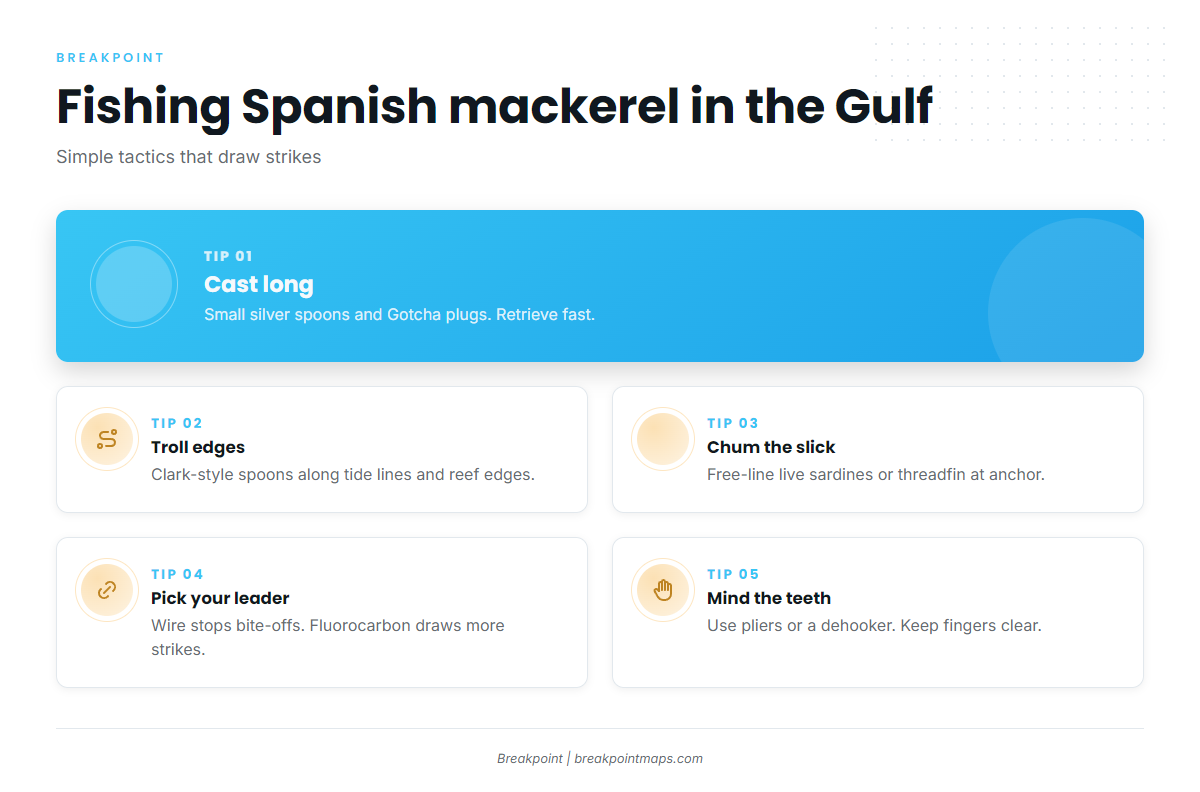
Small silver spoons such as the Clark style, Gotcha plugs and small jigs do most of the work. Cast long and retrieve fast, since speed draws strikes and limits bite-offs. The simple pier rig is a spinning rod, a small spoon or Gotcha, and a short leader.
Trolling
Troll small spoons, with the Clark spoon being the regional standard, along tide lines, beach bait schools and reef edges.
Chumming and live bait
Chumming at anchor near reefs, platforms or passes pulls fish up the slick. Free-line live scaled sardines or threadfin in the slick.
Leader choice: wire vs fluorocarbon
Wire stops bite-offs. Fluorocarbon draws more strikes in clear water but costs some lures. Switch to wire when bite-offs pile up.
Handling the teeth
Use pliers or a dehooker, and keep fingers clear of the jaw. The flesh is oily, so ice it quickly and eat it fresh.
Same structure, other species
King mackerel and cobia share the same reefs and platforms. See the guides to other coastal and offshore gamefish.
Mark the bait, the color breaks and the structure in Breakpoint before the run, and you start the day with a better idea of where to look.
Guides to Spanish mackerel fishing from specific ports: Orange Beach, Apalachicola, Biloxi, Corpus Christi, Boca Grande, Gulfport, Freeport and Carrabelle.
FAQ
Is a 13-inch Spanish mackerel legal in Texas?
No, if it is landed in Texas or kept in Texas state waters. Texas requires 14 inches measured tip to tip, even for fish caught in federal waters, where 12 inches fork length is legal.
What is the difference between fork length and total length?
Fork length runs from the snout tip to the fork of the tail and is used by Florida and federal rules. Texas measures in a straight line from the snout tip to the extreme tail tip with the jaw closed.
How do I tell Spanish mackerel from king mackerel?
Spanish mackerel carry yellowish spots and are the smaller fish. King mackerel have no spots as adults and carry separate, stricter limits. The species guide covers the comparison in detail.
Do the rules change past 9 miles?
Off Florida and Texas, federal rules apply beyond 9 nautical miles: 12 inches fork length, 15 per day, heads and fins intact. Fish landed in Texas must still meet Texas limits.
Do I need a federal permit for Spanish mackerel?
Private recreational anglers need no federal permit. For-hire vessels need the federal Gulf charter/headboat permit for coastal migratory pelagic fish.
Can I fillet Spanish mackerel at the dock in Texas?
Not on a jetty or pier. Head and tail stay on until the fish is landed on the mainland, a peninsula or a barrier island. In federal waters, fish must be kept with heads and fins intact.
Where do Gulf Spanish mackerel go in winter?
They move south and east as fall fronts cool the beach water, and winter off South Florida and the Keys. They return north and west with warming water in spring.
Do I need a Texas fishing license on a pier?
Anyone fishing Texas public waters needs a Texas fishing license plus a saltwater endorsement. Residents and non-residents under 17 are exempt. For other states, check FWC, ADCNR, MDMR or LDWF.