




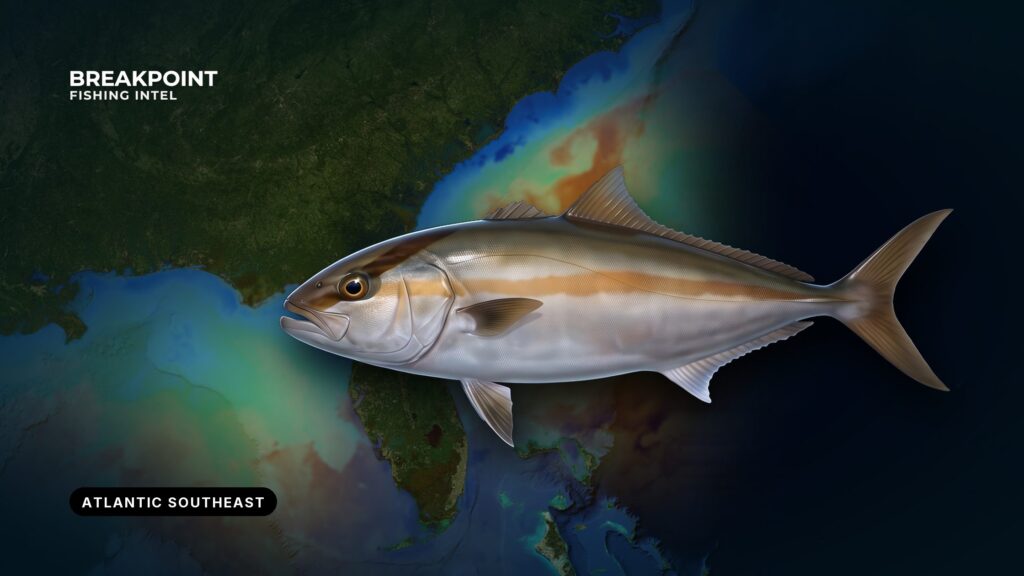
Greater amberjack in the Atlantic Southeast hold over wrecks, ledges and reefs from North Carolina to the Keys, and which rulebook applies depends on where you are on the chart. This guide covers where the fish hold, when to fish for them, how anglers target them, and the rules.
Two stocks of greater amberjack fall under two councils. The South Atlantic stock is managed by the SAFMC with NOAA Fisheries; the Gulf stock is managed by the Gulf Council. In April, fishing for greater amberjack is closed entirely in federal waters. The full detail is in Regulations below.
Quick Rules: South Atlantic Greater Amberjack
- Minimum size is 28 inches fork length.
- The bag limit is 1 per person per day.
- Closed April 1 to April 30. In federal waters you may not fish for, harvest or possess greater amberjack.
- NOAA can close the recreational sector early if the annual limit is projected to be reached.
- Off the Keys, the South Atlantic rules apply east of the Council boundary. The boundary runs along 83° W north to 24°35′ N, then east to the mainland.
Full detail and agency links are in Regulations below.
The Fish in Brief
Greater amberjack are the largest of the jacks. They are reef and wreck fish, and they pull hard toward structure the moment they feel the hook. Lesser amberjack, almaco jack and banded rudderfish look similar. For identification and biology, see the species guide.
Spring spawning is the reason for the April closure. NOAA Fisheries rates the South Atlantic stock as not overfished; the Gulf stock is in a different position, covered further down.
Where Greater Amberjack Live in the Atlantic Southeast
The region runs from North Carolina through the Florida Keys on the Atlantic side. For the other species you will meet on the same trips, such as king mackerel and snapper-grouper, see the Atlantic Southeast fishing guide.
The NC Division of Marine Fisheries profile describes amberjack on reefs, wrecks, rocky outcrops and other significant bottom structure, and that holds from the Carolinas to the Keys. The table below runs north to south.
| Area | Structure that holds fish |
|---|---|
| Carolinas | Offshore ledges, wrecks, artificial reefs |
| Georgia and northeast Florida | Offshore live bottom, artificial reefs |
| Southeast Florida and the Keys | Deep wrecks and humps near the Gulf Stream |
Carolina ledges and wrecks
Look offshore for ledges, wrecks and artificial reefs. Amberjack also turn up on king mackerel trips here, so a mackerel drift near structure can turn into an amberjack bite.
Georgia and northeast Florida offshore reefs
Offshore live bottom and artificial reefs carry the fish. Think in terms of structure type rather than a single spot; a reef that stacks bait is worth a pass.
Southeast Florida and the Keys
Deep wrecks and humps near the Gulf Stream hold fish. The Keys are also where the rulebook changes. The Council boundary sits off the Keys, so check which side of it you are on in Regulations below.
When to Fish
Fish move. The NCDMF profile notes a spring movement from the Carolinas toward southeast Florida, so fish you find in one area in one month may be gone the next.
April is closed in federal waters, so plan spring trips around it. Outside April, fish are available through the rest of the year where the rules allow. Treat the calendar as a rough guide and read the water, using the Structure and Water section below.
Structure and Water
Structure sets where the fish are. The water over it affects whether they are feeding.
- Water over structure: The position of the Gulf Stream edge relative to a wreck or ledge changes the current and the character of the water over it.
- Where fish sit: On the sounder, amberjack show up above the structure rather than tight to the bottom.
- What to do about it: Fish the marks, not the bottom.
Fish suspended above structure
Amberjack often hold above the wreck or ledge, unlike grouper, which sit tight to the bottom. That changes your presentation. Mark the fish on the sounder and set your drop depth to the marks.
Current and the Gulf Stream edge
Current decides which side of a wreck holds fish and how your drift lays out. The Gulf Stream edge’s effect on that current is an observation to test on the water, not a rule.
Finding the structure
Use Chart Contours to find ledges, wrecks and humps in the depth band you plan to fish. Then check OBS SST for where the Gulf Stream edge sits relative to that structure. Chlorophyll adds context on water clarity.
These layers have limits. Chart Contours show structure, not fish, and contours from older surveys may miss a wreck. Chart layers are not for navigation. They help you choose where to look; whether the fish are there is still up to them.
How Anglers Fish for Them
Amberjack fishing is heavy-tackle work. The fish run for structure, so the fight is hard from the first second.
Butterfly jigs and vertical jigging. Drop to the marks and work the jig through the suspended fish. Use heavy tackle, because a hooked fish heads straight for the wreck.
Live bait. Blue runners and goggle-eyes both work. Drift or fish baits at the depth of the marks. North of 28° N, natural bait requires non-offset, non-stainless circle hooks. The full rules are in Regulations.
Chumming. Per the NCDMF profile, chumming attracts and holds schools near the boat.
Boat position. Set up uptide so the drift carries baits or jigs over the marks, and reset after each pass.
Sharks. Do not leave a hooked fish hanging. Fight it hard and fast, and move off a wreck when sharks take over.
Mixed trips. Amberjack come up on snapper-grouper trips. See the reef fish fishing guides for the rest of that bite.
Handling and Release
Measure and decide quickly. Release short fish, and release all fish in April.
- Use a descending device to return fish showing barotrauma to depth.
- A dehooking device speeds release.
- Both devices are required on vessels fishing snapper-grouper in South Atlantic federal waters. The full spec is in Regulations.
- Keep fish with head and fins intact so fork length can be measured at the dock.
How This Region Differs from the Gulf
Two stocks fall under two councils. NOAA Fisheries rates the South Atlantic stock as not overfished. The Gulf of America stock is overfished and under a rebuilding plan, which is why the rules differ.
| Atlantic Southeast | Gulf | |
|---|---|---|
| Council | SAFMC | Gulf Council |
| Stock status | Not overfished | Overfished, rebuilding |
| Size | 28 inches fork length | Set separately (see Gulf guide) |
| Bag | 1 per person per day | Set separately |
| Season | Closed April 1 to 30 | Set separately |
For Gulf numbers, see greater amberjack in the Gulf.
Guides to greater amberjack fishing from specific ports: Boynton Beach, Golden Isles, Carolina Beach, Edisto Beach, Fernandina Beach, Savannah, Hatteras Village and Folly Beach.
Regulations
Which rules apply depends on which jurisdiction you are fishing in.
- State waters run from shore to 3 nautical miles and are set by the state agency.
- Federal waters (the South Atlantic EEZ) run from 3 to 200 nautical miles and are set by the SAFMC and NOAA Fisheries under 50 CFR part 622.
- Off the Keys, the Council boundary runs along 83° W north to 24°35′ N, then east to the mainland. The Gulf Council manages waters on the other side.
Federal waters
Size is 28 inches fork length, measured from the tip of the snout to the fork of the tail. The bag limit is 1 per person per day.
From April 1 to April 30 you may not fish for, harvest or possess greater amberjack in or from the South Atlantic EEZ. That rules out targeting them at all, including catch and release. NOAA can also close the recreational sector when the annual limit is projected to be reached.
Rules are on the SAFMC federal regulations page. The legal text is in the federal rule text.
Gear rules for snapper-grouper in federal waters:
- A dehooking device must be on board and ready.
- A descending device must be on board, attached to at least a 16-ounce weight and at least 60 feet of line.
- With natural bait north of 28° N, use non-offset, non-stainless circle hooks.
- With natural bait south of 28° N, use non-stainless hooks.
For the broader rules, see South Atlantic snapper-grouper federal rules.
Private anglers need no federal permit. For-hire vessels need the federal charter or headboat snapper-grouper permit.
Florida
FWC rules match the federal rules in Atlantic state waters: 28 inches fork length, 1 per day, closed in April. Private-vessel anglers need the State Reef Fish Angler designation. Special regulations apply in Biscayne National Park. Reef fish gear rules apply in state waters, and a descending device or venting tool must be rigged and ready.
See FWC greater amberjack rules and Florida fishing regulations.
Georgia
Georgia DNR Coastal Resources sets the rules in state waters. Federal rules apply beyond 3 nautical miles. See Georgia fishing regulations.
South Carolina
SCDNR sets the rules in state waters. See South Carolina fishing regulations.
North Carolina
NCDMF sets the rules in state waters. A vessel with a federal commercial or for-hire snapper-grouper permit follows the federal amberjack rules in state waters too, because the permit follows the vessel. See North Carolina fishing regulations.
Regulations at a glance
| Jurisdiction | Who sets the rules | Size | Bag | Season | Agency link |
|---|---|---|---|---|---|
| Federal waters (3 to 200 nm) | SAFMC / NOAA Fisheries | 28 in fork length | 1 per person per day | Closed April 1 to 30; possible early closure | SAFMC |
| Florida Atlantic state waters | FWC | 28 in fork length | 1 per person per day | Closed in April | FWC |
| Georgia state waters | Georgia DNR Coastal Resources | See agency | See agency | See agency | Breakpoint GA page |
| South Carolina state waters | SCDNR | See agency | See agency | See agency | Breakpoint SC page |
| North Carolina state waters | NCDMF* | See agency | See agency | See agency | Breakpoint NC page |
Swipe the table sideways to see every column.
*Vessels with a federal snapper-grouper permit follow federal rules in NC state waters.
Before you fish
Check the agency page before every trip. In-season closures post on NOAA South Atlantic seasonal closures.
Frequently Asked Questions
Is greater amberjack open in April in the South Atlantic?
No. It is closed April 1 to April 30 in federal waters. Florida state waters are also closed in April. For Georgia, South Carolina and North Carolina state waters, check the agency pages linked above.
Can I catch and release amberjack in April?
No, not in federal waters. The rule bars fishing for greater amberjack, not just keeping them. Do not target them in April.
How do I measure fork length?
Measure in a straight line from the tip of the snout to the fork of the tail. The minimum is 28 inches. Keep the head and fins intact so the fish can be measured at the dock.
Which rules apply in the Keys?
The Council boundary runs along 83° W north to 24°35′ N, then east to the mainland. East of it, South Atlantic rules apply. The Gulf Council manages the other side.
Do I need the State Reef Fish Angler designation?
Yes, if you fish from a private vessel and intend to land greater amberjack in Florida. Confirm the details on the FWC page.
Is a descending device required?
Yes, on vessels fishing snapper-grouper in South Atlantic federal waters. It must be attached to at least a 16-ounce weight and 60 feet of line. A dehooking device is also required.
How do I tell greater from lesser amberjack?
Start with the species guide. Lesser amberjack carry a different bag limit, so identification matters before you keep a fish. Almaco jack and banded rudderfish are look-alikes too.
Can I keep an amberjack on a charter?
Yes, within the 1-fish bag, the size limit and the season. The vessel’s federal permit can bring federal rules into state waters. Confirm with the agency page and your captain.