




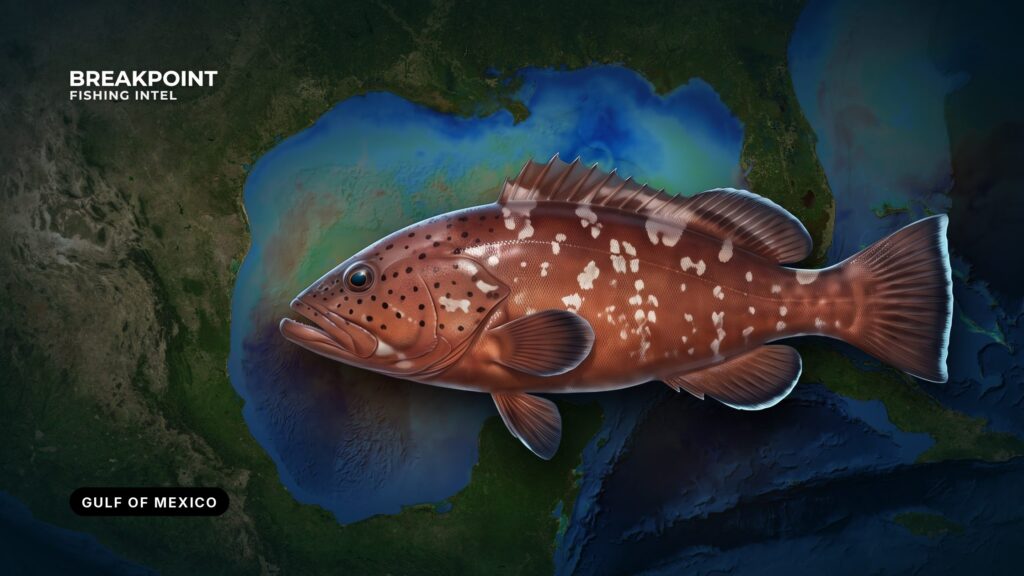
Most Gulf red grouper live on Florida’s side, on the West Florida Shelf, and fishing for them comes down to finding small patches of hard bottom on a big, gentle shelf. The Gulf Council says red grouper "are most abundant in the eastern Gulf" and are extremely common off Florida’s Gulf coast and in the Keys. For the wider region, see our Gulf of Mexico fishing guide. This guide covers where the hard bottom is, how to read it on chart and sonar, when the fish are there, and how federal and state rules divide. It will help you decide where to look; it won’t guarantee you catch anything.
Red grouper at a glance
Red grouper are a shallow-water grouper that stay close to home on hard bottom.
- Complex: The federal shallow-water grouper complex includes red grouper, gag and black grouper.
- Habitat: Adults sit on ledges, crevices and caverns of limestone reef and on low-profile live bottom (NOAA Fisheries).
- Movement: Non-migratory, with high site fidelity year-round (GCOOS).
- Diet: Opportunistic feeders that swallow prey whole: fish, octopus, crabs and shrimp (NOAA Fisheries).
- Size: The minimum size in Gulf waters off Florida is 20 inches total length.
Identification and full biology are in our red grouper species guide.
Where red grouper live in the Gulf
Gulf red grouper concentrate on the West Florida Shelf, from the Big Bend south to the Keys. The shelf is broad, gently sloping and mostly low relief, so a small patch of rock on open sand can hold fish that the surrounding miles do not.
Red grouper are far less common off Alabama, Mississippi, Louisiana and Texas, because they are most abundant in the eastern Gulf. The Keys run on a different rule set, covered in the Atlantic section below.
| Area | Red grouper presence |
|---|---|
| Big Bend to Florida Keys (West Florida Shelf) | Core of the Gulf range |
| Alabama, Mississippi, Louisiana, Texas | Far less common |
The bottom and water that hold them
Red grouper hold on hard bottom: limestone ledges, solution holes, low-profile live bottom and holes they dig themselves.
Hard bottom types
Four bottom types account for most of the fish:
- Limestone ledges: Ledges, crevices and caverns of limestone reef (NOAA Fisheries).
- Solution holes: Karst topography where limestone has dissolved into pits.
- Low-relief hard bottom with a thin sand veneer, boulders and cobble: This is where Gulf fish spawn. The GCOOS Gulf red grouper profile gives an average spawning depth of 70 m, about 230 feet.
- Live bottom: Sponges, corals and sea squirts on low-profile rock (NOAA Fisheries).
Holes the fish dig themselves
NOAA Fisheries says red grouper "excavate flat-bottom areas" that become habitat for other species. That means a fish can be holding on bottom that looks featureless at chart scale.
Reading it on chart and sonar
Look for changes in hardness as well as height. A thin sand veneer over limestone returns a hard, low, sharp bottom line, while deep, pure sand reads softer and wider.
Charted contours do not show individual solution holes or grouper-dug holes. Use the chart to pick an area, then let your sonar confirm what the chart suggests.
Our Chart Contours layer shows ledge lines and depth breaks across the shelf, so you can shortlist bottom before burning fuel to scan it. Chart layers are not for navigation.
Water temperature
FWC gives red grouper a preferred temperature of 66 to 77°F. The UF/IFAS Extension red grouper notes describe the pattern: fish favor deeper water when it is warm and move shallower as it cools.
When to go red grouper fishing in the Gulf of Mexico
Gulf red grouper are available year-round in state waters, and they don’t leave their bottom to spawn.
| Timing factor | Gulf detail |
|---|---|
| Spawning | February through June, peak March through May (GCOOS) |
| Spawning behavior | Adults spawn on site, no migration to aggregate |
| Seasonal depth shift | Deeper in warm months, shallower as water cools |
| Recreational landings | Rise in May and June, peak in July and August (GCOOS) |
The same bottom holds fish through spawning. The landings pattern shows when effort and harvest peak, which is a different thing from when catch is guaranteed.
Federal waters have no fixed closed season for red grouper, but NOAA can close recreational harvest in season, as the Regulations section explains.
How anglers fish for them
Most Gulf red grouper come on natural bait fished hard on the bottom with heavy tackle, from an anchored or drifting boat.
Anchor or drift
Both work. Anchor to hold a specific ledge or hole; drift to cover scattered low-relief bottom. Let your sonar decide, since the patchier the bottom reads, the more a drift earns its keep.
Baits
- Live bait: pinfish.
- Cut bait: squid strips, sardine, cigar minnow, often favored in warm months when red grouper scavenge.
- Alternatives: bucktail jigs and vertical jigging.
Rigs and tackle
Use a stout bottom rig with the bait flat on the bottom, knocker-style or double-snell, and heavy tackle. Gag and other Gulf reef fish share the same bottom and the same tackle.
Getting the fish out of the hole
Turn the fish’s head fast and pull it off the bottom before it reaches its hole. If it locks in and flares its gill plates, try one of two approaches:
- Play the banjo: Strum the tight line.
- Give it slack: Take all pressure off, wait, then reel fast when it swims out.
Leader chafe on the rock is the usual cause of break-offs.
Required gear and release
Barotrauma is pressure injury from being brought up from depth. Carry the gear to deal with it:
- Non-stainless-steel circle hooks when fishing natural bait. In Florida state waters they must also be non-offset.
- A dehooking device.
- A descending device or venting tool, rigged and ready.
- In Florida, a descending device with at least a 16-ounce weight and 60 feet of line.
NOAA Fisheries encourages venting tools or descenders for fish showing barotrauma.
When planning the run, look for bottom inside FWC’s 66 to 77°F preferred range. Chart Contours and OBS SST show you both before you leave the dock.
How the Gulf differs from the Atlantic
Gulf and Atlantic red grouper are managed under separate federal plans, so the rules don’t carry over.
- Gulf: the Gulf Reef Fish plan, run by the Gulf Council and NOAA Fisheries.
- Atlantic: the South Atlantic Snapper-Grouper plan.
Florida’s state rules also differ by coast. All Monroe County state waters, Gulf side included, follow Florida’s Atlantic grouper rules, so the Gulf grouper limits on this page do not apply in the Keys. For Atlantic figures, see our Atlantic red grouper guide.
Guides to red grouper fishing from specific ports: Dauphin Island, Apalachicola, Biloxi, Galveston, Orange Beach, Boca Grande, Carrabelle and Cedar Key.
Regulations
How federal and state rules divide
In Gulf state and federal waters off Florida, red grouper must be 20 inches total length.
Florida state waters run from shore to 9 nautical miles off the Gulf coast. Beyond that, federal rules apply, set by the Gulf Council and NOAA Fisheries under 50 CFR part 622. The federal bag limit regulation sets a 4-grouper aggregate with no more than 2 red grouper per person. In Alabama, reef fish state waters run 9 nautical miles, and grouper seasons open and close with federal waters.
Fish you bring in from federal waters must meet federal limits.
NOAA closes the recreational sector when landings reach or are projected to reach the recreational limit. Closures appear in NOAA Fisheries closure bulletins.
Madison-Swanson, Steamboat Lumps and The Edges are spawning-area zones with rules set by the Gulf Council. Our Gulf reef fish federal rules cover the closed areas and federal detail.
Florida
FWC sets the state waters rules. See the FWC grouper regulations page for the current rule.
| Rule | Florida state waters (0 to 9 nm) | Federal waters (9 nm and beyond) |
|---|---|---|
| Minimum size | 20 inches total length | 20 inches total length |
| Bag | 2 per person per day within the 4-grouper aggregate | 4 groupers combined, no more than 2 red |
| Season | Open year-round | No federal closed season; in-season closure possible |
| Captain and crew, for-hire | Zero | Zero |
| Landing | Head and fins intact | See state rule |
| Angler requirement | State Reef Fish Angler designation, private vessels | No federal permit for private anglers |
These figures exclude Monroe County. More detail is on our Florida regulations page. Check FWC before fishing.
Alabama
ADCNR’s Marine Resources Division sets Alabama’s rules. See the ADCNR size and creel limits page for the current rule.
| Rule | Alabama |
|---|---|
| Minimum size | 20 inches total length |
| Bag | 2 red grouper within the 4-grouper aggregate |
| Season | Open when federal waters are open |
| Permit | Gulf Reef Fish Endorsement |
| Hooks | Circle hooks with natural bait |
More detail is on our Alabama regulations page. Check ADCNR before fishing.
Mississippi, Louisiana and Texas
Red grouper are far less common in these waters. Check the state agency before fishing.
| State | Agency | Our page |
|---|---|---|
| Mississippi | Mississippi Department of Marine Resources | Mississippi regulations |
| Louisiana | Louisiana Department of Wildlife and Fisheries | Louisiana regulations |
| Texas | Texas Parks and Wildlife Department | Texas regulations |
FAQ
Do I need the State Reef Fish Angler designation?
Yes, if you fish reef fish from a private vessel in Florida, red grouper included. FWC requires the designation for private-vessel anglers. Confirm the current requirement on the FWC page before you go.
Do red grouper count toward the grouper aggregate?
Yes. Red grouper count toward the 4-grouper daily aggregate, with no more than 2 red grouper per person, in both Florida state waters and federal Gulf waters, per FWC and the federal regulations.
Can a charter captain keep red grouper?
No. Captain and crew on for-hire trips have a zero bag limit for red grouper under both FWC and federal rules, so the crew cannot keep a daily limit of their own.
Are the Keys under Gulf or Atlantic rules?
Atlantic. Monroe County state waters, Gulf side included, follow Florida’s Atlantic grouper rules, per FWC. The Gulf grouper limits on this page do not apply there.
How do I tell red grouper from gag?
Red grouper have a stocky, reddish-brown body with a whitish-spotted pattern and a rounded, dark-edged tail. Gag run grayer with darker, kiss-mark markings. Our species guide covers the details. The rules also differ: gag is 24 inches total length with a season set each year, and red grouper is 20 inches total length.
Do I need a descending device?
Yes. A descending device or venting tool must be rigged and ready in Gulf state and federal waters. In Florida, the descending device needs at least a 16-ounce weight and 60 feet of line, per FWC. NOAA Fisheries encourages descenders for fish showing barotrauma.
Why do the agencies say "Gulf of America"?
Federal documents use that name for the same waters.