




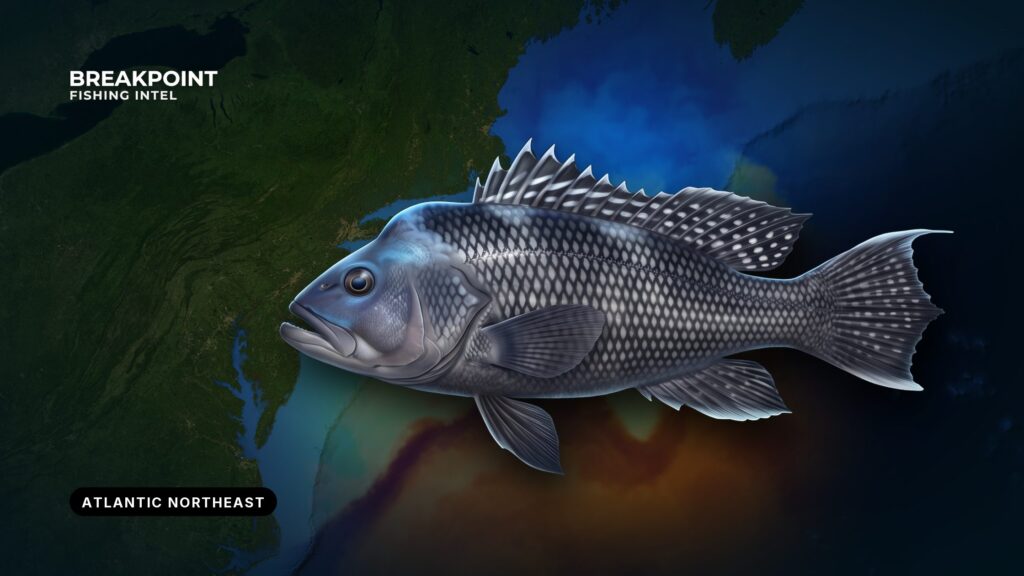
Black sea bass fishing in the Atlantic Northeast is structure fishing on a seasonal cycle: fish come inshore in spring, drop deeper through summer and leave the coast in fall. They are managed as the northern stock, north of Cape Hatteras. This guide covers the range from Maine to New Jersey, with Maryland as the southern edge of the same management system, and it works the grounds anglers actually name: Buzzards Bay, Narragansett Bay, Block Island, Montauk, Long Island Sound, Boston Harbor and the New Jersey wrecks and reefs.
The Atlantic Northeast fishing guide defines the region from Hatteras to the Gulf of Maine. This page covers four things: when the fish move, what bottom holds them, how they are fished here, and how state and federal rules divide.
Black Sea Bass at a Glance
A few marks identify a black sea bass:
- Scientific name: Centropristis striata.
- Look: A dark body and a long filament trailing from the upper tail.
- Habit: It lives on specific pieces of structure, not open sand.
- Sex change: Black sea bass are protogynous. Fish start as females, and some become males as they grow. Larger males carry the blue hump.
Scup and tautog share the same structure and often end up in the same bucket on a crowded rail, so look twice before you measure. For full identification and biology, see the black sea bass species guide.
When and Where: The Seasonal Cycle
Depth follows the season, so the season decides where you look. Think in three bands: shallow inshore structure, deeper reefs and wrecks, and the outer shelf.
Spring
Fish arrive inshore to spawn on shallow rock, ledges and bay structure. Buzzards Bay, Narragansett Bay, Long Island Sound and Block Island are classic spring grounds. Many state seasons open around this inshore arrival, but the agency sets the dates, so check it before you fish.
Summer
After spawning, fish move off the shallow hotspots onto deeper reefs, rock piles and wrecks. Larger fish tend to hold on outer structure. Cleveland Ledge in Buzzards Bay is a good example of a shallow spot that fish leave once the water warms, and they are best followed out to deeper bottom.
Fall and winter
New England fish move south and west and winter in deep water on the outer continental shelf off the Mid-Atlantic. October and November fishing gets harder because the fish are on the move and sit deeper. Your search area should follow them offshore onto deeper structure.
Range expansion north
Cape Cod was long the accepted northern edge of the range, but that edge has moved. Sea bass numbers in coastal waters have grown, and New Hampshire Fish and Game describes a fishery that has gained popularity there. Fish also show up in Boston Harbor and the Gulf of Maine. Massachusetts Division of Marine Fisheries biologists attribute the shift to biomass moving north with warming water.
Saving waypoints by season in Breakpoint and comparing them against these patterns helps you decide where to look.
The Bottom and Water That Hold Them
Sea bass don’t roam open sand. They live on specific pieces of hard bottom. Look for these:
- Rock piles, ledges and drop-offs
- Wrecks and artificial reefs
- Mussel beds
- Edges where hard bottom meets sand
- Inshore pilings and jetties for shore anglers
Moving water over structure concentrates bait and turns fish on, so a pile with some current usually outfishes a dead one. Tautog and scup work the same rock and wrecks, which is why the reef fish guides pair well with this one.
Contour data shows the shape of the bottom. It does not show whether fish are on a given pile, and some survey data is old. Confirm with your own sonar when you arrive.
In Breakpoint, the Chart Contours layer lets you shortlist rock piles, ledges and wreck sites before the run, so fuel goes to likely bottom. Chart layers are not for navigation.
How Anglers Fish for Them Here
The tackle is simple, and most of the skill is in staying on the bottom.
- High-low bait rigs: Two hooks on dropper loops above a sinker, baited with clam or squid. This is the standard setup along party boat rails.
- Jigs and bucktails: Metal jigs and bucktails worked close to the bottom keep the lure in the zone where sea bass feed. Anglers lean on them more over deeper structure as the season goes on.
- Holding bottom: Use enough weight to stay on bottom, since a rig swinging in the current tangles the rail. Anchor up-current to sit on a small pile, and drift broader reefs and wreck fields.
- Tide and current: Some current drives the bite. Slack tide often runs slow.
Party and head boats are the easiest way into the fishery if you don’t own a boat. Private boats can pick structure and move. Expect tautog, scup and fluke on the same bottom. Each has its own rules, so check the agency.
Fish pulled from deeper water can show pressure injury (barotrauma). Handle them quickly and get them back down promptly; a descending device is the release tool for it. Measure with the mouth closed.
How Black Sea Bass Fishing in the Atlantic Northeast Differs from the South Atlantic
Cape Hatteras splits black sea bass into 2 management stocks. North of Hatteras, NOAA Fisheries Greater Atlantic Regional Fisheries Office (GARFO), the Mid-Atlantic Fishery Management Council (MAFMC) and the Atlantic States Marine Fisheries Commission (ASMFC) manage the fishery. South of Hatteras, the NOAA Fisheries Southeast Regional Office and the South Atlantic Fishery Management Council (SAFMC) do.
Northern seasons track the spring inshore arrival and the fall departure. For southern size, bag and season figures, go to the South Atlantic council regulations and read our guide to black sea bass fishing in the Atlantic Southeast.
| Northeast (northern stock) | South Atlantic (southern stock) | |
|---|---|---|
| Dividing line | North of Cape Hatteras | South of Cape Hatteras |
| Councils and agencies | MAFMC, ASMFC, NOAA Fisheries GARFO | SAFMC, NOAA Fisheries Southeast Regional Office |
| Federal-waters approach | Federal measures waived; follow the landing state | Set through SAFMC federal rules |
| Where to check | Landing state’s agency | SAFMC |
Guides to black sea bass fishing from specific ports: New London / Waterford, Indian River Inlet, Ocean City, Barnstable / Cape Cod Bay harbors, Atlantic City, Captree, Oregon Inlet and Block Island.
Regulations
Federal waters run 3 to 200 nautical miles offshore. State waters run inside 3 miles. In federal waters, black sea bass fall under NOAA Fisheries GARFO and the MAFMC, and ASMFC coordinates the states. The federal rules for the Mid-Atlantic and New England cover the wider picture.
Federal waters defer to the state where you land. Federal coastwide recreational measures are waived through conservation equivalency, and that applies to private boats and to federally permitted party and charter vessels. The federal summer flounder and sea bass rule sets this out, and NOAA recreational management measures is the page for in-season changes.
Crossing the 3-mile line doesn’t switch sea bass rules the way it does for striped bass, which can’t be fished for or kept in federal waters at all.
Neighboring states differ because conservation equivalency and regional allocation let each state set its own measures. Limits are adjusted as harvest estimates and stock advice change.
For-hire vessels carrying passengers need a federal charter/party permit for black sea bass. The federal charter/party permit rules are in 50 CFR 648.4. Each state also runs its own saltwater license or registry, so check the agency.
| State | Managing agency | Breakpoint regulations page | Notes |
|---|---|---|---|
| Maine | Maine DMR | none | Expanding range; see agency |
| New Hampshire | New Hampshire Fish and Game | none | Growing fishery; see agency |
| Massachusetts | Massachusetts DMF | Massachusetts regulations | See agency |
| Rhode Island | RI DEM | none | Seasonal splits, see agency |
| Connecticut | CT DEEP | none | See agency |
| New York | NYSDEC | New York regulations | Seasonal splits, see agency |
| New Jersey | NJ Division of Fish & Wildlife | New Jersey regulations | Seasonal splits, see agency |
| Maryland | Maryland DNR | Maryland regulations | Same landing-state rule; in-season notices |
Maine
Maine Department of Marine Resources (DMR) manages the state fishery. Fish are showing up farther north than they used to. Check Maine DMR before you fish.
New Hampshire
New Hampshire Fish and Game manages the state fishery as the sea bass population grows along the coast. Check New Hampshire Fish and Game before you fish.
Massachusetts
Fish landed in Massachusetts from federal waters follow Massachusetts measures. See the Massachusetts black sea bass regulations for the state page. Massachusetts Division of Marine Fisheries sets the rules. Check Massachusetts DMF before you fish.
Rhode Island
Rhode Island Department of Environmental Management (RI DEM) sets the rules for fish landed in the state. Check RI DEM before you fish.
Connecticut
Connecticut Department of Energy and Environmental Protection (CT DEEP) sets the rules for fish landed in the state. Check CT DEEP before you fish.
New York
The New York saltwater regulations page covers the state. The New York State Department of Environmental Conservation (NYSDEC) sets the rules and seasonal splits. Check NYSDEC before you fish.
New Jersey
The New Jersey fishing regulations page covers the state. The New Jersey Division of Fish & Wildlife sets the rules and runs the Saltwater Registry. Check the Division before you fish.
Maryland
Maryland is the southern edge of the same northern-stock system, with the same landing-state rule. See the Maryland fishing regulations page for the state. Maryland DNR posts in-season changes on its Maryland DNR public notices page. Check Maryland DNR before you fish.
Frequently Asked Questions
Do federal waters have their own black sea bass limits?
No. Federal coastwide recreational measures are waived through conservation equivalency, so you follow the rules of the state where you land. NOAA Fisheries and the Mid-Atlantic Fishery Management Council oversee the federal side. Check NOAA Fisheries for any in-season change.
Which state’s rules apply if I fish federal waters?
The state where you land. This applies to private boats and to federally permitted for-hire vessels. A fish caught 20 miles out is still governed by the rules of your landing port. Check that state’s agency before you leave the dock.
Can you catch black sea bass in Maine or New Hampshire?
Yes. Numbers have grown north of Cape Cod, and anglers now target them in waters where they were once rare. Rules are set by Maine DMR and New Hampshire Fish and Game. Check the agency for the season, size and bag before you fish.
Why do neighboring states have different seasons?
Each state sets its own measures under conservation equivalency and regional allocation. The Atlantic States Marine Fisheries Commission coordinates the process, but state agencies write the final rules. That is why a short drive across a state line can change what you may keep.
How do Northeast rules differ from the Carolinas?
Cape Hatteras divides the two stocks. North of it, MAFMC, ASMFC and NOAA Fisheries GARFO manage the fishery. South of it, SAFMC and the NOAA Fisheries Southeast Regional Office do. Check the South Atlantic Fishery Management Council for southern rules.
When do black sea bass move offshore?
In fall, toward deep outer-shelf water off the Mid-Atlantic, where they winter. They return inshore in spring as the water warms. Timing shifts with water temperature and location, so treat the pattern as a guide to where to look rather than a calendar.
What fish get mistaken for black sea bass?
Scup and tautog, which share the same structure and often come up on the same rig. Black sea bass carry a dark body and a long filament on the upper tail. The black sea bass species guide covers identification in full. Each species has its own rules, so check the agency.
Before You Run
Fish follow the season: shallow structure in spring, deeper reefs and wrecks through summer, the outer shelf by fall. Rules follow the port where you land, not the water where you fish. Shortlist hard bottom for the season, and check your landing state’s agency before you leave the dock.
If you want that shortlist built from the data, download Breakpoint from the App Store or Google Play and look at the Chart Contours layer for your port.