




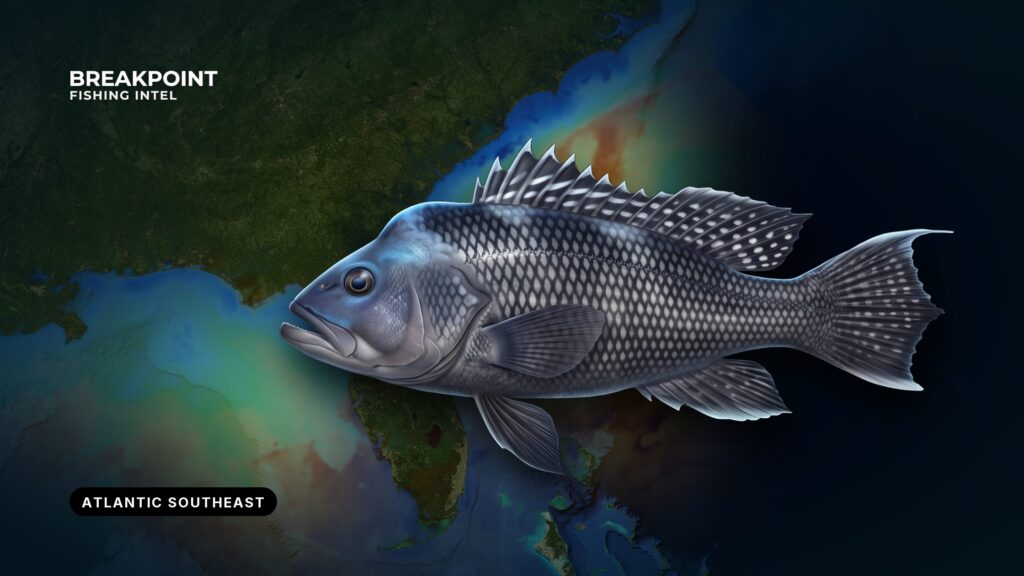
Black sea bass fishing in the Atlantic Southeast is hard-bottom fishing. The fish hold on ledges, live bottom, wrecks and reefs from Cape Hatteras south, and the rules that govern them change at Cape Hatteras and again at 3 nautical miles. The region runs from Cape Hatteras to the Florida Keys, per our Atlantic Southeast fishing guide, and sea bass are most common from the Carolinas to central and northeast Florida.
This guide covers where they hold, how to fish them and how the rules divide. It points you at bottom worth scanning with sonar, but it can’t promise fish.
What black sea bass are
Four facts identify a black sea bass:
- It is a stout, dark reef fish of the sea bass family.
- In the South Atlantic it belongs to the federal snapper-grouper complex.
- It is protogynous. Every fish starts as a female, and some become male.
- It is often confused with bank sea bass and rock sea bass.
FWC describes the fish as excellent table fare, with firm white flesh and mild flavor. For identification and life history, see our black sea bass guide.
Where and when black sea bass show up in the Southeast
In the South Atlantic Bight, sea bass usually sit more inshore than they do farther north. They share hard bottom with tropical reef fish such as snappers, groupers, porgies and grunts, according to the NC Department of Environmental Quality species profile.
Seasonal movement differs from the Mid-Atlantic:
- Mid-Atlantic fish migrate offshore and south in the fall and return inshore in spring.
- Southeast fish do not make that long run. They stay on nearshore and mid-shelf hard bottom.
- Depth by season: Shallower structure tends to hold fish in the cooler months, and deeper ledges tend to hold larger fish.
- Spawning: They spawn from February through May in the South Atlantic, per NC DEQ.
The federal South Atlantic recreational season opens April 1 and closes when the quota is met. The Regulations section covers the close.
On stock status, NOAA’s black sea bass profile lists the South Atlantic stock as not overfished and not subject to overfishing. NOAA also notes that assessments carry a high degree of uncertainty because data on the species are limited.
The bottom and water that hold them
Sea bass live on irregular hard bottom. The SEDAR South Atlantic species profile describes the habitat as low rock ridges, outcropping, coral patches and shipwrecks, and finds the fish most abundant at about 52 to 125 feet (16 to 38 m). Sea bass are among the most abundant species on South Atlantic artificial reefs.
They share that bottom with snapper, grouper, porgies and grunts. Our reef fish fishing guides cover those species.
Each structure type looks different on a chart:
- Ledges: Contour lines bunch tight over a short distance, a sharp step in depth.
- Low-relief live bottom: Subtle wiggles or isolated closed contours on otherwise flat bottom, often unmarked.
- Artificial reefs: Published permit areas with marked coordinates.
- Wrecks: Charted wreck symbols. Positions may be approximate.
- Coral patches and rock outcrops: Small irregular features near ledge systems that are hard to see at chart scale.
Three rules for reading what you find:
- Fish the edge of the step. The flat on top of a ledge holds less than the break itself.
- Scan for a hard bottom return. Then fish tight to the bottom.
- Know the limit of sonar. It cannot tell sea bass from other reef fish.
Chart Contours in Breakpoint shows ledges and contour breaks worth scanning with sonar before you burn fuel looking. Chart layers are not for navigation. A contour is only as good as the survey behind it, and some shelf areas were last surveyed decades ago, so small features may not appear.
How anglers approach black sea bass fishing in the Atlantic Southeast
Most anglers fish sea bass with bait on the bottom, with jigs as the alternative. How you set up on the structure matters as much as what you drop.
Rigs and bait
The standard rig is the high-low, or chicken rig, with two hooks on dropper loops above the sinker. Circle hooks are common, and some areas require them; the Regulations section covers that.
Squid and cut bait are the usual baits. Use enough weight to hold bottom in the current.
Jigs
Bucktails and slow-pitch style jigs work close to the bottom. Tip them with squid if you like. A jig helps you cull small fish, but it does not guarantee bigger ones.
Anchoring versus drifting
- Anchoring: On small ledges and wrecks, anchor up-current so the boat settles back over the structure.
- Drifting: Drift to search broad low-relief live bottom, then anchor once you find fish.
Why you catch shorts and what to do
Public artificial reefs and well-known numbers take steady pressure. Keepers get thinned out and small fish remain.
The fix is to move off the pressured numbers. Look for nearby low-relief live bottom or deeper ledges, find them on contours and confirm them with sonar.
Releasing fish and barotrauma
Fish pulled from deeper ledges can suffer barotrauma. Use a descending device to return them to depth, and use a dehooking tool. Federal snapper-grouper rules set release-gear requirements; the Regulations section points to where they are covered.
To plan a run in the Breakpoint app, drop a waypoint on a contour break and check the distance from your port.
How the Southeast differs from north of Hatteras
The management line sits at 35°15.3’N, near Cape Hatteras, per NC DEQ. South of it, NOAA Fisheries and the South Atlantic Fishery Management Council (SAFMC) manage black sea bass as the South Atlantic stock. North of it, NOAA Fisheries, the Mid-Atlantic Fishery Management Council (MAFMC) and the Atlantic States Marine Fisheries Commission (ASMFC) manage the Mid-Atlantic stock.
North of Hatteras, federal recreational measures are waived through conservation equivalency. Per the Federal Register Mid-Atlantic rule, anglers follow the rules of the state where they land. For that side of the line, see Atlantic Northeast black sea bass.
| South of Hatteras | North of Hatteras | |
|---|---|---|
| Managing bodies | NOAA Fisheries, SAFMC, state agencies | NOAA Fisheries, MAFMC, ASMFC, state agencies |
| Federal-waters rules | Set by SAFMC under the snapper-grouper plan | Federal measures waived; follow the landing state |
| Season | Opens April 1, closes on quota | Set by each state |
| Where to check | SAFMC and the state agency | The landing state’s agency |
Guides to black sea bass fishing from specific ports: Fernandina Beach, Darien, Carolina Beach, Edisto Beach, Mayport, Golden Isles, Hatteras Village and Folly Beach.
Regulations
Which rules apply depends on which side of 35°15.3’N you fish and whether you are inside or outside 3 nautical miles.
| Where you fish | Who sets the rule | Check |
|---|---|---|
| Federal waters south of Hatteras | NOAA Fisheries and SAFMC | SAFMC |
| North Carolina state waters | NC Division of Marine Fisheries | NC DMF proclamations |
| South Carolina state waters | SCDNR Marine Resources | SCDNR |
| Georgia state waters | GA DNR Coastal Resources Division | GA DNR |
| Atlantic Florida state waters | FWC | FWC |
Federal and state waters
State waters run 0 to 3 nautical miles off the Atlantic coast. Federal waters run from 3 to 200 nautical miles. SAFMC and NOAA Fisheries manage federal waters under the snapper-grouper plan. Check the South Atlantic Council regulations for the size and bag limits.
The federal season opens April 1 and closes when the quota is met. SAFMC announces the close, so check there before you go.
Release-gear rules for descending devices, dehooking devices and circle hooks are in the South Atlantic snapper-grouper federal rules.
North Carolina
North Carolina is the only state on both sides of the line. Waters south of 35°15.3’N follow South Atlantic rules. Waters north follow Mid-Atlantic measures set through NC proclamations. NC DEQ lists South Atlantic rules of 13 inches total length and 7 fish per person per day.
See our North Carolina regulations page. Proclamations are posted under NC DMF fisheries proclamations. Check the proclamation for your side of the line before fishing.
South Carolina
SCDNR Marine Resources sets the state-waters rules. Our South Carolina regulations page has the details. Check the SCDNR page before fishing.
Georgia
The Georgia DNR Coastal Resources Division sets the state-waters rules. Our Georgia regulations page has the details. Check the Georgia DNR page before fishing.
Florida (Atlantic)
FWC lists 13 inches total length and 7 fish per person in Atlantic state and federal waters. Gear rules on the Atlantic side:
- A dehooking device is required.
- Non-stainless steel hooks are required in state waters.
- Non-offset circle hooks are required north of 28°N latitude.
See our Florida regulations page and the FWC black sea bass rules. Check the FWC page before fishing.
Frequently asked questions
Where is the black sea bass line at Cape Hatteras?
The line is 35°15.3’N latitude. South of it, SAFMC and NOAA Fisheries manage black sea bass. North of it, MAFMC and ASMFC measures apply.
Do I need a descending device?
Federal South Atlantic snapper-grouper rules set release-gear requirements, including a descending device. Check SAFMC for current specifics. A descending device returns fish to depth and reduces barotrauma deaths.
Which rules apply in federal waters?
South of Hatteras, beyond 3 nautical miles, SAFMC and NOAA federal rules apply. North of Hatteras, you follow the rules of the state where you land.
How deep do sea bass live off the Carolinas?
They are most abundant at about 52 to 125 feet (16 to 38 m) on hard bottom, per SEDAR. They also use shallower reefs and jetties.
When do they spawn?
Sea bass spawn from February through May in the South Atlantic, per NC DEQ.
Are they good to eat?
Yes. FWC describes the flesh as firm and white with a mild flavor.
Why do I catch so many shorts?
Pressured public reefs hold many small fish. Try nearby low-relief live bottom or deeper ledges.