




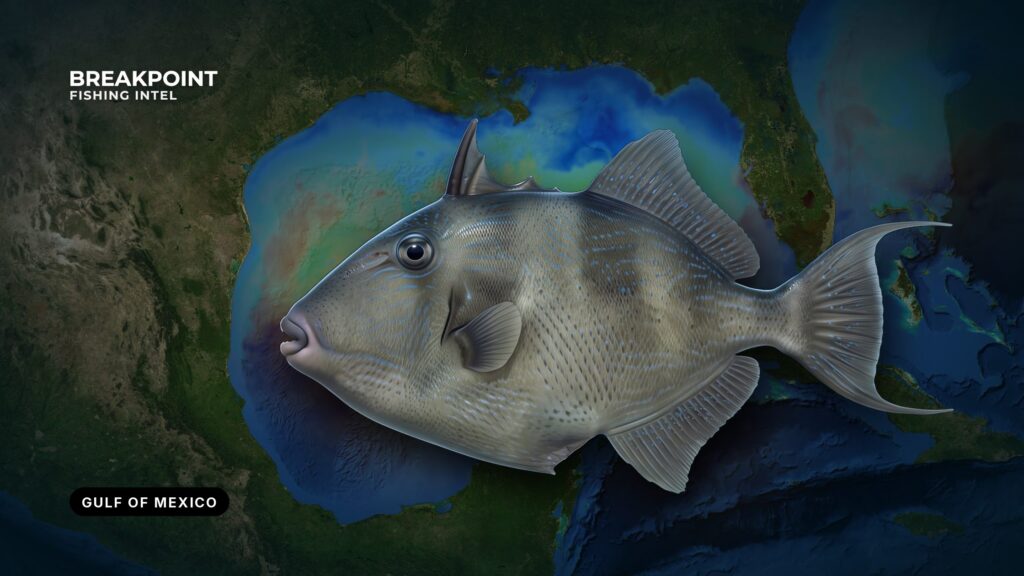
Gray triggerfish in the Gulf of Mexico live on the same drops as red snapper, but the Gulf manages them as a separate fishery with their own season and limit. The core federal rule is 15 inches fork length, 1 per person per day, with the season closed January 1 through the end of February and June 1 through July 31. The Gulf as a fishery runs from Texas to the Florida Keys line. This guide covers depths, structure, rigs, how the Atlantic differs, and the rules state by state.
Gray triggerfish at a glance
A gray triggerfish has a small, hard, bony mouth. When threatened, it wedges into a crevice and locks its first dorsal spine. Fish average 2 to 4 pounds, according to FWC. Juveniles drift with Sargassum in the open ocean before settling to the bottom, according to NOAA.
Identification, growth and spawning are covered in our gray triggerfish guide.
Where and when to find gray triggerfish in the Gulf of Mexico
Adults hold at 80 to 300 feet, according to NOAA. FWC describes them on hard bottom, reefs and ledges in water deeper than 80 feet. They are not found in shallow water, so plan runs around the deeper structure.
Spawning runs April to August, according to NOAA. Males build and guard nests in sand. Much of that window falls inside the June 1 to July 31 federal closure, but the overlap in timing doesn’t explain why the closure exists.
The federal Gulf season is split, open in spring (March to May) and again from August. The recreational quota governs, and NOAA can close the season early when the quota is met or projected to be met. If you’re planning a summer trip, triggers are catch-and-release from June 1 through July 31.
| Window | Federal Gulf status |
|---|---|
| January 1 through end of February | Closed |
| March through May | Open |
| June 1 through July 31 | Closed |
| August through December | Open |
Early quota closures can shorten the open windows, so check NOAA Fisheries before you go.
Bottom and water that hold triggers
Triggers hold where hard material breaks up the bottom, and they share that ground with red snapper, according to FWC. Adults live on hard ocean bottoms, reefs, ledges and artificial reefs, according to NOAA’s gray triggerfish profile.
Hard bottom and ledges
Natural hard bottom and rock ledges are the base habitat. The West Florida Shelf is the broad example. Snapper and triggers overlap here, so a drop that holds one often holds the other.
Artificial reefs, wrecks and platforms
These are the structure types to look for:
- Artificial reefs. NOAA lists them as adult habitat. The Alabama and Florida Panhandle reef zones are the best-known examples.
- Wrecks. Sunken vessels give triggers the vertical relief and crevices they use.
- Oil and gas platforms. Rigs off Louisiana and Texas serve as structure.
Finding structure
We map the depth contours and reef sites, and you decide where to drop. The Chart Contours layer shows the depth breaks that mark ledges and edges, with reef and structure data on top. Published reef and wreck positions can drift from where the material actually sits on the bottom, so confirm on your sounder. Chart layers are not for navigation.
How anglers fish for gray triggerfish
You fish the same drops as snapper and amberjack, with tackle sized for a fish that steals bait. FWC recommends light to medium bottom tackle with 20 to 50 pound test line. The rig setup:
- Rig: chicken or dropper rig with 2 or more hooks, baits just off the bottom.
- Hook: small, very sharp and strong, because of the hard mouth (FWC). Non-stainless-steel circle hooks are required with natural bait.
- Line: 20 to 50 pound test on light to medium bottom tackle (FWC).
- Bait: squid or tough cut bait that stays on the hook.
Triggers nip at bait and run. Keep the line tight from the drop, because slack lets them strip the hook. On a tight line the circle hook sets itself, and steady pressure keeps the fish out of the structure.
Release gear
Have a dehooking device on board. Rig a descending device or venting tool before the first drop rather than after a fish is up. Release triggers out of season or under 15 inches fork length.
Gulf vs. South Atlantic
The Gulf is managed by the Gulf of Mexico Fishery Management Council (GMFMC). The South Atlantic is managed by the South Atlantic Fishery Management Council (SAFMC), with a different season structure, bag structure and size limit. Both are administered through the NOAA Fisheries Southeast Regional Office.
| Factor | Gulf | South Atlantic |
|---|---|---|
| Council | GMFMC | SAFMC |
| Measurement | Fork length, 15 inches | Different limit. Check FWC and the Atlantic guide |
| Season structure | Split, two closures, quota-driven | Different structure |
| Bag structure | 1 per person inside the 20-fish reef fish aggregate | Different structure |
| Where to check | NOAA SERO, FWC Gulf | SAFMC, FWC Atlantic |
For Atlantic-side triggerfish rules and fishing, use the Atlantic guide.
Florida Gulf state waters run to 9 nautical miles, and Atlantic rules apply on the other coast. Keys anglers should check which side applies.
Guides to gray triggerfish fishing from specific ports: Dauphin Island, Boca Grande, Corpus Christi, Orange Beach, Carrabelle, Galveston, Clearwater and South Padre Island.
Regulations
Federal waters are managed by the Gulf of Mexico Fishery Management Council and NOAA Fisheries Southeast Regional Office under 50 CFR part 622. Federal rules call this water the Gulf of America. States set the rules inside their own waters. A trigger counts toward the 20-fish reef fish aggregate per person per day. For the wider picture, see Gulf reef fish federal rules. The council posts its Gulf Council federal regulations on its own site.
Measure fork length from the snout tip to the fork of the tail, not total length. Anglers used to red snapper’s total-length limit often get this wrong.
| Rule | Federal Gulf |
|---|---|
| Size | 15 inches fork length |
| Bag | 1 per person per day, inside the 20-fish reef fish aggregate |
| Closed | January 1 through the end of February, and June 1 through July 31 |
| Gear | Non-stainless-steel circle hooks with natural bait, a dehooking device, and a descending device or venting tool rigged and ready |
The federal reef fish season rules carry the legal text for these figures. NOAA can close the season early when the quota is met.
Texas
See the Texas regulations page. Texas Parks and Wildlife Department (TPWD) sets the rules in Texas state waters. Federal rules apply beyond the state line. Check TPWD before fishing.
Louisiana
See the Louisiana regulations page. The Louisiana Department of Wildlife and Fisheries (LDWF) sets the rules in Louisiana state waters. Federal rules apply beyond the state line. Check LDWF before fishing.
Mississippi
See the Mississippi regulations page. The Mississippi Department of Marine Resources (MDMR) sets the rules in Mississippi state waters.
Federal waters off Mississippi lie between 88°23.1′ W and 89°10.0′ W, out to 200 nm. They carry the federal figures: 15 inches fork length, 1 per person per day inside the 20-fish reef fish aggregate, closed January 1 through the end of February and June 1 through July 31.
Vessels with a federal charter vessel/headboat permit follow the more restrictive of the federal or state rule in state waters too.
Alabama
See the Alabama regulations page. ADCNR Marine Resources sets the rules in Alabama state waters. Federal rules apply beyond the state line. Check ADCNR before fishing.
Florida
See the Florida regulations page. FWC manages Gulf state waters from shore to 9 nautical miles. The FWC triggerfish regulations page carries the official figures.
| Rule | Florida Gulf state waters |
|---|---|
| Size | 15 inches fork length |
| Bag | 1 per person per day |
| Closed | January 1 through the end of February, and June 1 through July 31 |
| Open | March 1 to May 31 and August 1 to December 31 |
| Methods | Hook and line, spears and gigs |
Private vessels need the State Reef Fish Angler designation. State gear rules call for non-offset circle hooks with natural bait. The descending device needs at least a 16-ounce weight and 60 feet of line.
Gulf seasons close on quota, so check the agency page before every trip.
FAQ
When is gray triggerfish season open in the Gulf?
Federal waters are closed January 1 through the end of February and June 1 through July 31. The open windows are March through May and August through December. NOAA can close the season early when the quota is met or projected to be met.
What is the size limit, and how do I measure it?
The limit is 15 inches fork length. Measure from the tip of the snout to the fork of the tail. This is not total length, which is the measure used for red snapper.
Can I keep a triggerfish in June?
No. The season is closed June 1 to July 31 in federal waters and in Florida Gulf state waters. Release any trigger you catch in that window.
Do I need a descending device?
Yes, in federal waters. A descending device or venting tool must be rigged and ready for use. You also need a dehooking device and non-stainless-steel circle hooks when fishing with natural bait.
What does Florida require?
FWC sets 15 inches fork length and 1 per person per day, with the same two closures as federal waters. Private vessels need the State Reef Fish Angler designation. Gear rules include non-offset circle hooks with natural bait.
How do Gulf rules differ from the Atlantic?
The Gulf and Atlantic have different councils, GMFMC and SAFMC. Size, season and bag structure differ too. Check the Atlantic guide or FWC’s Atlantic rules before you fish that coast.
Do charter boats follow different rules?
Charter and headboat vessels in federal waters need a federal charter vessel/headboat permit for Gulf reef fish. Off Mississippi, a vessel with that permit follows the more restrictive of the federal or state rule in state waters too.