




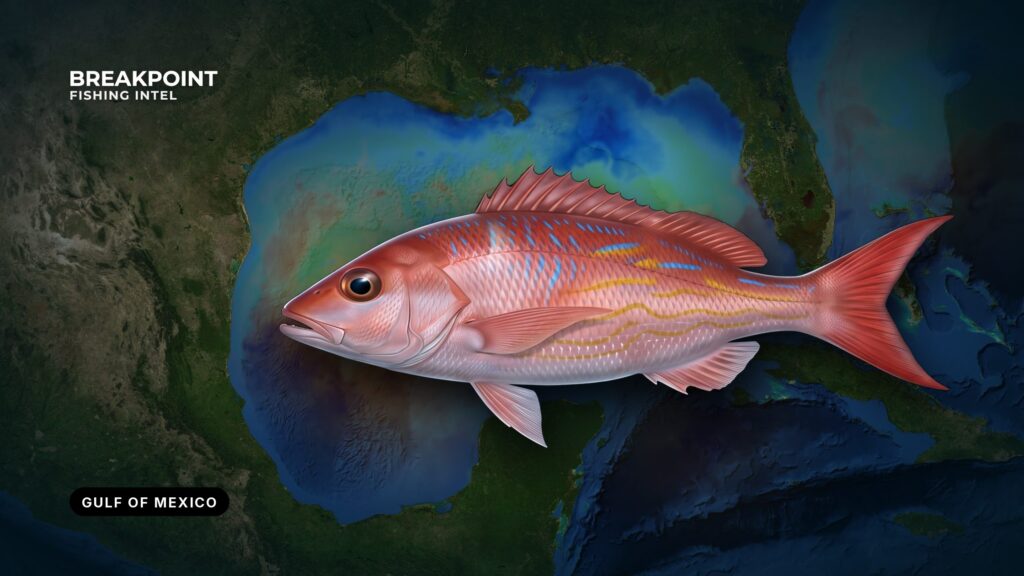
Vermilion snapper are a year-round Gulf target. They school over hard bottom in 60 to 400 ft of water, and they stay open when red snapper and gag are closed. Fishing them in the Gulf comes down to three things: the right depth band, the right bottom, and fishing the school instead of the seafloor. Gulf anglers call them beeliners. Federal documents call this water the Gulf of America, and agency pages use that name, so search both when you look up rules. This guide covers where to look and how to fish once you find them. It does not promise a catch. For Gulf-wide geography and seasons, start with our Gulf of Mexico fishing guide. Below you will find where and when, the bottom that holds fish, methods, how the Gulf compares with the Atlantic, and the federal and state rules.
Vermilion snapper at a glance
The basics, before we get to the water:
- Name: Rhomboplites aurorubens, commonly called beeliner.
- Size: up to about 2 ft long and up to 7 lb, according to NOAA. Those are maximums, not typical fish.
- Range: western Atlantic from North Carolina to Brazil, including the Gulf.
- Behavior: adults and juveniles form large schools, using the upper water column and moving up and down through the day.
- Maturity: they can reproduce at 1 to 2 years old.
- Diet: small fish, shrimp, crabs, worms, squid and other cephalopods, and plankton.
Size and range figures follow the FishBase vermilion snapper profile. For identification detail and life history, see our full vermilion snapper species guide.
Telling vermilion from red snapper
Vermilion snapper are smaller and more slender than red snapper, with a rounded anal fin and without the prominent canine "snapper teeth" of a red snapper. Both are red and often share the same reefs. Check the anal fin and mouth before you keep a fish, because red snapper have closed days and vermilion stay open.
Where and when to find them in the Gulf
NOAA puts vermilion snapper in 60 to 400 ft of water, most abundant shallower than 180 ft. That band is your search area. Across the Gulf, it runs through the West Florida Shelf, the Florida Panhandle, Alabama and Mississippi, Louisiana, and Texas. In each area, look for shelf hard bottom and artificial structure inside that depth band.
The depth band and the habitat stay put. Weather windows and other species’ seasons are what change.
| Factor | Fixed or moving | What it means for you |
|---|---|---|
| Depth band | Fixed | Start at 60 to 400 ft, with extra attention under 180 ft |
| Hard bottom and structure | Fixed | Ledges, rubble and reefs hold fish in every Gulf state |
| Availability | Fixed | Fish are present year-round |
| Weather windows | Moving | You decide the day from the forecast |
| Other species’ seasons | Moving | Red snapper and gag closures change what you can keep |
How deep to fish for beeliners
Look for hard bottom, ledges and rubble in the 60 to 400 ft band, then find the school’s depth on sonar. They often hold well above the bottom rather than on it. The next section covers the bottom that holds them.
Vermilion snapper fishing in the Gulf of Mexico by season
Vermilion are available year-round, and there is no closed federal recreational season. Spawning runs April through September in the north-central Gulf, according to the north-central Gulf spawning study, which sampled fish from Pensacola to the Mississippi River outflow.
When red snapper or gag are closed, vermilion stay open, which makes them a useful fallback for planning. Seasonal rules on other species are covered in the Regulations section below.
Bottom and water that hold them
Vermilion snapper live over rock, ledges, live bottom, gravel, and sand near the shelf edge. Hard bottom, rubble, artificial reefs and rigs add structure that holds schools. Read your chart for these features:
- Ledge: contour lines bunch together and the bottom steps down. Fish stack along the edge.
- Rubble: a broken, uneven patch on an otherwise flat bottom. It gives schools something to hold over.
- Shelf edge: where the shelf drops toward deeper water. Sand near the edge can hold fish too.
- Artificial reef: a charted reef or wreck on open bottom in the depth band.
- Rig: platform structure standing in the water column, with fish that ride above it.
Beeliners ride above structure, use the upper water column, and move vertically through the day, as documented in the SEDAR 55 stock assessment. The mark you want may sit well off the bottom, since the fish hold where the bait column holds.
Know what the tools can and cannot see. Chart layers show bottom, not fish. Satellite layers do not see a school at 120 ft. Sonar is the only tool that confirms fish.
Chart Contours and the bottom layers in Breakpoint show where contour lines bunch into ledges, where rubble breaks a flat, and where the shelf edge drops, across the 60 to 400 ft band. Use them to build a short list of bottom worth running to. Chart layers are not for navigation.
How Gulf anglers fish for vermilion
The common mistake is fishing vermilion like red snapper, with bait on the bottom. They school above structure, so your bait belongs in the school.
Fish the school, not the bottom
If a school marks 30 ft off the bottom, stop the drop at that depth. Read the line counter or count the drop so you can return to the same depth every time. Dropping to the bottom puts your bait under the fish.
Rigs and bait
- Rig: a chicken rig or double drop works well. A single drop is an option.
- Bait: small strips of squid and small cut fish.
- Hooks: circle hooks are required with natural bait. They must be non-stainless in federal waters. In Florida Gulf state waters they must also be non-offset. See the Regulations section.
- Retrieval: once you find a school, keep baits in it.
Keeping out-of-season fish off the hook
Fishing above the bottom reduces hookups with red snapper and gag, which hold tighter to structure. For more on those species and triggerfish, see our other reef fish guides.
Releasing fish with barotrauma
Barotrauma is pressure injury from a fast ascent. Rig a descending device or venting tool before you leave the dock, and carry a dehooking device. NOAA encourages these tools for fish that show signs of barotrauma.
Pick the bottom on the map, then confirm the school on sonar before you drop.
How the Gulf differs from the Atlantic
It is the same fish, with similar timing. Spawning runs April through late September in the Atlantic, with a June to August peak. Management differs. The Gulf is managed by the Gulf Council and NOAA Fisheries. The Atlantic is managed by the South Atlantic Fishery Management Council, and its size, bag and season rules differ from Gulf rules.
| Gulf | Atlantic Southeast | |
|---|---|---|
| Manager | Gulf Council and NOAA Fisheries | South Atlantic Fishery Management Council |
| Federal minimum size | 10 in TL | Set separately by the South Atlantic Council |
| Federal bag | 10 vermilion inside the 20-fish aggregate | Set separately by the South Atlantic Council |
| Closed federal recreational season | None | Set separately by the South Atlantic Council |
Florida’s Atlantic coast follows different vermilion rules from its Gulf coast. For the Atlantic side, see vermilion snapper in the Atlantic Southeast.
Guides to vermilion snapper fishing from specific ports: Dauphin Island, Boca Grande, Grand Isle, Biloxi, Corpus Christi, Orange Beach, Carrabelle and Gulfport.
Regulations
Which rules apply depends on where you catch the fish. State waters run from the shoreline to the state line, and federal waters run from there to 200 nm. Florida’s Gulf state waters extend to 9 nm. Each of the other Gulf states sets its own line, so check the state agency. NOAA Fisheries and the Gulf Council manage federal waters. See NOAA Fisheries Gulf regulations and the Gulf Council federal regulations, along with our summary of the Gulf reef fish federal rules.
The reef fish aggregate is a combined daily limit across several reef species. Vermilion count toward the federal 20-fish aggregate. Florida’s 10-fish snapper aggregate in state waters does not include vermilion.
The minimum size for vermilion snapper is 10 in total length in Gulf federal waters, in Florida Gulf state waters and in Mississippi. Measure from the snout to the tip of the tail. Alabama, Louisiana and Texas set their own state-water rules, so check ADCNR, LDWF or TPWD.
| Jurisdiction | Size (TL) | Bag | Season | Permit / reporting | Agency |
|---|---|---|---|---|---|
| Federal Gulf waters | 10 in | 10 vermilion inside the 20-fish aggregate | No closed recreational season | None for private anglers. For-hire vessels need a charter/headboat permit | NOAA Fisheries, Gulf Council |
| Florida Gulf state waters (to 9 nm) | 10 in | 10 per person, outside the 10-snapper aggregate | Open year-round | State Reef Fish Angler designation for private vessels | FWC |
| Mississippi | 10 in | 10 per person, inside the 20-fish aggregate | No closed season in state rules | Offshore Landing Permit | MDMR |
| Alabama | Check agency | Check agency | Check agency | Check agency | ADCNR |
| Louisiana | Check agency | Check agency | Check agency | Check agency | LDWF |
| Texas | Check agency | Check agency | Check agency | Check agency | TPWD |
Swipe the table sideways to see every column.
Federal waters
In Gulf federal waters, each angler may keep up to 10 vermilion snapper per day. Those fish count inside the 20-fish reef fish aggregate, a combined daily limit shared with lane snapper, gray triggerfish, tilefish and other species. There is no closed federal recreational season for vermilion.
Gear rules apply when you fish for Gulf reef fish. See the federal reef fish gear rules:
- Non-stainless circle hooks when fishing with natural bait.
- A dehooking device on board.
- A descending device or venting tool rigged and ready for use.
Federal rules change through federal action. Check NOAA bulletins before fishing.
Florida
In Florida Gulf state waters, vermilion snapper have a 10 in total length minimum and a 10-fish daily limit. The fish are not counted in the 10-fish snapper aggregate, and the season is open year-round. That aggregate applies to fish possessed in or outside Florida waters, and vermilion are excluded from it.
Private-vessel anglers need the State Reef Fish Angler designation. Circle hooks must be non-offset, and the descending device needs at least a 16 oz weight and 60 ft of line. See Florida fishing regulations and the FWC snapper regulations. Check FWC before fishing.
Alabama
The Alabama Department of Conservation and Natural Resources (ADCNR) sets vermilion rules in Alabama state waters. See Alabama fishing regulations. Check ADCNR before fishing.
Mississippi
Mississippi sets a 10 in total length minimum and a 10-fish daily limit for vermilion snapper, counted inside the 20-fish reef fish aggregate. There is no closed season in state rules. An Offshore Landing Permit is required.
Fish caught elsewhere may be landed in Mississippi if they meet the limits where they were caught. Red snapper are the exception. Fish must be kept with head, tail and flesh intact until they reach land. Gutting, scaling and gilling are allowed. A boat on a trip longer than 24 hours with a float plan filed with MDMR before departure may carry fillets, up to one day’s bag per species.
See Mississippi fishing regulations and the MDMR recreational catch limits. Check MDMR before fishing.
Louisiana
The Louisiana Department of Wildlife and Fisheries (LDWF) sets vermilion rules in Louisiana state waters. See Louisiana fishing regulations. Check LDWF before fishing.
Texas
Texas Parks and Wildlife Department (TPWD) sets vermilion rules in Texas state waters. See Texas fishing regulations. Check TPWD before fishing.
FAQ
Why are vermilion snapper called beeliners?
Beeliner is the common Gulf name for vermilion snapper, used by anglers across the region. Another name is mingo.
How do you tell vermilion snapper from red snapper?
Look at the anal fin and the mouth. A vermilion has a rounded anal fin and lacks the prominent canine "snapper teeth" of a red snapper. It is also smaller and slimmer. For more detail, see the vermilion snapper species guide.
What depth are vermilion snapper in the Gulf?
They live in roughly 60 to 400 ft of water, and NOAA reports them most abundant shallower than 180 ft. Fish at the depth of the school, which often sits well above the bottom. Confirm it on sonar before you drop.
Can you keep vermilion snapper year-round in the Gulf?
Yes in federal waters, in Florida Gulf state waters and under Mississippi state rules, where there is no closed season. For Alabama, Louisiana and Texas, check the state agency. Seasons on other species, such as red snapper and gag, are separate.
How does the reef fish aggregate count vermilion?
In federal waters, you may keep up to 10 vermilion inside a 20-fish combined aggregate. In Florida state waters, vermilion sit outside the 10-snapper aggregate. Mississippi counts them inside the 20-fish aggregate.
Do I need Florida’s State Reef Fish Angler designation for vermilion?
Yes, if you fish from a private vessel and land vermilion in Florida. Check FWC for current sign-up details before your trip.
Can I land vermilion caught off another state in Mississippi?
Yes, if the fish meet the limits where they were caught. Red snapper are the exception. An Offshore Landing Permit is required.
What descending device do I need?
Federal rules require a descending device or venting tool rigged and ready for use. Florida state waters require a descending device with at least a 16 oz weight and 60 ft of line.
Conclusion
Vermilion snapper reward anglers who match depth, bottom and rig to where the school is holding. Start with the 60 to 400 ft band, find the ledge, rubble or reef, and let sonar tell you where to stop the drop. Rules change with the line on the chart, so check the agency for the water you are fishing.
To build that short list of bottom before you leave the dock, download Breakpoint from the App Store or Google Play and see how Chart Contours and the bottom layers read the Gulf shelf.