




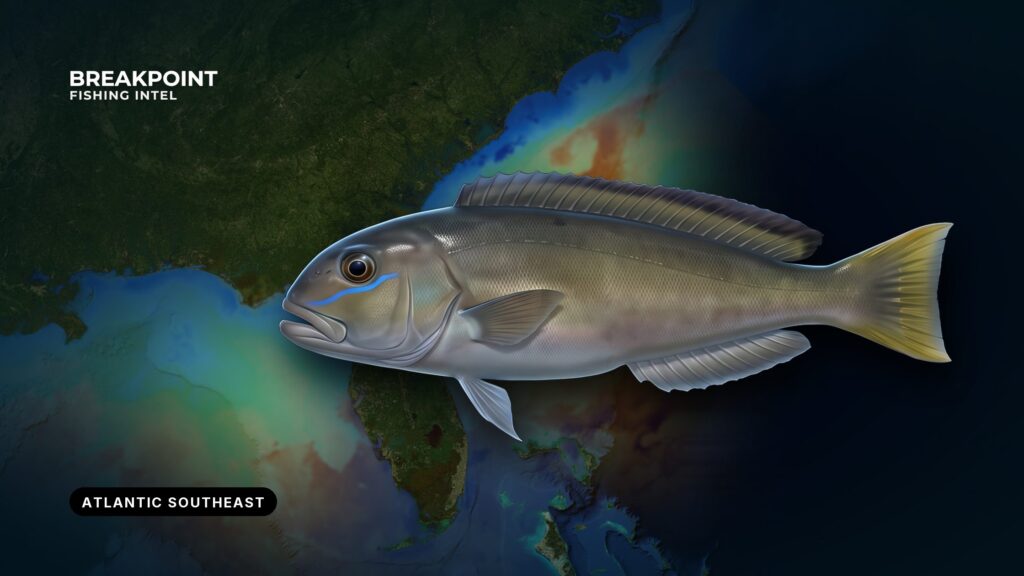
Blueline tilefish fishing in the Atlantic Southeast centers on the shelf edge and upper slope from North Carolina down the Florida Atlantic coast and through the Keys. SAFMC puts the fish at 240 to 780 feet, and other agencies list different ranges. Federal recreational harvest is open May 1 to August 31. The limit is 2 bluelines inside the 3-fish grouper and tilefish aggregate, and almost every fish comes from federal water.
This page covers where the fish live, the bottom and water that hold them, how anglers fish for them here, and how the rules split between federal and state water.
What a blueline tilefish is
SAFMC describes the blueline as dull olive-gray above and white below, with a narrow gold stripe underlined in blue from the snout to the eye. It has a long snout, long continuous dorsal and anal fins, and a strong, flat spine on the gill cover. It lacks the fleshy crest behind the head that the golden tilefish has.
Size and age figures vary by agency. NOAA’s blueline tilefish profile gives up to 35 inches and up to 26 years. SAFMC gives 32 inches and 15 years, and SEDAR 92 gives about 36 inches. NOAA lists the diet as crabs, shrimp, snails, worms, sea urchins and small fish.
Full identification and biology are in the blueline tilefish species guide.
Where and when bluelines live in the Atlantic Southeast
The fishery here runs from North Carolina to the Florida Atlantic coast and the Keys. The Atlantic Southeast fishing guide covers the wider region, from the Florida Straits to Cape Hatteras.
SEDAR 32 finds bluelines off South Carolina on rocky bottom at the shelf edge and on slope reefs. It describes them as relatively sedentary, with no north-south migration along the coast, so a productive piece of bottom tends to stay productive.
Timing follows spawning. Off the Carolinas, the SEDAR 32 assessment reports spawning from April to October, with peaks in May to June and September to October. That biology sits behind the short federal recreational season. Because the fishery runs on a defined window, trips should be planned for May through August.
The bottom and water that hold bluelines
The agencies agree on the habitat but not on depth.
| Source | Depth | Bottom temperature | Structure |
|---|---|---|---|
| NOAA | 98 to 774 ft | 59 to 73.4°F | Outer shelf, shelf break, upper slope; irregular bottom with ledges, crevices, boulders, rubble piles |
| SAFMC | 240 to 780 ft | 59 to 73°F | Sand, mud, shell hash; same habitat as groupers and snappers |
| SEDAR 92 | 150 to 840 ft (46 to 256 m) | 59 to 73°F | Shelf edge and upper slope reefs |
Given the disagreement on depth, the overlap is the best place to start as a core band.
Shelf break, ledges and burrows
The shelf break concentrates fish because the bottom changes character there. Hard edges, ledges and rubble sit where the bottom turns down, and soft sediment lies beside the hard patches.
Contour spacing on a chart shows which kind of bottom you’re looking at:
- Lines bunched together: a steep drop or a ledge.
- Wide, even spacing: flat bottom.
- Irregular, wiggly lines: broken ground worth a look.
Bluelines burrow head first into cone-shaped sand piles (NOAA). SEDAR 32 reports burrows in soft sandy sediment at 91 to 150 m, holding up to 3 fish. Look for soft bottom touching hard patches inside the depth band.
Bottom temperature and the Gulf Stream
All three agencies give 59 to 73°F as bottom temperature. The Gulf Stream influences the water over the shelf edge, but satellites read only the surface, so a warm surface edge says nothing direct about bottom temperature at 400 feet.
In Breakpoint, Chart Contours shows the shelf break and ledges, and OBS SST shows where the Gulf Stream edge sits. Surface temperature is not bottom temperature, some deep shelf soundings are sparse or old, and chart layers are not for navigation. Before the run, check the NWS offshore forecast for wind, wave height and period.
How anglers fish for bluelines here
Deep dropping means fishing heavy, bottom-weighted rigs straight down in deep water, often with electric reels. The technique matters more than the brand of gear:
- Keep the line straight. Aim for the straightest line from rod tip to weight, with the helm working with the angler.
- Fish at or just off the bottom, and drift across hard-to-soft transitions.
- Use sturdy baits such as squid and cut fish, and rebait often.
- Mark a waypoint where fish bite.
Golden tilefish live deeper, and snowy grouper share the same ground. Both count toward the same aggregate, so keep an eye on the cooler count. Rigs and reels are covered in the deep drop gear and technique guides.
Barotrauma is injury from expanding gas when a fish is pulled up from depth. A descending device is a weighted clip or box that returns the fish to depth before release. One must be on board in federal water, as the Regulations section explains.
Marking the contour breaks that produce lets the app take you back to them. The depths that hold bluelines lie almost entirely in federal water, so federal rules govern nearly every trip.
How the rules here differ from the Mid-Atlantic
Two councils manage blueline tilefish. From the VA/NC border north, the Mid-Atlantic Fishery Management Council manages them under its tilefish plan. South of the border, the South Atlantic Fishery Management Council manages them under the Snapper-Grouper FMP.
| Item | South Atlantic (federal) | Mid-Atlantic (federal, VA/NC border north) |
|---|---|---|
| Managing council | SAFMC | MAFMC |
| Season | May 1 to August 31; closed January 1 to April 30 and September 1 to December 31 | May 15 to November 14 |
| Bag | 2 bluelines inside the 3-fish grouper and tilefish aggregate, per person per day | 3 per person per trip, private vessel |
| For-hire anglers | Same 2 within the aggregate; captain and crew on federally permitted for-hire vessels keep 0 | 5 on a USCG uninspected vessel; 7 on an inspected vessel |
| Minimum size | See agency | None |
| Recreational permit | See agency | Free Private Recreational Tilefish Vessel Permit (private); charter/party tilefish permit (for-hire) |
| Reporting | See agency | Electronic trip report within 24 hours (private); electronic trip reports for for-hire |
| Descending device | Required on board | See agency |
The Mid-Atlantic permit and bag rules are in the federal Mid-Atlantic tilefish rules.
The Gulf is managed separately. See blueline tilefish in the Gulf.
Captains working near the VA/NC line need to know which side of the border they are fishing and landing on.
Guides to blueline tilefish fishing from specific ports: Pompano Beach, Murrells Inlet and Sebastian Inlet.
Regulations
State waters run from shore to 3 nautical miles. Federal waters, the EEZ, run from 3 to 200 nautical miles. Blueline depths sit almost entirely in the EEZ, so the federal rules below govern nearly every trip.
Federal waters
The federal rules in the South Atlantic:
- Season: closed January 1 to April 30 and September 1 to December 31.
- Bag: 2 bluelines per person within the 3-fish grouper and tilefish aggregate. An aggregate is a combined limit across the listed species.
- For-hire: captain and crew on federally permitted for-hire vessels keep zero.
- Release gear: a descending device must be on board.
Each year NMFS announces whether the recreational catch limit will close the season early, so the open window can be shorter than the fixed dates. The announcement is published as the NMFS season announcement.
Bag and season rules are on the SAFMC blueline tilefish regulations page. The wider rule set is in the full South Atlantic Snapper-Grouper rules.
Check SAFMC and NOAA Fisheries before you fish.
North Carolina
The depths bluelines live in fall in federal water. The state agency is the North Carolina Division of Marine Fisheries (NCDMF). State rules are on the North Carolina fishing regulations page.
Check NCDMF before fishing.
South Carolina
The depths bluelines live in fall in federal water. The state agency is the SCDNR Coastal Resources Division. State rules are on the South Carolina fishing regulations page.
Check SCDNR before fishing.
Georgia
The depths bluelines live in fall in federal water. The state agency is the Georgia DNR Coastal Resources Division. State rules are on the Georgia fishing regulations page.
Check Georgia DNR before fishing.
Florida
FWC sets these rules for Atlantic state waters:
- 2 bluelines per person per day, within the 3-fish grouper and tilefish aggregate.
- Open May 1 to August 31.
- No minimum size.
- Captain and crew on for-hire trips keep zero.
The blueline rule applies in all Monroe County state waters, on both the Atlantic and Gulf sides.
Gear rules:
- A dehooking device on board.
- A descending device (at least a 16-ounce weight and 60 feet of line) or a venting tool, rigged and ready.
- North of 28° N, non-stainless-steel, non-offset circle hooks with natural bait.
- South of 28° N, non-stainless-steel hooks.
See the FWC tilefish rules page and the Florida fishing regulations page.
Check FWC before fishing.
Frequently Asked Questions
Is blueline tilefish open in the South Atlantic?
Federal recreational harvest is open May 1 to August 31. NMFS can close it earlier if the catch limit is projected to be met. Check SAFMC and NOAA Fisheries before you go.
Do bluelines count toward the grouper limit?
Yes. A maximum of 2 bluelines fit inside the 3-fish grouper and tilefish aggregate (SAFMC, FWC). Golden tilefish and groupers count toward the same 3 fish.
Do I need a tilefish permit off North Carolina?
Only north of the VA/NC border, where the Mid-Atlantic permit and 24-hour trip reporting apply. South of the border, follow the SAFMC rules. Confirm your position and landing location with the agency.
Can for-hire captains keep bluelines?
No. Captain and crew on federally permitted for-hire vessels keep zero. FWC applies the same rule for for-hire trips in Florida state waters.
What depth holds bluelines?
NOAA gives 98 to 774 ft, SAFMC gives 240 to 780 ft and SEDAR 92 gives 150 to 840 ft. All three list bottom temperature at 59 to 73°F. The overlap is the core band.
Is a descending device required?
Yes. One must be on board in South Atlantic federal waters. Florida state waters require a descending device or a venting tool, plus a dehooking device.
What is the difference between blueline and golden tilefish?
Golden tilefish have a fleshy crest behind the head and live deeper. In Florida Atlantic state waters, golden tilefish are 1 per person and open year-round (FWC), also inside the aggregate.