




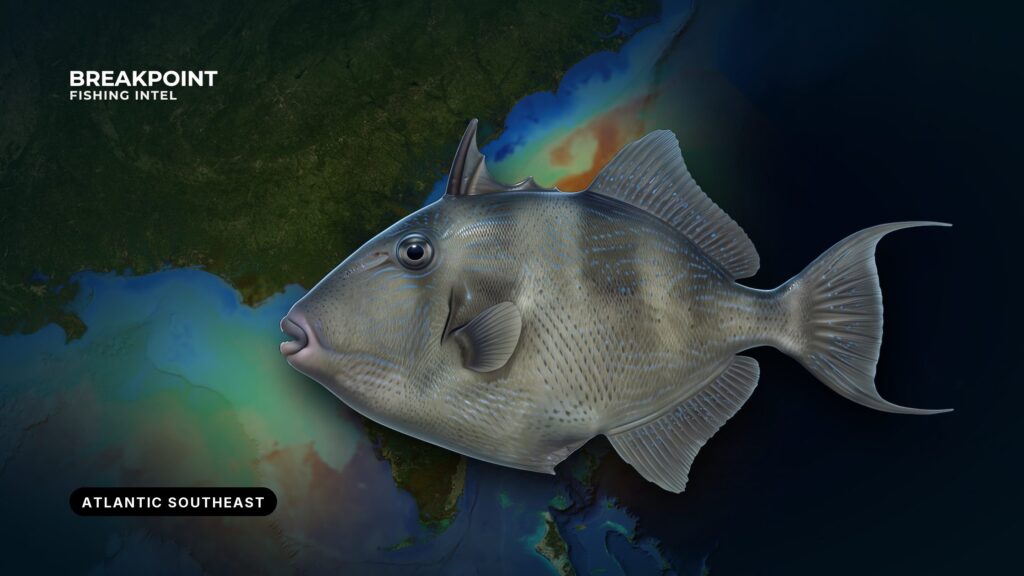
Gray triggerfish fishing in the Atlantic Southeast depends on finding hard bottom and knowing which jurisdiction you are fishing in. The fish hold on wrecks, rock and reef from North Carolina to the Atlantic side of the Florida Keys, mostly in 80 to 300 feet, and federal rules are the same across that whole stretch. This guide covers the bottom to mark, how to fish it, how state and federal lines fall, and the core rules in one table. For the wider region, see our Atlantic Southeast fishing guide.
Gray Triggerfish at a Glance
Gray triggerfish (Balistes capriscus) have a deep, compressed body and a small, hard mouth with strong teeth. The first dorsal spine locks upright, which gives the fish its "trigger." According to SAFMC, the gray’s drab coloring separates it from the vividly colored queen triggerfish, so check every fish before it goes in the cooler. Full identification and life history are in our gray triggerfish species guide.
Where and When to Find Them
Gray triggerfish range from North Carolina south through South Carolina, Georgia and Florida’s east coast to the Atlantic side of the Keys. Off the Keys, the Council line runs along 83° W north to 24°35′ N, then east to the mainland. That line marks where Gulf management begins (see the Atlantic vs. Gulf section below).
The NC Division of Marine Fisheries profile places gray triggerfish on hard bottom such as wrecks, rock outcroppings and reefs in 80 to 300 feet. NOAA Fisheries lists spawning from April to August. During that window males build and defend nests, which changes where the fish sit and how they bite.
Quick targets:
- Depth: 80 to 300 feet
- Bottom: hard bottom, wrecks, reefs
- Spawning: April to August
Bottom and Water That Hold Triggerfish
Triggerfish are a structure fish, so mark the bottom first and pick the drift second.
Live Bottom and Ledges
Rock outcroppings, ledges and live bottom are the primary natural habitat. Gray triggerfish live alone or in small groups and relate to specific pieces of structure rather than roaming open sand. Depth breaks and ledge edges are where that structure shows up on a chart. Work the edges and high spots before the flats around them.
Wrecks and Artificial Reefs
Wrecks and artificial reefs are charted, public structure, and they concentrate triggerfish. Each state in the region runs an artificial reef program, so there is plenty of marked bottom to check. Triggerfish share this bottom with black sea bass, vermilion snapper and grouper, so a good ledge usually produces a mixed trip. Our reef fish fishing guides cover the rest of that lineup.
Sand Near the Reef During Spawning
Per NOAA Fisheries, males build nests in the sand and defend them on the reef from April to August. In that window, drift the sand patches next to hard bottom as well as the structure itself.
What the Chart Can and Cannot Show
Small patches and low-relief rock may not appear on any chart, so let your sounder confirm what the chart suggests. Chart Contours shows the ledges and depth breaks that hold triggerfish between 80 and 300 feet. Chart layers are not for navigation.
How Anglers Fish for Triggerfish
Triggerfish nibble bait, which makes them hard to hook, according to the NCDMF profile. Every choice below is built around that habit.
Hooks That Fit a Small Mouth and the Rules
Use small, strong hooks. Hook rules apply on snapper-grouper trips with natural bait. North of 28° N, you need non-offset, non-stainless circle hooks. South of 28° N, hooks must be non-stainless. Run the smallest strong circle hook that stays legal, and let the fish load the rod rather than jerking at every tap.
Baits That Stay on the Hook
Tough baits hold up to nibbling better than soft ones. Squid is the standard because it stays on the hook through repeated picks. Cut fish and shrimp work but get stripped faster.
Rigs and Bottom Contact
Use a bottom rig, such as a dropper loop, that holds bait at the structure. Keep the bait close to the rock, where the fish are feeding.
Getting the Fish Off the Bottom
A hooked triggerfish dives into structure and locks its dorsal spine to wedge itself in. Keep steady pressure and work the fish up fast, before it reaches a crevice.
Releasing Fish You Don’t Keep
Short fish and fish over your bag go back; the descending device rule in the Regulations section covers how. Have the device rigged before the first drop.
Atlantic vs. Gulf: Which Line You’re On
Anglers who fish both coasts often assume Florida has one rule set. It doesn’t, because two councils manage the species. The SAFMC manages the Atlantic side under the snapper-grouper plan. The Gulf Council manages the Gulf side under a separate reef fish plan, with its own seasons, size and bag rules. The dividing line off the Keys is 83° W north to 24°35′ N, then east to the mainland.
Gulf seasons depend on quota and are set separately. Gulf seasons and limits are in our gray triggerfish guide for the Gulf.
| Atlantic side | Gulf side | |
|---|---|---|
| Federal council | SAFMC | Gulf Council |
| Management plan | Snapper-grouper | Reef fish |
| Federal size | 12 in fork length | See Gulf guide and FWC |
| Federal bag | 20-fish aggregate, max 10 of one species | See Gulf guide and FWC |
| Federal season | No closed recreational season | See Gulf guide and FWC |
Guides to gray triggerfish fishing from specific ports: Boynton Beach, Savannah, Hatteras Village, Edisto Beach, Fernandina Beach, St. Marys, Morehead City and Folly Beach.
Regulations
Rules change through council and agency action, so check the agency before fishing.
| Jurisdiction | Size | Bag | Season | Agency |
|---|---|---|---|---|
| Federal waters (3 to 200 nm) | 12 in fork length | 20-fish snapper-grouper aggregate, no more than 10 of one species | No closed recreational season | SAFMC |
| Florida Atlantic state waters | 12 in fork length | 10 per person per day | Open year-round | FWC |
| Georgia state waters | See agency | See agency | See agency | GA DNR Coastal Resources Division |
| South Carolina state waters | See agency | See agency | See agency | SCDNR |
| North Carolina state waters | See agency | See agency | See agency | NCDMF |
Swipe the table sideways to see every column.
How federal and state rules divide
State waters run from shore to 3 nautical miles. Federal waters run from 3 to 200 nautical miles. Where you fish sets which rules apply. Federal rules come from the SAFMC and NOAA Fisheries in 50 CFR part 622.
Federal waters
Federal rules for gray triggerfish:
- Size: 12 inches fork length.
- Bag: inside the 20-fish snapper-grouper aggregate per person per day, no more than 10 of any one species.
- Season: no closed recreational season.
Federal gear rules apply to snapper-grouper trips:
- A dehooking device and a descending device must be aboard and ready for use. The descending device needs at least a 16-ounce weight and 60 feet of line.
- With natural bait, circle hooks are required north of 28° N and non-stainless hooks south of 28° N.
The details are in the federal snapper-grouper gear rules. Private anglers need no federal permit. For-hire vessels need the federal charter/headboat permit for South Atlantic snapper-grouper.
Size, bag and season come from the SAFMC recreational regulations. In-season changes are posted on the NOAA South Atlantic seasonal closures page. Our South Atlantic snapper-grouper federal rules page covers the full aggregate and gear detail.
Florida
FWC sets the rules in Atlantic state waters:
- Size: 12 inches fork length.
- Bag: 10 per person per day.
- Season: open year-round.
Private vessels need the State Reef Fish Angler designation. A dehooking device and a descending device or venting tool must be rigged and ready. The same 28° N hook rule applies, and special regulations apply in Biscayne National Park. Note the bag difference: the federal limit is the 20-fish aggregate capped at 10 per species, while Florida state waters list 10 per person.
See the FWC gray triggerfish rules. The Florida Administrative Code chapter 68B-14 is the final authority. More in our Florida fishing regulations page.
Georgia
Federal rules apply beyond 3 nautical miles. The Georgia DNR Coastal Resources Division manages state waters, so check it before fishing. More in our Georgia fishing regulations page.
South Carolina
Federal rules apply beyond 3 nautical miles. SCDNR manages state waters, so check it before fishing. More in our South Carolina fishing regulations page.
North Carolina
Federal rules off North Carolina are the same as elsewhere in the region: 12 inches fork length, the 20-fish aggregate with no more than 10 of one species, and no closed season. NCDMF manages state waters, so check it before fishing. More in our North Carolina fishing regulations page.
Frequently Asked Questions
Is triggerfish open on the Florida east coast?
Yes. FWC lists gray triggerfish open year-round in Atlantic state waters, and federal waters have no closed recreational season. Check the agency for in-season changes before you go.
Do triggerfish count toward the snapper-grouper aggregate?
In federal waters, yes. They count inside the 20-fish aggregate, with no more than 10 of one species, according to SAFMC and NOAA Fisheries.
Do I need circle hooks for triggerfish?
North of 28° N with natural bait, you need non-offset, non-stainless circle hooks. South of 28° N, hooks must be non-stainless. This applies in federal waters and Florida state waters.
Do I need a descending device?
Yes in federal waters, along with a dehooking device. The descending device needs a 16-ounce weight and 60 feet of line. In Florida state waters, a descending device or venting tool must be rigged and ready.
What is the State Reef Fish Angler designation?
It is an FWC designation that private-vessel anglers need to harvest gray triggerfish and other listed reef fish in Florida. Check FWC for how to get it.
How do Gulf triggerfish rules differ?
They come from a different body, the Gulf Council, under a separate plan, split at the 83° W / 24°35′ N line. Seasons and limits are set separately. The Gulf guide covers them.
How do I tell gray triggerfish from queen triggerfish?
Gray is drab. Queen is vividly colored, according to SAFMC.
Do for-hire boats need a permit?
Yes. Federal charter vessels and headboats need the South Atlantic snapper-grouper charter/headboat permit. Private anglers need none.