




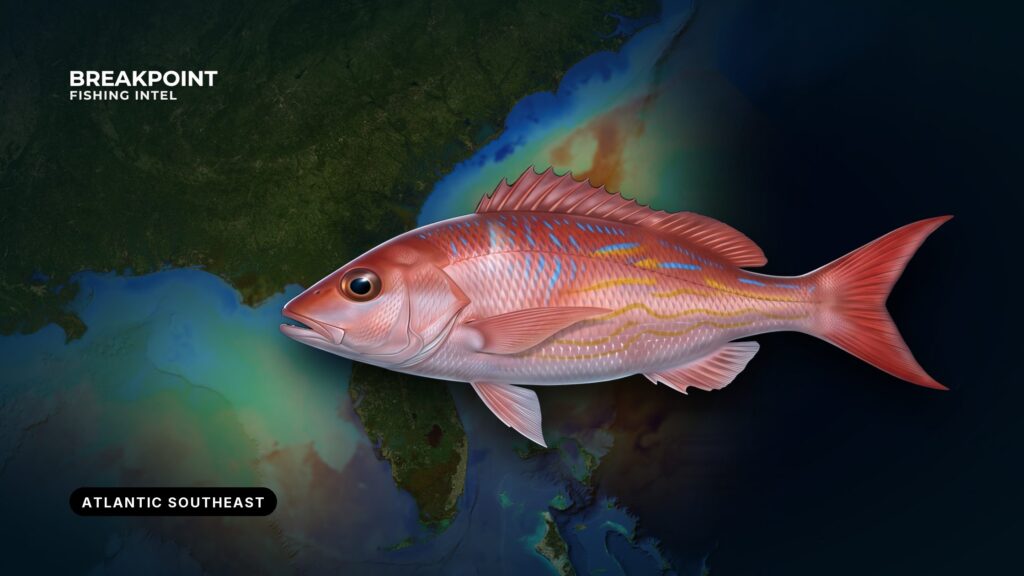
Vermilion snapper fishing in the Atlantic Southeast is a hard-bottom game. The fish, called beeliners or b-liners at the dock, school over rock, ledges and live bottom along the shelf from Cape Hatteras to the Florida Keys. This guide covers where the fish are, what bottom holds them, how to fish them, and which rulebook applies at your spot.
Waters out to 3 nautical miles are state waters. Federal waters lie beyond, and most vermilion come from federal water. There, the minimum is 12 inches total length and the bag is 5 per person per day, with no closed recreational season. Check the agency page before you fish.
About vermilion snapper
Vermilion snapper live in large schools, adults and young alike. The species ranges from Cape Hatteras to southeastern Brazil. SAFMC gives a maximum length of 24.2 inches TL, and NOAA says the fish reaches about 2 feet and 7 pounds. The oldest fish observed in the South Atlantic was 19 years old (SEDAR 55). Most fish mature by age 1, and all by age 2.
Identification, growth and spawning detail are in our vermilion snapper guide. In this region the species is managed in the South Atlantic snapper-grouper complex by SAFMC and NOAA Fisheries.
Where and when
SAFMC puts vermilion snapper at 59 to 400 feet, most abundant shallower than 250 feet. NOAA says most abundant shallower than 180 feet. Both describe where the fish are most abundant, and neither guarantees fish on a given spot.
The range runs the length of our Atlantic Southeast fishing guide: Cape Hatteras to the Keys, along the shelf edge, with the Gulf Stream offshore. Anglers run for them from ports such as Morehead City, Murrells Inlet, Jacksonville and Ponce Inlet.
Timing comes from spawning and from the rules:
- Spawning season: April through late September, peaking June to August (SAFMC). The fish spawn in aggregations.
- Movement: NOAA notes the fish do not travel very far.
- Retention: there is no closed federal recreational season, so the fish can be kept year-round in federal water. That does not mean they are on every spot in every month.
Depth figures by source:
| Source | Depth range | Where most abundant |
|---|---|---|
| SAFMC | 59 to 400 ft | Shallower than 250 ft |
| NOAA | 60 to 400 ft | Shallower than 180 ft |
Bottom and water
Vermilion are bottom-dwelling fish. SAFMC and NOAA both describe them over rock, ledges, live bottom, gravel or sand near the edge of the continental shelf. Hard bottom comes first.
Structure that holds them:
- Ledges and shelf-edge breaks: where the bottom steps down, fish stack along the drop.
- Live bottom: patches of hard, growth-covered bottom in the depth band above.
- Artificial reefs and wrecks: structure that can also hold fish. We make no claim about which holds more.
- Gravel and sand near the edge: vermilion also use these where they meet harder bottom.
The Gulf Stream shapes current and temperature along the outer shelf, which changes how the water moves over the bottom you are fishing.
Their diet sets your bait size. SAFMC lists fishes, shrimp, crabs, cephalopods and planktonic organisms, and small mouths call for small baits.
Chart Contours shows where the shelf breaks and ledges run between the 100 and 250 ft lines. Chart layers are not for navigation.
How anglers fish them
Reading marks and fishing the column
Vermilion use the upper water column and show diel vertical migration, according to the SEDAR 55 stock assessment. That changes where you put the bait.
Set baits at the depth of the marks rather than on the bottom. Schools often hold above structure, so fishing the mark depth puts bait in front of vermilion before the bottom fish find it.
Rigs, hooks and bait
Build the rig to match a school stacked in the water column:
- Rig: a multi-hook rig that spreads small baits vertically through the school.
- Lead: heavy enough to get through fish in the column and down to the mark.
- Hooks: small circle hooks. North of 28° N, natural bait requires non-offset, non-stainless circle hooks.
- Bait: small strips of squid or cut fish sized to a small mouth.
Drift vs. anchor
Drifting is the common approach. Find the marks, work out the drift, reposition upcurrent and drop through the school. Anchoring is an option over a tight piece of bottom. Move when the marks or the bites stop.
Bycatch on the same bottom
Black sea bass, red snapper and gray triggerfish share the bottom with vermilion. Red snapper is closed except for an announced season, so release it with a descending device outside that season.
Mixed-species fishing produces discards when some species cannot be kept, as a peer-reviewed snapper-grouper study notes. More on the other species is in our reef fish fishing guides.
Release with a descending device
In federal waters, a descending device rigged with at least a 16 oz weight and 60 ft of line must be on board and ready for use. Send fish showing barotrauma back to depth with it.
Pick your bottom on the map before you burn fuel looking for it.
Atlantic vs. Gulf
The Atlantic and the Gulf of America (Gulf of Mexico) have two councils, two stocks and so two rulebooks. SAFMC manages the Atlantic. The Gulf Council manages the Gulf.
In the Keys the council line runs along 83° W north to 24°35′ N, then east to the mainland. Atlantic rules apply on the Atlantic side of that line. Florida state waters extend 3 nautical miles on the Atlantic coast.
| Item | Atlantic (South Atlantic) | Gulf of America |
|---|---|---|
| Council | SAFMC | Gulf Council |
| Stock | South Atlantic stock | Gulf stock |
| Size | 12 in TL (federal) | Gulf Council rules, see the Gulf guide and FWC |
| Bag | 5 per person per day (federal) | Gulf Council rules, see the Gulf guide and FWC |
| Aggregate treatment | Outside the 10-fish snapper aggregate | Gulf Council rules, see the Gulf guide and FWC |
| Season | No closed recreational season (federal) | Gulf Council rules, see the Gulf guide and FWC |
| Circle hooks | Non-offset, non-stainless north of 28° N with natural bait | Gulf Council rules, see the Gulf guide and FWC |
The Gulf side is in our Gulf vermilion snapper guide.
Guides to vermilion snapper fishing from specific ports: Haulover, Golden Isles, Morehead City, Edisto Beach, Islamorada, St. Marys, Ocean Isle Beach and Georgetown.
Regulations
State waters run out to 3 nautical miles. Federal waters run from 3 to 200 nautical miles. Federal rules come first here because most vermilion are caught in federal water. Rules change by rulemaking, and in-season federal changes appear on NOAA’s closures page.
Federal waters (SAFMC and NOAA Fisheries)
Federal rules for vermilion snapper in the South Atlantic, found in 50 CFR part 622:
- Size: 12 in TL.
- Bag: 5 per person per day, outside the 10-fish snapper aggregate.
- Season: no closed recreational season.
Find the rules at SAFMC snapper-grouper regulations. In-season changes post on the NOAA South Atlantic seasonal closures page. Aggregates, grouper closures and red snapper are covered in full federal snapper-grouper rules.
For-hire vessels need a federal charter vessel/headboat permit for South Atlantic snapper-grouper. Some federal grouper closures also apply in state waters to federally permitted vessels.
Gear rules, from the federal gear rule, 50 CFR 622.188:
- A dehooking device on board.
- A descending device with at least a 16 oz weight and 60 ft of line, ready for use.
- Non-offset, non-stainless circle hooks with natural bait north of 28° N.
- Non-stainless hooks south of 28° N.
Check the agency page before you fish.
Regulations by jurisdiction
| Jurisdiction | Waters | Size | Bag | Season | Agency |
|---|---|---|---|---|---|
| Federal (SAFMC/NOAA) | 3 to 200 nm | 12 in TL | 5 per person per day | No closed recreational season | SAFMC |
| North Carolina | 0 to 3 nm | See NC DMF | See NC DMF | See NC DMF | NC DMF |
| South Carolina | 0 to 3 nm | See SCDNR | See SCDNR | See SCDNR | SCDNR |
| Georgia | 0 to 3 nm | See GA DNR CRD | See GA DNR CRD | See GA DNR CRD | GA DNR CRD |
| Florida (Atlantic) | 0 to 3 nm | See FWC | See FWC | See FWC | FWC |
Swipe the table sideways to see every column.
North Carolina
The North Carolina Division of Marine Fisheries sets state-waters rules. Follow its management work in the NC DMF snapper-grouper update. More on licenses and jurisdiction is in North Carolina fishing regulations.
Check the agency page before you fish.
South Carolina
The South Carolina Department of Natural Resources (SCDNR) sets state-waters rules. See South Carolina fishing regulations for licensing and jurisdiction.
Check the agency page before you fish.
Georgia
The Georgia DNR Coastal Resources Division sets state-waters rules. See Georgia fishing regulations for licensing and jurisdiction.
Check the agency page before you fish.
Florida (Atlantic)
The Florida Fish and Wildlife Conservation Commission (FWC) sets state-waters rules. Its page covers FWC Atlantic reef fish rules. FWC sets additional reef fish angler requirements; see FWC. The Atlantic side of the Keys boundary is 83° W north to 24°35′ N, then east to the mainland. See Florida fishing regulations for licensing and jurisdiction.
Check the agency page before you fish.
FAQ
Is vermilion snapper open in the Atlantic?
Federal waters have no closed recreational season for vermilion snapper, per SAFMC and NOAA Fisheries. In-season changes post on NOAA’s closures page. State waters follow state rules. Check the agency page before you fish.
What is the size and bag limit?
In federal waters the minimum is 12 in TL and the bag is 5 per person per day (50 CFR 622). State-waters figures are set by each state agency, so see the agency for the jurisdiction you are fishing.
Does vermilion count in the snapper aggregate?
No. Federally, vermilion sits outside the 10-fish snapper aggregate and has its own 5-fish bag per person per day. That is the SAFMC and NOAA Fisheries rule in 50 CFR 622 for South Atlantic federal waters.
Where does Atlantic management end in the Keys?
The council line runs along 83° W north to 24°35′ N, then east to the mainland. The South Atlantic Council manages the Atlantic side. The Gulf Council manages waters on the other side. Check the agency page before you fish.
Do I need circle hooks?
North of 28° N, you need non-offset, non-stainless circle hooks with natural bait. South of 28° N, you need non-stainless hooks. The requirement is in 50 CFR 622.188 for federal South Atlantic snapper-grouper fishing.
Do I need a descending device?
Yes, in federal waters. Carry it ready for use, with at least a 16 oz weight and 60 ft of line, along with a dehooking device. The requirement comes from 50 CFR 622.188 and SAFMC for South Atlantic snapper-grouper.
Are beeliners and vermilion the same fish?
Yes. Beeliner and b-liner are dock names for vermilion snapper. Identification against red snapper is covered in our vermilion snapper guide.
Why do I keep catching small ones?
Vermilion mature young and school in mixed sizes. Set baits at the depth of the marks, use small baits, and release undersize fish with the descending device. Results are never guaranteed, since schools move and bottom changes.